
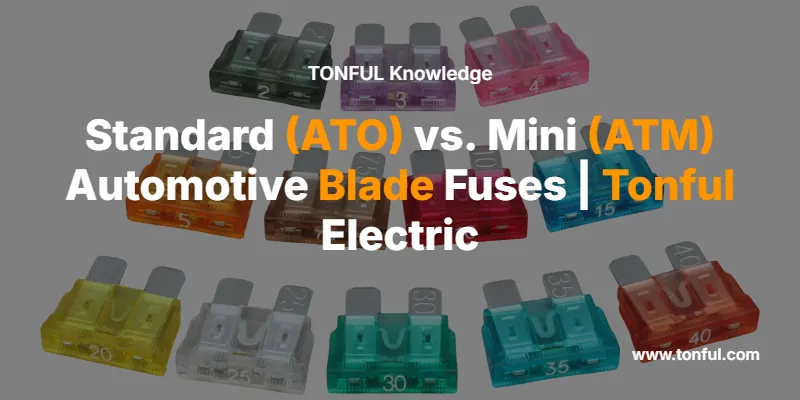
In the intricate electrical systems of modern vehicles, countless components work in harmony. Yet, one of the most critical for safety and function is also one of the smallest: the automotive blade fuse. This unassuming component is the first line of defense against overcurrent events, protecting sensitive electronics, preventing electrical fires, and ensuring vehicle reliability.
Originally, automotive electrical systems were protected by glass tube fuses, but as vehicles became more complex, a more robust and standardized solution was needed. This led to the development of the blade fuse by Littelfuse in 1976. Today, they are the undisputed standard, but they come in various sizes. Among the most common are the Standard (ATO/ATC) and the Mini (ATM/APM) types.
Understanding the distinction between these two is crucial for maintenance, repair, and engineering. This guide provides a comprehensive comparison to help you select the right automotive blade fuse for any application.
The Workhorse: Understanding Standard Blade Fuses (ATO/ATC)
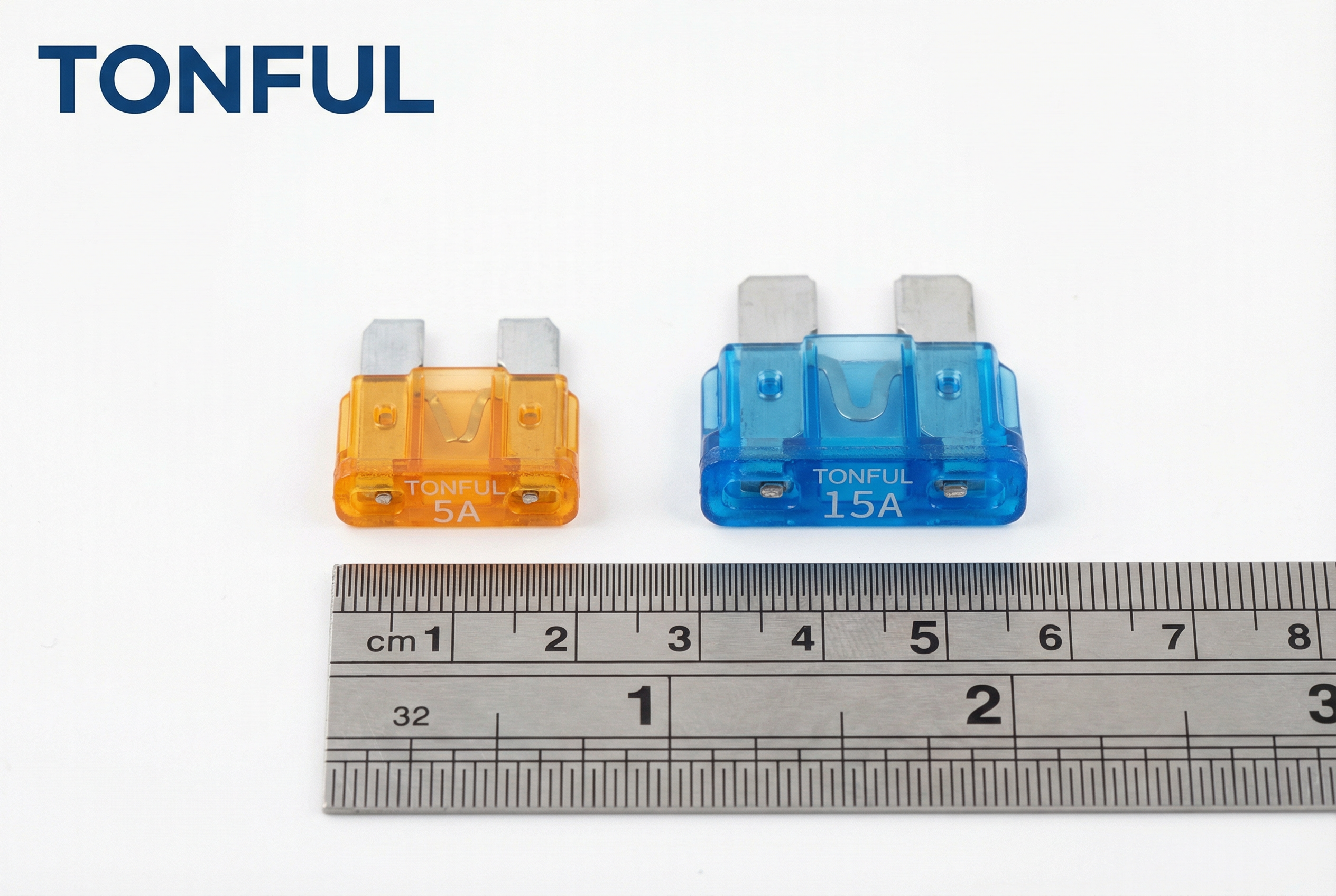
The Standard blade fuse is the original, the one that started it all. Also known by their industry classifications ATO (Automotive Technology Organization) and ATC, these fuses set the precedent for blade-type design.
- ATO (Automotive Fuse – Open Element): These fuses have an element that is open to the environment at the bottom, between the blades. They are less common today.
- ATC (Automotive Fuse – Closed Element): These feature a fully enclosed plastic body that protects the fuse element from moisture, vibration, and shorts. This is the most prevalent type of standard fuse.
Due to their larger size and robust construction, Standard fuses are often found in older vehicles and in circuits that handle higher currents or experience significant inrush current, such as those for power seats, radiator fans, and headlamps.
The Compact Solution: The Rise of Mini Blade Fuses (ATM/APM)
As vehicle technology advanced, the demand for more electronic features—from advanced driver-assistance systems (ADAS) to complex infotainment units—grew exponentially. This created a challenge: fitting more circuits into the same, or even smaller, physical space.
The Mini blade fuse, also known as ATM (Mini Automotive Fuse) or APM, was the answer. It offers the same overcurrent protection and amperage ratings as its larger counterpart but in a significantly smaller footprint. This space efficiency allows engineers to design more compact and densely populated fuse boxes, making them the dominant choice in most cars and trucks manufactured in the last two decades.
Head-to-Head Comparison: Standard vs. Mini Blade Fuses
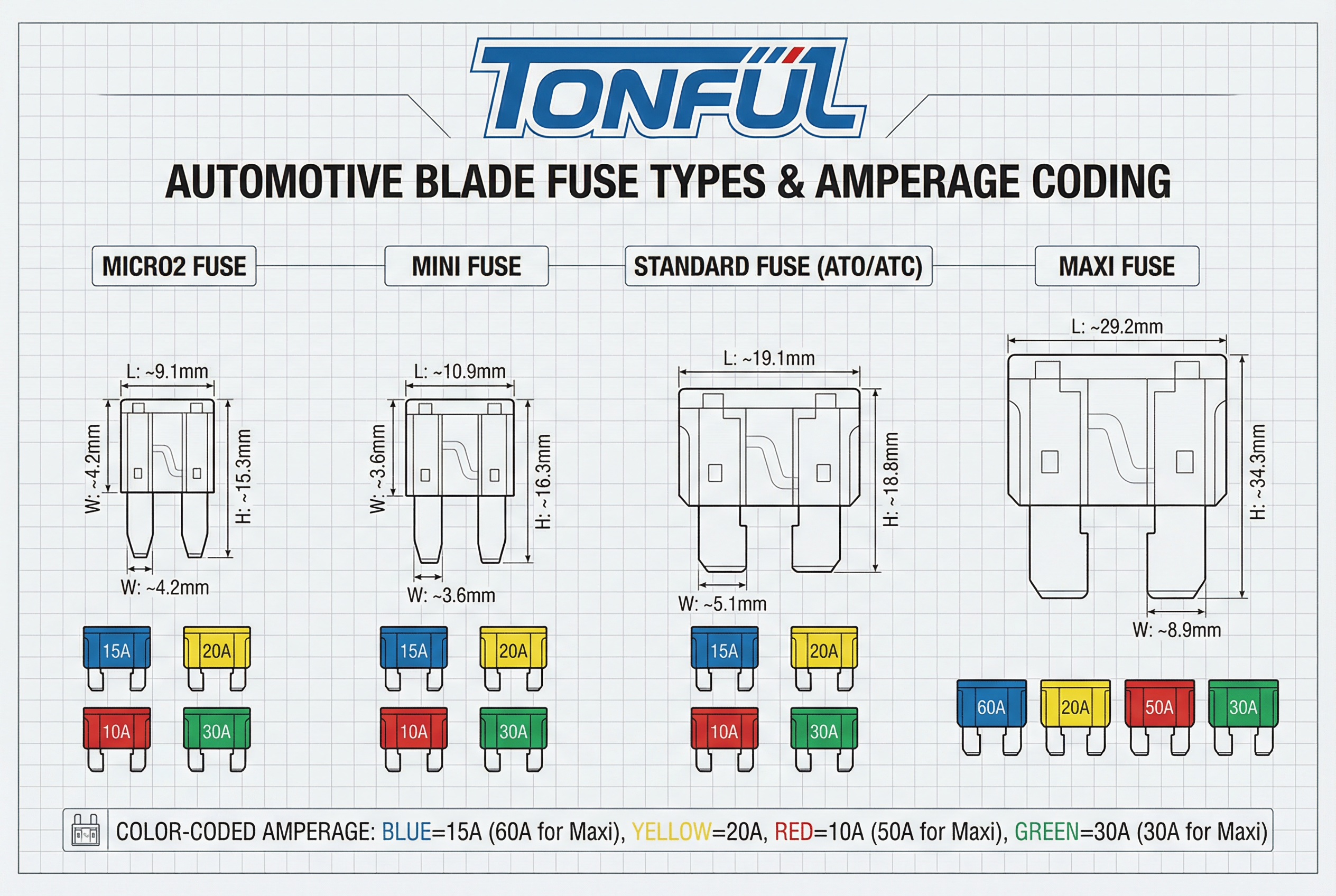
While both serve the same primary function, their differences in size, performance characteristics, and application are critical.
| Feature | Standard Blade Fuse (ATO/ATC) | Mini Blade Fuse (ATM/APM) |
|---|---|---|
| Physical Dimensions | 19.1 × 5.1 × 18.5 mm | 10.9 × 3.6 × 16.3 mm |
| Amperage Range | Typically 1A to 40A | Typically 2A to 30A |
| Industry Names | ATO (Open), ATC (Closed), APR | ATM (Mini), APM |
| Key Performance Characteristic | More robust and can better withstand high inrush currents without fatiguing. Ideal for motors and inductive loads. | Faster-acting response time, making them suitable for protecting sensitive micro-electronics and control modules. |
| Typical Applications | Older vehicles, power distribution boxes, circuits for power seats, headlamps, and cooling fans. | Modern vehicles (post-2000), ECU circuits, infotainment systems, interior lighting, and control modules. |
| Terminal Design | Wider and thicker blades, designed for larger fuse blocks. | Thinner and more compact blades for high-density fuse panels. |
How to Choose the Right Automotive Blade Fuse: A 3-Step Guide
Choosing the correct fuse is not a matter of preference; it is a matter of safety and system integrity.
Step 1: Identify the Required Fuse Type
First, determine if your vehicle uses Standard or Mini fuses. You cannot use them interchangeably.
- Check the Owner’s Manual: Your vehicle’s manual will specify the type and location of the fuses.
- Inspect the Fuse Box: Open the fuse panel and visually inspect an existing fuse. The size difference between Standard and Mini is immediately apparent. The fuse box cover or diagram may also label the fuse type.
Step 2: Determine the Exact Amperage
This is the most critical step. The amperage rating is the level of current the fuse will allow before it breaks the circuit.
- Never replace a blown fuse with one of a higher amperage rating. Doing so can lead to wire overheating, component damage, and a significant risk of fire.
- The amperage is printed on the top of the fuse. It is also designated by a universal color code.
Step 3: Verify with Color Codes
The color of the fuse body corresponds directly to its amperage rating, providing a quick and easy way to identify it. This standardization is a key benefit of the automotive blade fuse system.
Common Color Codes:
- Black: 1A
- Grey: 2A
- Violet: 3A
- Pink: 4A
- Tan: 5A
- Brown: 7.5A
- Red: 10A
- Blue: 15A
- Yellow: 20A
- Clear/White: 25A
- Green: 30A
- Blue-Green: 35A (Standard only)
- Orange: 40A (Standard only)
Troubleshooting and Replacement Best Practices
When a fuse blows, it’s a sign that it did its job by protecting a circuit.
- Identifying a Blown Fuse: A visual inspection will often reveal a broken or melted metal link inside the plastic housing. For a more definitive test, use a multimeter set to continuity mode; a good fuse will beep, while a blown one will not.
- The Safety Imperative: Always replace a blown fuse with a new one of the exact same amperage rating. Installing a 20A fuse in a 15A slot may seem like a quick fix, but it allows 33% more current to flow through a wire that isn’t designed for it, creating a severe fire hazard.
- Investigating Repeated Failures: If a replacement fuse blows immediately or repeatedly, there is an underlying problem in the electrical circuit, such as a short circuit, a faulty component drawing too much power, or a wiring issue. Do not keep replacing the fuse; the root cause must be diagnosed and repaired.
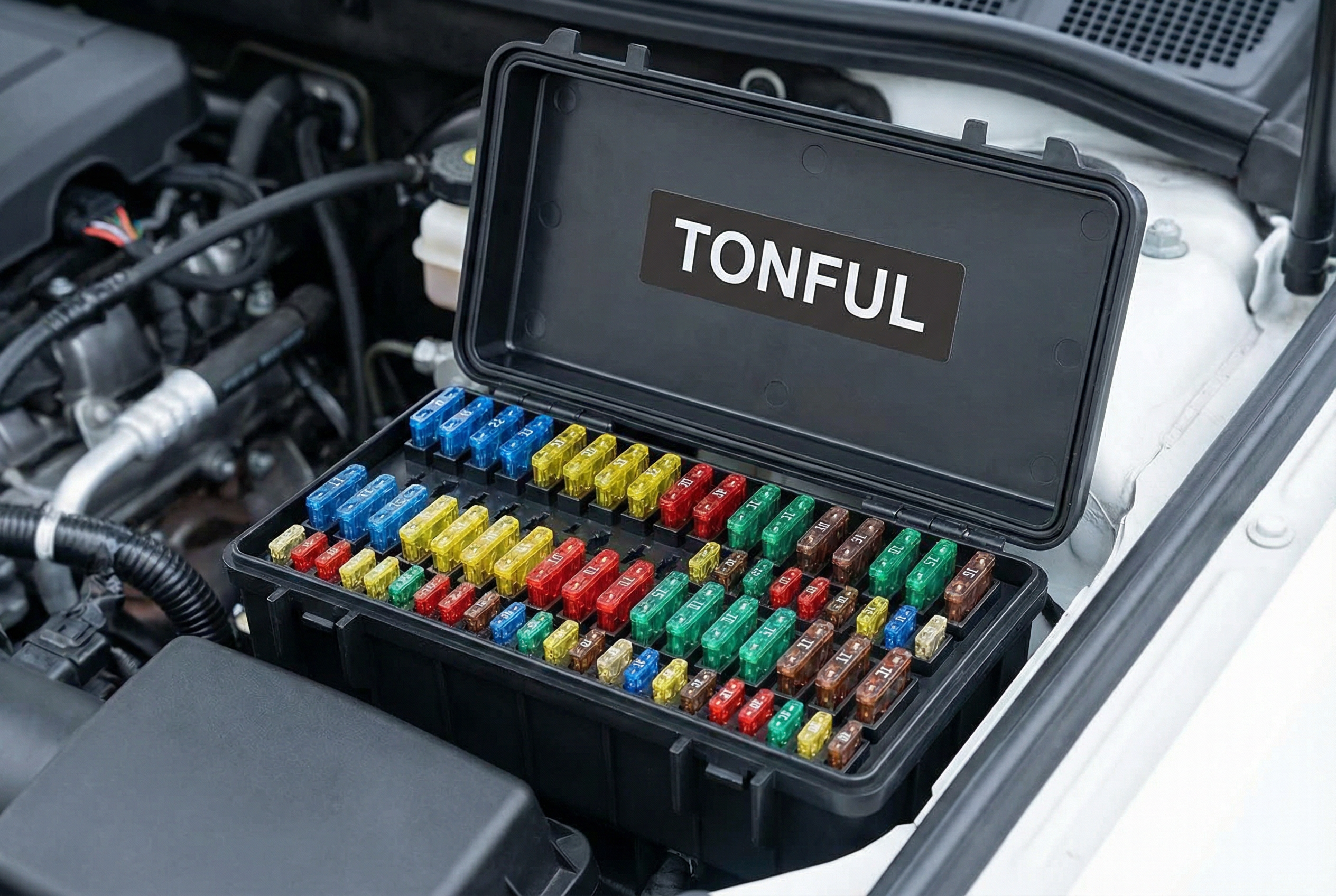
Why Partner with Tonful Electric for Your Automotive Fuse Needs
For automotive professionals, parts distributors, and engineers, the quality of a component as fundamental as a fuse cannot be compromised. While they may look similar, not all fuses are manufactured to the same standard.
At Tonful Electric, we specialize in manufacturing high-quality automotive blade fuses that meet stringent industry standards, including SAE J1284 and ISO 8820. Our commitment to quality means:
- Superior Materials: We use premium, impact-resistant polycarbonate for the housing and high-grade, tin-plated zinc or copper alloy for the terminals. This ensures consistent performance, resistance to corrosion, and a stable melting point.
- Precision Manufacturing: Our automated processes guarantee tight tolerances and reliable fusing characteristics, ensuring that each fuse performs exactly as rated.
- Reliability for Business: We provide dependable, high-volume supply for our B2B partners, ensuring you have access to certified, reliable components that protect your customers’ vehicles and your reputation.
When your business relies on quality electrical components, partner with a manufacturer that understands the science behind safety.
Frequently Asked Questions (FAQ)
1. Can I use a Mini fuse in a Standard slot or vice-versa?
No. The physical dimensions and blade spacing are different. They are not interchangeable. Some companies make adapters, but for safety and reliability, it is always best to use the fuse type specified by the vehicle manufacturer.
2. What happens if I use a fuse with a higher amperage?
You create a dangerous situation. The fuse is the weakest link by design. By installing a higher-rated fuse, you are essentially moving that weak link to the vehicle’s wiring or the component the fuse was meant to protect. This can cause wires to melt and potentially start a fire.
3. How can I tell for sure if a fuse is blown?
The most reliable method is to use a multimeter or a dedicated fuse tester. A visual check can often spot the broken filament, but sometimes the break is too small to see easily.
4. Why does my fuse keep blowing?
This indicates an ongoing electrical problem. The most common causes are a short circuit (a hot wire touching the vehicle’s ground), an overloaded circuit (a component drawing more current than it should), or a failing component. The underlying fault needs to be repaired.
5. Are the color codes for blade fuses universal?
Yes, the color-to-amperage coding system is standardized across the industry for Standard (ATO/ATC) and Mini (ATM/APM) blade fuses, regardless of the vehicle’s make or model.
6. What is the difference between an ATO and an ATC fuse?
Both are Standard-sized fuses. ATO (Open) fuses have an opening at the bottom that exposes the element, while ATC (Closed) fuses have a fully sealed plastic body. ATC fuses offer better protection against moisture and shorts and are far more common today.
Conclusion
The choice between a Mini and Standard automotive blade fuse is ultimately determined by the vehicle’s design. The Standard fuse remains a robust solution for high-power applications, while the Mini fuse enables the compact, feature-rich electrical systems of modern vehicles.
For professionals, the key takeaways are non-negotiable: always use the correct physical size and always match the amperage rating precisely. By adhering to these principles and choosing high-quality, certified fuses, you ensure the safety, reliability, and longevity of every automotive electrical system you work on.