Introduction: The Unsung Hero of High-Current Circuit Protection
In our increasingly electrified world, the demand for robust and reliable power has never been higher. Modern vehicles, heavy-duty machinery, and recreational marine craft are no longer simple mechanical systems; they are sophisticated electronic hubs packed with high-draw components like advanced driver-assistance systems (ADAS), powerful audio amplifiers, electric power steering, and complex auxiliary lighting. As these electrical loads grow, so does the risk of overcurrent events that can lead to catastrophic equipment failure or even fire. This is where the humble fuse steps in, and for high-current applications, one component stands out: the maxi blade fuse.
While standard ATO and ATC blade fuses are sufficient for most low-amperage circuits, they fall short when protecting power-hungry systems that draw upwards of 20 amperes. The maxi blade fuse was engineered specifically to fill this gap. It serves as a critical safety device, designed to be the sacrificial weak link in a high-current electrical circuit. By safely interrupting the flow of electricity during an overcurrent or short-circuit event, it protects expensive components, prevents wiring damage, and ensures the overall safety and reliability of the entire electrical system. It is the unsung hero working silently in fuse boxes to manage the immense power required by modern technology.
Decoding the Maxi Blade Fuse: Core Technical Specifications
To an untrained eye, a maxi blade fuse might just look like a larger piece of colored plastic with metal prongs. However, for an engineer, technician, or procurement manager, its design and material specifications reveal a component meticulously crafted for high-performance applications. Understanding these core technical details is essential for selecting the correct fuse to ensure optimal protection and system longevity.
Physical Dimensions
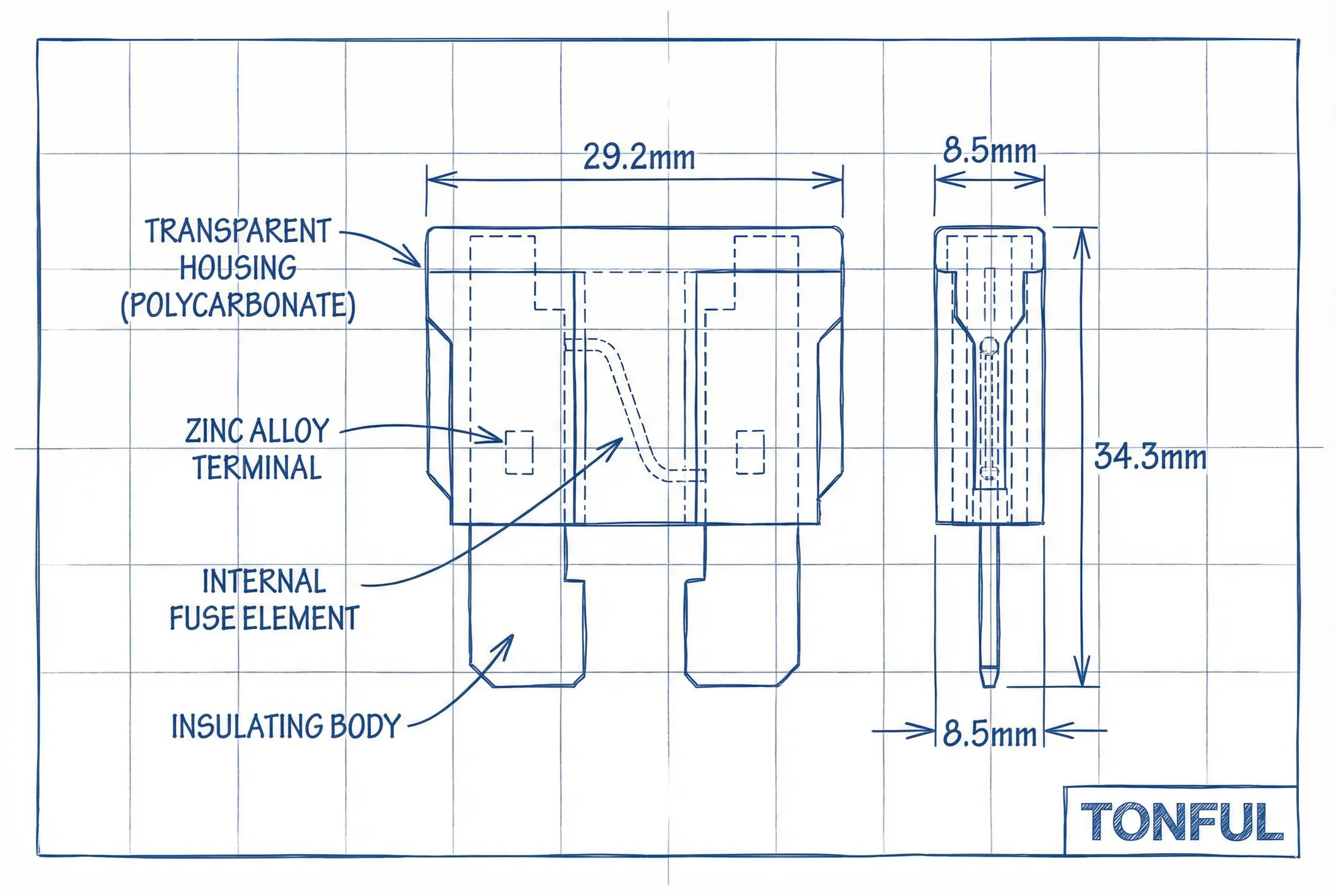
The most immediate differentiator of a maxi blade fuse is its size. With standard physical dimensions of approximately 29.2 mm in width, 8.5 mm in thickness, and 34.3 mm in height, it is significantly larger than a standard blade fuse. This increased size is not merely for show; the larger form factor provides a greater surface area, which is critical for dissipating the heat generated by high-current flows. This superior thermal management capability allows the fuse to handle significant electrical loads continuously without premature failure, a key requirement in demanding automotive and industrial environments.
Current & Voltage Ratings
Maxi blade fuses are designed to operate in a specific range of electrical conditions.
- Current Rating: They are typically available in amperage ratings from 20A to 120A. This range makes them ideal for protecting circuits that power starters, alternators, main fuse panel feeds, and other high-draw systems.
- Voltage Rating: The standard voltage rating for maxi fuses is 32V DC, making them perfectly suited for traditional automotive and truck electrical systems. However, with the rise of electric and hybrid vehicles, higher voltage versions, such as 58V DC, are becoming more common to accommodate the needs of modern vehicle architectures.
Material Composition
The choice of materials in a maxi blade fuse is critical to its performance and reliability. Reputable manufacturers use high-quality, stable materials to ensure consistent and safe operation.
- Housing: The colored plastic body is typically made from PA66 (Polyamide 66). This engineering-grade thermoplastic is chosen for its excellent thermal stability, high mechanical strength, and superb resistance to automotive chemicals like oil, grease, and antifreeze. It ensures the fuse maintains its structural integrity even in the harsh conditions of an engine bay.
- Terminals: The conductive blades are forged from a high-purity zinc alloy. This material provides an optimal balance of electrical conductivity to efficiently carry current and robust corrosion resistance to ensure a reliable electrical connection over the fuse’s lifespan.
Technical Parameter Table
For quick reference, the table below summarizes the key specifications of a typical maxi blade fuse.
| Parameter | Specification | Purpose & Benefit |
|---|---|---|
| Current Rating | 20A – 120A | Protects a wide range of high-power automotive and industrial circuits. |
| Voltage Rating | 32V DC / 58V DC | Compatible with standard and emerging vehicle electrical systems. |
| Housing Material | PA66 (Polyamide 66) | Provides high-temperature stability and chemical resistance. |
| Terminal Material | Zinc Alloy | Ensures excellent conductivity and long-term corrosion resistance. |
| Dimensions (W×T×H) | ~29.2 × 8.5 × 34.3 mm | Larger size enhances heat dissipation for high-current loads. |
| Interrupting Rating | Typically 1000A or 2000A @ 32V DC | Safely interrupts high short-circuit currents without rupture. |
Manufacturing Excellence: Quality and Compliance Standards
In the world of circuit protection, there is no room for compromise. A fuse failure—whether it’s failing to blow during an overcurrent event or blowing unnecessarily under normal load—can have severe consequences. For B2B customers, specifying and sourcing fuses that adhere to internationally recognized quality and performance standards is not just a best practice; it is a critical requirement for ensuring safety, reliability, and legal compliance. When selecting a maxi blade fuse supplier, verifying their commitment to these standards is paramount.
Adherence to SAE J1888
The Society of Automotive Engineers (SAE) sets the benchmark for many components used in the North American automotive industry. SAE J1888, “Fusible Links,” is a key standard that defines the performance requirements for automotive fuses, including maxi blade fuses. This standard specifies critical parameters such as:
- Time-Current Characteristics: It dictates how long a fuse must carry a certain percentage of its rated current without blowing (e.g., 110% of rating) and how quickly it must open at higher currents (e.g., 135%, 200%). This ensures predictable and consistent protection.
- Voltage Drop: It sets a maximum limit for the voltage drop across the fuse, ensuring it doesn’t significantly impede circuit performance.
- Environmental Testing: The standard includes tests for vibration, thermal shock, and humidity, ensuring the fuse can withstand the rigors of an automotive environment.
Compliance with SAE J1888 is a non-negotiable indicator of a high-quality maxi fuse suitable for automotive applications.
Compliance with ISO 8820-3
The International Organization for Standardization provides a global framework for product compatibility and quality. ISO 8820-3, “Road vehicles — Fuses — Part 3: Fuse-links with tabs (blade type),” is the international counterpart to the SAE standard. It establishes a globally recognized set of requirements for blade fuses, including their dimensions, performance characteristics, and test procedures. Adherence to ISO 8820-3 ensures that a maxi fuse will have a consistent form factor and reliable performance, regardless of where it was manufactured or where the vehicle will be serviced. For global manufacturers and fleet operators, sourcing ISO-compliant fuses is essential for supply chain consistency and international market access.
The Importance of UL Certification
Underwriters Laboratories (UL) is a global safety certification company that provides testing, inspection, and certification services. While many standards focus on performance, UL certification is a direct testament to a product’s safety. For fuses, standards like UL 248, “Low-Voltage Fuses,” evaluate a product’s ability to operate safely under normal conditions and, more importantly, to fail safely during a fault condition. A UL-listed maxi fuse has been independently verified to interrupt a short circuit without causing a fire, explosion, or electrical shock hazard. This certification is often a legal or contractual requirement for products sold in North America and is recognized globally as a symbol of safety and trust.
The Maxi Blade Fuse Color Code System: A Quick Reference Guide
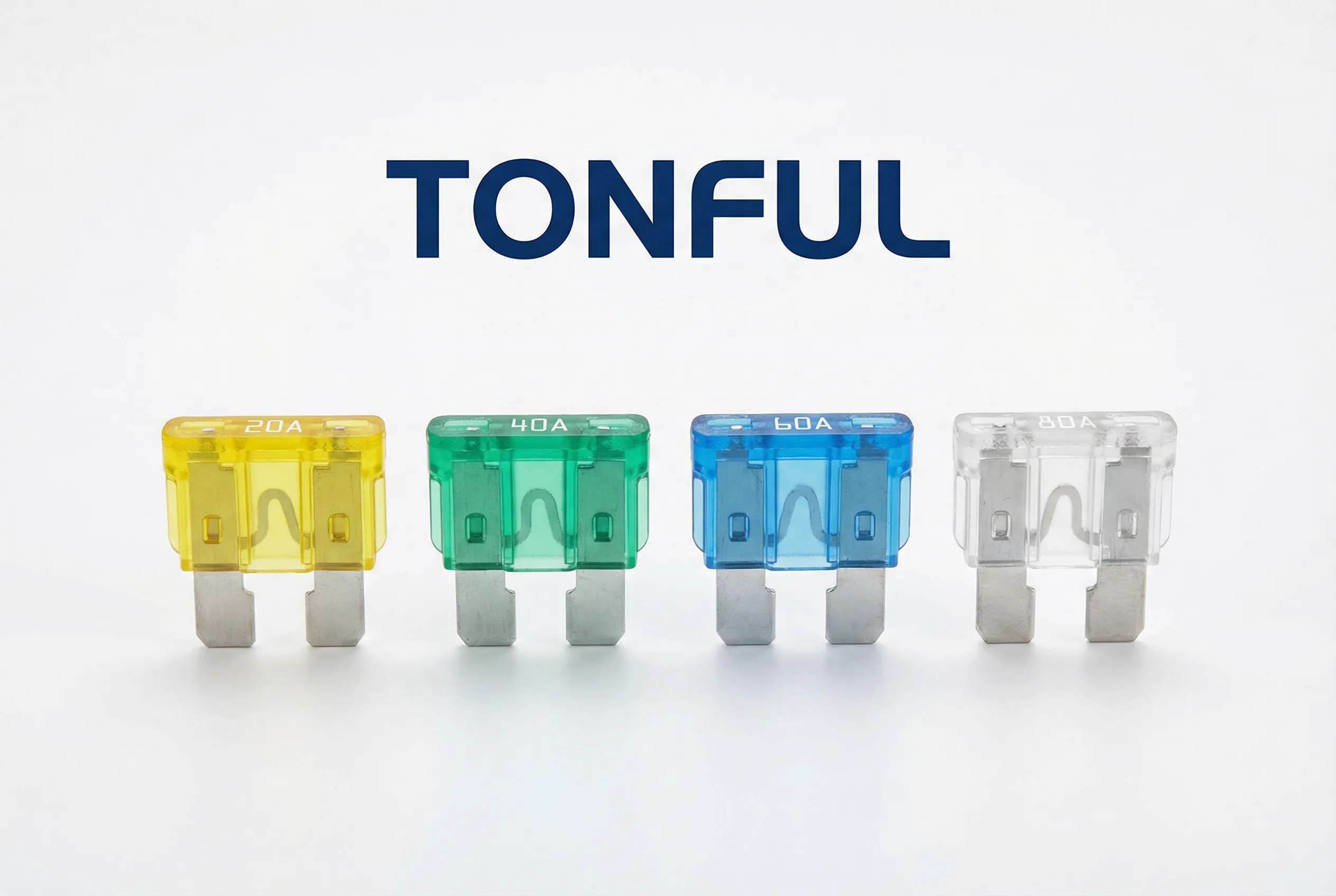
In a crowded fuse box, quickly and accurately identifying a fuse’s amperage rating is critical for safe and efficient maintenance. Misidentifying and installing an incorrectly rated fuse can lead to either nuisance blowing (if the rating is too low) or a dangerous failure to protect the circuit (if the rating is too high). To prevent this, the industry has adopted a standardized color-coding system for blade fuses, including the maxi series.
This system assigns a unique color to each specific amperage rating, allowing technicians to identify the correct fuse at a glance. The table below outlines the standard color code for maxi blade fuses.
| Amperage Rating | Color |
|---|---|
| 20A | Yellow |
| 25A | Natural (Clear/White) |
| 30A | Green |
| 35A | Brown |
| 40A | Orange (Amber) |
| 50A | Red |
| 60A | Blue |
| 70A | Tan |
| 80A | Clear |
| 100A | Purple |
| 120A | Dark Purple/Violet |
When replacing a blown maxi fuse, always match the amperage rating of the new fuse to the one being replaced and ensure the color corresponds correctly. This simple cross-reference is a vital safety check.
Key Applications: Where Maxi Blade Fuses Power and Protect
Maxi blade fuses are the workhorses of modern electrical systems, deployed wherever high current demands robust, reliable protection. Their versatility and durability make them a staple across a wide range of industries, from consumer vehicles to heavy-duty industrial machinery. Understanding their key applications highlights their critical role in enabling today’s technology.
Automotive and Light-Duty Vehicles
In the modern automobile, maxi fuses are indispensable. They are typically found in the main under-hood fuse box (the Power Distribution Center) and are responsible for protecting the vehicle’s most power-hungry circuits. Common applications include:
- Main Power Feeds: Protecting the primary circuits that distribute power from the battery to various sub-panels.
- Alternator Output: Handling the high current generated by the alternator to recharge the battery and power the vehicle’s electrical system.
- Electric Cooling Fans: Safeguarding the large motors that drive radiator fans, which can have very high inrush currents upon startup.
- Anti-lock Brake System (ABS) Pumps: Ensuring the reliable operation of the ABS motor during emergency braking maneuvers.
- High-Power Accessories: Protecting aftermarket additions like high-wattage stereo amplifiers, winches, and auxiliary lighting systems.
Heavy-Duty Trucks and Commercial Fleets
The electrical demands of heavy-duty trucks, buses, and construction equipment far exceed those of passenger cars. In these environments, reliability is directly tied to uptime and profitability. Maxi fuses provide the robust protection needed for:
- Liftgate Motors: Protecting the powerful hydraulic or electric motors used for cargo liftgates.
- Starter Solenoids: Handling the immense current required to engage the starter motor on large diesel engines.
- HVAC Blower Motors: Safeguarding the large blower motors needed to heat and cool large cabins.
- Power Inverters: Providing critical protection for inverters that convert DC battery power to AC power for tools and onboard equipment.
Marine, RV, and Specialty Vehicles
Recreational vehicles (RVs) and marine craft are essentially mobile homes with complex, self-contained electrical systems. Maxi fuses are essential for safely managing their high-capacity power systems.
- Battery Banks: Protecting the main connections to and from large house battery banks.
- Inverter/Charger Systems: Safeguarding the high-amperage lines running to power inverters and battery chargers.
- Windlasses and Bow Thrusters: Providing circuit protection for the powerful electric motors that operate anchors and maneuvering thrusters on boats.
- Slide-out Motors: Ensuring the safe operation of the motors that extend and retract RV slide-outs.
The Rise of Maxi Fuses in Electric Vehicles (EVs)
The transition to electric vehicles introduces new challenges and opportunities for circuit protection. While primary traction battery systems in EVs operate at very high voltages (400V-800V) and require specialized fuses, the 12V auxiliary systems in EVs are becoming more powerful than ever. These systems power everything from the infotainment screen and power steering to the water pumps for battery cooling. As noted in recent market trend analysis, the increasing electronic complexity in EVs is driving demand for reliable high-current fuses like the maxi series, particularly higher-voltage variants (e.g., 58V) to handle these advanced auxiliary loads.
Maxi vs. Other Fuses: A Comparative Analysis
Choosing the right fuse requires understanding not only the specifications of the fuse itself but also how it compares to other available options. The maxi blade fuse occupies a specific niche in the circuit protection landscape, bridging the gap between low-current standard fuses and ultra-high-current bolt-down fuses.
Maxi Fuse vs. Standard Blade (ATO/ATC)
This is the most common comparison. The primary difference is capacity.
- Current Range: Standard ATO/ATC fuses typically range from 1A to 30A (with some up to 40A), while Maxi fuses start at 20A and go up to 120A.
- Size: The maxi fuse is significantly larger, allowing for better heat dissipation required by the higher currents it handles.
- Application: Standard fuses are used for general-purpose circuits like interior lighting, radio, and ECU memory. Maxi fuses are reserved for the main power distribution and high-load components mentioned previously. You cannot and should not use them interchangeably.
Maxi Fuse vs. MIDI® Fuse
The MIDI® fuse represents a step up from the Maxi fuse, designed for even higher current applications and a different mounting style.
- Form Factor: Maxi fuses are a blade-style, push-in fuse. MIDI® fuses are a “bolt-down” style, secured to fuse holders with nuts and bolts. This provides a more secure connection for extremely high-vibration environments and higher currents.
- Current Range: While there is some overlap, MIDI® fuses generally cover a higher range, typically from 30A to 200A or more.
- Interrupting Rating: MIDI® fuses often have a higher interrupting rating, making them suitable for circuits with very high potential short-circuit currents, such as primary battery protection.
Maxi Fuse vs. MEGA® Fuse
MEGA® fuses are another type of bolt-down fuse, positioned for even higher-power applications than MIDI® fuses.
- Current Range: MEGA® fuses handle very high currents, typically starting around 60A and going up to 500A.
- Application: They are almost exclusively used for primary battery and alternator protection in heavy-duty trucks, buses, and large marine vessels where fault currents can be extremely high.
- Time-Delay Characteristics: Many MEGA® fuses are designed with “slow-blow” or time-delay characteristics to handle the large, temporary inrush currents of starter motors without nuisance blowing.
Comparative Specification Table
| Feature | Standard (ATO/ATC) | Maxi Blade Fuse | MIDI® Fuse | MEGA® Fuse |
|---|---|---|---|---|
| Mounting Style | Blade (Push-in) | Blade (Push-in) | Bolt-Down | Bolt-Down |
| Typical Current | 1A – 30A | 20A – 120A | 30A – 200A | 60A – 500A |
| Voltage Rating | 32V DC | 32V / 58V DC | 32V / 58V DC | 32V DC |
| Typical Use Case | General Circuits | Main Feeds, Fans | Alternators, Starters | Primary Battery |
| Size | Small | Large | Medium Bolt-Down | Large Bolt-Down |
How to Safely Install, Test, and Replace a Maxi Blade Fuse
Proper handling of fuses is fundamental to electrical system maintenance and safety. A maxi blade fuse is simple to replace, but following the correct procedure is crucial to avoid personal injury or damage to the electrical system.
Step 1: Safety First – Disconnect the Power
Before touching any part of the fuse box, always disconnect the power source. In a vehicle, this means disconnecting the negative terminal of the battery. This prevents any risk of short circuits or electric shock.
Step 2: Locate the Blown Fuse
Consult the vehicle’s owner’s manual or the diagram on the fuse box cover to identify the maxi fuse corresponding to the non-functional circuit. Visually inspect the fuse. A blown fuse will typically have a broken or melted filament visible through the clear top of the fuse housing.
Step 3: Confirm the Fuse is Blown (Optional but Recommended)
While a visual inspection is often sufficient, the most reliable method is to test the fuse with a multimeter.
- Remove the fuse from its slot. You may need a fuse puller tool, as they can be seated very firmly.
- Set your multimeter to the “continuity” setting (it often has a symbol like a sound wave or a diode).
- Touch one probe to each of the fuse’s blades.
- Good Fuse: The multimeter will beep or show a reading of near-zero ohms.
- Blown Fuse: The multimeter will remain silent and show an open circuit (often displayed as “OL” or “1”).
Step 4: Select the Correct Replacement
This is the most critical step. The replacement fuse must have the exact same amperage rating as the one it is replacing. The rating is printed on the top of the fuse. Cross-reference this with the color code to be certain. Never replace a fuse with one of a higher amperage rating. The original fuse blew for a reason, and a higher-rated fuse will not blow when it should, potentially leading to a fire.
Step 5: Install the New Fuse
Align the blades of the new maxi fuse with the slot in the fuse holder and press it firmly into place. Ensure it is fully seated to guarantee a solid electrical connection. A loose fuse can cause arcing, overheating, and intermittent circuit failure.
Step 6: Reconnect Power and Test the Circuit
Reconnect the battery’s negative terminal and test the circuit (e.g., turn on the cooling fans, operate the liftgate) to confirm that it is now functioning correctly. If the new fuse blows immediately or soon after, it indicates an underlying problem in the circuit (like a short to ground or a failing component) that requires professional diagnosis.
Frequently Asked Questions (FAQ) about Maxi Blade Fuses
1. Can I use a 40A fuse to replace a 30A maxi fuse?
No, you must never replace a fuse with one of a higher amperage rating. The 30A fuse is designed to protect the circuit’s wiring and components from currents exceeding 30 amps. Installing a 40A fuse would allow excessive current to flow, creating a serious risk of overheating, component damage, and fire.
2. What causes a maxi fuse to blow repeatedly?
A fuse that blows repeatedly is a symptom of a deeper problem. The most common causes are a short circuit (a power wire is touching a ground point), an overloaded circuit (too many devices are drawing power), or a failing component (like a fan motor that is beginning to seize and draw too much current). Simply replacing the fuse will not fix the issue; the circuit requires a thorough diagnosis.
3. Are all maxi blade fuses the same physical size?
Yes, maxi blade fuses adhere to a standard form factor (approximately 29.2 × 8.5 × 34.3 mm) to ensure interchangeability between different manufacturers and vehicles, as defined by standards like ISO 8820-3.
4. What is the difference between a maxi fuse and a J-Case fuse?
While both are used in high-current applications, they have different form factors. A maxi fuse is a blade-style fuse, while a J-Case fuse is a cartridge-style, box-shaped fuse. They are not interchangeable.
5. Why do some maxi fuses have a 58V rating instead of 32V?
The 58V rating is for use in higher-voltage DC systems, which are becoming more common in electric vehicles, hybrid vehicles, and some industrial equipment. Using a 32V fuse in a 58V system is unsafe, as it may not be able to properly extinguish the electrical arc when it blows, leading to a fire hazard.
6. What does the “interrupting rating” of a fuse mean?
The interrupting rating (or breaking capacity) is the maximum fault current that a fuse can safely interrupt without rupturing or exploding. For maxi fuses, this is typically 1000A or 2000A at their rated voltage. This is a critical safety feature for circuits connected directly to a high-capacity source like a car battery.
7. How can I tell if a maxi fuse is blown without a multimeter?
Most maxi fuses have a clear window on top that allows for visual inspection of the internal metal filament. If this filament is visibly broken or melted, the fuse is blown. However, sometimes the break can be very fine, making a multimeter test the most definitive method.
8. Does the color of the maxi fuse matter, or just the number on top?
Both matter, and they should always match. The color is a quick visual indicator of the amperage rating printed on top. Using both as a cross-reference is a best practice that helps prevent accidental installation of an incorrectly rated fuse.
Conclusion: Partner with TONFUL for Reliable High-Current Protection
Throughout this guide, we’ve established that the maxi blade fuse is far more than a simple component; it is a critical safety device engineered to protect high-value assets in demanding electrical environments. From its robust material composition and precise dimensions to its adherence to strict international standards, every aspect of a quality maxi fuse is designed for one purpose: to provide reliable, predictable protection against high-current faults. For engineers, fleet managers, and manufacturers, selecting the right fuse is a decision that directly impacts safety, reliability, and operational integrity.
When sourcing these critical components, partnering with a specialist manufacturer is non-negotiable. TONFUL Electric is a professional B2B manufacturer dedicated to the field of circuit protection. Our portfolio of maxi blade fuses is designed and produced in strict accordance with the highest industry standards, including SAE J1888 and ISO 8820-3, and our commitment to safety is validated by certifications like UL. We understand the technical demands of the automotive, heavy-duty, and marine industries, and our expertise is built into every fuse we produce. By choosing TONFUL, you are not just buying a component; you are investing in peace of mind and partnering with a team that is committed to the quality and safety of your products.