
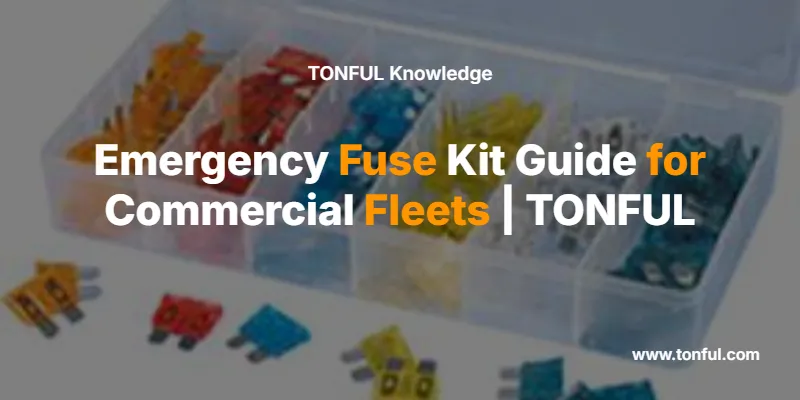
In the high-stakes world of fleet management, vehicle downtime is the enemy. Whether you operate heavy-duty logistics trucks, municipal service vehicles, or a rental fleet, a simple electrical fault can ground a revenue-generating asset, costing thousands in lost productivity and emergency service calls. As a Senior Electrical Engineer at TONFUL Electric, I have analyzed countless electrical failures, and the solution often comes down to a component smaller than a postage stamp: the automotive fuse.
Building a comprehensive emergency fuse kit is not just a maintenance best practice; it is a regulatory requirement and a strategic operational necessity. This guide will walk you through engineering a compliant, efficient, and robust fuse kit tailored for modern fleet demands.
The Regulatory and Operational Imperative

Before we dive into technical specifications, it is crucial to understand the legal framework governing commercial fleets. FMCSR Title 49 CFR Part 393.95 (Subpart H) specifically mandates that all power units in commercial service must carry spare fuses for every type and size needed to operate required parts and accessories.
Failure to produce a proper Fuse Kit during a roadside DOT inspection can result in violations, fines, and detrimental impacts on your carrier safety rating. Beyond compliance, the operational ROI is undeniable. A blown fuse in a powertrain control module (PCM) or a fuel pump circuit renders a vehicle immovable. The cost of a tow and a dealership diagnostic fee can exceed $800, while a replacement blade fuse costs cents.
Essential Fuse Types for Commercial Fleets

Modern commercial vehicles utilize a diverse array of circuit protection. A “one-size-fits-all” approach no longer works. To build the perfect kit, you must understand the specific automotive blade fuse types utilized in your fleet’s specific make and model years.
1. ATO/ATC (Regular) Blade Fuses
The industry standard since the late 1970s. These are ubiquitous in older trucks and auxiliary circuits in modern vehicles. They typically handle currents from 1A to 40A.
2. Mini and Low-Profile Mini Fuses
As vehicle electronics became more complex, space inside fuse boxes became premium real estate. Mini blade fuses offer the same protection characteristics as ATO fuses but in a smaller footprint. You must distinguish between standard Mini (ATM) and Low-Profile Mini (APS), as they are not always interchangeable due to terminal depth.
3. Micro2 and Micro3 Fuses
Found in late-model fleet vehicles (2015+), these sub-miniature fuses allow for high-density circuit protection.
- Micro2: Standard two-blade design for single circuits.
- Micro3: distinct three-blade design that protects two separate circuits sharing a common power source, reducing wiring harness weight.
4. Maxi Blade Fuses
The maxi blade fuse is the heavy lifter of the blade family. Rated up to 100A, these handle high-current applications like air suspension compressors, lift gates, and main power distribution.
5. MEGA and MIDI (Bolt-Down) Fuses
For high-amperage battery and alternator protection (up to 500A), bolt-down fuses are essential. Unlike blade fuses, these require tools to replace, but carrying spares is critical for major electrical faults.
Technical Specifications Comparison

| Fuse Type | Dimensions (mm) | Typical Amp Range | Primary Application | Voltage Rating |
|---|---|---|---|---|
| ATO/ATC | 19.1 × 18.8 × 5.1 | 1A – 40A | General Accessory, Lighting | 32V DC |
| Mini (ATM) | 10.9 × 16.3 × 3.8 | 2A – 30A | ECU, ABS, Infotainment | 32V DC |
| Micro2 | 9.1 × 15.3 × 3.8 | 5A – 30A | Sensors, Solenoids | 32V DC |
| Maxi | 29.2 × 34.3 × 8.9 | 20A – 100A | Main Power, Starter Motors | 32V DC |
| JCASE | Cartridge Style | 20A – 60A | High Inrush Circuits | 32V DC |
Component Breakdown: Designing the Kit

A box of loose fuses is not a kit. To ensure a driver or technician can effect a repair safely on the side of the highway, your kit must be a self-contained repair station. Here is the recommended inventory list for a TONFUL Fleet Maintenance Kit.
The Core: Fuses
Organize fuses by type, utilizing assorted boxes with dividers. Ensure you cover the full spectrum of automotive fuse amp ratings.
- Critical Spares: 7.5A, 10A, 15A, 20A, and 30A are the most statistically likely to blow.
Diagnostics and Extraction

- Fuse Pullers: Include multiple sizes. Using pliers can damage the plastic housing or crush the fuse element.
- Multimeter or Test Light: Essential for verifying if a fuse is actually blown without removing it. Knowing how to test a blade fuse saves diagnostic time.
Repair Consumables
Sometimes a blown fuse is a symptom of damaged wiring.
- Crimping Tool: A high-quality crimping tool is vital for repairing shorted wires.
- Wire Connectors: Include heat-shrink butt connectors and ring terminals. Refer to our guide on wire connectors for selecting waterproof options for exterior repairs.
- Insulation: Professional grade electrical tape for temporary wire insulation.
Step-by-Step Guide: Building Your Fleet Fuse Kit
1. Conduct a Fleet Audit
Do not guess. Survey your vehicles. A mixed fleet of Ford Transits, International LT trucks, and Toyota forklifts will require a mix of Micro2, Maxi, and standard ATO fuses.
2. Define Quantity Based on Fleet Size
Determine how many kits you need. Ideally, every vehicle should have a “Driver Kit” (basic spares), and every shop technician should have a “Master Kit” (comprehensive).
3. Establish Color Coding Standards
Familiarize your team with blade fuse color codes.
- Red: 10A
- Blue: 15A
- Yellow: 20A
- Green: 30A
This universal standard prevents dangerous errors like replacing a 10A fuse with a 30A fuse.
4. Create a “Restock Protocol”
A fuse kit is useless if it is empty. Implement a policy where drivers must report any fuse usage during their post-trip inspection so the kit can be replenished.
Recommended Kit Quantities by Fleet Size
Use the following table to determine inventory levels for your shop’s Master Fuse Kit.
| Fuse Type | Small Fleet (<10 Vehicles) | Medium Fleet (10-50 Vehicles) | Large Fleet (50+ Vehicles) |
|---|---|---|---|
| ATO/ATC Mix | 50 pcs | 200 pcs | 500+ pcs |
| Mini Mix | 50 pcs | 200 pcs | 500+ pcs |
| Maxi Mix | 10 pcs | 30 pcs | 100 pcs |
| Micro2/3 Mix | 20 pcs | 100 pcs | 300 pcs |
| Testers | 2 units | 5 units | 10+ units |
| Pullers | 5 units | 20 units | 1 per vehicle |
Comparison: Standard vs. Mini Fuses
When selecting components, confusion often arises between standard vs mini fuses. While they perform the same function—interrupting the circuit during an overcurrent event—they are physically incompatible.
- Standard (ATO): Wider blade spacing, larger heat dissipation area. Better for continuous load circuits.
- Mini (ATM): Compact, lower weight. Ideal for high-density fuse blocks in modern ECUs.
Understanding the fuse purpose helps in explaining to drivers why they cannot force a standard fuse into a mini slot.
Cost-Benefit Analysis: The ROI of Preparation
Is it worth investing in premium TONFUL fuse kits? Let’s look at the numbers.
| Cost Item | Reactive Scenario (No Kit) | Proactive Scenario (TONFUL Kit) |
|---|---|---|
| Spare Fuse Cost | $5.00 (Gas station markup) | $0.15 (Bulk kit price) |
| Vehicle Downtime | 4-6 Hours | 15 Minutes |
| Service Call / Tow | $400 – $1,200 | $0 |
| Missed Delivery Penalty | Variable (High) | $0 |
| Total Estimated Cost | $1,000+ | <$1.00 |
By equipping your fleet with high-quality auto fuses, you effectively insure your operations against minor electrical faults turning into major logistical failures.
FAQ: Emergency Fuse Kits
Q: Can I replace a blown fuse with one of a higher amperage rating?
A: Absolutely not. Fuses are designed to be the weakest link in the circuit. Using a higher amperage fuse (e.g., replacing a 10A with a 20A) allows excessive current to flow, which can melt wiring harnesses and cause catastrophic electrical fires. Always match the manufacturer’s specified rating.
Q: How do I visually identify a blown blade fuse?
A: Hold the fuse up to a light source. Inside the translucent plastic housing, there is a U-shaped metal wire (the fusible link). If this wire is severed or there is dark burn residue inside the plastic, the fuse is blown.
Q: Why do I need Micro2 and Micro3 fuses? Can’t I just use Mini?
A: No. Micro fuses have different terminal widths and spacing. They physically will not fit into a Mini fuse slot, and vice versa. Always check your vehicle’s owner’s manual.
Q: Should I use glass tube fuses in my modern fleet kit?
A: Generally, no. Glass tube (SFE/AGC) fuses are legacy technology found mostly in pre-1980s vehicles or some marine applications. Unless you are maintaining vintage equipment, stick to blade and cartridge styles.
Q: What is the shelf life of a fuse?
A: Quality fuses from reputable manufacturers like TONFUL have an indefinite shelf life if stored in dry assorted boxes away from extreme corrosion or moisture.
Q: Are “glow-when-blown” fuses worth the extra cost?
A: For hard-to-reach fuse panels, they can be helpful as they light up when the circuit breaks. However, for a standard emergency kit, standard high-quality zinc or copper alloy blade fuses are reliable and cost-effective.
Equip your fleet with the reliability of TONFUL electrical components. Browse our full catalog of blade fuses and start building your emergency kits today.