
In the world of professional electrical work, the long-term integrity of a connection is just as critical as the initial installation. For any project exposed to the elements—whether it’s outdoor landscape lighting, a marine application, or an industrial washdown area—the failure of a single wire splice can lead to costly callbacks, system downtime, and significant safety hazards. Corrosion, water ingress, and dust accumulation are the primary enemies of a secure electrical connection.
This is where waterproof wire nuts become an indispensable tool for the professional. These connectors are specifically engineered to create a durable, insulated, and environmentally sealed enclosure for wire splices. However, not all waterproof connectors are created equal. The key to choosing the right component lies in understanding the Ingress Protection (IP) rating system. This guide provides a detailed comparison of the two most common ratings, IP67 and IP68, helping you select the correct waterproof wire nut to ensure every connection is safe, reliable, and built to last.
Understanding Ingress Protection: What is the IP Code?
The IP Code, as defined by the International Electrotechnical Commission (IEC) standard 60529, is a universal system used to classify the degree of protection an electrical enclosure provides against the intrusion of foreign objects (like dust and tools) and moisture. The two-digit code gives engineers, contractors, and specifiers a precise, standardized measure of an item’s resistance to its environment.
The First Digit: Protection Against Solids (Dust)
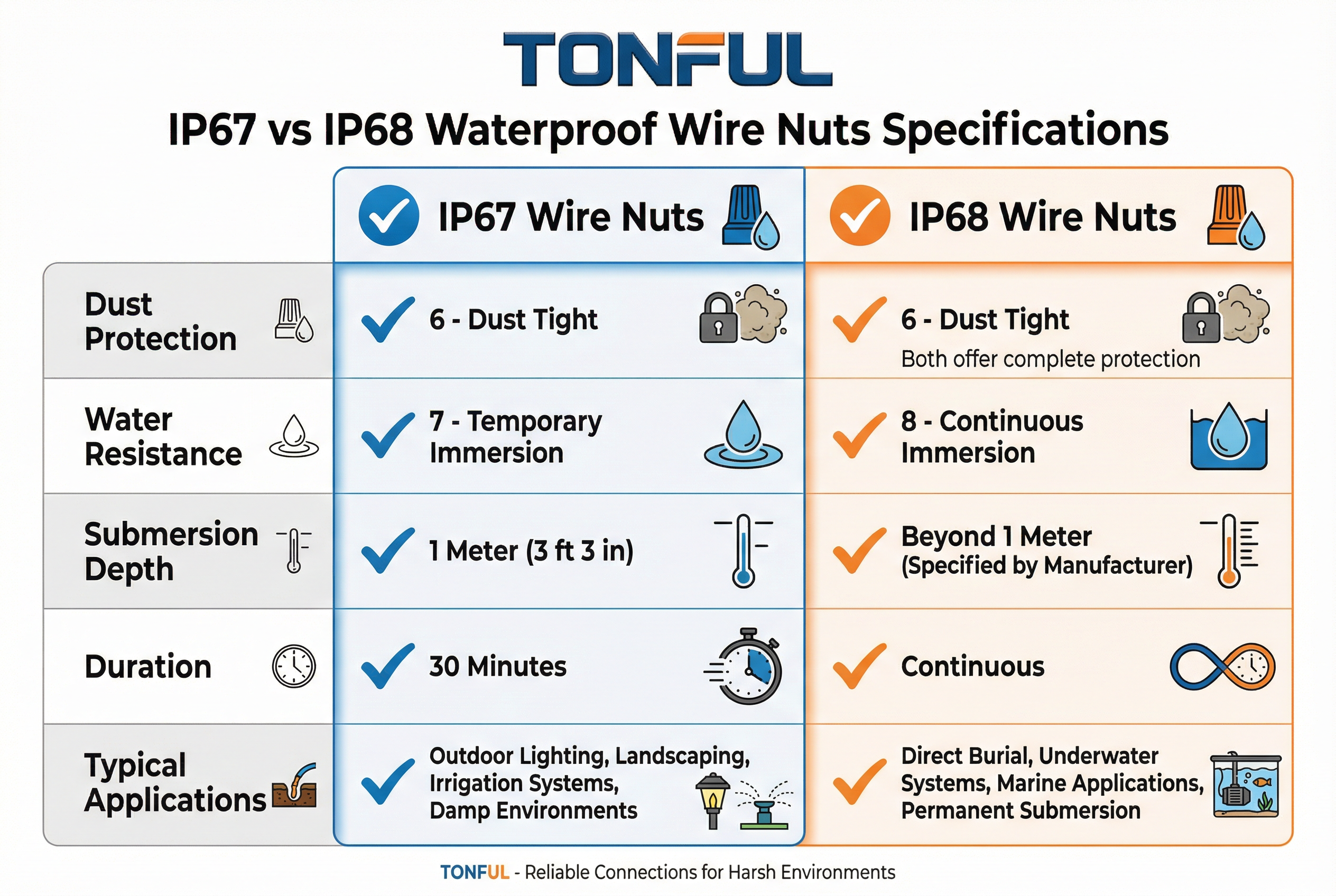
For waterproof wire nuts, the first digit in the IP rating is almost always a ‘6’. This indicates the highest level of protection against solid particles. A rating of ‘6’ signifies that the connector is completely “dust-tight.” No ingress of dust is permitted, making it suitable for deployment in fine-particle environments like construction sites, workshops, or agricultural settings without compromising the connection inside.
The Second Digit: The Critical Factor for Waterproofing
The second digit is the crucial differentiator for any waterproof application. It rates the enclosure’s effectiveness against the ingress of water. It is this number that separates a connector that can handle a bit of rain from one that can be buried underground indefinitely. When comparing IP67 and IP68 wire nuts, this second digit is the primary focus of the selection process.
A Deep Dive into the IP67 Rating for Wire Nuts
An IP67 rating provides a clearly defined and reliable level of water protection for a wide range of common applications.
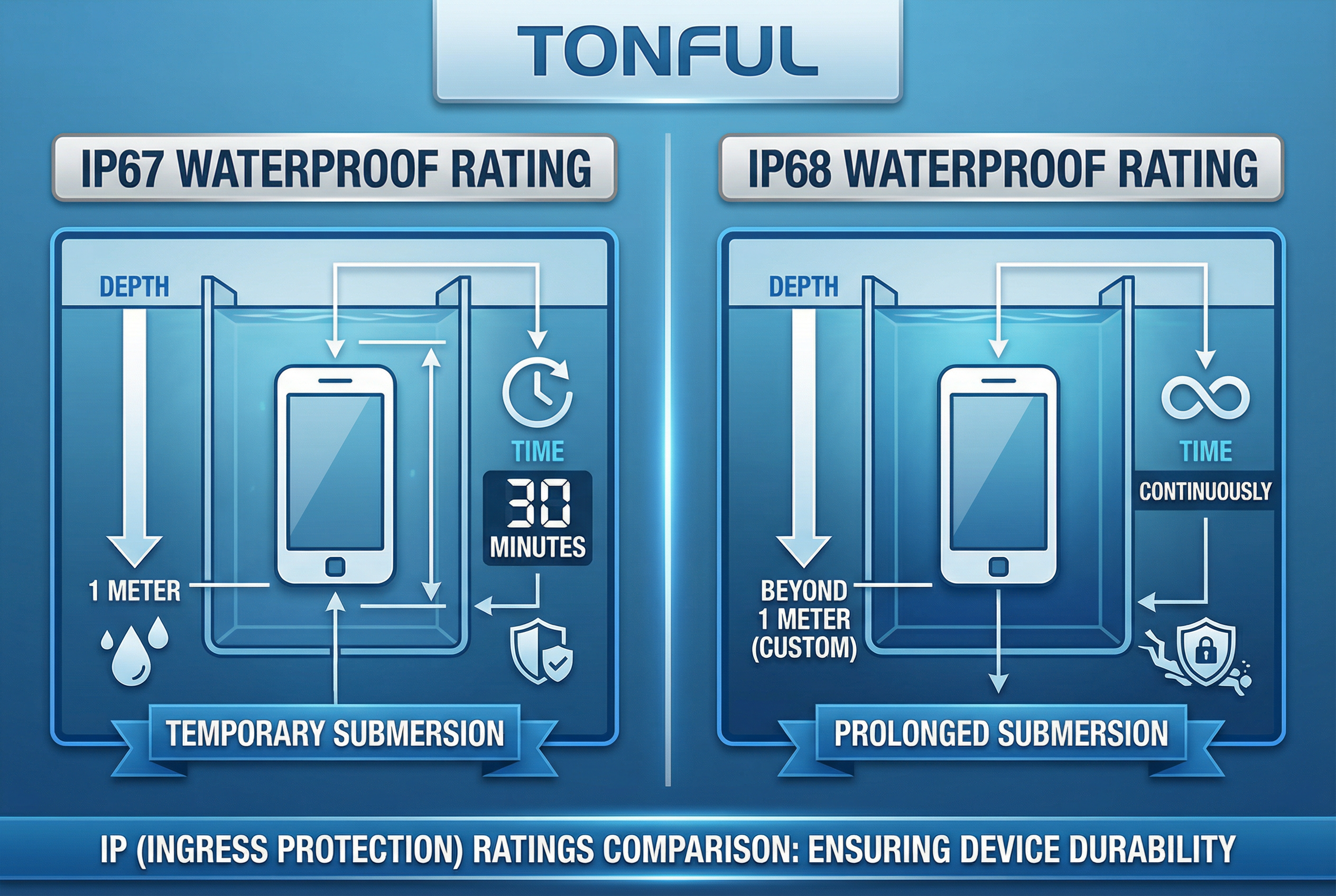
Definition: A product rated IP67 is protected against the effects of temporary immersion in water. The official standard specifies that the enclosure must prevent water ingress when submerged at a depth of up to 1 meter for a maximum of 30 minutes.
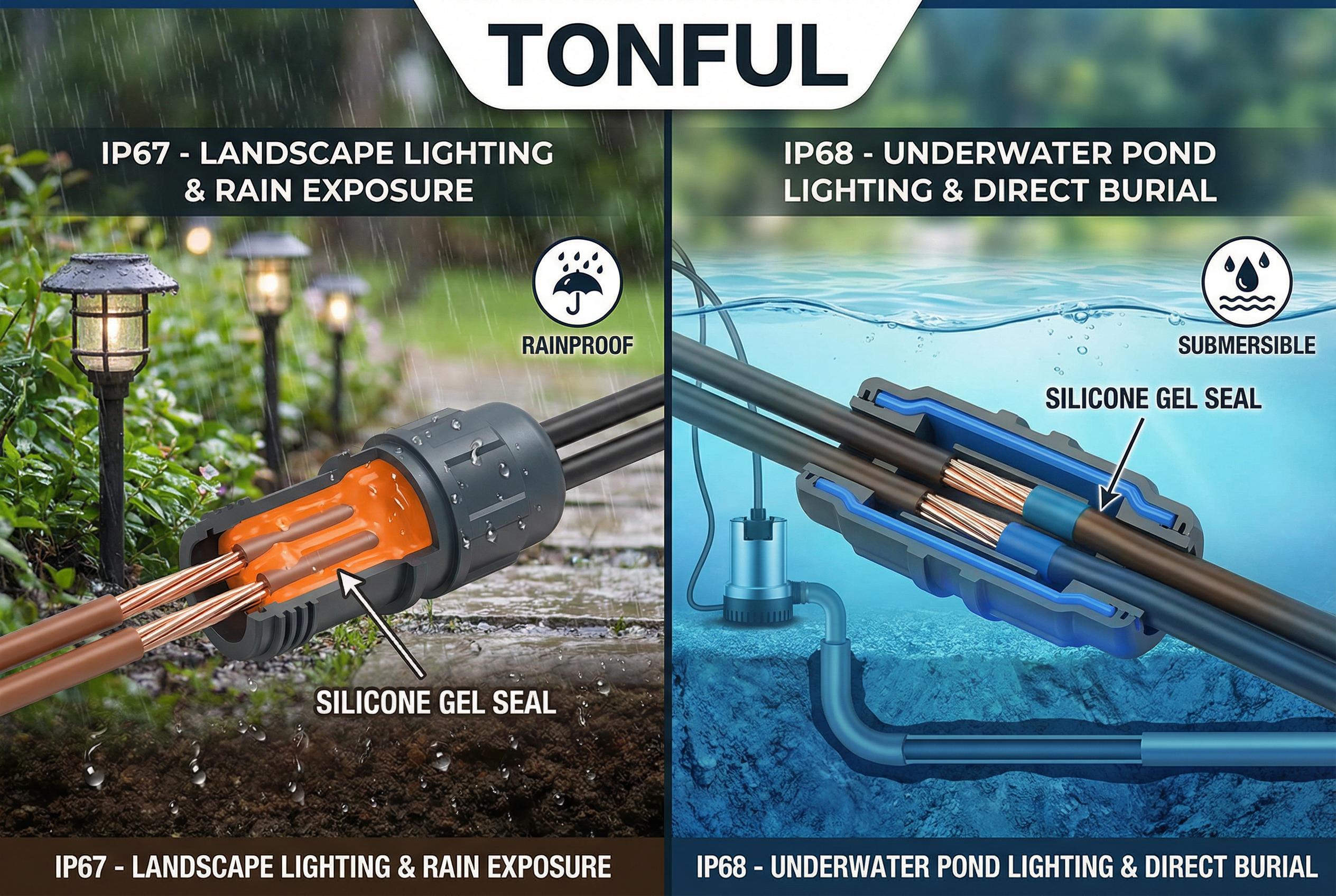
In practice, this means an IP67-rated wire nut is robust enough to handle heavy rain, splashing, and even temporary, shallow flooding. The pre-filled silicone sealant inside the nut prevents moisture from reaching the wire splice, and the durable housing protects the connection from physical damage.
Common Applications for IP67 Wire Nuts
IP67 wire nuts are the ideal, cost-effective choice for applications where the connection is exposed to moisture but is not intended to live permanently underwater.
- Landscape Lighting: Connecting low-voltage pathway lights, uplights, and garden fixtures that are subject to rain and sprinkler systems.
- Irrigation Systems: Splicing wires for electric valve solenoids and controllers housed in valve boxes where water may temporarily pool.
- Outdoor Signage: Wiring for LED and other illuminated signs exposed to the elements.
- Deck and Patio Wiring: For outlets and lighting systems installed in outdoor living spaces.
For these scenarios, IP67 provides more than adequate protection, ensuring a long-lasting, safe connection without the additional cost associated with a higher rating.
Demystifying the IP68 Rating for Wire Nuts
When a project demands uncompromising protection against permanent water exposure, the IP68 rating is the professional standard.
Definition: A product rated IP68 is protected against the effects of long-term, continuous immersion in water under conditions specified by the manufacturer.
This is the most critical aspect of the IP68 rating: it is not a single, universal standard but a baseline that manufacturers build upon. While it guarantees protection beyond the 1-meter/30-minute limit of IP67, the actual depth and duration are defined by the manufacturer. For example, one manufacturer might test and certify their IP68 wire nuts for submersion at 2 meters for 24 hours, while a more robust product, like those from Tonful Electric, might be rated for direct burial at greater depths indefinitely. This makes checking the manufacturer’s data sheet absolutely essential.
When to Insist on IP68 Wire Nuts
IP68 wire nuts are designed for the most demanding environments where failure is not an option. You should specify IP68 for any application involving permanent submersion or high-risk water exposure.
- Submersible Pumps: Connections for well pumps, pond and fountain pumps, and sump pumps where the splice may be continuously underwater.
- Direct Burial Applications: For any low-voltage electrical line that will be buried directly in the ground, especially in areas with a high water table or poor drainage.
- Marine and Boating: Critical connections on boats and docks where components are exposed to bilge water or direct sea contact.
- Wastewater Treatment Facilities: Environments with constant high humidity, washdowns, and the risk of flooding.
Using IP68 connectors in these situations is a long-term investment in reliability and safety.
IP67 vs. IP68 Wire Nuts: A Head-to-Head Technical Comparison
For professionals, choosing the right component is a matter of matching the product’s capability to the project’s demands. This table breaks down the key differences to guide your selection.
| Feature | IP67 Wire Nut | IP68 Wire Nut |
|---|---|---|
| Immersion Depth | Up to 1 meter (approx. 3.3 feet) | Deeper than 1 meter |
| Immersion Duration | Temporary (maximum of 30 minutes) | Continuous / Long-Term (hours, days, or permanently) |
| Governing Standard | IEC 60529 defines a universal test (1m/30min) | IEC 60529 sets the baseline; specific performance is defined by the manufacturer |
| Best For | Exposure to rain, splashes, damp soil, and temporary, shallow pooling of water | Permanent submersion, direct burial in soil, and mission-critical applications |
| Common Use Cases | Landscape lighting, irrigation boxes, outdoor speakers, deck wiring | Submersible pumps, pond/fountain wiring, marine applications, underground splices |
| Cost Factor | More economical; standard choice for most outdoor needs | Premium / Higher cost, justified by superior protection and risk mitigation |
| Common Mistake | Using for a permanently submerged connection, assuming it’s “good enough.” | Over-specifying for a simple damp-location junction box where IP67 would suffice. |
How to Choose the Right Waterproof Wire Nut: A Professional’s Guide
Making the right choice goes beyond just reading a spec sheet. It involves a practical assessment of the job site and a clear understanding of risk versus cost.
Step 1: Analyze the Application Environment
First, perform a thorough analysis of the environment where the connection will live. Ask yourself and your team a series of critical questions:
- Will the wire nut be exposed to dripping, splashing, or sprayed water? Or will it be fully submerged?
- If submerged, will it be temporary (e.g., a flooded junction box) or permanent (e.g., a pond pump)?
- What is the maximum potential water depth the connection will encounter?
- Will the connection be buried in soil? If so, what is the water table level in that area?
- What are the consequences of a connection failure in this specific application? (e.g., a single light out vs. a critical pump failure).
Your answers will immediately point you toward either IP67 for temporary/shallow exposure or IP68 for permanent/deep submersion.
Step 2: Evaluate the Cost vs. Risk Equation
While IP68 wire nuts carry a higher upfront cost, this expense must be weighed against the potential cost of failure. For a non-critical landscape light, an IP67 connector is often a perfectly sound and economical choice. However, for a submersible well pump that supplies water to a property, the small additional cost of an IP68 connector is negligible compared to the expense and headache of a premature failure. A failed pump connection could require expensive excavation, a new pump, and significant downtime. In professional contracting, avoiding a single callback often pays for the marginal cost difference of using premium components across dozens of jobs.
Step 3: Always Check the Manufacturer’s IP68 Specifications
As mentioned, not all IP68 ratings are the same. When you determine that an IP68 wire nut is necessary, your job is not done. The final step is to verify the manufacturer’s specific test data and certifications. A reputable manufacturer like Tonful Electric will provide a clear datasheet stating the exact depth and duration for which their IP68 connectors are rated. Vague claims of being “IP68 rated” without supporting data should be a red flag. Always demand clarity to ensure the component you specify will perform as expected in the field.
The Tonful Advantage: Engineering for Real-World Reliability
The IP rating is a critical benchmark, but it doesn’t tell the whole story. True long-term reliability comes from the quality of the materials and the manufacturing process. This is where a dedicated B2B manufacturer like Tonful Electric stands apart.
The performance of a waterproof wire nut depends on three core components working in harmony:
- The Silicone Sealant: A premium, non-hardening silicone sealant is essential. It must remain viscous and flexible enough to flow around the inserted wires, displacing all air and moisture, and it must not dry out or crack over time, even with temperature fluctuations.
- The Housing: The outer shell, typically a durable thermoplastic, must be rugged enough to withstand the torque of installation and provide robust physical protection. It should also be UV-stabilized for above-ground applications to prevent sun exposure from making the plastic brittle.
- The Wire Spring: A corrosion-resistant, live-action square wire spring provides the mechanical connection. It needs to bite into the conductors securely while expanding and contracting with temperature changes to maintain constant pressure on the splice.
At Tonful, we engineer our waterproof connectors for professionals who can’t afford a failed connection. We use high-grade materials and conduct rigorous testing that simulates real-world conditions, ensuring our IP67 and IP68 ratings are not just lab-certified, but field-proven.
Frequently Asked Questions (FAQ)
1. What is the main difference between IP67 and IP68 for wire nuts?
The primary difference is the level and duration of water protection. IP67 guarantees protection against temporary immersion up to 1 meter for 30 minutes. IP68 guarantees protection against continuous immersion beyond 1 meter, with the exact depth and time specified by the manufacturer.
2. Are IP68 wire nuts worth the extra cost?
For applications involving permanent submersion, direct burial, or mission-critical equipment (like well pumps), yes. The extra cost is a small investment to prevent catastrophic failure, downtime, and expensive repairs. For standard outdoor lighting or irrigation systems, IP67 is often sufficient and more cost-effective.
3. Can I use an IP67-rated wire nut for a direct burial application?
No, this is strongly discouraged. Direct burial applications require an IP68 rating. Soil can become saturated for long periods, far exceeding the 30-minute limit of IP67. Using an IP67 connector underground is a common cause of premature failure.
4. Do IP ratings degrade over time?
The rating itself is a measure of the product’s design, but the materials can degrade. This is why material quality is so important. Exposure to UV radiation, extreme temperatures, or harsh chemicals can cause seals and housings to break down. Choosing connectors from a quality manufacturer ensures they are made with durable, long-lasting materials.
5. Does an IP68 rating protect against high-pressure water jets?
Not necessarily. IP ratings for water immersion (x7, x8) and water jets (x5, x6) are independent tests. A connector can be rated for submersion (IP68) but not for high-pressure jets. For environments like industrial washdowns, you may need a product rated IP66, IP69K, or both. Always check the specific ratings against your needs.
Conclusion: Making the Right Connection Every Time
In the professional electrical trades, precision and reliability are paramount. Choosing between IP67 and IP68 waterproof wire nuts is a critical decision that directly impacts the longevity and safety of your work. The selection is simple when guided by the application’s environment: IP67 is the robust, reliable standard for components exposed to temporary or shallow water, while IP68 is the necessary choice for permanent submersion and high-risk environments.
By analyzing the job site, weighing the risks, and choosing high-quality components from a trusted manufacturer, you ensure that every connection you make is secure, protected, and built to withstand the test of time.
For electrical connections that demand uncompromising reliability, explore Tonful Electric’s full range of IP67 and IP68 waterproof wire nuts or contact our engineering team for a project consultation.