
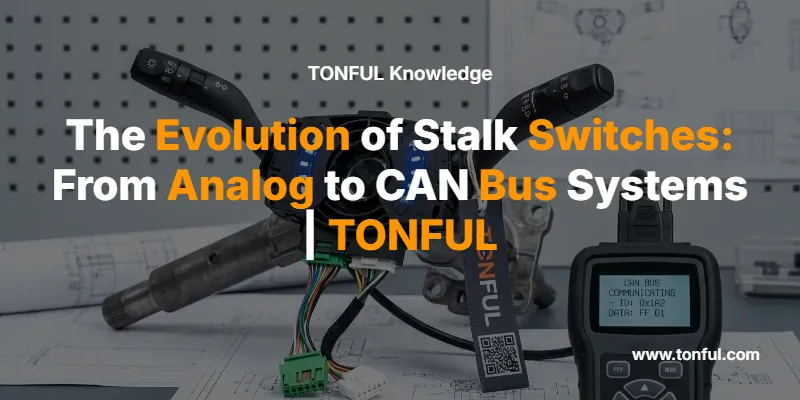
Introduction: The Critical Role of Stalk Switches in Modern Vehicles
Stalk switches, also known as multifunction switches or turn signal switches, represent one of the most frequently used control interfaces in automotive vehicles. These steering column-mounted devices have evolved dramatically over the past century, transforming from simple mechanical levers into sophisticated electronic control units that communicate through advanced digital protocols.
For automotive engineers, OEM manufacturers, and fleet managers, understanding the evolution of stalk switch technology is essential for making informed decisions about vehicle electrical systems, maintenance strategies, and future-proofing investments. This comprehensive guide examines the technological journey from analog mechanical systems to modern CAN bus integration, providing technical insights that matter to B2B decision-makers.

The Mechanical Era: Analog Stalk Switches (1920s-1980s)
Simple Mechanical Construction
Early stalk switches operated through purely mechanical means, utilizing physical contacts and direct electrical connections. These combination switches featured basic functionality including turn signals, high/low beam control, and eventually windshield wiper operation.
The mechanical design relied on:
- Physical copper contact points
- Spring-loaded return mechanisms
- Thermal flasher units for turn signal operation
- Direct wire-to-wire connections
- Simple on/off switching logic
Limitations of Analog Systems
While mechanically reliable, analog stalk switches presented several challenges:
- Wiring Complexity: Each function required dedicated wiring throughout the vehicle, resulting in heavy harnesses and increased installation costs
- Limited Functionality: Space constraints limited the number of available functions
- Wear and Maintenance: Physical contacts degraded over time, requiring periodic replacement
- No Diagnostic Capability: Fault detection required manual testing with multimeters
- Fixed Configuration: Functions could not be modified without hardware changes

The Electronic Transition: Electromechanical Systems (1980s-2000s)
Introduction of Electronic Control Units
The 1980s marked a pivotal shift as vehicles began incorporating Electronic Control Units (ECUs) for various subsystems. This transition enabled stalk switches to evolve from purely mechanical devices into electromechanical interfaces that sent electrical signals to control modules rather than directly switching high-current loads.
Key technological advances included:
- Replacement of thermal flashers with electronic timing circuits
- Integration of resistive or Hall-effect position sensors
- Microprocessor-based signal processing
- Reduced current handling requirements
- Enhanced reliability through solid-state components
Multiplexing: Reducing Wiring Complexity
As vehicles incorporated more electronic features, multiplexing emerged as a solution to wiring complexity. Rather than each switch requiring dedicated wires, multiplexed systems allowed multiple signals to share common communication lines, significantly reducing harness weight and installation complexity.
| Feature | Mechanical Era | Electronic/Multiplexed Era |
|---|---|---|
| Wiring per Function | 2-4 dedicated wires | 2 shared communication wires |
| Harness Weight | 25-35 kg | 15-20 kg |
| Installation Time | 8-12 hours | 4-6 hours |
| Diagnostic Capability | Manual testing only | Electronic fault codes |
| Function Flexibility | Fixed hardware | Software configurable |
| Average Lifespan | 5-8 years | 10-15 years |
This era saw the introduction of integrated automotive electrical connectors and improved terminal designs that could handle both power and signal connections reliably.
The Digital Revolution: CAN Bus Integration (2000s-Present)
Understanding CAN Bus Architecture
The Controller Area Network (CAN bus) protocol, originally developed by Bosch in 1986, revolutionized automotive communication systems. By the early 2000s, CAN bus had become the standard communication backbone in modern vehicles, enabling sophisticated data exchange between Electronic Control Units.

How Modern CAN Bus Stalk Switches Function
Unlike their analog predecessors, CAN bus-integrated stalk switches operate as intelligent nodes on the vehicle network:
- Signal Detection: Internal sensors detect lever position and button presses
- Message Formatting: Microcontroller converts inputs into standardized CAN messages
- Network Transmission: Messages broadcast onto CAN bus with appropriate priority identifiers
- Multi-Module Reception: Relevant ECUs receive and act upon messages
- Status Feedback: System provides confirmation through instrument cluster indicators
The switch no longer directly controls electrical loads. Instead, it communicates intentions to the Body Control Module (BCM) or other relevant ECUs, which then activate appropriate outputs based on programmed logic and system conditions.
Technical Specifications of Modern Stalk Switches
| Specification | Typical Value | Notes |
|---|---|---|
| Communication Protocol | CAN 2.0B / CAN FD | ISO 11898 standard |
| Baud Rate | 125-500 kbps (standard) / 1-8 Mbps (CAN FD) | Application dependent |
| Operating Voltage | 9-16V DC | Nominal 12V systems |
| Message Identifier Length | 11-bit or 29-bit | Extended frames for complex data |
| Current Draw (Active) | 50-150 mA | Includes illumination |
| Current Draw (Sleep) | <1 mA | Low power mode |
| Operating Temperature | -40°C to +85°C | Automotive grade components |
| MTBF (Mean Time Between Failures) | >100,000 hours | Modern solid-state designs |
| Cycle Rating | >200,000 operations | Per function |
Advantages of CAN Bus Integration
The transition to CAN bus architecture provides substantial benefits for vehicle manufacturers and fleet operators:
System-Level Benefits:
- Reduced Wiring: Up to 40% reduction in harness weight and cost
- Flexible Configuration: Functions can be modified through software updates
- Enhanced Diagnostics: Real-time fault detection and detailed error logging
- Improved Safety: Redundant communication paths and error checking
- Future-Ready: Easy integration of new features without hardware changes
Operational Advantages:
- Predictive Maintenance: Systems can detect degradation before complete failure
- Remote Diagnostics: Fleet managers can monitor switch health remotely
- Reduced Downtime: Faster fault identification and targeted repairs
- Standardization: Compatible with industry-standard diagnostic tools
Quality automotive connectors and crimping terminals remain critical for reliable CAN bus connections, as signal integrity depends on proper electrical connections.

Technical Comparison: Analog vs. CAN Bus Systems
Electrical and Communication Characteristics
| Characteristic | Analog Systems | CAN Bus Systems |
|---|---|---|
| Switching Method | Direct electrical contact | Digital message transmission |
| Signal Type | Discrete on/off states | Multiplexed digital data |
| Wire Count (typical) | 15-25 wires | 2-4 wires (CAN + power) |
| Voltage Drop Sensitivity | High | Low (digital threshold) |
| EMI Susceptibility | Moderate to high | Low (differential signaling) |
| Maximum Cable Length | <5 meters (function dependent) | >40 meters (network dependent) |
| Data Transmission Rate | N/A | 125 kbps – 8 Mbps |
| Multi-Function Capability | Limited (5-8 functions) | Extensive (20+ functions) |
| Error Detection | None | CRC, ACK, bit monitoring |
| Prioritization | Hardware dependent | Message ID based |
Reliability and Maintenance Factors
| Factor | Analog Systems | CAN Bus Systems |
|---|---|---|
| Contact Wear | Significant issue | Minimal (electronic switching) |
| Corrosion Impact | Critical failure mode | Reduced through sealed connectors |
| Environmental Protection | IP54-IP67 typical | IP67-IP69K achievable |
| Self-Diagnostic Capability | None | Comprehensive built-in testing |
| Fault Isolation | Time-consuming | Rapid electronic identification |
| Replacement Complexity | Moderate | Requires programming/coding |
| Parts Availability | Decreasing | Widely available |
| Average Repair Time | 2-4 hours | 1-2 hours (with diagnostics) |
The evolution toward CAN bus systems has made proper electrical tools and diagnostic equipment essential for installation and maintenance personnel.
Advanced Features in Modern Stalk Switch Systems
Programmable Functions and Customization
Modern CAN bus stalk switches offer unprecedented flexibility through software configuration. Functions that once required physical switch replacement can now be modified through ECU programming:
- Configurable Detents: Adjust lever return behavior for different markets
- Function Assignment: Remap buttons to control different systems
- Sensitivity Adjustment: Modify activation thresholds for various conditions
- Sequential Operation: Program complex multi-step operations
- Conditional Logic: Enable features based on vehicle state (speed, gear position, etc.)
Integration with Advanced Driver Assistance Systems (ADAS)
Contemporary stalk switches increasingly interface with ADAS features, requiring sophisticated communication protocols and failsafe mechanisms:
- Adaptive Cruise Control: Stalk inputs control following distance and speed settings
- Lane Keeping Assistance: Turn signal activation influences lane-change assistance behavior
- Automatic High Beam: Override controls for driver preference
- Traffic Sign Recognition: Manual confirmation of detected speed limits
- Parking Assistance: Gear position indication and parking mode activation

Cybersecurity Considerations
As vehicles become more connected, stalk switches—like all networked components—must address cybersecurity concerns:
- Message Authentication: Cryptographic validation of CAN messages
- Intrusion Detection: Monitoring for abnormal traffic patterns
- Secure Boot: Verified firmware loading during initialization
- Update Security: Encrypted software updates with digital signatures
- Isolation Strategies: Network segmentation to contain potential breaches
Future Trends and Emerging Technologies
CAN FD and CAN XL: Next-Generation Protocols
The automotive industry is transitioning to enhanced CAN protocols:
CAN FD (Flexible Data Rate):
- Data phase speeds up to 8 Mbps
- Payload increased from 8 to 64 bytes
- Backward compatible with classical CAN
- Ideal for bandwidth-intensive applications
CAN XL:
- Speeds up to 10 Mbps
- Payload up to 2048 bytes
- Enhanced security features
- Future-proof for autonomous vehicles
Automotive Ethernet and Hybrid Architectures
While CAN bus remains dominant for control functions, high-bandwidth applications increasingly utilize Automotive Ethernet (100/1000 Mbps). Future vehicles may employ hybrid architectures where stalk switches communicate via CAN bus to a gateway that bridges to Ethernet backbones for ADAS and infotainment systems.
Touchscreen and Haptic Interface Integration
The industry is exploring alternatives to traditional stalks:
- Capacitive Touch Surfaces: Replacing mechanical levers with touch-sensitive areas
- Haptic Feedback: Providing tactile confirmation without mechanical movement
- Adaptive Interfaces: Context-sensitive controls that change based on driving mode
- Gesture Recognition: Camera-based input systems supplementing physical controls
However, regulatory requirements and driver familiarity ensure that physical stalk switches will remain relevant for the foreseeable future, particularly in commercial and heavy-duty applications.
Sustainability and Materials Innovation
Environmental considerations drive material selection in modern stalk switches:
- Recyclable thermoplastics replacing traditional materials
- Lead-free solder and RoHS compliance
- Reduced packaging and transportation footprint
- Design for disassembly and component reuse
- Extended lifespan through enhanced durability
TONFUL Electric’s commitment to sustainable manufacturing includes comprehensive recycling programs for electrical components and adherence to global environmental standards.
Selecting the Right Stalk Switch Technology
Application-Based Selection Criteria
| Application Type | Recommended Technology | Key Considerations |
|---|---|---|
| Legacy Vehicle Retrofit | Analog/Electromechanical | Compatibility, wiring constraints |
| Standard Passenger Vehicles | CAN 2.0B | Cost-effective, proven reliability |
| Premium/Luxury Vehicles | CAN FD | High bandwidth, advanced features |
| Commercial/Heavy-Duty | Ruggedized CAN | Environmental protection, durability |
| Electric Vehicles | CAN FD/Ethernet Gateway | High-speed communication, battery management integration |
| Autonomous Vehicles | Automotive Ethernet-ready | Future technology roadmap, sensor fusion |
Key Specifications to Evaluate
When sourcing stalk switches for OEM or aftermarket applications, consider:
- Environmental Rating: IP67 minimum for exposed applications
- Temperature Range: Extended range (-40°C to +105°C) for extreme climates
- Connector Type: Standardization for supply chain efficiency
- Protocol Compliance: Verified conformance to ISO standards
- Cycle Life: Minimum 200,000 operations per function
- EMC Performance: Compliance with automotive EMC directives
- Haptic Quality: Consistent tactile feedback throughout lifespan
Quality wire connectors and proper crimping tools ensure reliable installation and long-term performance.
Maintenance and Troubleshooting Modern Stalk Switches
Common CAN Bus Switch Issues
| Symptom | Probable Cause | Diagnostic Approach |
|---|---|---|
| No function operation | Power supply failure | Check voltage at connector |
| Intermittent operation | Poor connector contact | Inspect terminals, check for corrosion |
| Multiple functions inoperative | CAN bus communication failure | Verify bus voltage, check termination |
| Single function failure | Internal switch failure | Monitor CAN traffic with diagnostic tool |
| Erratic behavior | EMI interference | Check shielding, verify grounding |
| No illumination | LED driver failure | Test backlight circuit independently |
Diagnostic Best Practices
Modern stalk switch diagnosis requires specialized tools and knowledge:
- CAN Bus Analyzers: Essential for monitoring message traffic and identifying communication faults
- Oscilloscopes: Verify signal integrity and timing
- Multimeters: Check power supply and ground connections
- Diagnostic Software: Access ECU fault codes and real-time data
- Technical Documentation: Reference wiring diagrams and communication matrices
Fleet managers should invest in quality diagnostic equipment and ensure technicians receive proper training on CAN bus systems.
TONFUL Electric: Your Partner in Automotive Electrical Solutions
As a leading manufacturer of automotive electrical components, TONFUL Electric provides comprehensive solutions for OEMs, tier-one suppliers, and aftermarket distributors. Our product portfolio includes:
- Stalk Switches: Analog, multiplexed, and CAN bus variants for diverse applications
- Combination Switches: Integrated multi-function solutions
- Electrical Connectors: High-reliability terminals and housings
- Wire Management: Waterproof connectors and protection systems
- Fusing Solutions: Comprehensive circuit protection
- Installation Tools: Professional-grade crimping and diagnostic equipment
Our engineering team supports clients throughout the product lifecycle, from initial specification to production validation and field support. With ISO/TS 16949 certification and commitment to continuous improvement, TONFUL Electric delivers the quality and reliability that modern automotive applications demand.
Frequently Asked Questions
Q: What is the main difference between analog and CAN bus stalk switches?
A: Analog stalk switches use direct electrical connections to control vehicle functions through physical contacts, while CAN bus switches send digital messages over a communication network to control modules that activate the desired functions. CAN bus systems offer reduced wiring, enhanced diagnostics, and greater flexibility but require compatible electronic control units.
Q: Can I replace an analog stalk switch with a CAN bus version?
A: Direct replacement is not possible without significant system modifications. CAN bus switches require compatible ECUs, communication network infrastructure, and proper software programming. Retrofitting typically requires a complete electrical system upgrade, making it impractical for most applications. Consult with qualified automotive electricians for feasibility assessment.
Q: How long do modern CAN bus stalk switches typically last?
A: Modern CAN bus stalk switches are designed for 200,000-300,000 operations per function and typically achieve 10-15 years of service life under normal operating conditions. Actual lifespan depends on usage patterns, environmental conditions, and maintenance practices. Regular inspection and proper connector care maximize longevity.
Q: What are the signs that a stalk switch needs replacement?
A: Common indicators include intermittent function operation, complete function failure, abnormal resistance or sticking during operation, illumination failure, or diagnostic trouble codes related to switch communication. Modern vehicles may display specific fault codes identifying stalk switch issues. Professional diagnosis with appropriate scan tools confirms replacement necessity.
Q: Are CAN bus stalk switches more expensive than analog versions?
A: Initial component cost is typically 30-50% higher for CAN bus switches compared to analog equivalents. However, total system cost is often lower due to reduced wiring harness expenses, simplified installation, decreased warranty claims, and enhanced diagnostic capabilities. Fleet operators realize additional savings through predictive maintenance and reduced downtime.
Q: How do I ensure compatibility when sourcing replacement stalk switches?
A: Verify original equipment manufacturer (OEM) part numbers, confirm electrical connector configuration, check CAN bus protocol version and baud rate, validate software/firmware compatibility with vehicle ECUs, and ensure environmental ratings meet application requirements. Working with reputable suppliers like TONFUL Electric ensures proper specification matching and technical support.
For technical inquiries, custom specifications, or bulk procurement of automotive electrical components, contact TONFUL Electric’s engineering team. We deliver precision-engineered solutions that meet the demanding requirements of modern vehicle electrical systems.