
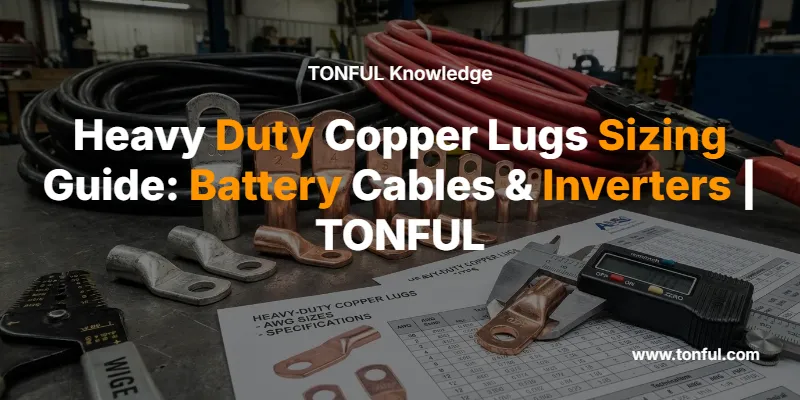
Understanding Heavy-Duty Copper Lugs for High-Current Applications
Heavy-duty copper lugs serve as the critical connection point between battery cables and high-power electrical equipment. In applications ranging from solar inverter systems to marine battery banks, proper lug sizing directly impacts system efficiency, safety, and longevity. A correctly sized copper lug maintains minimal resistance, prevents overheating, and ensures reliable power transmission under continuous high-current loads.
The selection process involves multiple technical considerations: wire gauge compatibility, current-carrying capacity (ampacity), mounting hole diameter, barrel length, and material specifications. Unlike standard crimp terminals used in lower-current applications, heavy-duty copper lugs must withstand sustained currents exceeding 100 amperes while maintaining electrical integrity across temperature extremes and mechanical vibration.
This comprehensive guide addresses the technical requirements for sizing copper lugs in battery-to-inverter connections, solar energy storage systems, automotive high-performance applications, and marine electrical installations. We’ll examine industry standards, provide detailed sizing tables, and outline best practices that ensure compliance with UL 486A-486B certification requirements.

AWG Wire Gauge System and Ampacity Fundamentals
The American Wire Gauge (AWG) system provides a standardized logarithmic scale for measuring conductor diameter. Understanding this system is essential for proper copper lug selection, as the gauge number inversely correlates with wire diameter—smaller AWG numbers indicate larger wire diameters and higher current-carrying capacity.
AWG Size and Current Capacity Relationship
For copper conductors at 75°C insulation rating (the most common specification for battery cable applications), the following ampacity ratings apply:
| AWG Size | Conductor Diameter (mm) | Ampacity at 75°C | Typical Application |
|---|---|---|---|
| 8 AWG | 3.26 | 50A | Light inverters, auxiliary systems |
| 6 AWG | 4.11 | 65A | 500-750W inverters, golf carts |
| 4 AWG | 5.19 | 85A | 1000-1500W inverters, RV systems |
| 2 AWG | 6.54 | 115A | 1500-2000W inverters, marine applications |
| 1 AWG | 7.35 | 130A | 2000-2500W inverters, solar battery banks |
| 1/0 AWG | 8.25 | 150A | 2500-3000W inverters, high-performance automotive |
| 2/0 AWG | 9.27 | 175A | 3000-4000W inverters, commercial solar systems |
| 4/0 AWG | 11.68 | 230A | 5000W+ inverters, industrial battery banks |
These ratings assume three or fewer current-carrying conductors in conduit or cable, with ambient temperature at 30°C (86°F). For free-air installations, ampacity increases by approximately 15-20%. When selecting wire connectors for these applications, always verify that terminal temperature ratings match or exceed conductor insulation specifications.
Temperature Derating and Safety Factors
Professional installations require applying a 125% safety factor to continuous loads. For a 3000W inverter operating at 12V, the calculated current is 250A (3000W ÷ 12V). Applying the safety factor yields 312.5A, necessitating 4/0 AWG cable with appropriately sized copper lugs. This calculation prevents terminal overheating and ensures compliance with National Electrical Code (NEC) requirements.
Comprehensive Copper Lug Sizing Tables
Battery-to-Inverter Cable Sizing Chart
The following table provides recommended copper lug specifications for common inverter configurations. These recommendations account for voltage drop limitations (≤2% for DC circuits) and thermal management requirements:
| System Voltage | Inverter Power | Cable Length | Minimum AWG | Recommended Lug Hole Size | Continuous Current Rating |
|---|---|---|---|---|---|
| 12V | 1000W | Up to 5 ft | 4 AWG | 5/16″ (M8) | 85A |
| 12V | 1500W | Up to 5 ft | 2 AWG | 5/16″ (M8) | 115A |
| 12V | 2000W | Up to 5 ft | 1 AWG | 3/8″ (M10) | 130A |
| 12V | 3000W | Up to 5 ft | 2/0 AWG | 3/8″ (M10) | 175A |
| 24V | 2000W | Up to 10 ft | 4 AWG | 5/16″ (M8) | 85A |
| 24V | 3000W | Up to 10 ft | 2 AWG | 5/16″ (M8) | 115A |
| 48V | 5000W | Up to 15 ft | 2 AWG | 3/8″ (M10) | 115A |
| 48V | 6500W | Up to 15 ft | 2/0 AWG | 3/8″ (M10) | 175A |
For cable runs exceeding these distances, increase wire gauge by one size to compensate for additional voltage drop. When connecting multiple batteries in parallel, use equal-length cables with heat shrink terminals to ensure balanced current distribution.

Application-Specific Lug Selection Guide
Different applications impose unique requirements on copper lug specifications. The following table addresses industry-specific considerations:
| Application | Environment | Recommended Finish | Critical Features | Typical AWG Range |
|---|---|---|---|---|
| Solar Energy Storage | Outdoor, UV exposure | Tin-plated copper | Corrosion resistance, wide temperature range (-40°C to +125°C) | 2 AWG to 4/0 AWG |
| Marine Battery Systems | Salt water, high humidity | Heavy tin plating (≥5μm) | Marine-grade corrosion protection, vibration resistance | 4 AWG to 2/0 AWG |
| Automotive Performance | Engine compartment heat, vibration | Tin-plated or bare copper | Compact design, high vibration tolerance | 6 AWG to 1/0 AWG |
| RV/Camper Systems | Temperature cycling, mobile installation | Tin-plated copper | Flexible cable compatibility, space efficiency | 4 AWG to 2 AWG |
| Industrial UPS Systems | Climate-controlled, stationary | Bare copper acceptable | High ampacity, long service life (20+ years) | 1/0 AWG to 4/0 AWG |
For marine and outdoor applications, tin-plated copper lugs provide superior corrosion resistance compared to bare copper. The tin coating (typically 5-10 microns thick) prevents oxidation while maintaining excellent electrical conductivity. Our automotive connectors incorporate similar protective finishes for demanding environments.
Material Specifications: Tinned vs. Bare Copper Lugs
Conductivity and Corrosion Resistance
Pure copper exhibits electrical conductivity of 100% IACS (International Annealed Copper Standard), making it the preferred material for high-current terminals. However, bare copper oxidizes when exposed to moisture and atmospheric contaminants, forming copper oxide layers that increase contact resistance and generate heat at connection points.
Tin plating addresses this limitation by providing a protective barrier that prevents oxidation while maintaining 90-95% of copper’s conductivity. The tin layer also facilitates soldering operations and improves contact stability over the terminal’s service life. For battery interconnect applications requiring frequent disconnection, tin-plated lugs demonstrate superior performance in maintaining low contact resistance.
Manufacturing Standards and Quality Indicators
High-quality copper lugs manufactured to UL 486A-486B standards utilize electrolytic tough pitch (ETP) copper with minimum 99.9% purity. The manufacturing process involves:
- Precision stamping or machining to create the lug palm and mounting hole
- Barrel formation with controlled wall thickness for optimal crimp compression
- Tin electroplating (for plated versions) with thickness verification
- Dimensional inspection ensuring compatibility with standard crimping dies
- Pull-force testing validating mechanical strength per UL requirements
When specifying electrical crimp tools for lug installation, verify that crimping dies match the lug manufacturer’s specifications. Improper die selection can result in under-crimping (insufficient contact pressure) or over-crimping (conductor strand damage).

UL 486A-486B Crimping Standards and Compliance
Understanding UL Certification Requirements
UL 486A-486B establishes comprehensive safety and performance standards for wire connectors and soldering lugs used with copper, aluminum, and copper-clad aluminum conductors. This standard specifies minimum pull-force requirements, temperature rise limits, and installation procedures that ensure reliable electrical connections in accordance with the National Electrical Code.
For copper lugs in battery cable applications, UL 486A-486B mandates:
Tensile Strength Requirements: Crimped connections must withstand specific pull forces without separation. For example, a properly crimped 2 AWG lug must sustain a minimum pull force of 400 pounds (1,780 N) for one minute without conductor slippage or terminal failure.
Temperature Rise Testing: Under rated current load, the temperature rise at the crimped connection must not exceed 30°C above ambient temperature. This requirement prevents thermal degradation of insulation and ensures long-term connection reliability.
Resistance Measurements: The electrical resistance of a crimped connection must not exceed 120% of the resistance of an equivalent length of conductor. This specification ensures minimal voltage drop and heat generation at the terminal interface.
Proper Crimping Technique for UL Compliance
Achieving UL-compliant crimp connections requires adherence to specific installation procedures:
- Wire Preparation: Strip insulation to expose conductor length matching the lug barrel depth (typically 15-20mm for heavy-duty lugs). Do not remove or cut individual wire strands during preparation.
- Full Barrel Insertion: Insert all conductor strands completely into the lug barrel until they reach the barrel stop. Verify that no strands protrude from the barrel entry point.
- Die Selection: Use crimping dies specifically designed for the lug size and conductor gauge. Hexagonal dies provide superior compression uniformity compared to oval or square profiles.
- Crimp Position: For long-barrel lugs requiring multiple crimps, position the first crimp closest to the lug palm, then work toward the barrel opening. Maintain consistent spacing between crimps (typically 8-10mm).
- Compression Verification: Measure crimp height (barrel diameter after compression) using a micrometer. Compare measurements against manufacturer specifications to confirm proper compression.
Our wire crimping tools include calibrated dies and built-in compression verification features that simplify UL-compliant installation procedures.

Installation Best Practices and Common Mistakes
Critical Installation Parameters
Proper copper lug installation extends beyond crimping technique to encompass multiple factors affecting connection reliability:
Mounting Bolt Torque Specifications: Over-tightening mounting bolts can deform the lug palm, creating stress concentrations that lead to premature failure. Under-tightening results in high contact resistance and potential arcing. Apply manufacturer-specified torque values using a calibrated torque wrench:
| Lug Hole Size | Bolt Size | Recommended Torque |
|---|---|---|
| 5/16″ (M8) | M8 | 10-12 N⋅m (89-106 lb⋅in) |
| 3/8″ (M10) | M10 | 15-18 N⋅m (133-159 lb⋅in) |
| 1/2″ (M12) | M12 | 25-30 N⋅m (221-265 lb⋅in) |
Surface Preparation: Clean all contact surfaces with electrical contact cleaner before assembly. Remove oxidation from copper surfaces using fine abrasive cloth (400-grit or finer). Apply a thin layer of conductive grease to prevent future oxidation in outdoor or marine applications.
Strain Relief: Secure cables within 6 inches of the lug connection using appropriate cable clamps or tie-downs. This prevents mechanical stress from transferring to the crimped connection during vibration or cable movement.
Five Most Common Sizing Mistakes
- Undersizing for Surge Current: Selecting lugs based solely on continuous current ratings without accounting for inverter surge demands. Many inverters draw 2-3× rated current during startup, requiring cable and lug sizing for peak loads.
- Ignoring Voltage Drop: Failing to account for cable length in sizing calculations. A 2% voltage drop at 12V represents 0.24V loss, which significantly impacts inverter efficiency in long cable runs.
- Mixing Lug Hole Sizes: Using different mounting hole diameters within the same battery bank, creating installation complications and potential safety hazards.
- Temperature Rating Mismatch: Pairing 90°C-rated cable with 75°C-rated lugs, limiting the system to the lower temperature specification and reducing effective ampacity.
- Inadequate Barrel Length: Selecting lugs with insufficient barrel length for highly flexible welding cable, resulting in incomplete strand engagement and reduced pull strength.
When upgrading existing systems with ring terminals or other connector types, verify compatibility across all system components to avoid these common pitfalls.
Battery Interconnect and Parallel Connection Considerations
Equal-Length Cable Requirements
When connecting multiple batteries in series, parallel, or series-parallel configurations, cable length equality becomes critical for balanced current distribution. Unequal cable lengths create resistance imbalances that cause preferential current flow through lower-resistance paths, leading to uneven battery discharge rates and reduced system lifespan.
For parallel battery connections, use identical cable lengths and lug specifications between each battery and the common busbar. In a four-battery parallel bank, all positive interconnect cables should measure exactly the same length, as should all negative cables. This ensures each battery contributes equally to the total current output.
Busbar Integration
Large battery banks (6+ batteries) benefit from busbar integration rather than direct battery-to-battery connections. A properly designed busbar system uses heavy-duty copper bars (typically 1/4″ × 2″ or larger) with multiple mounting points for battery cables. This approach provides:
- Reduced connection complexity with fewer individual cable runs
- Improved current distribution through low-resistance copper bars
- Simplified maintenance access for individual battery service
- Enhanced mechanical stability reducing vibration-induced failures
When designing busbar systems, select copper lugs with mounting hole spacing that matches busbar hole patterns. Standard spacing includes 1-inch, 1.5-inch, and 2-inch centers depending on busbar size and battery terminal configuration.

Frequently Asked Questions
Q: Can I use aluminum lugs instead of copper lugs for battery connections?
A: While aluminum lugs cost less than copper alternatives, they are not recommended for battery-to-inverter connections. Aluminum exhibits higher electrical resistance (approximately 60% of copper’s conductivity), requires larger sizes to achieve equivalent ampacity, and is more susceptible to oxidation at connection points. Copper lugs provide superior performance and reliability for high-current DC applications.
Q: What’s the difference between seamless and seamed barrel construction?
A: Seamless barrel lugs are formed from solid copper stock through machining or deep drawing processes, eliminating potential weak points at seams. Seamed barrels are rolled and welded from copper sheet. For applications involving high vibration or thermal cycling, seamless construction offers superior mechanical strength and fatigue resistance, though at higher cost.
Q: How often should I inspect and retorque copper lug connections?
A: Initial retorque should occur 24-48 hours after installation, as copper compression settling can reduce contact pressure. Subsequently, inspect connections quarterly in high-vibration environments (marine, automotive) or annually in stationary installations. Check for discoloration, corrosion, or looseness. Retorque to specification if mounting bolts have loosened more than 1/4 turn.
Q: Can I crimp copper lugs using a hammer and punch?
A: No. Proper crimping requires controlled compression using calibrated dies that create uniform pressure distribution across the barrel circumference. Hammer-and-punch methods produce inconsistent compression, potentially damaging conductor strands and failing to meet UL 486A-486B pull-force requirements. Invest in appropriate hydraulic crimping tools for professional-grade installations.
Q: What wire stripping length should I use for different lug sizes?
A: Strip insulation to expose conductor length matching the lug barrel depth minus 2-3mm. Typical stripping lengths: 8-10mm for 8-6 AWG, 12-15mm for 4-2 AWG, 15-18mm for 1-1/0 AWG, and 18-22mm for 2/0-4/0 AWG. Verify specific dimensions in the lug manufacturer’s datasheet, as barrel lengths vary between manufacturers.
Proper copper lug selection and installation form the foundation of reliable high-current electrical systems. By understanding AWG sizing principles, applying appropriate safety factors, following UL 486A-486B standards, and implementing professional installation techniques, engineers and technicians can ensure optimal system performance and longevity. For additional technical support or product specifications, consult TONFUL Electric’s comprehensive terminal and connector catalog or contact our technical applications team.