
Foundational Knowledge: A Procurement Manager’s Guide to Automotive Fuse Types
Before you can evaluate a supplier, you must deeply understand the product. Automotive blade fuses, while seemingly simple, come in various form factors, each designed for specific applications. A supplier’s ability to produce a wide range of these types with consistent quality is a key indicator of their expertise. The primary categories are Standard (ATO/ATC), Mini, Micro, and Maxi fuses.
The key distinction between the original ATO (Automotive Technology Organization) and the more common ATC (Automotive Technology Closed) fuse is its construction. ATC fuses feature a fully sealed plastic housing, offering superior resistance to moisture and corrosion, making them the standard for modern manufacturing.
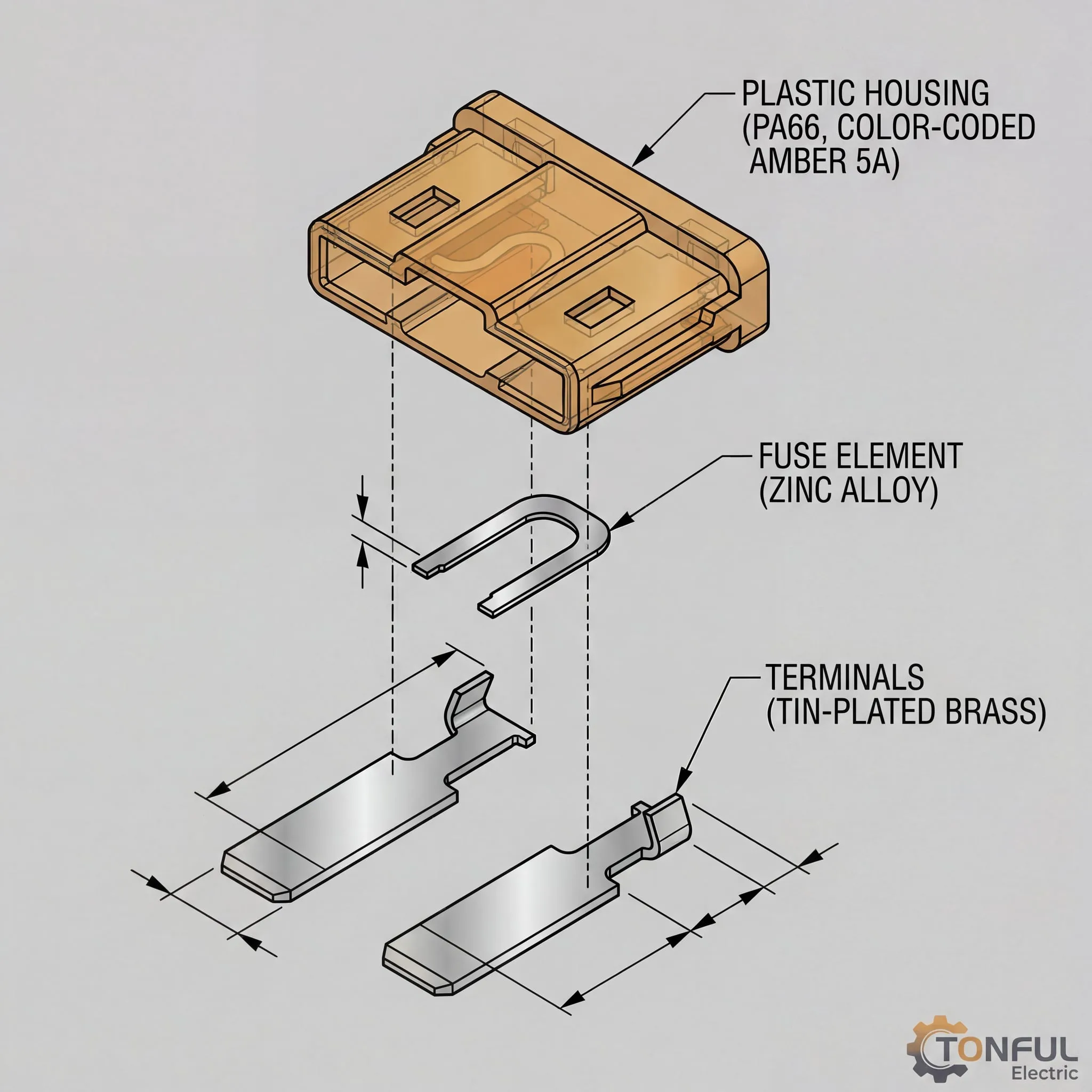
This table breaks down the essential specifications for the most common blade fuse families:
| Fuse Type | Common Names | Dimensions (L × W × H) | Typical Amperage Ratings | Key Applications |
|---|---|---|---|---|
| Maxi | APX, Heavy-Duty | 29.2 × 8.5 × 34.3 mm | 20A – 120A | High-current circuits: alternators, starter solenoids, EV power distribution. |
| Standard | ATO, ATC, Regular | 19.1 × 5.1 × 18.5 mm | 1A – 40A | General-purpose circuits: lighting, HVAC motors, power windows, audio systems. |
| Mini | APM, ATM | 10.9 × 3.6 × 16.3 mm | 2A – 30A | Space-constrained circuits: infotainment, instrument clusters, various ECUs. |
| LP-Mini | Low-Profile Mini | 10.9 × 3.8 × 8.73 mm | 2A – 30A | Height-restricted applications: high-density body control modules (BCMs). |
| Micro2 | ATR | 9.1 × 3.8 × 15.3 mm | 5A – 30A | Ultra-compact applications: modern sensors, specific ECU power feeds. |
| Micro3 | ATL | 14.4 × 4.2 × 18.1 mm | 5A – 15A (per circuit) | Dual-circuit protection in a single fuse body: headlights, power seats. |
A competent supplier should not only be able to manufacture these different types but also provide clear technical documentation for each one.
The Core Framework: 7 Key Criteria for Evaluating Auto Fuse Suppliers
A truly reliable supplier distinguishes themselves through a holistic commitment to quality that is evident in every aspect of their operation. Use these seven criteria as your evaluation framework.
1. Technical Capability and Manufacturing Process
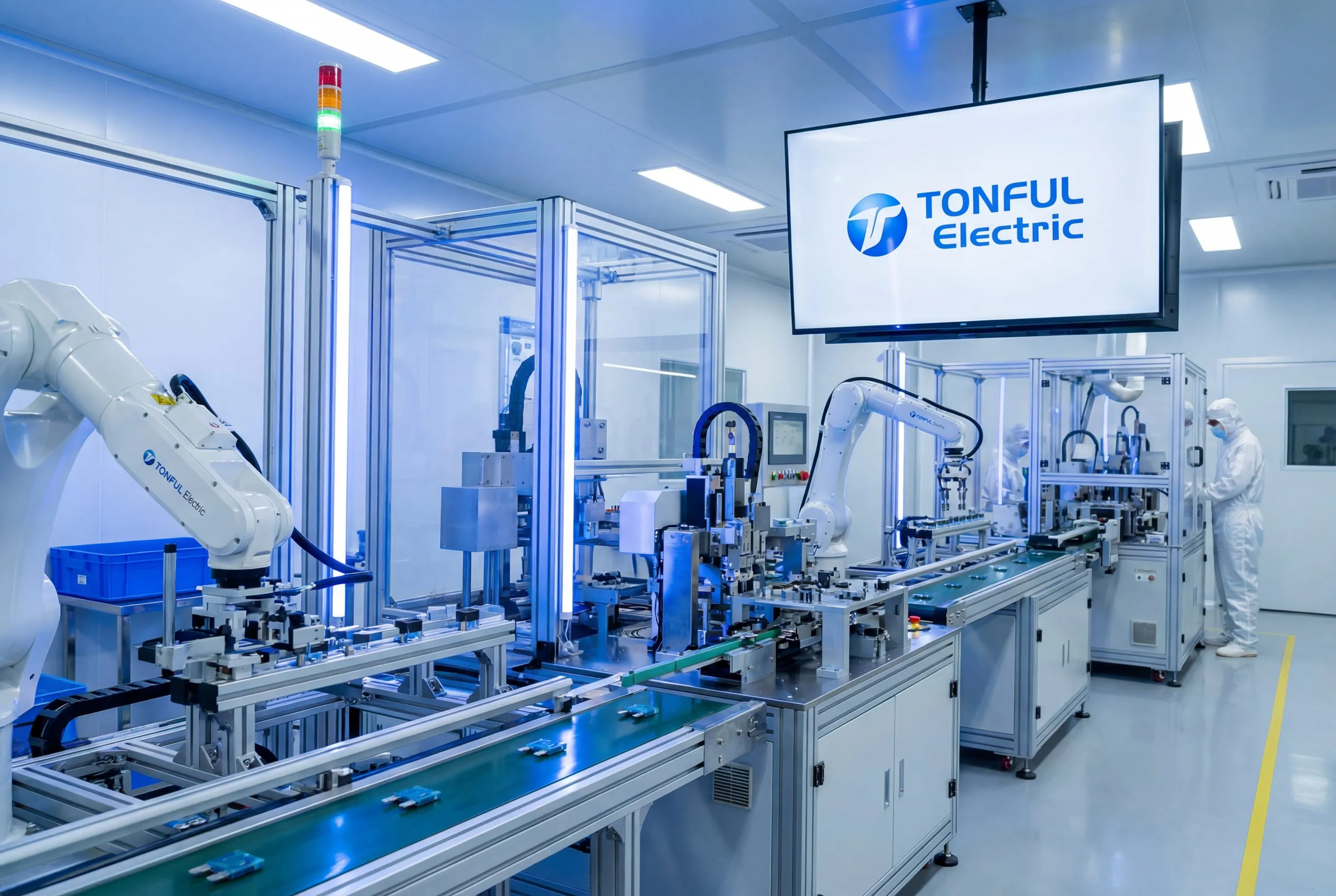
A supplier’s manufacturing process is the foundation of their quality. Look for evidence of a mature, controlled process that emphasizes precision and automation. This includes:
- Material Science: Deep knowledge of zinc alloys for fuse elements and heat-resistant, non-conductive plastics (like PBT or PES) for the housing.
- Element Precision: Use of high-precision stamping or forming processes for the fuse element. The geometry of this element dictates the fuse’s performance and must be controlled to microscopic tolerances.
- Automated Assembly: High-speed, automated assembly lines that ensure every fuse is built to the exact same specification, minimizing human error.
- In-line Vision Inspection: Automated Optical Inspection (AOI) systems that visually check each fuse for dimensional accuracy and proper assembly.

2. Quality Management Systems and Certifications
Certifications are non-negotiable proof of a supplier’s commitment to global automotive standards.
- ISO 9001: This is the absolute baseline for quality management. Any supplier without it should not be considered.
- IATF 16949: This is the gold standard for the automotive industry. It extends ISO 9001 with stringent requirements for process control, risk management, and continuous improvement. A supplier with IATF 16949 certification has proven their ability to meet the demanding quality levels of top automotive OEMs.
- ISO 8820: This is the critical, product-specific standard for automotive fuses. It defines the dimensions, performance requirements, and testing procedures for blade-type fuses. A supplier claiming compliance must be able to provide test reports proving they meet the requirements of ISO 8820-3 for blade fuses.

3. Rigorous Testing and Verification
Top-tier suppliers don’t just build products; they try to break them. A dedicated in-house testing lab is a sign of a mature quality organization. The supplier should be able to provide data from a battery of tests, including:
- Electrical Testing: Verifying the time-current characteristics (how fast the fuse blows at different overloads), voltage drop, and interrupting rating (the maximum current the fuse can safely interrupt).
- Environmental Testing: Subjecting fuses to thermal shock, humidity, and saltwater spray to ensure they perform reliably in the harsh automotive environment.
- Mechanical Testing: Vibration and terminal pull-force tests to ensure the fuse remains mechanically stable throughout its service life.
4. Supply Chain Reliability and Capacity
A great fuse is useless if it doesn’t arrive on time. Evaluate the supplier’s supply chain maturity.
- Production Capacity: Do they have the scale to meet your volume requirements without compromising quality?
- Lead Times: Are their stated lead times realistic and reliable?
- Logistics Experience: Do they have a proven track record of shipping globally and managing complex logistics?
5. R&D and Engineering Support
Your supplier should be a partner, not just a vendor. A strong engineering department indicates a forward-looking company. They should be able to provide detailed technical support, assist with fuse selection for new applications, and even discuss potential custom solutions.
6. Communication and Service
Professionalism in communication is a strong indicator of overall business quality. Look for responsive, clear communication from their sales and engineering teams. English proficiency is essential for smooth collaboration with international clients.
7. Ethical and Environmental Standards
Modern sourcing extends beyond just product quality. A responsible supplier should demonstrate commitment to ethical labor practices and environmental management. Look for compliance with standards like RoHS (Restriction of Hazardous Substances) and REACH, which are key indicators of a sustainable and responsible operation .
Your Action Plan: A 4-Step Process for Vetting Suppliers
Armed with the evaluation criteria, follow this structured process to move from a long list of potential suppliers to a trusted partner.
Step 1: Initial Research & Longlisting
Identify potential suppliers through online directories, trade shows, and industry referrals. Review their websites and product catalogs, shortlisting those who publicly claim IATF 16949 certification and showcase a professional manufacturing operation.
Step 2: The RFQ & Documentation Review
Issue a detailed Request for Quotation (RFQ) that asks for more than just price. Request copies of their IATF 16949 and ISO 9001 certificates. Ask for a product datasheet and test reports demonstrating compliance with ISO 8820. Their response quality and completeness will be your first major filter.
Step 3: The Factory Audit – Your Ultimate Verification
A factory audit is the single most important step in verifying a supplier’s true capabilities. It provides transparent, firsthand proof of their processes, quality systems, and ethical standards . While an in-person visit is ideal, a detailed virtual audit can also be highly effective.
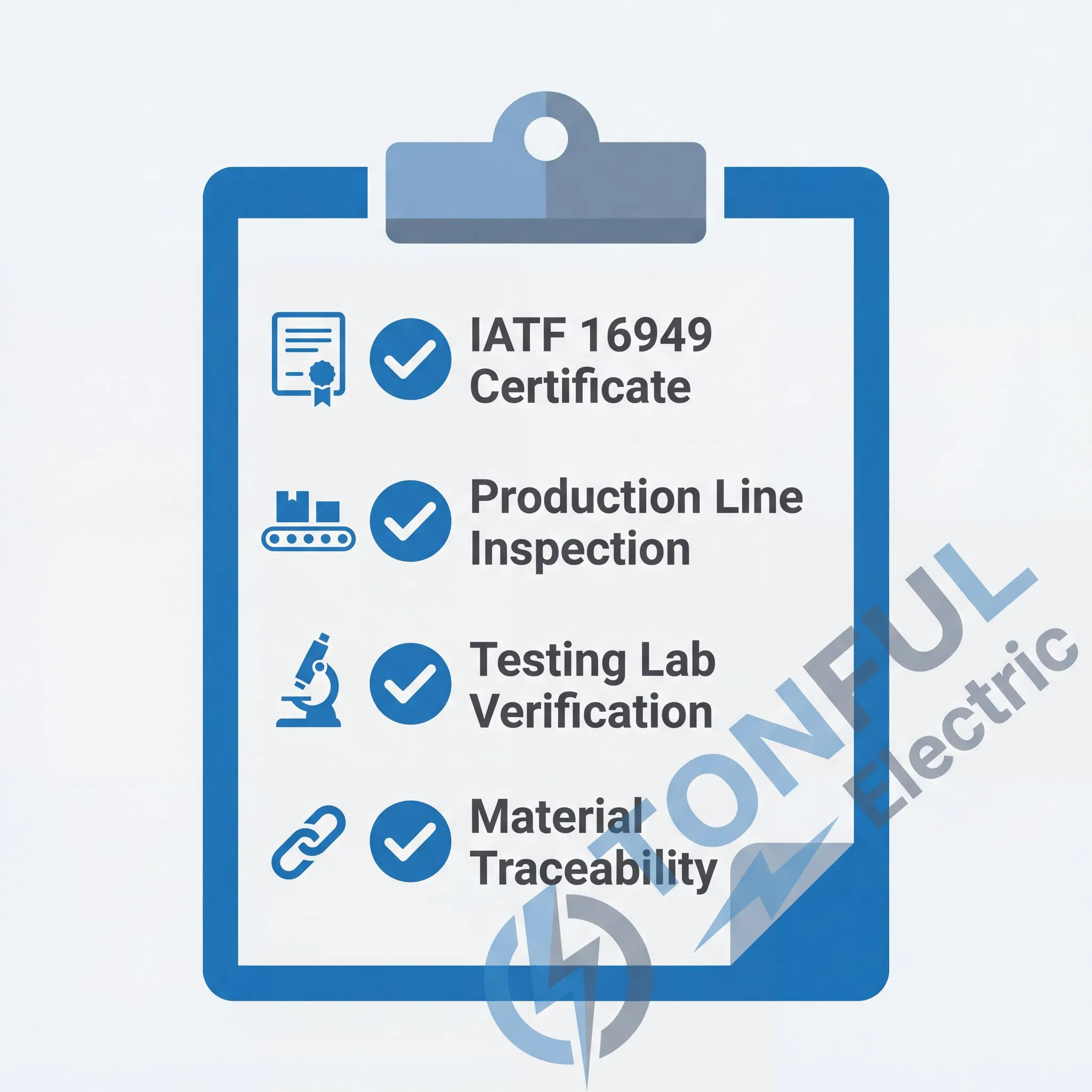
Use this checklist as a guide for your audit:
| Area | Key Checkpoint |
|---|---|
| Quality System | Verify IATF 16949 certificate is valid and applies to the correct facility. |
| Review quality manual, work instructions, and operator training records. | |
| Production Line | Observe the fuse element stamping and automated assembly process. |
| Check for in-line automated quality checks (e.g., vision systems). | |
| Testing Lab | Confirm the existence and capability of electrical and environmental test equipment. |
| Request to see test reports linked to a specific production batch. | |
| Warehouse | Check for raw material traceability records (e.g., zinc alloy batch numbers). |
| Evaluate inventory management and Finished Goods handling processes. | |
| Compliance | Review documentation related to RoHS and REACH compliance. |
Step 4: Sample Evaluation and Final Selection
Request samples from your top 2-3 audited suppliers. These should not be hand-picked “golden samples” but representative samples from a recent production run. Conduct your own testing if possible, or at a minimum, a detailed visual inspection. Based on the culmination of your audit and sample evaluation, you can make your final selection with confidence.
The TONFUL Electric Advantage: Where Quality Meets Reliability
The rigorous framework detailed in this guide is not just a theoretical model; it is the operating principle that defines a premier automotive component manufacturer. At TONFUL Electric, our entire manufacturing philosophy is built upon these pillars of quality, precision, and reliability.
We are an IATF 16949-certified manufacturer, and our state-of-the-art facility integrates automated assembly and 100% in-line quality verification. Every fuse we produce is designed and tested to meet the stringent requirements of ISO 8820, ensuring predictable, safe performance. Our dedicated engineering team provides expert support to help you select the perfect circuit protection solution for your application.
By partnering with TONFUL Electric, you are choosing a supplier that understands the critical nature of every component and is committed to delivering the quality and reliability the automotive industry demands.
Contact a TONFUL Electric specialist today to discuss your circuit protection needs or request a complimentary sample kit.
Frequently Asked Questions (FAQ)
Q1: What is the main difference between ATO and ATC fuses?
A1: The primary difference is their construction. ATO (Open) fuses have an opening at the bottom of the plastic housing, exposing the element. ATC (Closed) fuses have a fully sealed plastic body that protects the element from moisture and corrosion. For this reason, ATC fuses are the preferred standard in modern vehicles.
Q2: Why is IATF 16949 crucial for an auto fuse supplier?
A2: IATF 16949 is the global quality management standard for the automotive industry. It goes far beyond ISO 9001, requiring suppliers to demonstrate robust process controls, comprehensive risk management (like FMEA), and a culture of continuous improvement. A supplier with IATF 16949 certification has proven they can meet the stringent quality and traceability demands of top automotive OEMs.
Q3: What are common red flags when evaluating suppliers online?
A3: Be wary of suppliers who are not transparent about their certifications, have a non-professional website with little technical detail, are unwilling to provide detailed test data, or communicate unprofessionally. An immediate red flag is a price that seems too good to be true—it almost always indicates a compromise on material quality or process control.
Q4: Can I rely on a supplier’s ISO certificate alone?
A4: No. A certificate is a necessary starting point, but it must be verified. Always check the certificate’s validity and scope. More importantly, the certificate must be backed by the tangible evidence you gather during a factory audit. The audit confirms that the processes described in the quality manual are actually being followed on the factory floor.
Conclusion
Sourcing automotive fuses in China is a high-stakes task that demands a disciplined, quality-focused approach. Moving beyond a simple price comparison to a comprehensive evaluation of a supplier’s technical capability, quality systems, and manufacturing processes is essential for mitigating risk and ensuring long-term vehicle reliability. By using the framework of Manufacturing, Certification, and Verification, procurement professionals can confidently identify and partner with world-class suppliers. Choosing a partner who has already embedded this framework into their DNA is the most effective way to safeguard your product, your customers, and your brand.