
Introduction
In high-vibration environments—from automotive engine compartments to marine electrical systems—maintaining secure electrical connections is critical. While spade fork terminals have long been the industry standard for screw-type connections, hook blade terminals offer a superior alternative that addresses the primary weakness of fork designs: vibration-induced loosening.
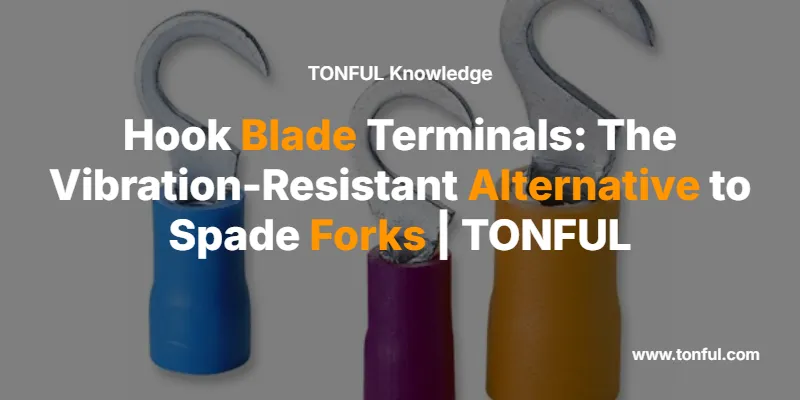
Hook blade terminals, also called hooked blade connectors or lipped blade terminals, feature a curved or hooked end that wraps partially around a screw or stud. This design creates a mechanical lock that resists rotation and displacement, making them ideal for applications where reliability cannot be compromised.
This comprehensive guide examines why hook blade terminals deliver more secure connections than traditional spade forks, their technical specifications, applications, and installation best practices.
What Are Hook Blade Terminals?
Hook blade terminals are crimp-type electrical connectors featuring a hooked or curved blade end that partially encircles a screw terminal or stud. Unlike the open U-shaped fork of spade terminals, the hook design creates a semi-closed connection that resists backing out under vibration.
Key Design Features
1. Hooked Blade Geometry
The defining characteristic is the curved hook that wraps 180-270 degrees around the connection point, creating a mechanical interlock that prevents the terminal from rotating off the screw.
2. Funnel Entry Barrel
The wire insertion end features a flared funnel design that guides wire strands into the crimp barrel, preventing strand hang-up and ensuring consistent crimps.
3. Serrated Crimp Barrel
Internal serrations create multiple contact points with the wire, maximizing tensile strength and electrical conductivity after crimping.
4. Color-Coded Insulation
Available in PVC vinyl or nylon insulation, color-coded by wire gauge:
- Red: 22-18 AWG
- Blue: 16-14 AWG
- Yellow: 12-10 AWG
5. Tin-Plated Copper Construction
High-purity electrolytic copper (Alloy 110) with tin plating provides excellent conductivity and corrosion resistance.
Hook Blade Terminals vs. Spade Fork Terminals: Technical Comparison
| Feature | Hook Blade Terminals | Spade Fork Terminals |
|---|---|---|
| Geometry | Curved hook (180-270° wrap) | Open U-fork (90-120° opening) |
| Vibration Resistance | Excellent – Hook prevents rotation | Moderate – Can rotate off loosened screws |
| Installation | Requires full screw removal | Can slide on with partial screw loosening |
| Removal | Requires full screw removal | Can slide off with partial loosening |
| Mechanical Security | Superior – Mechanical interlock | Good – Friction-dependent |
| Best Applications | High-vibration environments, permanent installations | Frequent maintenance access, low-vibration areas |
| Stud Size Range | #4, #6, #8, #10, 1/4″, 5/16″ | #4, #6, #8, #10, 1/4″, 5/16″ |
| Wire Gauge Range | 22-10 AWG | 22-10 AWG |
| Voltage Rating | 600V | 600V |
| Temperature Range | -40°C to 105°C | -40°C to 105°C |
| Cost | Slightly higher | Standard pricing |
Why Hook Blade Terminals Are More Secure
1. Superior Vibration Resistance
The primary advantage of hook blade terminals is their resistance to vibration-induced failure. In automotive, marine, and industrial applications, constant vibration can gradually loosen screw terminals. With spade forks, this loosening allows the terminal to rotate and eventually slide off the screw.
Hook blade terminals prevent this failure mode through their curved geometry. Even if the screw loosens slightly, the hook remains engaged around the screw shaft, maintaining electrical contact.
Real-World Impact:
- Automotive: Engine vibrations (20-200 Hz) can loosen connections over time
- Marine: Hull vibrations from engines and wave action create constant stress
- Industrial: Machinery vibrations in manufacturing environments
- Off-Road Vehicles: Extreme shock and vibration conditions
2. Mechanical Interlock Prevents Rotation
The hook creates a positive mechanical lock that prevents the terminal from rotating around the screw axis. Spade forks rely primarily on friction and clamping force, which diminishes as screws loosen.
3. Maintains Contact Under Thermal Cycling
Temperature fluctuations cause metal expansion and contraction, which can loosen screw connections over time. The hook design maintains contact even when thermal cycling reduces clamping pressure.
4. Reduced Installation Errors
The hook guides proper alignment during installation, reducing the risk of partial engagement that can occur with spade forks when installers rush or work in confined spaces.

Technical Specifications and Standards
Material Specifications
Conductor Material:
- High-purity electrolytic copper (Alloy 110)
- Minimum 99.9% copper content
- Annealed for optimal crimping
- Tin-plated finish (3-5 microns thickness)
Insulation Materials:
| Material | Temperature Range | Advantages | Applications |
|---|---|---|---|
| PVC Vinyl | -40°C to 85°C | Cost-effective, flexible | General automotive, marine |
| Nylon (PA) | -40°C to 105°C | Heat resistant, rigid | Engine compartments, high-temp |
| Heat Shrink | -55°C to 125°C | Waterproof seal, strain relief | Marine, outdoor, harsh environments |
Electrical Ratings
- Voltage Rating: 600V AC/DC
- Current Capacity: Varies by wire gauge (see table below)
- Contact Resistance: < 0.5 milliohms
- Insulation Resistance: > 1000 MΩ
Wire Gauge and Current Capacity
| Wire Gauge | Color Code | Max Current | Stud Sizes |
|---|---|---|---|
| 22-18 AWG | Red | 16A | #4, #6, #8, #10 |
| 16-14 AWG | Blue | 25A | #6, #8, #10, 1/4″ |
| 12-10 AWG | Yellow | 40A | #8, #10, 1/4″, 5/16″ |

Applications: Where Hook Blade Terminals Excel
1. Automotive Applications
Hook blade terminals are ideal for automotive electrical systems exposed to constant engine vibration:
- Engine compartment wiring: Alternators, starters, ignition systems
- Underbody connections: Chassis grounds, lighting circuits
- Audio systems: Amplifier connections, speaker terminals
- Battery management: Auxiliary battery connections, charging systems
Why They’re Better: Automotive environments combine vibration, temperature extremes (-40°C to 125°C), and exposure to chemicals. Hook terminals maintain reliable connections where spade forks would loosen. [citation]
Learn more about automotive electrical connectors and how to crimp automotive electrical connectors.
2. Marine Electrical Systems
Marine environments demand terminals that resist both vibration and corrosion:
- Navigation lighting: Running lights, anchor lights
- Bilge pump circuits: Critical safety systems
- Instrument panels: Gauges and monitoring systems
- Deck equipment: Windlasses, davits, thrusters
Why They’re Better: Hull vibrations from engines and wave action, combined with corrosive saltwater exposure, make hook terminals essential for reliability. Use tin-plated copper with heat shrink insulation for maximum corrosion protection.
For comprehensive guidance, see our complete guide to marine electrical wiring and marine wiring corrosion prevention.

3. Industrial Control Panels
Manufacturing and process control environments require vibration-resistant connections:
- Motor control circuits: Contactors, overload relays
- PLC I/O connections: Input/output terminal blocks
- Safety circuits: Emergency stops, interlocks
- Power distribution: Circuit breaker connections
Why They’re Better: Industrial machinery generates continuous vibration. Hook terminals prevent the connection failures that cause costly downtime.
4. Off-Road and Heavy Equipment
Construction, agriculture, and mining equipment face extreme vibration:
- Construction equipment: Excavators, bulldozers, loaders
- Agricultural machinery: Tractors, combines, harvesters
- Mining vehicles: Haul trucks, drilling equipment
- Recreational vehicles: ATVs, UTVs, off-road trucks
Why They’re Better: Shock loads and continuous vibration in off-road conditions would quickly loosen spade fork connections.
5. Renewable Energy Systems
Solar and wind installations require long-term reliability:
- Solar combiner boxes: String connections
- Inverter terminals: DC and AC connections
- Battery storage systems: BMS connections
- Wind turbine nacelles: High-vibration environment
Why They’re Better: These systems must operate reliably for 20-25 years with minimal maintenance. Hook terminals reduce failure rates in vibrating wind turbines and outdoor solar installations.
For solar applications, see our guide on UV-resistant solar wire connectors.
Installation Best Practices
Tools Required
- Crimping tool – Ratcheting crimper designed for insulated terminals
- Wire strippers – Adjustable or automatic strippers
- Screwdriver or nut driver – Appropriate size for terminal screw
- Multimeter – For connection verification
- Heat gun (for heat shrink terminals) – Adjustable temperature
For tool selection guidance, see how to choose the correct tool.
Step-by-Step Installation
Step 1: Select Proper Terminal Size
Match terminal to wire gauge and stud size. Using incorrect sizes compromises both electrical and mechanical performance.
Step 2: Strip Wire to Correct Length
Strip insulation to match the terminal barrel depth (typically 5-7mm). Too little creates weak crimps; too much exposes bare wire.
Step 3: Insert Wire Fully
Push wire completely into the terminal barrel until insulation reaches the barrel entrance. The funnel entry should guide wire strands smoothly.
Step 4: Crimp Properly
Position crimper perpendicular to terminal and compress fully until ratchet releases. A proper crimp creates a gas-tight connection that’s stronger than the wire itself.
Step 5: Inspect Crimp Quality
- Wire should not pull out with moderate force
- No wire strands should be visible outside barrel
- Insulation should be captured but not damaged
- Barrel should show clear crimp indentation
Step 6: Mount to Screw Terminal
Remove screw completely, position hook around screw shaft, and tighten to manufacturer’s torque specification (typically 7-12 in-lbs for small terminals).
Step 7: Apply Strain Relief
Secure wire within 2-3 inches of terminal using cable ties or clamps to prevent flexing at the crimp point.
Step 8: Verify Connection
Use multimeter to confirm continuity and measure voltage drop under load (should be < 0.1V for most applications).
For detailed crimping guidance, see our articles on how to crimp a terminal and common crimping mistakes.

Common Mistakes to Avoid
1. Using Spade Forks Where Hooks Are Needed
Problem: Specifying spade forks for high-vibration applications because they’re more familiar or slightly cheaper.
Solution: Evaluate the application environment. If vibration is present, choose hook terminals for long-term reliability.
2. Incomplete Hook Engagement
Problem: Partially threading the hook onto the screw instead of removing the screw completely.
Solution: Always remove the screw fully, position the hook completely around the screw shaft, then reinstall and tighten.
3. Over-Crimping or Under-Crimping
Problem: Improper crimping damages wire strands or creates weak connections.
Solution: Use a quality ratcheting crimper that prevents release until proper compression is achieved. See our guide on what should be done to ensure a good crimp connection.
4. Mixing Wire Gauges and Terminal Sizes
Problem: Using undersized terminals on heavy-gauge wire or oversized terminals on light-gauge wire.
Solution: Always match terminal color code to wire gauge. Refer to the wire gauge capacity table above.
5. Ignoring Insulation Material Requirements
Problem: Using standard PVC terminals in high-temperature engine compartments.
Solution: Select nylon insulation for temperatures above 85°C, or heat shrink terminals for maximum environmental protection.
6. Inadequate Strain Relief
Problem: Allowing wire movement to stress the crimp point, causing fatigue failures.
Solution: Secure wires within 2-3 inches of terminals using appropriate cable management.
7. Overtightening Screws
Problem: Excessive torque deforms the terminal hook and can crack insulation.
Solution: Use a torque screwdriver set to manufacturer specifications (typically 7-12 in-lbs for small terminals, 20-35 in-lbs for larger terminals).

Quality Standards and Certifications
Industry Standards
UL 486E – Standard for Equipment Wiring Terminals
Covers mechanical strength, current-carrying capacity, and temperature rise requirements.
IEC 60947-7-1 – Low-voltage switchgear and controlgear – Part 7-1: Ancillary equipment – Terminal blocks for copper conductors
International standard for terminal block connections.
SAE J1128 – Low Voltage Primary Cable (automotive)
Specifies requirements for automotive wire and terminal combinations.
ABYC E-11 – AC and DC Electrical Systems on Boats (marine)
American Boat and Yacht Council standards for marine electrical connections.
TONFUL Quality Assurance
At TONFUL Electric, our hook blade terminals undergo rigorous testing:
- Pull-off testing: Minimum 15 lbs tensile strength for 22-18 AWG
- Vibration testing: 10-55 Hz sweep, 10G acceleration, 8 hours
- Salt spray testing: 96-hour exposure per ASTM B117
- Temperature cycling: -40°C to 125°C, 100 cycles
- Voltage drop testing: < 0.5 milliohms contact resistance
All terminals are manufactured from 99.9% pure electrolytic copper and meet or exceed UL, CSA, and CE requirements.
Choosing Between Hook and Spade Fork Terminals
Choose Hook Blade Terminals When:
- ✅ Application involves continuous vibration (automotive, marine, industrial machinery)
- ✅ Connection must remain secure for extended periods without maintenance
- ✅ Failure consequences are severe (safety systems, critical equipment)
- ✅ Installation is in difficult-to-access locations
- ✅ Temperature cycling is present
- ✅ Maximum reliability is required
Choose Spade Fork Terminals When:
- ✅ Application is in a low-vibration environment (stationary equipment, control panels)
- ✅ Frequent connection/disconnection is required for maintenance
- ✅ Installation space is limited and full screw removal is difficult
- ✅ Cost optimization is critical and vibration is minimal
- ✅ Temporary or prototype wiring is needed
For more information on terminal selection, see our guides on ring vs spade terminals and quick disconnect terminals types.
Frequently Asked Questions (FAQ)
Q1: Can hook blade terminals be reused after removal?
A: No, crimp terminals should never be reused. The crimping process creates a permanent gas-tight connection that is compromised when removed. Reusing terminals can result in high resistance connections, overheating, and failure. Always use new terminals for each connection.
Q2: What’s the difference between hook terminals and ring terminals?
A: Ring terminals have a completely closed circular eye that requires full screw removal for installation, providing maximum security. Hook terminals have a partial hook (180-270° wrap) that also requires screw removal but is easier to install than rings. Both are more secure than spade forks in vibration environments.
Q3: Can I use hook blade terminals on terminal blocks?
A: Yes, hook blade terminals work excellently on screw-type terminal blocks in industrial control panels. They’re particularly valuable in applications where the terminal block is mounted on vibrating equipment or in mobile installations.
Q4: How do I know if I’ve crimped a hook terminal correctly?
A: A proper crimp should:
- Capture wire strands completely with no stragglers visible
- Not allow wire to pull out with 15+ lbs of force
- Show clear barrel deformation from the crimper
- Capture wire insulation at the barrel entrance for strain relief
- Not damage the terminal insulation
Perform a pull test on the first few crimps to verify your technique. See how to identify the quality of a crimp terminal.
Q5: Are hook blade terminals better than soldered connections?
A: For most applications, properly crimped hook terminals are superior to soldered connections. Crimping creates a gas-tight connection with better vibration resistance and no risk of cold solder joints. Soldering can also wick up wire strands, creating a rigid point that’s prone to fatigue failure. See our comparison of solder vs crimp connections.
Q6: What size hook terminal do I need for my wire gauge?
A: Match the terminal color code to your wire gauge:
- Red terminals: 22-18 AWG wire
- Blue terminals: 16-14 AWG wire
- Yellow terminals: 12-10 AWG wire
Using the wrong size creates weak crimps and potential failures. When in doubt, consult our wire terminal selection guide.
Q7: Can hook terminals be used in outdoor applications?
A: Yes, but choose terminals with appropriate insulation and corrosion protection:
- Marine/outdoor: Use tin-plated copper with heat shrink insulation
- Direct burial: Use heat shrink terminals with adhesive lining
- UV exposure: Select UV-resistant nylon insulation
For outdoor lighting, see our guide on waterproof wire nuts installation for outdoor lighting.
Q8: What torque should I use when tightening hook terminals?
A: Recommended torque values:
- #4-#6 screws: 5-7 in-lbs (0.6-0.8 Nm)
- #8-#10 screws: 7-12 in-lbs (0.8-1.4 Nm)
- 1/4″ screws: 20-25 in-lbs (2.3-2.8 Nm)
- 5/16″ screws: 30-35 in-lbs (3.4-4.0 Nm)
Use a torque screwdriver to avoid overtightening, which can damage terminals.
Conclusion: The Superior Choice for Reliable Connections
Hook blade terminals represent a significant advancement over traditional spade fork terminals for applications where vibration, reliability, and long-term performance are critical. While spade forks remain useful for low-vibration environments requiring frequent access, the mechanical interlock provided by hook terminals makes them the superior choice for:
- Automotive electrical systems exposed to engine vibration
- Marine applications with hull vibrations and corrosive environments
- Industrial machinery with continuous vibration
- Off-road equipment facing extreme shock and vibration
- Renewable energy systems requiring 20+ year reliability
The modest additional cost of hook terminals is insignificant compared to the cost of connection failures, equipment downtime, and safety risks associated with loosened connections.
At TONFUL Electric, we manufacture premium hook blade terminals using 99.9% pure electrolytic copper, precision tin plating, and high-quality PVC, nylon, or heat shrink insulation. Our terminals meet or exceed UL, CSA, and CE standards, and undergo rigorous quality testing to ensure reliable performance in the most demanding applications.
For technical specifications, bulk pricing, or custom terminal solutions, contact our engineering team. We provide comprehensive support for OEM manufacturers, electrical contractors, and industrial maintenance operations worldwide.
Related Resources
Terminal Selection Guides:
- What is a Crimp Terminal?
- Complete Guide to Types of Wire Connectors
- Wire Terminal Applications in Electrical Connections
Installation Guides:
- How to Crimp Automotive Electrical Connectors
- Are Crimped Electrical Connections as Good as Soldered?
Application-Specific Guides:
Product Information:
About TONFUL Electric
TONFUL Electric is a leading B2B manufacturer of professional-grade electrical components, specializing in terminals, connectors, fuses, and wiring accessories for automotive, marine, industrial, and renewable energy applications. With over 20 years of manufacturing experience, TONFUL delivers high-quality products that meet international standards and exceed customer expectations.
Contact Us:
- Website: https://tonful.com
- Email: info@tonful.com
- Phone: +86-xxx-xxxx-xxxx