
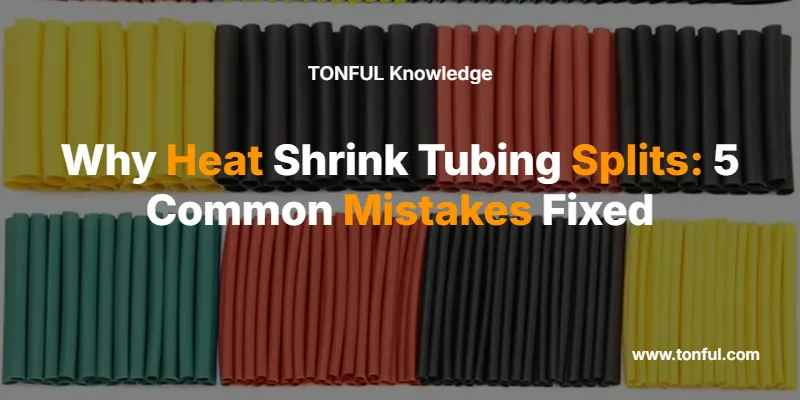
Heat shrink tubing is an essential component in electrical installations, providing insulation, protection, and organization for wires and cables. However, even experienced technicians sometimes encounter a frustrating problem: the tubing splits during or after installation. Understanding why heat shrink tubing splits and how to prevent it can save time, money, and ensure reliable electrical connections.
In this comprehensive guide, we’ll explore the five most common installation mistakes that cause heat shrink tubing to split, along with practical solutions to achieve professional results every time.
Understanding Heat Shrink Tubing Basics
Before diving into common mistakes, it’s important to understand how heat shrink tubing works. Heat shrink tubing is a thermoplastic tube that contracts when exposed to heat, typically between 90°C to 120°C (194°F to 248°F) for standard polyolefin materials. The tubing is manufactured in an expanded state and “remembers” its original smaller diameter through a process called cross-linking.
When properly installed, heat shrink tubing creates a tight, protective seal around wires, terminals, and connectors. However, improper installation techniques can compromise the tubing’s integrity, leading to splits, cracks, or premature failure.

Mistake #1: Using Excessive Heat Temperature
One of the most common causes of split heat shrink tubing is applying too much heat. Many installers mistakenly believe that higher temperatures will speed up the shrinking process, but this approach often backfires.
Why Excessive Heat Causes Splitting
When heat shrink tubing is exposed to temperatures significantly above its recommended shrink temperature, several problems occur:
- Material degradation: The polymer structure breaks down, making the tubing brittle
- Uneven shrinkage: Hot spots cause localized over-shrinking while other areas remain under-shrunk
- Burn marks and charring: Visible damage that weakens the material
- Loss of mechanical strength: The tubing becomes prone to cracking under stress
Different materials have specific temperature requirements. Standard polyolefin tubing typically shrinks at 90-120°C (194-248°F), while specialized materials like PVDF require 175°C (347°F). Using a temperature that’s too high for your specific tubing material will inevitably cause problems.
The Solution
Always verify the manufacturer’s temperature specifications before heating. Use a heat gun with adjustable temperature settings and maintain the recommended distance from the tubing—typically 6-8 inches. Apply heat gradually and evenly, moving the heat source in a circular motion around the tubing rather than focusing on one spot.
For professional applications, consider investing in quality electrical tools with precise temperature control to ensure consistent results.

Mistake #2: Selecting the Wrong Tubing Size
Choosing the incorrect size of heat shrink tubing is another leading cause of splitting. The relationship between the tubing’s expanded diameter, the component diameter, and the shrink ratio must be carefully calculated.
Understanding Shrink Ratios
Heat shrink tubing is rated by its shrink ratio, which indicates how much the tubing can contract:
| Shrink Ratio | Expanded Diameter | Recovered Diameter | Best Applications |
|---|---|---|---|
| 2:1 | 2x final size | 1x final size | Standard wire insulation, simple connections |
| 3:1 | 3x final size | 1x final size | Irregular shapes, moderate size variations |
| 4:1 | 4x final size | 1x final size | Complex geometries, large diameter transitions |
| 6:1 | 6x final size | 1x final size | Extreme size variations, specialized applications |
Why Wrong Sizing Causes Splits
If the tubing is too small for the application, it will be stretched beyond its design limits when slipped over the component. During heating, this pre-stressed material attempts to shrink further, creating excessive tension that results in longitudinal splitting.
Conversely, tubing that’s too large may not shrink tightly enough, leaving gaps or requiring excessive heat to achieve proper fit—which circles back to Mistake #1.
The Solution
Always measure the largest diameter of your component before selecting tubing. Choose a tubing size where:
- The expanded diameter is at least 20-30% larger than your component
- The recovered diameter will be 10-20% smaller than the smallest section you’re covering
For complex applications involving automotive connectors or terminals, consider using 3:1 or 4:1 shrink ratio tubing to accommodate irregular shapes.

Mistake #3: Ignoring Sharp Edges and Burrs
Sharp edges, burrs, and jagged surfaces on the underlying component are silent killers of heat shrink tubing. These physical hazards can puncture or cut the tubing during installation or create stress concentration points that lead to splitting during the shrinking process.
Common Sharp Edge Scenarios
- Cut wire ends: Improperly trimmed stranded wires with sharp individual strands
- Terminal edges: Crimp terminals with rough edges or burrs from manufacturing
- Connector housings: Molded plastic connectors with flash or sharp parting lines
- Solder joints: Pointed solder peaks on wire splices
- Cable armor: Exposed metal braiding or armor with sharp cut ends
When heat shrink tubing is applied over these hazards, the material may appear intact initially. However, during the heating process, the tubing softens and conforms tightly to the underlying surface. Sharp points that were merely touching the tubing now press into it, creating weak points or immediate punctures. As the tubing cools and regains rigidity, these stressed areas often split.
The Solution
Always inspect and prepare the surface before applying heat shrink tubing:
- Deburr all edges: Use a file, sandpaper, or deburring tool to smooth sharp edges on terminals and connectors
- Trim wires cleanly: Use quality wire strippers to ensure clean cuts without frayed ends
- Smooth solder joints: File or sand solder joints to create rounded profiles
- Add protective layers: For unavoidable sharp edges, consider using electrical tape as a buffer layer before applying heat shrink
For applications with inherently sharp components, consider using heavy-wall heat shrink tubing, which offers greater puncture resistance than standard thin-wall varieties.

Mistake #4: Uneven or Rushed Heat Application
The heating technique used during installation significantly impacts the final result. Rushing the process or applying heat unevenly is a common mistake that leads to splits, wrinkles, and incomplete shrinkage.
Problems with Uneven Heating
When heat is applied inconsistently:
- Localized over-shrinking: Areas receiving too much heat shrink excessively and become brittle
- Trapped air bubbles: Unheated sections don’t shrink, creating voids that weaken the installation
- Longitudinal stress: One side shrinks before the other, creating tension that can cause splitting
- Chill marks: Wrinkles and folds that indicate incomplete or uneven shrinkage
Proper Heating Technique
The correct method for heating heat shrink tubing involves:
- Start in the center: Begin heating at the middle of the tubing, not the ends
- Use circular motion: Rotate the heat gun around the tubing circumference
- Work outward: After the center is shrunk, move toward one end, then return to center and work toward the other end
- Maintain consistent distance: Keep the heat gun 6-8 inches from the tubing
- Watch for visual cues: The tubing should shrink smoothly without bubbles or wrinkles
This technique forces air out of the ends of the tubing and prevents air pockets that can cause uneven shrinkage and splitting.
The Solution
Never rush the heating process. For critical applications, use a heat gun with temperature control rather than an open flame or unregulated heat source. Professional electrical tool kits often include heat guns specifically designed for heat shrink applications with optimal temperature ranges.
For production environments, consider using heat shrink ovens or tunnels that provide uniform, controlled heating for consistent results across multiple installations.

Mistake #5: Neglecting Longitudinal Shrinkage
Many installers focus solely on the radial shrinkage (diameter reduction) of heat shrink tubing and forget about longitudinal shrinkage—the fact that the tubing also gets shorter when heated. This oversight can create tension that leads to splitting, especially in constrained installations.
Understanding Longitudinal Shrinkage
Most heat shrink tubing experiences 5-15% longitudinal shrinkage during the heating process. This means a 100mm piece of tubing may shrink to 85-95mm in length. While this seems minor, it can create significant problems:
- Tension on connections: If the tubing is cut to exact length, shrinkage pulls on the connection points
- Exposed areas: The tubing may retract, leaving portions of the wire or terminal exposed
- Stress concentration: Pulling forces concentrate at the tubing ends, creating weak points prone to splitting
- Connector damage: In extreme cases, the pulling force can damage the underlying connection
The Solution
Always account for longitudinal shrinkage when cutting heat shrink tubing:
- Add 10-15% extra length: If you need to cover 50mm, cut the tubing to 55-57mm
- Center the tubing: Position the tubing so it extends equally beyond both ends of the area to be covered
- Secure the ends first: For long pieces, lightly heat the ends first to anchor them before shrinking the middle section
- Use adhesive-lined tubing: For critical applications, heat shrink terminals with adhesive lining provide better grip and reduce movement during shrinkage
This is particularly important when working with waterproof wire connectors or sealed connections where maintaining coverage is critical for environmental protection.
Comparison: Common Heat Shrink Tubing Materials
Understanding the properties of different heat shrink materials can help you select the right tubing for your application and avoid splitting issues:
| Material | Shrink Temperature | Operating Temperature | Shrink Ratio | Key Advantages | Common Applications |
|---|---|---|---|---|---|
| Polyolefin | 90-120°C (194-248°F) | -55°C to +125°C | 2:1, 3:1 | Cost-effective, flexible, flame-resistant | General wire insulation, automotive |
| PVC | 70-90°C (158-194°F) | -10°C to +105°C | 2:1 | Low cost, low shrink temperature | Indoor applications, low-temp environments |
| PVDF | 175°C (347°F) | -55°C to +175°C | 2:1, 4:1 | Chemical resistant, transparent | Chemical processing, high-temp applications |
| FEP | 190-230°C (374-446°F) | -200°C to +200°C | 1.3:1 | Extreme temperature, chemical inert | Aerospace, medical, extreme environments |
| Elastomer | 120-150°C (248-302°F) | -75°C to +175°C | 2:1, 3:1 | Highly flexible, excellent sealing | Harsh environments, vibration resistance |
Selecting the appropriate material for your operating environment reduces the risk of premature failure and splitting due to environmental stress.
Prevention Checklist: Avoiding Heat Shrink Tubing Splits
To ensure successful installations every time, follow this comprehensive checklist:
Before Installation:
- Verify the correct tubing size and shrink ratio for your application
- Inspect the manufacturer’s specifications for temperature requirements
- Check all components for sharp edges, burrs, or rough surfaces
- Deburr and smooth all contact surfaces
- Cut tubing 10-15% longer than the coverage area needed
- Ensure you have the proper heating tool with temperature control
During Installation:
- Slide tubing over the component before making final connections
- Center the tubing with equal overhang on both ends
- Use the correct temperature setting for your tubing material
- Maintain 6-8 inches distance between heat source and tubing
- Start heating at the center of the tubing
- Apply heat in a circular motion around the circumference
- Work gradually toward the ends, ensuring even shrinkage
- Watch for smooth, wrinkle-free shrinkage without bubbles
After Installation:
- Allow tubing to cool completely before handling
- Inspect for complete shrinkage with no gaps or loose areas
- Check for any signs of splitting, cracking, or damage
- Verify that all intended areas are covered
- Test the connection if applicable
For professional installations requiring multiple connections, consider using assorted boxes of heat shrink tubing in various sizes to ensure you always have the right size on hand.
When to Replace Split Heat Shrink Tubing
Even with proper installation techniques, heat shrink tubing can deteriorate over time due to environmental factors, mechanical stress, or aging. Knowing when to replace compromised tubing is essential for maintaining electrical safety and reliability.
Signs That Replacement Is Needed
- Visible splits or cracks: Any breach in the tubing compromises its protective function
- Discoloration or brittleness: UV damage or heat aging makes tubing prone to failure
- Loose fit: Tubing that has relaxed and no longer grips tightly
- Exposed conductors: Any visible wire or terminal indicates inadequate coverage
- Chemical damage: Swelling, softening, or surface degradation from chemical exposure
For critical applications such as automotive combination switches or auto fuse connections, regular inspection and preventive replacement are recommended.
FAQ: Heat Shrink Tubing Installation
Q: Can I use a lighter or torch instead of a heat gun for heat shrink tubing?
A: While possible, it’s not recommended. Open flames provide uneven, excessive heat that easily causes splitting, burning, and damage. A heat gun with temperature control provides consistent, appropriate heat for professional results. For occasional use, a hair dryer can work for thin-wall tubing, though it may take longer.
Q: How do I know if my heat shrink tubing is fully shrunk?
A: Properly shrunk tubing will fit tightly against the underlying component with no air gaps, wrinkles, or loose areas. The surface should appear smooth and uniform. You should not be able to easily rotate or slide the tubing along the wire or component.
Q: Can heat shrink tubing be reused if I need to access the connection?
A: No, heat shrink tubing cannot be effectively reused. Once shrunk, the material has undergone permanent molecular changes. Attempting to remove and reapply it will result in poor fit and compromised protection. Always use fresh tubing for repairs or modifications.
Q: What’s the difference between adhesive-lined and standard heat shrink tubing?
A: Adhesive-lined (dual-wall) heat shrink tubing contains an inner layer of hot-melt adhesive that melts during heating, creating a waterproof seal. This is ideal for waterproof wire nuts and outdoor applications. Standard tubing provides insulation and abrasion protection but isn’t inherently waterproof.
Q: Why does my heat shrink tubing have wrinkles after installation?
A: Wrinkles (chill marks) indicate uneven heating. The wrinkled areas didn’t receive enough heat to fully shrink. Apply additional heat to these areas using circular motions until the wrinkles disappear and the tubing fits smoothly.
Conclusion
Heat shrink tubing splitting is almost always preventable with proper technique and attention to detail. The five common mistakes—excessive heat, wrong sizing, ignoring sharp edges, uneven heating, and neglecting longitudinal shrinkage—account for the vast majority of installation failures.
By following the guidelines in this article, you can achieve professional, reliable heat shrink installations that provide lasting protection for your electrical connections. Remember to always use quality materials from reputable manufacturers, invest in proper tools, and never rush the installation process.
For industrial and commercial applications requiring consistent, high-quality results, TONFUL Electric offers a comprehensive range of electrical connectors, terminals, and electrical tools designed to meet the demanding requirements of modern electrical installations.
Whether you’re working on automotive wiring, industrial control panels, or marine electrical systems, proper heat shrink tubing installation is a fundamental skill that ensures safety, reliability, and longevity of your electrical connections.