
Understanding HVAC Wiring Safety Requirements
Safe and reliable electrical connections are the foundation of every air conditioning installation. For HVAC professionals and electrical contractors, selecting the appropriate wire nuts isn’t just about making connections—it’s about ensuring system longevity, preventing equipment failure, and protecting against fire hazards. With the introduction of UL 60335-2-40 standards in 2025 and the transition to A2L refrigerants, proper wire connection methods have never been more critical.
Wire nuts serve as the primary connection method for HVAC wiring, from low-voltage thermostat circuits to high-amperage condenser units. However, outdoor condenser installations face unique challenges: extreme temperature fluctuations, moisture exposure, UV degradation, and vibration. Standard wire nuts that work perfectly in controlled indoor environments can fail catastrophically when exposed to these harsh conditions.
This comprehensive guide examines wire nut selection criteria specifically for HVAC applications, covering everything from AWG sizing requirements to IP ratings for outdoor installations. Whether you’re installing residential split systems or commercial rooftop units, understanding these specifications will help you create connections that meet code requirements and stand the test of time.
HVAC Electrical Requirements and Wire Gauge Standards
Understanding Air Conditioner Power Demands
Modern air conditioning units operate at either 120V or 240V, with most residential central air systems requiring 240V dedicated circuits. The electrical requirements vary significantly based on unit capacity:
| AC Unit Capacity | Typical Voltage | Average Amperage | Minimum Wire Gauge | Maximum Breaker Size |
|---|---|---|---|---|
| 1.5-2 Ton (18,000-24,000 BTU) | 240V | 15-20A | 12 AWG | 25-30A |
| 2.5-3 Ton (30,000-36,000 BTU) | 240V | 20-28A | 10 AWG | 35-40A |
| 3.5-4 Ton (42,000-48,000 BTU) | 240V | 28-35A | 8 AWG | 45-50A |
| 5 Ton (60,000 BTU) | 240V | 35-45A | 8 AWG | 50-60A |
The National Electrical Code (NEC) requires wire sizing based on the Minimum Circuit Ampacity (MCA) listed on the equipment nameplate, not the breaker size. According to NEC Article 440, conductors must be sized at 125% of the largest motor plus 100% of additional motors. This calculation prevents conductor overheating during compressor startup when inrush current can reach 300-400% of running amperage.
For outdoor condenser wiring runs exceeding 50 feet, voltage drop becomes a critical consideration. Long wire runs require upsizing to maintain proper voltage at the equipment—typically one gauge size larger for every additional 50 feet beyond the initial run.
Low-Voltage Control Circuit Requirements
Thermostat wiring operates at 24V AC and typically uses 18 AWG multi-conductor cable for runs under 250 feet. While these circuits carry minimal current (typically under 2 amps), proper connections are essential for reliable system operation. The color-coded wires control specific functions:
- Red (R): 24V power from transformer
- White (W): Heat call
- Yellow (Y): Cooling call
- Green (G): Fan operation
- Blue/Black (C): Common return
Unlike high-voltage connections that must be housed in approved enclosures, NEC classifies thermostat wiring as Class 2 circuits, which don’t require conduit protection in many jurisdictions. However, outdoor sections should always be protected from physical damage and UV exposure.

Wire Nut Types and Specifications for HVAC Applications
Standard Twist-On Wire Connectors
Traditional twist-on wire nuts remain the most common connection method for HVAC installations. These connectors use an internal metal coil spring that grips wires when twisted clockwise. The color-coding system indicates capacity:
| Color | Wire Gauge Range | Number of Wires | Voltage Rating | Common HVAC Applications |
|---|---|---|---|---|
| Gray | 22-16 AWG | 2-3 | 300V | Thermostat connections, low-voltage control |
| Blue | 22-14 AWG | 3-4 | 300V | Control circuits, safety switches |
| Orange | 22-14 AWG | 2-4 | 600V | Light-duty connections, sensor wiring |
| Yellow | 18-12 AWG | 2-4 | 600V | Indoor air handler connections, 15A circuits |
| Red | 18-10 AWG | 3-4 | 600V | Condenser unit power, 20-30A circuits |
| Blue (Large) | 12-6 AWG | 2-3 | 600V | Large tonnage units, 40-60A circuits |
Standard wire nuts work reliably in climate-controlled environments but have significant limitations for outdoor HVAC applications. The plastic housing provides insulation but offers no moisture protection. When exposed to condensation, rain, or ground moisture, standard wire nuts can allow water infiltration that leads to corrosion and connection failure.
Waterproof Wire Nuts for Outdoor Applications
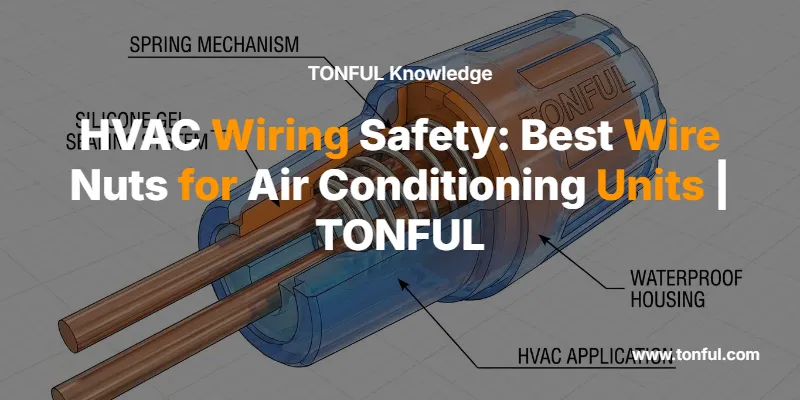
Waterproof wire nuts incorporate silicone gel or grease-filled chambers that seal out moisture while maintaining electrical continuity. These specialized connectors are essential for outdoor condenser installations where connections are exposed to weather.
TONFUL’s waterproof wire nut line features three key protective elements:
- Silicone Gel Sealant: Encapsulates wire ends completely, preventing moisture penetration
- Enhanced Spring Mechanism: Maintains constant pressure despite temperature cycling
- UV-Resistant Housing: Prevents degradation from prolonged sun exposure
The gel-filled design automatically seals around individual wire strands without requiring manual pre-twisting. This feature is particularly important for aluminum-to-copper connections common in older HVAC systems where dissimilar metals require extra corrosion protection.
Heat-Shrink Wire Connectors
Heat shrink terminals combine mechanical crimping with adhesive-lined tubing that creates a waterproof seal when heated. These connectors excel in high-vibration applications such as rooftop units where constant motor operation can loosen traditional wire nuts over time.
The installation process requires specialized tools: wire strippers, a crimping tool matched to the terminal size, and a heat gun capable of reaching 250-350°F. While more time-intensive than twist-on connectors, heat-shrink connectors provide superior long-term reliability in harsh environments.

Safety Standards and Certifications for HVAC Wire Connectors
UL Listing and Fire-Retardant Requirements
All wire nuts used in HVAC installations must carry UL (Underwriters Laboratories) listing to meet National Electrical Code requirements. UL 486C covers wire connectors and specifies testing protocols for temperature rise, pull-out strength, and flame resistance.
The 2025 transition to UL 60335-2-40 standards for HVAC equipment introduced more stringent safety requirements, particularly regarding flammable A2L refrigerants. While this standard primarily addresses equipment design, it emphasizes the importance of fail-safe electrical connections that won’t create ignition sources.
Fire-retardant wire nuts, such as Ideal’s Wire-Nut 73B series, have gained UL approval for limiting smoke and heat generation during fire exposure. These connectors use thermoplastic compounds that resist combustion and self-extinguish when the flame source is removed.
IP Ratings for Outdoor Installations
The Ingress Protection (IP) rating system classifies connector resistance to solid particles and liquids. For HVAC applications, understanding IP ratings is essential:
| IP Rating | Protection Level | HVAC Application Suitability |
|---|---|---|
| IP20 | Indoor, dry locations | Air handler connections, indoor controls |
| IP44 | Splash-resistant | Protected outdoor locations, covered disconnect boxes |
| IP65 | Dust-tight, low-pressure water jets | Exposed outdoor connections, condenser wiring |
| IP67 | Dust-tight, temporary water immersion | Ground-level installations, flood-prone areas |
| IP68 | Dust-tight, continuous submersion | Direct burial, underground conduit boxes |
IP67 vs IP68 waterproof wire nuts offer different protection levels for specific scenarios. IP67-rated connectors withstand temporary immersion up to 1 meter for 30 minutes—adequate for most outdoor condenser installations. IP68 connectors tolerate continuous submersion and are required for direct burial applications or installations in areas subject to flooding.
Temperature Rating Considerations
Wire connector temperature ratings must exceed the maximum ambient temperature plus heat generated by current flow. Standard wire nuts typically carry 105°C (221°F) ratings, suitable for most HVAC applications. However, connections inside outdoor condensers can experience temperatures exceeding 150°F during summer operation.
High-temperature wire nuts rated for 150°C (302°F) or higher are recommended for:
- Connections near compressors or hot gas lines
- Rooftop installations in hot climates
- Commercial refrigeration applications
- Industrial process cooling systems
TONFUL’s high-temperature wire nut series maintains UL approval up to 221°F continuous operation, with short-term ratings to 302°F for startup surge conditions.

Selection Criteria for HVAC Wire Nuts
Matching Wire Gauge and Conductor Count
Proper wire nut sizing requires matching both wire gauge (AWG) and the number of conductors being joined. Overstuffing a connector with too many or too-thick wires prevents proper spring engagement, creating high-resistance connections that generate heat. Conversely, using oversized connectors on small-gauge wires allows conductors to pull loose.
The packaging for quality wire nuts displays a matrix showing acceptable wire combinations. For example, a red wire nut might list: “3 #12 AWG, 4 #14 AWG, or 2 #10 AWG.” These ratings assume copper conductors—aluminum wire requires specific connectors marked “AL/CU” to prevent galvanic corrosion.
When connecting dissimilar wire gauges (common when splicing thermostat wires to equipment leads), select the connector based on the largest wire in the group. Always verify the total number of conductors falls within the rating.
Material Compatibility and Corrosion Resistance
Most wire nuts use brass or copper alloy springs that provide excellent conductivity and corrosion resistance. However, the plastic housing material varies significantly:
- Polycarbonate: High impact resistance, UV stable, temperature range -40°F to 221°F
- Nylon: Superior chemical resistance, less brittle in cold, temperature range -40°F to 194°F
- PVC: Economical, adequate for indoor use, degrades with UV exposure
- Thermoplastic Elastomer: Flexible in cold, excellent sealing properties for waterproof models
For outdoor HVAC installations, polycarbonate or nylon housings provide the best long-term durability. Cheap PVC wire nuts will become brittle and crack within 2-3 years of sun exposure, compromising both insulation and moisture protection.
Installation Environment Assessment
Before selecting wire nuts, evaluate the installation environment:
Indoor Air Handler Connections:
- Standard twist-on wire nuts (yellow or red)
- 600V minimum voltage rating
- UL listed for 105°C operation
- Fire-retardant housing preferred
Outdoor Condenser Units:
- Waterproof wire nuts with silicone gel seal
- IP65 minimum rating (IP67 for ground-level units)
- UV-resistant housing
- Temperature rated to 150°C
Underground or Direct Burial:
- IP68-rated waterproof connectors
- Housed in weatherproof junction boxes
- Listed for wet locations per NEC 300.5
- Corrosion-resistant materials throughout
Vibration-Prone Applications:
- Heat shrink terminals with adhesive lining
- Mechanical crimp plus thermal seal
- Cable tie strain relief required
- Lock washers on terminal screws
TONFUL offers application-specific wire nut kits for HVAC professionals that include appropriate connectors for each connection point in typical split-system installations, eliminating guesswork and reducing inventory complexity.

Installation Best Practices for HVAC Wire Connections
Proper Wire Preparation Techniques
The quality of wire preparation directly impacts connection reliability. Follow these steps for optimal results:
- Strip Length: Remove 5/8″ to 3/4″ of insulation—enough to engage the wire nut spring but not so much that bare conductor extends beyond the connector
- Clean Conductors: Use wire brush or sandpaper to remove oxidation from aluminum wires; copper typically requires no cleaning unless heavily tarnished
- Straight Cut: Ensure wire ends are cut squarely, not at an angle; diagonal cutters work better than side-cutters for clean cuts
- Strand Alignment: For stranded wire, twist strands clockwise before insertion to prevent individual strands from missing the spring
Pre-twisting wires together before installing standard wire nuts creates a stronger mechanical connection and improves conductivity. However, waterproof gel-filled connectors should NOT have pre-twisted wires—the individual strands must remain separated for proper gel encapsulation.
Correct Installation Methods
Standard twist-on wire nuts require specific installation technique:
- Hold wires firmly together with ends aligned
- Push wire nut onto wire bundle while twisting clockwise
- Continue twisting until resistance increases significantly (typically 3-5 full rotations)
- Tug each wire individually to verify mechanical connection
- No bare conductor should be visible below the wire nut skirt
A properly installed wire nut creates such a secure mechanical connection that the wires will break before pulling free. If any wire slides out with moderate pulling force, remove the connector and reinstall.
For outdoor installations, apply quality electrical tape over the wire nut, wrapping from the connector down onto the wire insulation. This prevents water wicking into the connection along wire strands. However, tape alone does NOT make a standard wire nut waterproof—only gel-filled connectors provide true moisture protection.
Junction Box Requirements
NEC Article 314.30 requires all wire splices to be housed in approved enclosures except for specific exemptions. For HVAC installations:
Indoor Connections: Standard metal or plastic junction boxes rated for the circuit voltage. Boxes must remain accessible (not concealed behind drywall) and provide at least 2 cubic inches of space per conductor entering the box.
Outdoor Connections: Weatherproof junction boxes with gasketed covers rated for outdoor use. NEMA 3R (rain-tight) minimum, NEMA 4X (corrosion-resistant) preferred for coastal or industrial environments. All conduit entries must use weatherproof fittings with sealing washers.
Disconnect Box Connections: The outdoor disconnect switch commonly serves as the junction point for condenser wiring. Verify adequate space exists for wire nuts plus required bending radius before making connections inside these boxes.
Low-voltage thermostat wiring (Class 2 circuits per NEC Article 725) does not require junction boxes in most jurisdictions, but outdoor sections benefit from weatherproof protection to extend wire life.
Common Mistakes to Avoid in HVAC Wire Connections
Undersizing Wire Nuts for Circuit Amperage
One of the most dangerous mistakes is using wire nuts sized for the wire gauge without considering the circuit amperage. A small red wire nut might technically fit two 10 AWG wires, but if those wires carry 30 amps, the connector’s internal spring may not provide adequate contact area. The resulting high-resistance connection generates heat that can melt the connector housing.
Always select wire nuts rated for the actual circuit current, not just the wire size. Quality manufacturers provide amperage ratings alongside wire gauge specifications. For motor circuits with high inrush current, use connectors rated 25-50% above the circuit breaker size.
Using Standard Wire Nuts in Outdoor Locations
Standard wire nuts fail rapidly when exposed to outdoor conditions. Moisture infiltration causes corrosion that increases connection resistance, leading to overheating and eventual failure. UV radiation degrades plastic housings, making them brittle and prone to cracking.
HVAC technicians frequently use standard wire nuts with electrical tape in outdoor applications, believing the tape provides waterproofing. While tape helps, it cannot create a hermetic seal. Water vapor permeates tape layers and wicks along wire strands into the connection. The only reliable solution is waterproof wire connectors specifically designed for wet locations.
Mixing Aluminum and Copper Without Proper Connectors
Older HVAC systems often used aluminum wiring for cost savings, while replacement components have copper leads. Connecting these dissimilar metals without proper connectors creates galvanic corrosion at the interface, dramatically increasing resistance over time.
Only wire nuts marked “AL/CU” should be used for aluminum-to-copper connections. These connectors contain corrosion-inhibiting compounds and use spring designs that maintain contact pressure despite the different expansion rates of the two metals. TONFUL’s AL/CU rated waterproof wire nuts provide both moisture protection and dissimilar-metal compatibility.
Inadequate Strain Relief
Vibration from compressors and fan motors can gradually loosen wire connections over time. Without proper strain relief, the repeated flexing causes wire fatigue and eventual failure. This is particularly problematic for solid-core copper wire, which work-hardens and breaks after repeated bending.
Install strain relief at all connection points:
- Use cable clamps within 8″ of wire nut connections
- Secure cables to reduce vibration transmission
- Provide service loops to prevent tension on terminals
- Use heat-shrink connectors for high-vibration applications
Exceeding Wire Nut Fill Capacity
When splice points require joining more wires than a single wire nut can accommodate, technicians sometimes force extra conductors into an undersized connector. This prevents proper spring engagement and creates unreliable connections.
The correct solution is using pigtails—short jumper wires that reduce the number of conductors at each connection point. For example, to join six 14 AWG wires, create three pigtails that connect to a single point via a larger wire nut rated for three conductors.

TONFUL Wire Nut Product Recommendations for HVAC
Standard HVAC Installation Kit
TONFUL’s HVAC Wire Connector Kit includes everything needed for typical residential split-system installations:
- 10× Yellow wire nuts (14-12 AWG) for indoor air handler connections
- 10× Red wire nuts (12-10 AWG) for condenser power connections
- 20× Blue wire nuts (18-14 AWG) for control circuit wiring
- 10× Gray wire nuts (22-18 AWG) for thermostat connections
- 1× Roll professional-grade electrical tape
All connectors feature UL-listed brass springs and polycarbonate housings rated to 600V and 105°C. The kit provides sufficient quantity for two complete installations with spare connectors for future service.
Waterproof Outdoor Connection Kit
For outdoor condenser installations, TONFUL offers specialized weatherproof kits:
- 5× Large waterproof wire nuts (10-6 AWG) with silicone gel seal
- 10× Medium waterproof wire nuts (14-12 AWG) with silicone gel seal
- 5× Small waterproof wire nuts (18-16 AWG) for control circuits
- IP67 rating for complete moisture protection
- UV-resistant housings for 10+ year outdoor life
- Color-coded for easy gauge identification
These gel-filled connectors encapsulate wire connections completely, preventing corrosion in humid climates or coastal environments. The silicone gel remains flexible from -40°F to 221°F, maintaining seal integrity through extreme temperature cycling.
Heat-Shrink Terminal Assortment
For high-reliability applications, TONFUL’s heat shrink terminal kit provides crimped connections with adhesive-lined tubing:
- Ring terminals in 6, 8, 10, 12, and 14 AWG sizes
- Butt splice connectors for in-line connections
- Quick disconnect terminals for serviceable connections
- Marine-grade adhesive lining for waterproof seal
- Translucent tubing for connection inspection
These terminals require specialized crimping tools but deliver the highest reliability for rooftop units, industrial applications, or anywhere vibration threatens connection integrity.
Frequently Asked Questions
Q: Can I use regular wire nuts for outdoor AC condenser connections?
A: Standard wire nuts are not designed for outdoor use and will fail when exposed to moisture. Even when wrapped with electrical tape, water vapor infiltrates the connection, causing corrosion and eventual failure. Always use waterproof wire nuts rated for wet locations (IP65 or higher) for outdoor HVAC applications. These gel-filled connectors provide true moisture protection that tape cannot match.
Q: What wire size do I need for a 3-ton air conditioner?
A: Most 3-ton (36,000 BTU) air conditioners require 10 AWG copper wire and a 30-40 amp circuit breaker. However, you must verify the exact requirements by checking the Minimum Circuit Ampacity (MCA) and Maximum Overcurrent Protection (MOCP) on the equipment nameplate. Some high-efficiency units may have lower amperage requirements, while older or less efficient models might need 8 AWG wire. Never rely on tonnage alone—always consult the manufacturer’s specifications.
Q: How do I know which color wire nut to use?
A: Wire nut colors indicate their capacity for different wire gauges and conductor counts. For HVAC work: gray wire nuts handle thermostat wiring (22-18 AWG), blue for control circuits (18-14 AWG), yellow for air handler connections (14-12 AWG), and red for condenser power (12-10 AWG). Always check the connector packaging for specific wire combination ratings, as sizes vary slightly between manufacturers. When in doubt, choose the next size larger rather than forcing wires into an undersized connector.
Q: Do low-voltage thermostat connections need waterproof wire nuts?
A: Outdoor thermostat wire connections should use waterproof connectors even though they carry only 24V. While the low voltage presents minimal shock hazard, moisture infiltration causes corrosion that disrupts control signals, leading to system malfunctions. Water in thermostat connections can cause intermittent operation, short cycling, or complete system failure. Use small waterproof wire connectors (rated for 18-22 AWG) for outdoor thermostat wire splices.
Q: Are wire nuts better than crimp connectors for HVAC installations?
A: Both connection methods have appropriate applications. Twist-on wire nuts excel for indoor installations, providing reliable connections that are easily serviceable. Crimp terminals with heat-shrink tubing offer superior vibration resistance for outdoor condensers, rooftop units, or industrial applications. For residential split systems, waterproof wire nuts provide the best balance of reliability, ease of installation, and service accessibility. Commercial installations often benefit from crimped connections due to higher vibration and more demanding environmental conditions.
Q: How often should I inspect wire connections in HVAC equipment?
A: Outdoor condenser connections should be visually inspected annually during routine maintenance. Look for corrosion, loose connections, damaged insulation, or brittle wire nut housings. Indoor connections typically require inspection only if system problems occur. However, connections in commercial equipment should be checked during preventive maintenance intervals (typically quarterly). Any signs of overheating (discolored insulation, melted connectors, or burnt smells) require immediate attention and replacement of affected components.
Conclusion
Proper wire nut selection represents a critical but often overlooked aspect of HVAC system installation and service. With the implementation of new safety standards in 2025 and the increasing demands placed on electrical connections in modern air conditioning equipment, choosing appropriate connectors is more important than ever.
Standard twist-on wire nuts serve well for indoor applications, but outdoor condenser installations demand waterproof wire nuts that can withstand moisture, temperature extremes, and UV exposure. Understanding wire gauge requirements, amperage ratings, IP protection levels, and proper installation techniques ensures connections that provide years of reliable service.
TONFUL Electric’s comprehensive line of wire connectors addresses every HVAC connection requirement, from low-voltage thermostat circuits to high-amperage condenser power. Our UL-listed products meet the latest safety standards while providing the durability and reliability that HVAC professionals demand. By following the selection criteria and installation best practices outlined in this guide, contractors can ensure safe, code-compliant connections that protect both equipment and personnel.
For HVAC professionals seeking reliable electrical connection solutions, visit TONFUL’s wire connector product line or contact our technical support team for application-specific recommendations. Quality connections today prevent costly service calls tomorrow.