
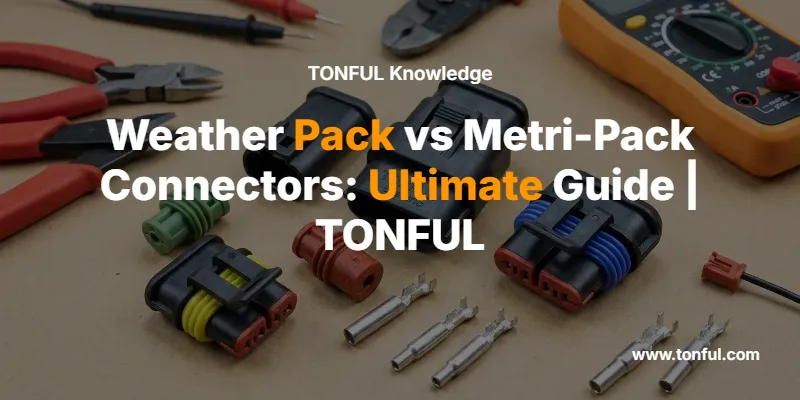
When it comes to automotive electrical rewiring, choosing the right connector system can make the difference between a reliable, long-lasting connection and a frustrating failure. Two of the most popular connector families in the automotive industry are Weather Pack and Metri-Pack connectors, both manufactured by Aptiv (formerly Delphi/Packard Electric). This comprehensive guide will help you understand the key differences, applications, and selection criteria for these industry-standard connector systems.
What Are Weather Pack Connectors?
Weather Pack connectors are environmentally sealed electrical connectors designed specifically for harsh automotive environments. Introduced in the 1970s, these connectors feature a distinctive cylindrical terminal design with triple-ribbed silicone seals that provide superior protection against moisture, dust, dirt, and other contaminants.
Key Features of Weather Pack Connectors
- Operating Temperature Range: -40°C to +125°C (-40°F to 257°F)
- Maximum Current Rating: 20 amps continuous
- Wire Gauge Compatibility: 22-12 AWG
- Voltage Rating: Up to 16 volts DC (some applications up to 50V)
- Terminal Material: Tin-plated copper with open barrel crimp design
- Housing Material: Nylon (PA6) with excellent chemical and abrasion resistance
- Seal Type: Self-lubricating silicone with multiple sealing ribs
- Configuration Options: 1, 2, 3, 4, and 6-circuit configurations

Weather Pack connectors use a unique sealing system where each wire is sealed individually with a round silicone grommet that crimps onto the wire along with the terminal. The connector housing features an integral locking latch that provides both mechanical retention and strain relief. This design ensures that even in extreme conditions—such as engine compartments, chassis wiring, or off-road applications—the electrical connection remains secure and corrosion-free.
What Are Metri-Pack Connectors?
Metri-Pack connectors represent the second-generation modular connector system from Aptiv, introduced in 1981. These connectors feature a more compact, rectangular design with flat blade terminals standardized to metric measurements. The Metri-Pack family offers significantly more versatility than Weather Pack, with multiple series designed for different current capacities and application requirements.
Metri-Pack Series Overview
| Series | Blade Width | Current Rating | Temperature Range | Primary Applications |
|---|---|---|---|---|
| 150 | 1.5mm | 14 amps | -40°C to +125°C | Low-current sensors, control modules |
| 280 | 2.8mm | 30 amps | -40°C to +125°C | General automotive, engine compartment |
| 480 | 4.8mm | 42 amps | -40°C to +125°C | Medium-current applications |
| 630 | 6.3mm | 46 amps | -40°C to +125°C | High-current circuits, power distribution |
| 800 | 8.0mm | 60+ amps | -40°C to +125°C | Heavy-duty power applications |

Key Features of Metri-Pack Connectors
- Terminal Design: Flat blade (male) and box profile (female)
- Terminal Position Assurance (TPA): Secondary locking mechanism prevents terminal backout
- Connector Position Assurance (CPA): Ensures proper mating of connector halves
- Sealed and Unsealed Options: Available in both configurations for different environments
- Compact Footprint: Smaller overall dimensions than Weather Pack
- Device Connectivity: Designed to connect directly to sensors, switches, relays, and ECUs
- Standardized Spacing: 280 series matches mini automotive fuse (APM/ATM) blade spacing
The Metri-Pack system’s modular design and multiple series options make it the preferred choice for OEM applications where specific current requirements and space constraints must be met. The 280 series is particularly versatile, commonly found in engine compartments of GM, BMW, Mopar/Jeep, and many other automotive brands.
Weather Pack vs. Metri-Pack: Direct Comparison
Understanding the differences between these two connector families is essential for selecting the right system for your rewiring project.
Design and Terminal Configuration
| Feature | Weather Pack | Metri-Pack |
|---|---|---|
| Terminal Shape | Cylindrical (round) | Flat blade (rectangular) |
| Terminal Type | Open barrel, crimp-only | Open barrel, crimp-only |
| Connector Profile | Larger, cylindrical body | Compact, rectangular body |
| Mating Style | In-line mating pairs | Device and in-line options |
| Secondary Locks | Integral locking latch | TPA and CPA systems |

Performance Specifications
| Specification | Weather Pack | Metri-Pack 280 | Metri-Pack 150 |
|---|---|---|---|
| Max Current | 20A | 30A | 14A |
| Wire Range | 22-12 AWG | 22-12 AWG | 24-16 AWG |
| Voltage Rating | 16V DC (50V some apps) | 48V | 48V |
| Temperature | -40°C to +125°C | -40°C to +125°C | -40°C to +125°C |
| Contact Resistance | <10mΩ | <10mΩ | <10mΩ |
| IP Rating | IP67 (when properly sealed) | IP67/IP68 (sealed versions) | IP67/IP68 (sealed versions) |
Application Suitability
Weather Pack Excels In:
- General automotive rewiring projects
- Marine and agricultural equipment
- Off-road vehicles and racing applications
- Situations requiring frequent disconnection and reconnection
- Applications where standardization simplifies inventory
- Harsh environments with exposure to moisture, salt spray, and contaminants
- Retrofit and repair work where Weather Pack is already present
Metri-Pack Excels In:
- OEM-style installations requiring compact packaging
- Direct connection to sensors, switches, and electronic control modules
- Applications requiring higher current capacity (280, 480, 630 series)
- Low-voltage, low-current sensor circuits (150 series)
- Space-constrained engine compartments
- Professional harness manufacturing
- Applications requiring specific current ratings

Sealing Systems and Environmental Protection
Both connector families offer excellent environmental protection, but their sealing mechanisms differ significantly.
Weather Pack Sealing System
Weather Pack uses a dual-seal approach:
- Individual Wire Seals: Each terminal has a round silicone seal that crimps onto the wire insulation
- Connector Interface Seal: A large silicone seal on one connector half mates with the opposite housing
This design creates multiple barriers against moisture ingress. The self-lubricating silicone seals feature multiple ribs that maintain their sealing properties over time without deteriorating or corroding other materials. The seals accommodate slight variations in wire insulation diameter, making them forgiving during installation.
Metri-Pack Sealing System
Metri-Pack sealed versions use a similar approach but with a more compact design:
- Cable Seals: Individual seals for each wire (similar to Weather Pack)
- Rear Connector Seal: Some configurations use a multi-wire rear seal instead of individual seals
- TPA Clip: Provides additional mechanical retention and environmental protection
The sealed Metri-Pack system achieves IP67 or IP68 ratings (depending on series and installation), making it suitable for direct exposure to water jets, temporary submersion, and extreme environmental conditions. The unsealed versions are designed for protected environments where moisture resistance is less critical.
Installation and Tooling Requirements
Proper installation is critical for both connector types to achieve their rated performance and environmental protection. Both systems require specialized crimping tools for optimal results.
Weather Pack Installation Process
- Strip Wire: Remove insulation to expose the correct length of conductor (typically 5-6mm)
- Position Seal: Slide the appropriate cable seal onto the wire before crimping
- Crimp Terminal: Use a Weather Pack crimping tool to crimp the terminal onto both the conductor and the insulation
- Seal Positioning: Ensure the cable seal is properly positioned against the terminal crimp
- Insert Terminal: Push the terminal into the connector housing until it clicks into place
- Verify Lock: Tug the wire to ensure the terminal is fully locked
- Mate Connectors: Align and push connector halves together until the locking latch engages
Required Tools:
- Weather Pack crimping tool (open barrel die)
- Wire strippers
- Terminal removal tool (for service work)
Metri-Pack Installation Process
- Strip Wire: Remove insulation to the specified length (varies by series)
- Position Seal: Slide cable seal onto wire
- Crimp Terminal: Use series-specific crimping tool
- Insert Terminal: Push or pull terminal into housing (depends on push-to-seat or pull-to-seat design)
- Install TPA: Insert Terminal Position Assurance clip
- Mate Connectors: Align and connect housing halves
- Install CPA: Insert Connector Position Assurance lock (if equipped)
Required Tools:
- Metri-Pack series-specific crimping tool
- Wire strippers
- Terminal removal tool
- TPA installation tool (optional but recommended)

Professional-grade crimping tools ensure consistent, reliable crimps that meet the manufacturer’s specifications. While some installers use universal crimping tools, dedicated tools for each connector type produce superior results with lower rejection rates. For more information on proper crimping techniques, see our guide on how to crimp automotive electrical connectors.
Common Applications in Automotive Rewiring
Weather Pack Applications
- Engine Sensors: Coolant temperature, oil pressure, knock sensors
- Lighting Circuits: Headlights, fog lights, auxiliary lighting
- Fuel System: Fuel pump connections, fuel level senders
- Charging System: Alternator connections
- HVAC Systems: Blower motor, climate control sensors
- Trailer Connections: Towing harnesses, auxiliary power
- Custom Installations: Aftermarket accessories, performance upgrades
Weather Pack’s universal design and wide availability make it the go-to choice for custom automotive electrical work, racing applications, and retrofit projects. The ability to mix and match wire gauges within the same connector housing provides exceptional flexibility. For outdoor and marine applications, consider our waterproof wire connectors solutions.
Metri-Pack Applications
- ECU Connections: Engine control modules, transmission controllers
- Sensor Circuits: MAF sensors, throttle position sensors, oxygen sensors
- Actuators: Fuel injectors, solenoid valves, stepper motors
- Switch Inputs: Combination switches, door switches, brake switches
- Relay Sockets: Power distribution, control circuits
- Instrument Clusters: Gauge connections, warning light circuits
- Body Control Modules: Central locking, window controls, seat controls
Metri-Pack’s compact design and direct device connectivity make it ideal for OEM-style installations where space is limited and professional appearance is important. The 280 series is particularly popular for its compatibility with standard automotive fuses and relays. Learn more about automotive electrical connectors in our comprehensive guide.
Advantages and Disadvantages
Weather Pack Advantages
- ✅ Universal Compatibility: One terminal fits all connector cavities
- ✅ Simplified Inventory: Fewer part numbers to stock
- ✅ Easy Disconnection: Simple locking latch design
- ✅ Wide Availability: Found at most automotive parts stores
- ✅ Forgiving Installation: Easier for DIY installers
- ✅ Cost-Effective: Generally less expensive than Metri-Pack
- ✅ Proven Reliability: Decades of field use in harsh environments
- ✅ Mix Wire Gauges: Use different wire sizes in same connector
Weather Pack Disadvantages
- ❌ Lower Current Capacity: Limited to 20 amps maximum
- ❌ Larger Size: Takes up more space than Metri-Pack
- ❌ Limited Configurations: Fewer circuit options than Metri-Pack
- ❌ In-Line Only: Not designed for direct device mounting
- ❌ Bulkier Profile: May not fit in tight engine compartments
Metri-Pack Advantages
- ✅ Higher Current Options: Up to 60+ amps in 800 series
- ✅ Compact Design: Smaller footprint saves space
- ✅ Multiple Series: Optimized for specific current requirements
- ✅ Device Connectivity: Direct mounting to sensors and modules
- ✅ TPA/CPA Systems: Superior terminal and connector retention
- ✅ OEM Standard: Matches factory connector systems
- ✅ Sealed and Unsealed: Choose appropriate protection level
- ✅ Professional Appearance: Clean, integrated look
Metri-Pack Disadvantages
- ❌ Complex Inventory: Multiple series and configurations to stock
- ❌ Series-Specific Tools: Requires different crimping tools for each series
- ❌ More Expensive: Higher cost per connection than Weather Pack
- ❌ Installation Complexity: More steps and components
- ❌ Limited Availability: Not as widely stocked as Weather Pack
- ❌ Less Forgiving: Requires more precise installation technique
Selection Guide: Which Connector Should You Choose?
Choosing between Weather Pack and Metri-Pack depends on several factors specific to your project requirements.
Choose Weather Pack When:
- Current requirements are 20 amps or less
- Simplicity and ease of installation are priorities
- You need a universal solution for multiple wire gauges
- Budget constraints are important
- Frequent disconnection and reconnection is expected
- Working on custom, retrofit, or racing applications
- Maximum environmental protection is needed
- You want parts readily available for future service
Choose Metri-Pack When:
- Current requirements exceed 20 amps (use 280, 480, or 630 series)
- Space constraints require compact connectors
- Connecting directly to sensors, switches, or ECUs
- Matching OEM connector systems
- Professional appearance and integration are important
- Specific current ratings must be met for safety
- Working in protected environments (unsealed versions)
- Building professional-grade wiring harnesses
Hybrid Approach
Many professional installers use both connector types in the same vehicle:
- Metri-Pack 150/280: For sensor connections, ECU interfaces, and low-current circuits
- Weather Pack: For power distribution, lighting circuits, and auxiliary accessories
- Metri-Pack 480/630: For high-current applications like alternator connections or electric fan motors
This approach optimizes each connection for its specific requirements while maintaining a professional, reliable electrical system. For a comprehensive understanding of different wire terminal types, explore our manufacturer’s guide.
Cost Considerations and Availability
Weather Pack Pricing
Weather Pack connectors are generally the most economical choice for custom automotive wiring:
- Individual Connectors: $2-5 per mated pair (depending on circuit count)
- Terminals: $0.10-0.25 each
- Seals: $0.05-0.15 each
- Crimping Tools: $30-150 (depending on quality)
- Assortment Kits: $50-200 for comprehensive kits
Weather Pack components are widely available from:
- Automotive parts stores (AutoZone, O’Reilly, NAPA)
- Online retailers (Amazon, eBay)
- Specialty electrical suppliers (Del City, Waytek Wire)
- Racing and performance shops
- TONFUL Electric (OEM-quality components)
Metri-Pack Pricing
Metri-Pack connectors typically cost more due to their specialized design:
- Individual Connectors: $3-8 per mated pair (varies by series)
- Terminals: $0.15-0.40 each
- Seals: $0.10-0.20 each
- TPA/CPA Components: $0.25-0.50 each
- Crimping Tools: $50-300 per series
- Assortment Kits: $100-400 for comprehensive kits
Metri-Pack components are available from:
- Specialty automotive electrical suppliers
- Industrial electrical distributors
- Online suppliers (Del City, Waytek Wire, Mouser)
- OEM parts departments
- TONFUL Electric (professional-grade components)
The higher initial investment in Metri-Pack components is often justified by their superior performance in specific applications and professional appearance. For bulk purchasing options, consult our wholesale connector guide.
Quality Considerations and Counterfeit Concerns
As with many popular automotive components, counterfeit Weather Pack and Metri-Pack connectors have entered the market. These inferior products may look similar but often fail to meet the original specifications for materials, dimensions, and performance.
Identifying Quality Connectors
Genuine Aptiv/Delphi Connectors:
- Molded markings: “DELPHI,” “P. E. D.,” or “APTIV”
- Consistent material quality and finish
- Precise dimensional tolerances
- High-quality silicone seals (not hard rubber)
- Proper terminal retention force
- Correct color coding
Warning Signs of Counterfeits:
- Unusually low prices
- Missing or incorrect markings
- Poor molding quality with flash or voids
- Hard or brittle seals
- Terminals that don’t lock properly
- Incorrect dimensions
TONFUL Electric sources only genuine OEM-quality components that meet or exceed original equipment specifications. Our quality control processes ensure every connector delivers reliable performance in demanding automotive environments.
Installation Best Practices
Proper installation is critical for achieving the rated performance and longevity of both Weather Pack and Metri-Pack connectors.
General Installation Guidelines
- Use Proper Wire: Use automotive-grade wire (TXL, GXL, or SXL) with appropriate gauge for current requirements
- Correct Strip Length: Follow manufacturer specifications for wire strip length
- Clean Connections: Ensure wire ends are clean and free from corrosion
- Proper Crimping: Use dedicated crimping tools, not pliers or universal tools
- Seal Positioning: Verify seals are correctly positioned before crimping
- Terminal Inspection: Check each crimp for proper formation and retention
- Pull Test: Perform a pull test on each terminal after insertion
- Proper Routing: Route wires to avoid sharp edges, heat sources, and moving parts
- Strain Relief: Provide adequate strain relief to prevent stress on terminals
- Protection: Use heat shrink tubing or electrical tape for additional protection where needed
Common Installation Mistakes to Avoid
- Over-crimping or under-crimping: Results in weak connections or broken terminals
- Incorrect seal size: Leads to moisture ingress and corrosion
- Missing TPA/CPA: Allows terminals to back out or connectors to separate
- Wrong wire gauge: Causes poor terminal retention or overheating
- Damaged seals: Compromises environmental protection
- Forcing terminals: Can damage retention barbs or connector cavities
- Mixing connector types: Weather Pack and Metri-Pack are not interchangeable
For detailed crimping techniques, refer to our guide on common crimping mistakes and how to avoid them.
Maintenance and Service
Both Weather Pack and Metri-Pack connectors are designed for long service life, but periodic inspection and maintenance can prevent failures.
Inspection Procedures
- Visual Inspection: Check for damaged housings, broken latches, or corroded terminals
- Seal Condition: Verify seals are intact and not hardened or cracked
- Terminal Retention: Gently pull on wires to ensure terminals are locked
- Corrosion Check: Look for green corrosion (copper) or white corrosion (aluminum/tin)
- Contact Resistance: Use a multimeter to check for high resistance connections
- Locking Mechanisms: Ensure latches, TPA, and CPA are functioning properly
Service and Repair
When service is required:
- Terminal Removal: Use proper terminal removal tools to avoid damage
- Cleaning: Clean terminals with electrical contact cleaner
- Seal Replacement: Replace damaged or hardened seals
- Terminal Replacement: Replace corroded or damaged terminals
- Housing Replacement: Replace cracked or damaged connector housings
- Proper Reassembly: Follow installation procedures for reassembly
For comprehensive connector maintenance, see our article on how to diagnose a failing turn signal switch, which includes connector inspection techniques.
Frequently Asked Questions (FAQ)
Q: Can I use Weather Pack and Metri-Pack connectors interchangeably?
A: No, Weather Pack and Metri-Pack connectors are not compatible with each other. They use different terminal designs (cylindrical vs. flat blade) and different housing configurations. Each system requires its own specific components.
Q: What’s the maximum current I can safely run through a Weather Pack connector?
A: Weather Pack connectors are rated for 20 amps continuous maximum. For higher current applications, consider Metri-Pack 280 (30A), 480 (42A), or 630 (46A) series connectors.
Q: Do I need special tools to install these connectors?
A: Yes, both connector types require proper crimping tools for reliable installation. While universal crimping tools may work, dedicated tools for each connector type produce superior results and are strongly recommended for professional installations.
Q: Are Weather Pack connectors truly waterproof?
A: When properly installed, Weather Pack connectors achieve IP67 rating, meaning they can withstand temporary immersion in water up to 1 meter depth. However, they are not designed for permanent submersion. For underwater applications, consider specialized submersible connectors.
Q: Can I mix different wire gauges in the same connector?
A: With Weather Pack, yes—all terminals fit all connector cavities, allowing you to mix wire gauges from 22 to 12 AWG. With Metri-Pack, you must use the appropriate terminal and seal for each wire gauge, but you can mix gauges within the series specifications.
Q: Which connector type is better for marine applications?
A: Both sealed Weather Pack and sealed Metri-Pack connectors are suitable for marine environments when properly installed. Weather Pack’s simpler design may be easier to service, while Metri-Pack offers higher current capacity options. For marine applications, also consider our marine wiring corrosion prevention guide.
Q: How do I remove terminals from these connectors?
A: Both connector types require terminal removal tools that depress the retention barbs while pulling the wire. Never force terminals out without the proper tool, as this can damage the connector housing and make it unusable.
Q: Are aftermarket connectors as good as OEM Aptiv/Delphi connectors?
A: Quality varies significantly among aftermarket suppliers. Genuine Aptiv/Delphi connectors and high-quality alternatives from reputable manufacturers like TONFUL Electric meet or exceed OEM specifications. However, cheap counterfeit connectors may fail prematurely due to inferior materials and poor dimensional tolerances.
Conclusion
Both Weather Pack and Metri-Pack connectors represent proven, reliable solutions for automotive electrical connections. Weather Pack offers simplicity, universal compatibility, and excellent environmental protection at an economical price point, making it ideal for custom installations, racing applications, and general automotive rewiring. Metri-Pack provides superior current capacity options, compact packaging, and professional OEM-style integration, making it the preferred choice for space-constrained applications and direct device connectivity.
The key to successful automotive rewiring is matching the connector system to your specific requirements:
- Evaluate current requirements and choose a connector rated appropriately
- Consider space constraints and select the most compact solution that meets your needs
- Assess environmental exposure and choose sealed or unsealed versions accordingly
- Plan for serviceability and select connectors that are readily available for future maintenance
- Use quality components from reputable manufacturers like TONFUL Electric
- Invest in proper tools for professional-quality installations
- Follow best practices for crimping, assembly, and installation
By understanding the strengths and limitations of each connector family, you can design and build automotive electrical systems that deliver reliable performance for years to come. Whether you’re rewiring a classic car, building a race car, or repairing a modern vehicle, choosing the right connector system is a critical decision that impacts both performance and reliability.
For more information about automotive electrical components, explore our comprehensive guides on auto connector manufacturing, terminal selection, and electrical tools. TONFUL Electric is committed to providing high-quality electrical components and expert guidance for all your automotive wiring needs.
TONFUL Electric is a leading manufacturer of automotive electrical connectors, terminals, and wiring components. With decades of experience in the industry, we provide OEM-quality products that meet the demanding requirements of automotive, marine, and industrial applications. Contact us today to learn more about our comprehensive range of automotive electrical solutions.