
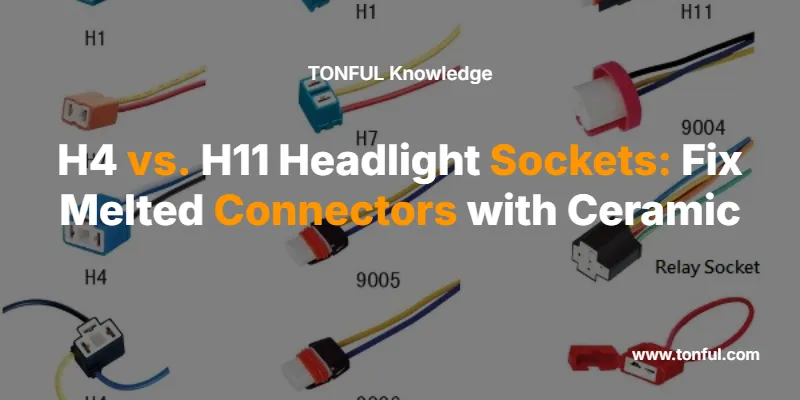
When headlight connectors fail, vehicle safety is immediately compromised. Melted headlight sockets represent one of the most common electrical failures in automotive lighting systems, affecting millions of vehicles annually. This comprehensive guide examines the critical differences between H4 and H11 headlight sockets and explains why ceramic replacement connectors offer superior performance over standard plastic alternatives.
Understanding Headlight Socket Types: H4 vs. H11
H4 Headlight Socket Specifications
The H4 socket (also designated as 9003 or HB2) features a three-prong design that accommodates dual-filament bulbs. This configuration allows a single bulb to provide both high beam and low beam functions through separate filaments. H4 sockets are predominantly found in European and Asian vehicles, particularly in older models and commercial trucks.
Key H4 Socket Characteristics:
- Pin Configuration: 3-pin design (high beam, low beam, ground)
- Voltage Rating: 12V standard automotive voltage
- Power Range: 55W-100W depending on bulb specification
- Bulb Type: Dual-filament halogen, LED, or HID compatible
- Common Applications: 7″ round headlights, rectangular H4656 bulbs, quad headlight systems (outer/low beam position)
The three-terminal design makes H4 sockets visually distinctive and easily identifiable during replacement procedures.
H11 Headlight Socket Specifications
The H11 socket represents a more modern single-filament design commonly used in contemporary vehicles. Unlike the H4’s dual-filament capability, H11 sockets power only one lighting function—typically low beam headlights or fog lights. The H11 socket features a unique L-shaped connector with two narrow-set prongs enclosed in a plastic oval casing.
Key H11 Socket Characteristics:
- Pin Configuration: 2-pin design with L-shaped orientation
- Voltage Rating: 12V standard automotive voltage
- Power Range: 55W standard (up to 80W for performance bulbs)
- Bulb Type: Single-filament halogen, LED, or HID compatible
- Common Applications: Low beam headlights, fog lights in modern vehicles (2005+)
- Interchangeability: Compatible with H8, H9, and H16 bulbs (same connector, different wattage)
The compact design of H11 sockets allows for more flexible headlight housing configurations in modern vehicle designs.


Comparison Table: H4 vs. H11 Headlight Sockets
| Feature | H4 Socket | H11 Socket |
|---|---|---|
| Filament Type | Dual-filament (high/low beam) | Single-filament (one function) |
| Pin Count | 3 pins | 2 pins |
| Connector Shape | Triangular arrangement | L-shaped oval |
| Standard Wattage | 55W/60W (low/high) | 55W |
| Maximum Wattage | 100W/130W | 80W |
| Typical Vehicle Age | Pre-2005 models | 2005+ models |
| Primary Application | Main headlights (dual-beam) | Low beams, fog lights |
| Regional Preference | Europe, Asia | North America, Global |
| Replacement Complexity | Moderate | Easy |
| Ceramic Upgrade Availability | Widely available | Widely available |
Why Headlight Sockets Melt: Root Causes
Understanding the failure mechanisms behind melted headlight connectors is essential for preventing recurrence after replacement.
1. Electrical Resistance and Heat Generation
The primary cause of socket melting is excessive electrical resistance at the connection point. When terminals become corroded, loose, or improperly sized, resistance increases. According to Joule’s Law (P = I²R), even small increases in resistance generate significant heat when combined with the high current draw of headlight bulbs (typically 4.5-8 amps for standard halogen bulbs).
2. Inadequate Wire Gauge
Factory headlight harnesses often use 16-gauge or even 18-gauge wiring, which approaches its current-carrying capacity limits with standard 55W bulbs. When users upgrade to higher-wattage bulbs (80W-100W) without upgrading the wiring, the undersized conductors generate excessive heat that transfers to the socket.
Recommended Wire Gauges for Headlight Applications:
- Standard 55W bulbs: 16 AWG minimum, 14 AWG recommended
- Performance 80W bulbs: 14 AWG minimum, 12 AWG recommended
- High-output 100W+ bulbs: 12 AWG minimum with relay harness
3. Poor Terminal Contact
Manufacturing tolerances in mass-produced plastic sockets can result in loose terminal fit. Over time, vibration and thermal cycling further degrade contact pressure, increasing resistance. The resulting heat accelerates plastic degradation in a destructive feedback loop.
4. Plastic Material Limitations
Standard OEM headlight sockets use thermoplastic materials (typically nylon or polypropylene) with working temperature limits of 250-280°F (121-138°C). While adequate for ideal conditions, these materials cannot tolerate the heat generated by poor connections or high-wattage bulbs. Learn more about choosing the right wire connectors.
5. Environmental Factors
Moisture intrusion, road salt, and contaminants accelerate terminal corrosion. Corroded terminals increase resistance, generating heat that melts the surrounding plastic—a common failure pattern in vehicles operated in harsh climates.
The Ceramic Socket Solution: Superior Heat Resistance
Ceramic headlight socket replacements address the fundamental weakness of plastic connectors through superior thermal properties and enhanced electrical performance.
Material Properties Comparison
| Property | Plastic Socket | Ceramic Socket |
|---|---|---|
| Maximum Operating Temperature | 250-280°F (121-138°C) | 572°F (300°C) |
| Thermal Conductivity | 0.2-0.3 W/m·K | 2-3 W/m·K |
| Dielectric Strength | 15-20 kV/mm | 10-15 kV/mm |
| Moisture Resistance | Moderate | Excellent |
| Dimensional Stability | Degrades with heat | Maintains shape |
| Chemical Resistance | Good | Excellent |
| Lifespan | 3-5 years | 10+ years |
| Cost | $5-10 | $15-25 |
Why Ceramic Outperforms Plastic
1. Extreme Heat Tolerance
Ceramic materials maintain structural integrity at temperatures up to 572°F (300°C)—more than double the capability of plastic alternatives. This thermal margin provides a safety buffer even under worst-case scenarios of poor connections or high-wattage bulbs.
2. Superior Heat Dissipation
Ceramic’s higher thermal conductivity (10x better than plastic) allows heat to dissipate away from the connection point rather than accumulating in the socket body. This prevents the thermal runaway effect that destroys plastic connectors.
3. Dimensional Stability
Unlike plastics that soften and deform under heat, ceramic maintains precise dimensional tolerances throughout its temperature range. This ensures consistent terminal contact pressure over the socket’s lifetime.
4. Corrosion Resistance
Ceramic’s chemical inertness prevents degradation from moisture, road salt, and automotive fluids. The material does not absorb moisture, eliminating one pathway for terminal corrosion.
5. Vibration Resistance
Ceramic’s rigidity prevents the micro-movements that gradually loosen plastic socket terminals. This maintains optimal electrical contact even in high-vibration applications like commercial trucks and off-road vehicles.

Step-by-Step: Replacing Melted Headlight Connectors
Tools and Materials Required
Essential Tools:
- Wire strippers (12-16 AWG capacity)
- Crimping tool for insulated terminals
- Heat gun or lighter (for heat shrink)
- Diagonal cutters
- Multimeter (for testing)
- Small flathead screwdriver
Materials Needed:
- Ceramic replacement socket (H4 or H11 as appropriate)
- Heat shrink tubing (3/16″ and 1/4″)
- Dielectric grease (for terminal protection)
- Electrical tape (high-temperature rated)
- Wire connectors or solder (for splicing)
For professional-grade crimping tools, TONFUL Electric offers complete solutions for automotive electrical work.
Replacement Procedure
Step 1: Safety Preparation
Disconnect the vehicle’s negative battery terminal to prevent electrical shorts. Allow the headlight system to cool completely if recently operated.
Step 2: Access and Inspection
Remove the headlight assembly or access the socket from the engine bay. On some vehicles, turning the front wheels fully to one side provides better access. Photograph the existing wire colors and connections before disassembly.
Step 3: Remove Damaged Socket
Carefully cut away the melted socket, leaving as much wire length as possible. If the socket has partially fused to the bulb, use a flathead screwdriver to carefully separate them. Inspect the bulb for damage—melted sockets often damage bulb terminals.
Step 4: Prepare Wires
Strip 3/8″ (10mm) of insulation from each wire. Inspect the wire for heat damage extending beyond the socket—discolored or brittle insulation indicates the wire must be cut back further to reach undamaged conductor.
Step 5: Install New Ceramic Socket
Match wire colors to the new ceramic socket terminals:
For H4 Sockets:
- Ground (typically black or brown): Center terminal
- Low beam (typically white or yellow): One outer terminal
- High beam (typically blue or light blue): Remaining outer terminal
For H11 Sockets:
- Ground (typically black): One terminal
- Power (typically varies by manufacturer): Other terminal
Use heat shrink butt connectors or solder connections for maximum reliability. If soldering, apply heat shrink tubing before making the connection. Quality heat shrink terminals ensure waterproof, vibration-resistant connections.

Step 6: Seal and Protect
Apply a small amount of dielectric grease to each terminal before inserting the bulb. This prevents moisture intrusion and corrosion without interfering with electrical conductivity (dielectric grease is non-conductive but protects around—not on—the actual contact surfaces).
Slide the protective boot (if included) over the socket to seal against moisture and contaminants.
Step 7: Testing and Verification
Reconnect the battery and test both low and high beam functions (for H4) or the single function (for H11). Use a multimeter to verify proper voltage at the socket (should read 12-14V with lights on).
Inspect the connection after 10-15 minutes of operation. The socket should remain cool to the touch—any significant heat indicates a problem requiring immediate attention.
Preventing Future Socket Failures
Best Practices for Long-Term Reliability
1. Use Appropriate Wattage Bulbs
Never exceed the socket’s rated wattage. For standard ceramic sockets, limit bulbs to:
- H4 sockets: 55W/60W (low/high) maximum
- H11 sockets: 55W maximum
Higher wattage bulbs require relay harness installations that power the lights directly from the battery, using the original circuit only for relay activation.
2. Upgrade Wire Gauge
When replacing sockets, consider upgrading to 14 AWG wiring if the original harness used smaller gauge wire. This reduces voltage drop and heat generation throughout the circuit.
3. Maintain Clean Connections
Annually inspect and clean headlight connections with electrical contact cleaner. Remove any corrosion with fine sandpaper or a wire brush before it increases resistance.
4. Apply Dielectric Grease
Use dielectric grease around (not on) terminals during every bulb change. This prevents moisture intrusion—the leading cause of terminal corrosion.
5. Consider LED Upgrades
LED headlight bulbs draw 60-70% less current than halogen equivalents, dramatically reducing heat generation in sockets and wiring. This extends socket life while improving light output. Ensure LED bulbs are compatible with your vehicle’s electrical system to avoid CAN bus errors.
6. Install Relay Harnesses
For vehicles with aging wiring or users who prefer high-output bulbs, relay harness kits power headlights directly from the battery. This eliminates current flow through aging factory wiring and switches, preventing socket overheating while improving light output through reduced voltage drop.
Selecting Quality Ceramic Replacement Sockets
Critical Quality Factors
1. Wire Gauge and Length
Premium ceramic sockets include 14 AWG wire pigtails (6-8 inches long) made in the USA. Avoid cheap alternatives with thin 16-18 AWG wire—these defeat the purpose of the upgrade.
2. Terminal Quality
Inspect the metal terminals before purchase. Quality terminals feature:
- Brass or copper construction (not steel)
- Tin or silver plating for corrosion resistance
- Spring tension for secure bulb contact
- Proper gauge thickness (not thin stamped metal)
TONFUL Electric manufactures automotive electrical connectors with premium brass terminals and professional-grade plating for maximum reliability.
3. Moisture Seals
Look for sockets with both front and rear silicone moisture seals. The front seal protects the terminal area, while the rear seal prevents moisture from wicking along the wires into the connector.
4. Ceramic Quality
Not all ceramic is equal. High-quality sockets use dense, high-temperature ceramic that resists thermal shock. Cheap alternatives may use ceramic-filled plastic that offers limited improvement over standard plastic.
5. Manufacturer Reputation
Purchase from established automotive electrical component manufacturers. Unknown brands may use substandard materials or incorrect terminal dimensions that result in loose bulb fit.

H4 vs. H11: Which Socket Does Your Vehicle Use?
Identification Methods
Method 1: Visual Inspection
Remove the existing bulb and count the terminals:
- 3 terminals: H4 socket
- 2 terminals in L-shape: H11 socket
Method 2: Vehicle Documentation
Consult your owner’s manual or the label inside the headlight housing. The bulb type is typically printed on the housing or listed in the manual’s bulb replacement section.
Method 3: Online Lookup
Use automotive parts websites’ bulb finder tools. Enter your vehicle’s year, make, and model to determine the correct socket type for each lighting position (low beam, high beam, fog lights).
Method 4: Parts Store Assistance
Automotive parts retailers can look up your vehicle’s bulb specifications in their systems. Bring your vehicle information (VIN, year, make, model) for accurate identification.
Common Vehicle Applications
H4 Socket Vehicles:
- Jeep Wrangler (pre-2007)
- Toyota Tacoma (1995-2004)
- Honda Civic (1992-2000)
- Ford F-Series (1992-2003)
- Most European vehicles (Volkswagen, BMW, Mercedes-Benz) through mid-2000s
H11 Socket Vehicles:
- Honda Accord (2008+)
- Toyota Camry (2007+)
- Ford F-150 (2004+)
- Chevrolet Silverado (2007+)
- Subaru Outback (2010+)
- Most vehicles manufactured after 2005
Advanced Troubleshooting: When Ceramic Isn’t Enough
Persistent Overheating After Ceramic Upgrade
If a new ceramic socket still shows signs of overheating, the problem extends beyond the socket itself:
1. Insufficient Ground Connection
Poor ground connections force current to find alternative paths, increasing resistance. Run a dedicated ground wire from the headlight socket directly to a clean chassis ground point. Use 14 AWG wire and ensure the chassis connection is free of paint, rust, and corrosion.
2. Voltage Regulator Issues
A failing voltage regulator can output excessive voltage (15V+), causing bulbs to draw more current and generate excessive heat. Test voltage at the battery with the engine running—it should read 13.5-14.5V. Higher readings indicate regulator problems.
3. Corroded Wiring Harness
Corrosion may extend deep into the wiring harness beyond the socket area. This requires tracing the circuit and replacing damaged sections or installing a complete replacement harness.
4. Incompatible Bulbs
Some aftermarket LED and HID bulbs draw current spikes during startup that can damage sockets. Use quality bulbs from reputable manufacturers designed specifically for your socket type.
5. Electrical System Issues
Persistent problems may indicate broader electrical issues such as alternator problems, damaged wiring, or corroded fuse boxes. Professional electrical system diagnosis may be necessary.
For comprehensive electrical system components, explore TONFUL Electric’s terminals and connectors designed for demanding automotive applications.
Cost-Benefit Analysis: Ceramic vs. Plastic Replacement
Initial Investment Comparison
| Socket Type | Material Cost | Labor Cost (DIY) | Labor Cost (Shop) | Total Cost Range |
|---|---|---|---|---|
| Plastic OEM | $5-10 | $0 | $50-80 | $5-90 |
| Plastic Aftermarket | $3-8 | $0 | $50-80 | $3-88 |
| Ceramic Premium | $15-25 | $0 | $60-100 | $15-125 |
| Ceramic with Harness | $25-40 | $0 | $80-120 | $25-160 |
Long-Term Value Proposition
Plastic Socket Replacement:
- Expected lifespan: 3-5 years
- Failure risk with high-wattage bulbs: High
- Replacement frequency: Every 3-5 years
- 10-year cost: $30-60 (2-3 replacements)
Ceramic Socket Replacement:
- Expected lifespan: 10+ years
- Failure risk with high-wattage bulbs: Low
- Replacement frequency: Once
- 10-year cost: $15-25 (one-time investment)
The ceramic upgrade pays for itself after the first replacement cycle while providing superior safety and reliability throughout the vehicle’s lifetime.
Safety Considerations and Fire Prevention
Melted headlight sockets represent more than an inconvenience—they pose genuine fire hazards. The Consumer Product Safety Commission reports thousands of vehicle fires annually originating from electrical system failures, with headlight circuits among the common ignition sources.
Warning Signs of Imminent Socket Failure
- Flickering headlights: Indicates intermittent connection due to heat-damaged terminals
- Burning smell: Melting plastic produces a distinctive acrid odor
- Dim headlights: Voltage drop from increased resistance reduces light output
- Discolored socket housing: Brown or black discoloration indicates heat damage
- Brittle plastic: Socket housing that cracks or crumbles when touched
- Corroded terminals: Green, white, or brown deposits on metal contacts
If you observe any of these symptoms, replace the socket immediately. Continued operation risks complete electrical failure or fire.
Fire Prevention Best Practices
- Never use bulbs exceeding socket ratings: This is the leading cause of socket failures
- Inspect sockets annually: Catch problems before they become dangerous
- Replace both sides simultaneously: If one socket has failed, the other likely shows similar wear
- Upgrade to ceramic proactively: Don’t wait for failure—especially on older vehicles
- Maintain proper connections: Clean, tight connections prevent resistance heating
For professional-grade automotive fuses that protect electrical circuits, TONFUL Electric offers comprehensive circuit protection solutions.
Environmental and Regulatory Considerations
Disposal of Damaged Components
Melted plastic sockets should be disposed of according to local electronic waste regulations. Many components contain materials that should not enter landfills. Check with local recycling centers for proper disposal methods.
Compliance with Vehicle Standards
When replacing headlight sockets, ensure the repair maintains compliance with Federal Motor Vehicle Safety Standards (FMVSS) 108 in the United States, or equivalent regulations in other jurisdictions. Key requirements include:
- Maintaining proper headlight aim after reassembly
- Using bulbs that meet photometric standards
- Ensuring all electrical connections are properly insulated
- Maintaining proper circuit protection (fuses)
Aftermarket modifications that increase light output beyond legal limits may violate regulations and create liability in accident situations.
Professional vs. DIY Installation
When to Hire a Professional
While socket replacement is within the capabilities of most DIY enthusiasts, certain situations warrant professional assistance:
- Limited electrical experience: If you’re uncomfortable working with automotive electrical systems
- Extensive damage: When wiring damage extends beyond the socket area
- Difficult access: Some vehicles require significant disassembly to access headlight sockets
- Persistent problems: When socket replacement doesn’t resolve the issue
- Warranty concerns: Professional installation may be required to maintain vehicle warranties
DIY Installation Advantages
For mechanically inclined vehicle owners, DIY socket replacement offers several benefits:
- Cost savings: Eliminate labor charges ($50-120)
- Immediate repair: No appointment scheduling required
- Learning opportunity: Gain valuable automotive electrical skills
- Quality control: Ensure proper materials and techniques are used
With basic tools and careful attention to detail, most vehicle owners can successfully complete this repair in 30-60 minutes per socket.
Frequently Asked Questions (FAQ)
Can I use an H11 bulb in an H4 socket?
No. H11 and H4 bulbs have completely different base designs and pin configurations. H4 uses a three-prong triangular arrangement for dual-filament operation, while H11 uses a two-prong L-shaped connector for single-filament operation. The bulbs are not physically interchangeable.
How long do ceramic headlight sockets last?
Quality ceramic headlight sockets typically last 10+ years under normal operating conditions. The ceramic material does not degrade from heat or environmental exposure like plastic alternatives. Actual lifespan depends on factors including bulb wattage, environmental conditions, and connection quality.
Can I upgrade to higher wattage bulbs with ceramic sockets?
While ceramic sockets tolerate higher temperatures, upgrading to bulbs exceeding 55W-60W requires additional electrical system modifications. Install a relay harness that powers the headlights directly from the battery, using the original circuit only for relay activation. This prevents overloading factory wiring and switches. Never exceed 100W without professional electrical system upgrades.
Why does only one headlight socket melt?
Asymmetric socket failure typically indicates a localized problem rather than a systemic issue. Common causes include: poor ground connection on the affected side, corrosion in that specific socket, manufacturing defect in one socket, or damage to wiring on that side. When replacing a failed socket, inspect the opposite side—if it shows any signs of heat damage, replace both simultaneously.
Are ceramic sockets compatible with LED headlight bulbs?
Yes. Ceramic sockets are fully compatible with LED, halogen, and HID bulbs that match the socket type (H4 or H11). LED bulbs actually benefit ceramic sockets less than halogen bulbs because LEDs draw 60-70% less current, generating minimal heat in the socket. However, ceramic sockets still provide superior durability and moisture resistance regardless of bulb technology.
What causes headlight sockets to melt with stock bulbs?
Socket melting with factory-specification bulbs indicates an electrical problem rather than excessive power draw. Common causes include: corroded terminals increasing resistance, loose connections creating arcing, inadequate wire gauge in the factory harness, poor ground connections forcing current through alternative paths, or manufacturing defects in the socket. Address the root cause during replacement to prevent recurrence.
Can I repair a melted socket instead of replacing it?
No. Once a socket has melted, the plastic has lost structural integrity and terminal contact pressure. Attempting to reuse a melted socket will result in poor connections, continued overheating, and likely failure. The only safe solution is complete socket replacement. The modest cost of a new ceramic socket is insignificant compared to the fire risk of continuing to use damaged components.
Do I need special tools to replace headlight sockets?
Basic hand tools are sufficient for most socket replacements: wire strippers, crimping tool, diagonal cutters, and a heat gun or lighter for heat shrink connections. A multimeter is helpful but not essential. No specialized automotive tools are required. For professional results, invest in quality crimping tools designed for automotive electrical work.
Conclusion: Ceramic Sockets as the Definitive Solution
Melted headlight sockets represent a preventable failure that compromises vehicle safety and creates fire hazards. Whether your vehicle uses H4 dual-filament or H11 single-filament sockets, upgrading to ceramic replacements provides a permanent solution that outlasts plastic alternatives by years while tolerating the thermal stresses that destroy standard connectors.
The modest additional cost of ceramic sockets—typically $10-15 more than plastic alternatives—is insignificant compared to the benefits: superior heat resistance, extended lifespan, enhanced safety, and elimination of repeat failures. For vehicle owners who have experienced socket failures, ceramic replacement should be considered mandatory rather than optional.
By understanding the fundamental differences between H4 and H11 socket designs, recognizing the root causes of socket failures, and following proper installation procedures, vehicle owners can ensure reliable headlight operation for years to come. The investment in quality ceramic sockets and proper installation techniques pays dividends in safety, reliability, and peace of mind.
For professional-grade automotive electrical components including ceramic headlight sockets, terminals, connectors, and complete wiring solutions, TONFUL Electric provides manufacturers and distributors with quality products backed by rigorous testing and industry-leading warranties. Explore our complete range of automotive electrical solutions designed for demanding applications.