
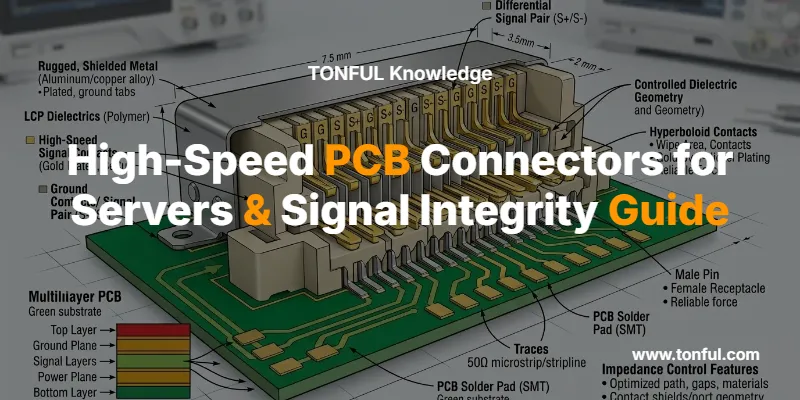
In today’s data-driven world, server performance hinges on reliable, high-speed data transmission. As data centers push toward 112G and 224G signaling speeds, PCB connectors have become critical components in maintaining signal integrity and system reliability. For engineers designing next-generation server infrastructure, understanding how to select and implement high-speed PCB connectors is essential for preventing data loss, minimizing latency, and ensuring 24/7 operational stability.
Understanding High-Speed PCB Connectors in Server Applications
High-speed PCB connectors serve as the backbone of modern server architectures, facilitating data transfer between processors, memory modules, storage devices, and network interfaces. Unlike traditional connectors that handle lower-frequency signals, high-speed PCB connectors must maintain signal integrity at frequencies exceeding several gigahertz while managing complex electromagnetic challenges.
Modern server environments demand connectors that support multiple high-speed protocols simultaneously, including PCIe Gen 5 (32 GT/s), PCIe Gen 6 (64 GT/s), and emerging standards. These connectors must deliver consistent performance across thousands of mating cycles while withstanding the thermal stresses of continuous operation in densely packed rack environments.

TONFUL Electric specializes in manufacturing precision electrical PCB connectors designed for demanding server applications, combining advanced materials with rigorous quality control to meet the stringent requirements of data center operators worldwide.
Key Signal Integrity Challenges in Server PCB Connectors
Impedance Matching and Controlled Impedance
Impedance matching represents the foundation of signal integrity in high-speed PCB connectors. When the characteristic impedance of a connector doesn’t match the transmission line impedance (typically 50Ω for single-ended or 85-100Ω for differential pairs), signal reflections occur, causing data errors and reduced bandwidth.
For PCIe and other differential signaling protocols common in servers, maintaining tight impedance tolerance (±10% or better) throughout the connector transition is critical. This requires precise control over contact geometry, dielectric materials, and the physical spacing between signal pins. Modern high-speed connectors incorporate carefully engineered pin arrangements that minimize impedance discontinuities at the PCB-to-connector interface.
Crosstalk and Electromagnetic Interference
As signal densities increase in server applications, crosstalk between adjacent signal paths becomes a primary concern. Crosstalk occurs when electromagnetic fields from one signal path induce unwanted voltages in neighboring conductors, potentially causing bit errors in high-speed data streams.
Differential signaling, commonly used in server PCB connectors, provides inherent crosstalk immunity through common-mode noise rejection. When properly implemented with balanced trace routing and controlled spacing, differential pairs can achieve crosstalk levels below -40 dB, ensuring reliable operation even in dense connector arrays.

Insertion Loss and Return Loss
Insertion loss measures the signal power lost as it passes through a connector, while return loss quantifies the power reflected due to impedance mismatches. In high-speed server applications operating at 25+ Gbps per lane, even small losses accumulate across multiple connectors and PCB traces, potentially degrading the signal below acceptable thresholds.
High-quality PCB connectors minimize insertion loss through optimized contact materials (typically gold-plated copper alloys), reduced contact resistance, and streamlined signal paths. For PCIe Gen 5 applications, industry best practices target insertion loss below 1 dB at 16 GHz and return loss better than -15 dB across the operating frequency range.
PCB Connector Types for Server Applications
| Connector Type | Typical Data Rate | Pin Count Range | Primary Applications | Key Advantages |
|---|---|---|---|---|
| Pin Header Connectors | Up to 10 Gbps | 2-80 pins | General I/O, low-speed peripherals | Cost-effective, versatile mounting options |
| Box Header Connectors | Up to 20 Gbps | 10-100 pins | Board-to-board interconnects | Robust mechanical retention, shrouded design |
| Wafer Connectors | Up to 15 Gbps | 2-50 pins | Signal distribution, modular systems | Compact footprint, easy assembly |
| FPC/FFC Connectors | Up to 10 Gbps | 4-80 contacts | Flexible interconnects, space-constrained designs | Ultra-low profile, flexible routing |
| High-Speed Backplane Connectors | 56+ Gbps | 100-400+ pins | Server backplanes, storage arrays | Maximum density, optimized signal integrity |
TONFUL offers a comprehensive range of these connector types, including specialized pin header connectors, box header connectors, wafer connectors, and FPC/FFC connectors engineered for high-speed server applications.

Design Considerations for Signal Integrity
Differential Pair Routing and Length Matching
Differential signaling dominates modern server architectures due to its superior noise immunity and ability to operate at higher speeds with lower voltage swings. Proper differential pair implementation requires maintaining consistent spacing between the two traces (typically 3-5 times the trace width) and matching their lengths to within tight tolerances—often ±5 mils (0.127 mm) or better for multi-gigabit applications.
When routing differential pairs through PCB connectors, designers must ensure that the connector pin assignment preserves pair integrity and minimizes skew. Advanced connector designs incorporate internal geometry that maintains differential impedance through the connector body, eliminating discontinuities that could generate reflections or mode conversion.
Ground Plane Strategy and Via Placement
Solid ground planes serve multiple critical functions in high-speed PCB connector implementations: they provide a low-impedance return path for high-frequency currents, shield against electromagnetic interference, and help maintain controlled impedance. Strategic via placement near connector pins ensures that return currents flow along the shortest possible path, minimizing loop inductance and reducing radiated emissions.
For optimal performance, ground vias should be placed within one trace width of signal vias, and ground pins should be interspersed throughout the connector pin field to provide localized return paths for each signal pair. This approach significantly reduces crosstalk and improves signal integrity compared to designs with ground pins concentrated at the connector periphery.

Material Selection and Dielectric Properties
The dielectric materials used in both the PCB substrate and connector housing significantly impact signal integrity at high frequencies. Low-loss dielectric materials with stable dielectric constants (Dk) and low dissipation factors (Df) are essential for minimizing signal attenuation and maintaining consistent impedance across temperature variations.
Modern high-speed server PCBs typically employ specialized materials such as Megtron-6, Rogers RO4000 series, or similar low-loss laminates for critical signal layers. Connector manufacturers must select compatible housing materials—often liquid crystal polymer (LCP) or high-temperature thermoplastics—that provide stable electrical properties while withstanding the thermal stresses of reflow soldering and operational heating.
PCIe and High-Speed Protocol Requirements
PCIe Generation Comparison
| PCIe Generation | Data Rate per Lane | Encoding | Bandwidth (x16) | Typical Connector Requirements |
|---|---|---|---|---|
| PCIe Gen 3 | 8.0 GT/s | 128b/130b | ~16 GB/s | Standard impedance control, basic SI design |
| PCIe Gen 4 | 16.0 GT/s | 128b/130b | ~32 GB/s | Enhanced impedance tolerance, improved materials |
| PCIe Gen 5 | 32.0 GT/s | 128b/130b | ~64 GB/s | Strict impedance control (±5%), low-loss materials |
| PCIe Gen 6 | 64.0 GT/s | PAM4 | ~128 GB/s | Ultra-low loss, advanced equalization, premium connectors |
As PCIe generations advance, the electrical requirements for connectors become increasingly stringent. PCIe Gen 5 and Gen 6 implementations demand connectors with insertion loss below 0.5 dB at fundamental frequencies and return loss better than -20 dB to maintain adequate signal margins for error-free operation.
SATA and Storage Interface Connectors
While PCIe dominates processor and memory interconnects, SATA connectors remain prevalent for traditional hard drive and SSD connections in server storage arrays. SATA 3.0 operates at 6 Gbps, requiring differential impedance of 100Ω ±10% and careful attention to signal quality to prevent data corruption during sustained read/write operations.
For applications requiring both SATA and PCIe connectivity, hybrid connector solutions like U.2 and M.2 provide flexibility while maintaining signal integrity across multiple protocols. These advanced connectors incorporate protocol-specific signal conditioning and separate ground isolation to prevent interference between different interface types.

Testing and Validation for Signal Integrity
Ensuring that PCB connectors meet signal integrity requirements demands comprehensive testing throughout the design and manufacturing process. Time-domain reflectometry (TDR) measurements identify impedance discontinuities, while vector network analyzer (VNA) testing characterizes insertion loss, return loss, and crosstalk across the full operating frequency range.
For production validation, automated optical inspection (AOI) verifies contact alignment and plating quality, while mechanical testing confirms that connectors maintain electrical performance through thousands of mating cycles. TONFUL Electric implements rigorous quality control protocols including 100% contact resistance testing and sample-based signal integrity validation to ensure consistent performance across production lots.
Salt spray testing per ASTM B117 standards validates corrosion resistance for connectors deployed in harsh data center environments, while thermal cycling tests confirm that electrical parameters remain stable across the -40°C to +85°C temperature range typical of server operating conditions. These validation procedures ensure that automotive electrical connectors and industrial-grade PCB connectors maintain reliability in demanding applications.
Best Practices for High-Speed PCB Connector Implementation
Successful implementation of high-speed PCB connectors in server designs requires attention to multiple interconnected factors:
- Layout and Routing Excellence: Minimize trace length between connectors and active components, maintain consistent differential pair spacing throughout the signal path, and avoid routing high-speed signals across split ground planes or near noisy power distribution networks. Use controlled impedance routing for all signals above 1 Gbps, and implement appropriate termination schemes (series or parallel) based on the specific protocol requirements.
- Mechanical Design Integration: Ensure adequate mechanical support for connectors to prevent stress on solder joints during board flexure or thermal expansion. Specify connectors with appropriate retention mechanisms—locking tabs, guide pins, or threaded standoffs—to maintain contact integrity during shipping and installation. Consider the impact of connector height on airflow patterns within the server chassis, as blocked airflow can create thermal hotspots that degrade signal integrity.
- Manufacturing Process Optimization: Work closely with PCB fabricators to specify appropriate stackup designs that support the required impedance targets while remaining manufacturable at reasonable cost. Define clear acceptance criteria for impedance tolerance, surface finish quality, and via aspect ratios. For terminals and connectors, specify appropriate solder paste volumes and reflow profiles to ensure reliable solder joints without creating shorts or voids.
- System-Level Signal Integrity Analysis: Perform full-channel simulations that include the PCB traces, connectors, and package models for both transmitter and receiver components. Use these simulations to optimize equalization settings, validate eye diagram margins, and identify potential signal integrity issues before committing to hardware prototypes. Modern simulation tools can predict bit error rates (BER) and help designers make informed tradeoffs between cost, performance, and manufacturability.
Emerging Trends in Server PCB Connector Technology
The relentless push toward higher data rates drives continuous innovation in PCB connector technology. Co-packaged optics (CPO) represents a paradigm shift, moving optical-electrical conversion closer to the processor and potentially eliminating some traditional high-speed copper interconnects. However, electrical connectors will remain essential for power delivery, management interfaces, and shorter reach connections within server blades.
Advanced connector designs now incorporate active components such as retimers or redrivers directly into the connector assembly, extending signal reach and enabling longer PCB traces without degrading signal quality. These “active connectors” represent a hybrid approach that bridges the gap between purely passive interconnects and fully integrated optical solutions.
Material science advances continue to improve connector performance, with new dielectric formulations offering lower loss tangent values and more stable electrical properties across temperature and humidity variations. Gold-plating alternatives using palladium-nickel or other noble metal alloys provide cost savings while maintaining the corrosion resistance and low contact resistance essential for reliable high-speed operation.
For comprehensive electrical component solutions beyond connectors, TONFUL also manufactures electrical tools, wire terminals, and auto fuses that complement complete server and data center installations.
Frequently Asked Questions (FAQ)
Q1: What is the difference between single-ended and differential PCB connectors for servers?
Single-ended connectors carry signals referenced to a common ground, while differential connectors use paired signals where data is encoded in the voltage difference between two complementary traces. Differential signaling provides superior noise immunity, lower electromagnetic emissions, and enables higher data rates—making it the preferred choice for modern server applications operating above 1 Gbps. Most PCIe, SATA, and Ethernet connections in servers use differential signaling.
Q2: How do I calculate the required impedance for my PCB connector application?
The target impedance depends on your specific protocol: USB requires 90Ω differential, PCIe typically uses 85Ω differential, and HDMI specifies 100Ω differential. For single-ended signals, 50Ω is the most common target. Use PCB stackup calculators or electromagnetic field solvers to determine the trace geometry (width, spacing, and dielectric thickness) needed to achieve your target impedance, then work with your connector supplier to ensure the connector maintains that impedance through its pin field.
Q3: What causes signal integrity degradation in high-speed PCB connectors?
The primary causes include impedance mismatches at the PCB-connector interface, excessive insertion loss due to resistive contacts or poor materials, crosstalk between adjacent signal pins, and ground bounce from inadequate return path design. Manufacturing defects such as contaminated contacts, misaligned pins, or voids in solder joints can also degrade performance. Proper design, material selection, and quality control minimize these issues.
Q4: How often should PCB connectors be replaced in server environments?
High-quality PCB connectors designed for server applications typically support 50-100 mating cycles minimum, with premium connectors rated for 500+ cycles. In practice, connectors in fixed server installations rarely require replacement unless physical damage occurs. However, connectors in hot-swappable modules (drive bays, expansion cards) should be inspected during routine maintenance and replaced if contact wear, corrosion, or mechanical damage is evident.
Q5: Can I use standard PCB connectors for PCIe Gen 5 and Gen 6 applications?
No—PCIe Gen 5 (32 GT/s) and Gen 6 (64 GT/s) require connectors specifically designed for ultra-high-speed applications with tightly controlled impedance, minimal insertion loss, and low crosstalk. Standard connectors lack the precision manufacturing and advanced materials needed to maintain signal integrity at these speeds. Always specify connectors that are explicitly rated and tested for your target PCIe generation to ensure reliable operation and avoid costly redesigns.
Conclusion
High-speed PCB connectors represent a critical technology enabler for modern server infrastructure, directly impacting system performance, reliability, and scalability. As data rates continue to climb toward 224G and beyond, the importance of proper connector selection, implementation, and validation only increases. By understanding the fundamental signal integrity challenges—impedance control, crosstalk management, and loss minimization—and applying industry best practices throughout the design process, engineers can create robust server platforms that meet the demanding requirements of next-generation data centers.
TONFUL Electric remains committed to advancing PCB connector technology through continuous innovation in materials, manufacturing processes, and quality assurance. Our comprehensive product portfolio, from basic female header connectors to advanced high-speed interconnects, provides solutions for every server application. For technical consultation on your specific high-speed connector requirements, contact our engineering team to discuss how TONFUL connectors can optimize your next server design.
Keywords: PCB connectors, high-speed connectors, signal integrity, server connectors, differential pairs, impedance matching, PCIe connectors, data center infrastructure, backplane connectors, TONFUL Electric