
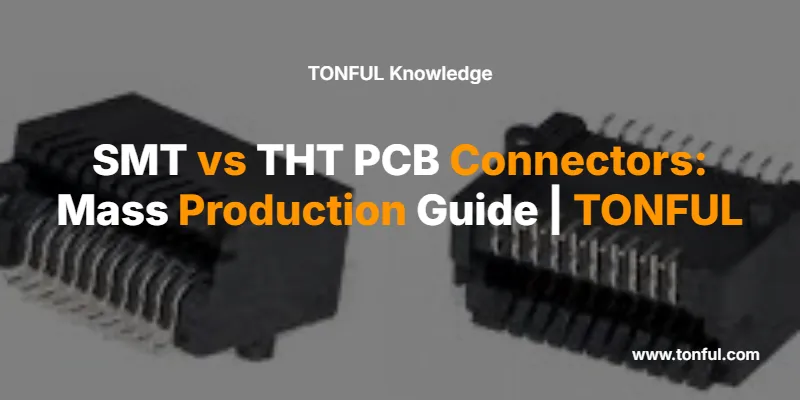
When selecting PCB connectors for high-volume manufacturing, engineers face a critical decision: Surface Mount Technology (SMT) or Through-Hole Technology (THT)? This choice directly impacts production costs, assembly speed, mechanical reliability, and long-term product performance. As a leading manufacturer of automotive electrical connectors and terminals, TONFUL Electric has extensive experience optimizing connector selection for mass production environments.
This comprehensive guide examines the technical, economic, and practical differences between SMT and THT PCB connectors to help you make informed decisions for your manufacturing operations.
Understanding SMT and THT PCB Connector Technologies
What is Surface Mount Technology (SMT)?
Surface Mount Technology involves mounting connector components directly onto the surface of printed circuit boards without drilling holes. SMT connectors use flat contact pads and are soldered using automated reflow ovens. Since the 1980s, SMT has become the dominant assembly method, accounting for over 90% of modern PCB assemblies due to its automation capabilities and space efficiency.

What is Through-Hole Technology (THT)?
Through-Hole Technology requires drilling holes through the PCB, inserting connector leads through these holes, and soldering them on the opposite side. THT connectors create robust mechanical bonds by anchoring leads through multiple PCB layers. While older than SMT, THT remains essential for applications requiring superior mechanical strength, particularly for automotive connectors and heavy-duty industrial equipment.

Comprehensive Comparison: SMT vs. THT for Mass Production
Assembly Speed and Throughput
| Factor | SMT Connectors | THT Connectors |
|---|---|---|
| Placement Speed | Up to 200,000 components per hour | 500-1,000 boards per day (typical) |
| Automation Level | Fully automated pick-and-place | Semi-automated or manual insertion |
| Production Throughput | 10-20x faster than THT | Significantly slower |
| Labor Requirements | Minimal human intervention | Higher labor costs for insertion |
Modern SMT assembly lines achieve extraordinary speeds through fully automated pick-and-place machines capable of positioning up to 200,000 components per hour. This automation advantage makes SMT the clear winner for high-volume production. In contrast, THT assembly requires component lead insertion—either manually or through slower automated insertion machines—followed by wave soldering or selective soldering processes that cannot match SMT reflow speeds.
Cost Analysis for Mass Production
| Cost Component | SMT | THT |
|---|---|---|
| PCB Fabrication | Lower (no drilling required) | Higher (drilling adds 30-40% to cost) |
| Component Costs | Generally lower due to smaller size | Higher due to larger components |
| Assembly Labor | Minimal (automated) | Significant (manual/semi-auto) |
| Equipment Investment | High initial, low per-unit | Lower initial, high per-unit |
| Per-Board Cost (High Volume) | $1-3 per board | $5-15 per board |
For mass production scenarios, SMT delivers substantial cost advantages. The elimination of drilling operations alone can reduce PCB fabrication costs by 30-40%. Combined with faster assembly speeds and minimal labor requirements, SMT typically achieves per-board costs of $1-3 in high-volume runs, compared to $5-15 for THT assemblies.

PCB Space Efficiency and Component Density
| Characteristic | SMT Connectors | THT Connectors |
|---|---|---|
| Minimum Pitch | 0.4mm – 0.5mm possible | 2.54mm (0.1″) typical minimum |
| Board Mounting | Both sides of PCB | Single side only |
| Component Size | Significantly smaller footprint | Larger physical dimensions |
| Routing Space | Maximum available | Reduced by through-holes |
SMT connectors enable dramatically higher component density, with minimum pitches as small as 0.4mm compared to THT’s typical 2.54mm spacing. Additionally, SMT allows component placement on both sides of the PCB, effectively doubling available real estate. This space efficiency is critical for modern compact electronics requiring miniaturization.
Mechanical Strength and Reliability
| Property | SMT Connectors | THT Connectors |
|---|---|---|
| Mechanical Bond Strength | Moderate (surface solder only) | Excellent (leads anchored through board) |
| Vibration Resistance | Lower | Superior |
| Thermal Cycling Durability | Good | Excellent |
| External Stress Tolerance | Poor (traces can peel) | Excellent |
| Best Applications | Internal connections, stable environments | External connectors, high-stress applications |
THT connectors provide superior mechanical reliability because leads pass through the PCB and are soldered on the opposite side, creating robust physical anchors. This makes THT the preferred choice for connectors subjected to repeated mating cycles, mechanical stress, vibration, or thermal cycling—common in automotive, aerospace, and industrial applications. SMT connectors, while adequate for stable internal connections, are more susceptible to solder joint failure under mechanical stress or impact.

Application-Specific Recommendations
When to Choose SMT Connectors
SMT connectors are optimal for:
- Consumer Electronics: Smartphones, tablets, wearables requiring miniaturization
- High-Volume Production: Products with annual volumes exceeding 10,000 units
- Cost-Sensitive Projects: Where per-unit cost reduction is critical
- Compact Designs: Space-constrained applications requiring high component density
- Internal Board-to-Board Connections: Pin header connectors, female header connectors, and wafer connectors for internal signals
- High-Speed Signal Applications: Where shorter signal paths reduce impedance
When to Choose THT Connectors
THT connectors remain essential for:
- Automotive Electronics: Engine control units, dashboard systems requiring vibration resistance
- Aerospace and Defense: Mission-critical systems demanding maximum reliability
- Industrial Equipment: Heavy machinery, robotics with high mechanical stress
- Power Connectors: High-current applications requiring robust connections
- External I/O Connectors: USB ports, power jacks, automotive combination switches subjected to repeated use
- Harsh Environments: Applications with extreme temperature cycling or vibration
- Prototyping: Low-volume development where manual assembly is acceptable
Hybrid Assembly Approach
Many modern designs strategically combine both technologies to optimize performance and cost:
- SMT for: Microcontrollers, resistors, capacitors, FPC/FFC connectors for internal signals
- THT for: Power connectors, external I/O, large electrolytic capacitors, transformers
This hybrid approach leverages SMT’s efficiency for high-density circuitry while using THT for mechanically critical components. Industries like automotive, medical devices, and industrial controls commonly employ this strategy.

Manufacturing Process Comparison
SMT Assembly Process
- Solder Paste Application: Automated stencil printer applies solder paste to surface pads
- Component Placement: High-speed pick-and-place machines position connectors with ±0.05mm accuracy
- Reflow Soldering: Controlled heating profile melts solder, forming connections
- Automated Optical Inspection (AOI): Machine vision verifies placement and solder quality
- Testing: Electrical testing confirms functionality
Process Time: 2-5 minutes per board (high-volume lines)
THT Assembly Process
- PCB Drilling: Precision drilling creates holes for component leads
- Component Insertion: Manual or semi-automated insertion of connector leads
- Wave Soldering or Selective Soldering: Molten solder wave creates connections
- Manual Inspection: Visual verification of solder joints
- Testing: Electrical testing confirms functionality
Process Time: 15-30 minutes per board (typical)
Quality and Reliability Considerations
Solder Joint Quality
| Aspect | SMT | THT |
|---|---|---|
| Joint Formation | Reflow oven (programmable, repeatable) | Wave/selective solder (variable) |
| Consistency | Excellent (automated process control) | Good (depends on operator skill) |
| Inspection | Automated AOI with high accuracy | Manual or semi-automated |
| Rework Difficulty | Requires specialized equipment | Easier with standard soldering iron |
SMT reflow soldering provides superior consistency through programmable temperature profiles and automated process control. This results in highly repeatable solder joint quality essential for mass production. THT wave soldering, while reliable, introduces more variables and typically requires manual inspection.
Environmental Durability
For applications involving harsh environmental conditions, consider these factors:
- Thermal Cycling: THT connectors better withstand repeated expansion/contraction cycles
- Humidity Exposure: Both technologies perform well with proper conformal coating
- Vibration: THT provides 3-5x better vibration resistance
- Shock Impact: THT anchored leads prevent component dislodgement
TONFUL’s waterproof wire connectors and sealed connector solutions complement both SMT and THT assemblies for outdoor and automotive applications.
Design Considerations for Engineers
PCB Layout Guidelines
For SMT Connectors:
- Maintain minimum 0.5mm clearance between pads
- Design thermal relief pads for heat dissipation
- Include fiducial marks for pick-and-place alignment
- Plan for both-sided assembly if needed
- Consider stencil aperture design for optimal solder paste volume
For THT Connectors:
- Ensure adequate annular ring around drilled holes (minimum 0.15mm)
- Plan hole diameter for lead tolerance (typically +0.1-0.15mm)
- Account for wave solder shadowing effects
- Reserve single-sided mounting area
- Consider via placement to avoid interference with through-holes
Transition Strategies
Companies transitioning from THT to SMT for cost reduction should:
- Conduct Design for Manufacturing (DFM) Review: Identify components requiring THT retention
- Prototype Hybrid Designs: Test mixed assembly before full conversion
- Validate Mechanical Requirements: Ensure SMT connectors meet stress specifications
- Invest in AOI Systems: Automated inspection critical for SMT quality control
- Train Assembly Personnel: Different skill sets required for SMT equipment operation
Cost-Benefit Analysis Summary
Break-Even Volume Analysis
| Production Volume | Recommended Technology | Rationale |
|---|---|---|
| < 100 units | THT | Lower tooling costs, manual assembly acceptable |
| 100 – 1,000 units | THT or Hybrid | Depends on complexity and budget |
| 1,000 – 10,000 units | Hybrid or SMT | SMT benefits begin outweighing setup costs |
| > 10,000 units | SMT (with THT for critical components) | Maximum cost efficiency through automation |
Total Cost of Ownership (5-Year Projection)
For a typical product with 50,000 units/year production:
SMT Approach:
- Initial equipment investment: $500,000 – $1,000,000
- Per-unit manufacturing cost: $2.50
- 5-year total: $1,625,000 (equipment + 250,000 units × $2.50)
THT Approach:
- Initial equipment investment: $100,000 – $200,000
- Per-unit manufacturing cost: $8.00
- 5-year total: $2,200,000 (equipment + 250,000 units × $8.00)
Savings with SMT: $575,000 over 5 years (26% reduction)
Industry Trends and Future Outlook
The electronics manufacturing industry continues evolving, with several key trends affecting connector selection:
Miniaturization Demands
Consumer electronics increasingly require smaller form factors, driving SMT adoption for box header connectors and high-density interconnects. Connector pitches continue shrinking, with 0.35mm pitch SMT connectors now commercially available.
Automotive Electrification
Electric vehicles demand both technologies: SMT for control electronics and THT for high-current power connections. TONFUL’s automotive connector solutions address this dual requirement with hybrid designs optimized for EV applications.
Advanced Manufacturing Technologies
- 3D Printed Electronics: Emerging additive manufacturing may blur SMT/THT distinctions
- Embedded Components: Connectors integrated within PCB layers reduce assembly steps
- Robotic Assembly: Advanced robotics improving THT automation economics
- AI-Powered Inspection: Machine learning enhancing SMT quality control
FAQ: SMT vs. THT PCB Connectors
Q: Can SMT connectors handle the same current as THT connectors?
A: Generally, THT connectors handle higher currents due to larger contact areas and better heat dissipation through leads anchored in plated holes. However, modern SMT power connectors with enhanced thermal management can handle 10-30A in many applications. For currents exceeding 30A, THT remains preferable.
Q: Is it possible to convert an existing THT design to SMT?
A: Yes, but requires careful redesign. Key considerations include verifying mechanical stress requirements, ensuring adequate PCB space for SMT footprints, validating thermal performance, and confirming connector availability in SMT packages. A hybrid approach often works best, retaining THT for mechanically critical connectors while converting other components to SMT.
Q: Which technology is more environmentally friendly?
A: SMT generally has lower environmental impact due to reduced material usage (smaller components), less PCB waste (no drilling), lower energy consumption (faster processing), and reduced chemical usage in manufacturing. However, both technologies can be manufactured to RoHS and environmental compliance standards.
Q: How does rework and repair differ between SMT and THT?
A: THT components are significantly easier to rework using standard soldering irons, making them preferable for prototyping and field-repairable products. SMT rework requires specialized hot air stations, precise temperature control, and skilled technicians. However, modern SMT rework stations make repairs feasible with proper training.
Q: What is the typical failure rate difference between SMT and THT connectors?
A: In stable environments, both technologies achieve similar reliability (< 100 FIT – Failures In Time per billion hours). However, in high-vibration or mechanical stress environments, THT connectors demonstrate 3-5x lower failure rates due to superior mechanical anchoring. Application-specific testing is essential for mission-critical designs.
Conclusion: Making the Right Choice for Your Production
The decision between SMT and THT PCB connectors for mass production ultimately depends on your specific application requirements, production volumes, and budget constraints. SMT dominates modern electronics manufacturing due to its superior cost efficiency, assembly speed, and space utilization—making it the default choice for high-volume consumer electronics and compact designs.
However, THT connectors remain indispensable for applications demanding maximum mechanical reliability, particularly in automotive, aerospace, industrial, and power electronics sectors. The most sophisticated designs often employ a hybrid approach, strategically leveraging each technology’s strengths.
As a leading manufacturer of electrical connectors and automotive electrical components, TONFUL Electric offers comprehensive connector solutions for both SMT and THT applications. Our engineering team provides design consultation to help you optimize connector selection for your specific mass production requirements.
For technical specifications on our PCB connector product line, including pin headers, female headers, box headers, wafer connectors, and FPC/FFC connectors, contact TONFUL Electric today.