
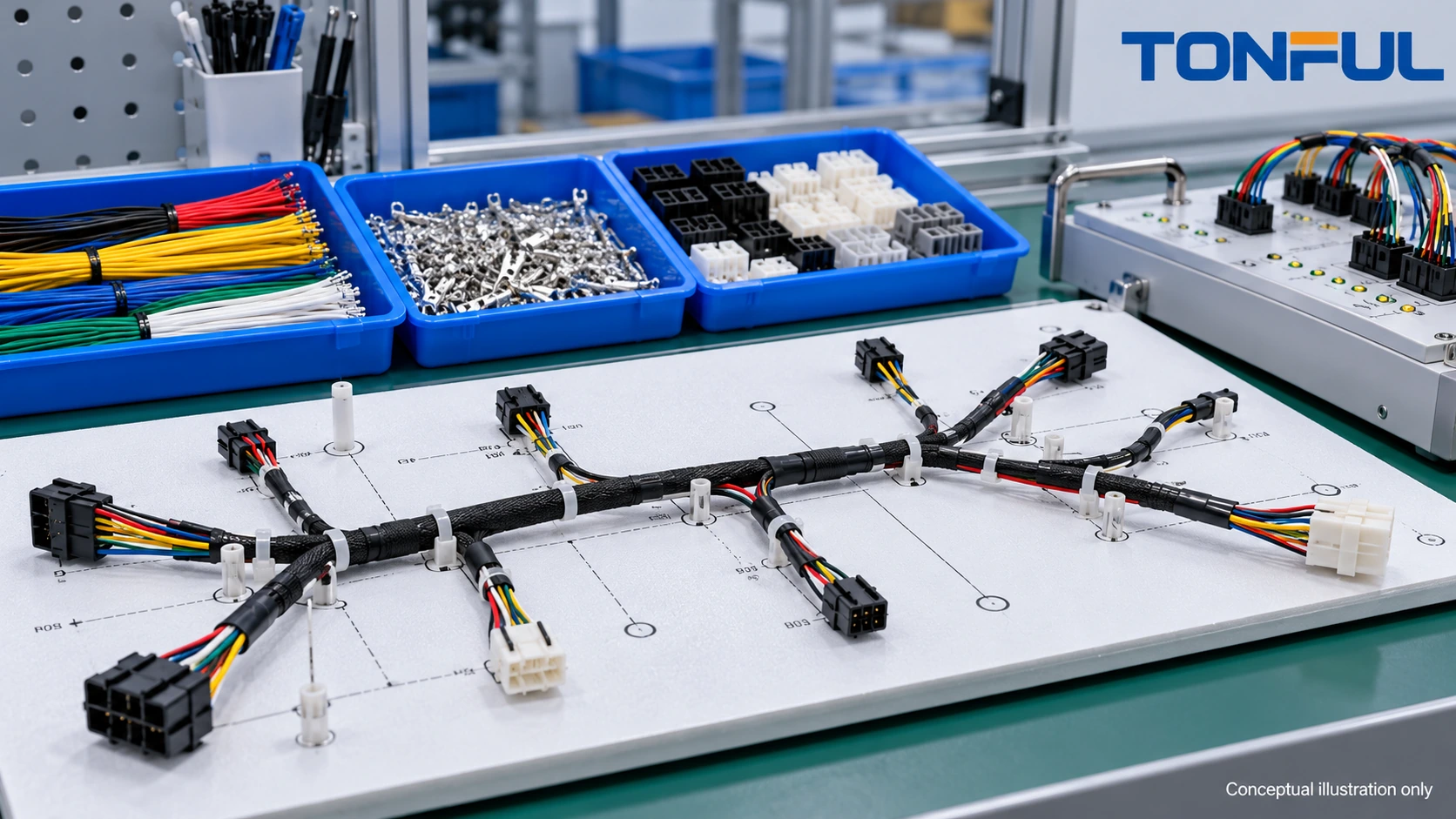
The wire harness manufacturing process converts a controlled circuit design into an assembly that can be built, inspected and tested repeatedly. Cutting wire and installing connectors are only part of that work. Production also needs approved materials, compatible termination tooling, clear routing datums and a test program tied to the correct pinout.
For buyers, the useful question is what evidence connects each operation to the finished lot. A supplier should be able to show which documents were used, how the setup was verified, what was inspected before concealment and how failures were contained. The sequence below describes a practical production route; exact methods and acceptance criteria depend on the harness and contract.
Review the Drawing and Release the Manufacturing Baseline
Resolve circuit and mechanical ambiguities
Start with the drawing, BOM, wire list, connector drawings and circuit schedule. Confirm that revisions agree and that the design owner has approved the documents for the intended build. Record unresolved items before purchasing materials or creating a tester map.
Connector views deserve particular attention. Identify mating-face versus wire-entry views, cavity numbering, key orientation and populated positions. A mirrored cavity map can produce an assembly that looks correct and passes an incorrectly mapped tester. Review circuit identity independently against the schematic or authorized design record.
For mechanical definition, identify branch datums, connector orientation, breakout locations, support points, service loops and covering limits. State whether lengths are measured straight, routed or under another specified condition. Capture installation context where enclosure geometry affects access or bending.
Use a requirement register for missing limits, contradictions and proposed changes. Each issue needs an owner, decision, approval and effective revision. The custom wire harness sourcing guide helps buyers organize the supplier-facing requirements without treating a general capability page as a product specification.
Link risk to shop-floor controls
Translate the released design into a process flow, risk review, control plan, work instructions and inspection records. Apply PFMEA or customer core-tool requirements where required by contract or project planning. The documents should agree about special characteristics, inspection frequency and reaction rules.
A terminal seating risk, for example, may require cavity identification, an insertion check and confirmation that the secondary lock closes correctly. An electrical test alone may not detect a partly retained terminal. Select controls from the failure mechanism rather than adding generic inspections to every operation.

Receive, Identify and Prepare the Correct Materials
Receiving checks should confirm the exact manufacturer and part number, approved source, lot identity and drawing requirements. Similar connector housings can use different terminals or seals. Wire must match conductor construction, insulation, size, outside diameter and color requirements where specified.
Maintain identification after packaging is opened. Link reels, terminal strips, seal bags and protective materials to the work order or finished lot at the required traceability level. Record partial reels and leftover materials so they do not lose identity when returned to stores.
Control cutting and stripping
Prepare a cut list tied to the released wire schedule. Specify length, strip dimensions, end preparation, marking and orientation. Verify the setup on actual wire before processing the order. Recheck after relevant machine adjustments, wire changes or interruptions according to the control plan.
Inspect for nicked strands, cut strands, insulation damage, residue and incorrect strip length. Wire material and strand construction affect blade settings and handling. A stripping program approved for one wire does not automatically apply to another wire with the same nominal gauge.
Keep prepared circuits identified through later operations. If marks are applied before cutting, confirm that the printed position and orientation remain correct after trimming. Prevent mixed lengths or colors from entering the same tray without a controlled sorting method.
Establish restart and material-change checks
First-piece verification should show that the resumed process produces the intended feature. Define which changes trigger it: wire reel, terminal reel, applicator, program, blade adjustment or maintenance. Retain the result rather than relying on a verbal setup approval.
Protect prepared conductors from contamination and deformation. Do not introduce tinning, twisting or other end treatment unless the approved termination process requires it. Such changes can alter the fit and behavior of a crimp connection.
Terminate, Splice and Assemble With Verified Setups
Match tooling to the termination system
Confirm the terminal, wire and approved tool or applicator combination. Record tool identity, cavity or setup, relevant maintenance status and verification results. Follow component-specific application instructions and the governing acceptance documents for conductor crimp, insulation support and seal positioning.
Crimp height, pull results, visual inspection and section analysis provide different evidence. Select their use and frequency from the product requirements and process risk. Force monitoring can reveal deviations from a qualified process signature, but it cannot substitute for establishing the correct setup and limits.

For workmanship context, IPC’s official IPC/WHMA-A-620 overview identifies its coverage of interconnection materials, methods and acceptance activities. Buyers must state the agreed revision and class, then resolve product-specific requirements through the drawing and contract. Citing a standard does not establish supplier certification.
Inspect hidden features before covering
Splices need a defined wire combination, location, method and protective construction. Multi-branch connections should be engineered for the actual conductors and applicable requirements. Do not select a barrel or weld setup merely from nominal gauge labels.
Inspect terminals, seals, splices and conductor condition while accessible. Preserve the required evidence before tape, sleeves, overmolds or backshells conceal them. Where soldering is specified, apply the appropriate controlled process and inspect the required features before assembly continues.
Build on a controlled formboard or fixture
Identify the formboard revision and verify its datums against the drawing. Route branches without pulling conductors into position or transferring fixture tension to terminals. Confirm wire identity at each connector cavity, terminal seating, secondary locks and unused-cavity treatment.
Apply covers, tape, conduit, labels and clips at defined positions. Excessively tight bundling can affect flexibility and insulation; loose coverings can interfere with installation. Check the finished harness in the specified measurement condition. The HMLV prototyping guide explains how production-intent samples can expose these assembly difficulties before repeat orders.
Test the Released Circuit Map and Control Failures
Validate the tester and its measurement boundary
The test program and fixture need an identity, revision and approval against the released pinout. Verify expected connections and prohibited connections. Use defined fault challenges to show that the setup detects the opens, shorts or miswires it is intended to detect.
State measurement conditions and the source of acceptance limits. Continuity tests establish connectivity within the selected threshold; they do not prove every power connection has acceptable loaded voltage drop. The harness continuity testing guide develops that distinction.
Include resistance, insulation resistance, dielectric withstand, shielding or functional tests when the product or approved plan requires them. Identify connected electronics and sensitive components before applying a test. Qualified personnel should use approved equipment, fixtures and safety procedures for energized or high-voltage testing.
Preserve failed results and authorize retests
Record the failed circuit, program, fixture, work order and unit identity. Inspect the assembly and fixture before deciding the cause. A worn fixture contact can generate a false open, while an intermittent product fault can disappear when the harness is moved. Preserve both the initial result and investigation.
Define invalid-test criteria separately from product failure. Rework needs an authorized method and post-rework verification of affected and related characteristics. Passing after repeated attempts does not erase a valid failure. Trend recurrence by component, tool, operator, fixture and build condition as appropriate.
When a valid defect suggests a shared setup problem, establish the containment boundary from the last demonstrated acceptable condition. Include work in progress and shipped material where the traceability evidence supports that scope. Verify the corrected setup before restarting, then retain the authorization and the affected lot identifiers. If the records cannot establish a narrow boundary, quality personnel must determine a conservative containment scope rather than excluding assemblies by assumption.
Review the corrective action at the operation that created the defect. Changing a final-test threshold to accept an unexplained failure can hide the original problem. Confirm whether the instruction, material combination, fixture, tool or design requires revision, and update the linked control documents before closing the action.
Release the Lot, Protect the Assembly and Discuss Your Build
Final inspection should confirm dimensions, connector configuration, labels, protection and required test records. Packaging must prevent crushed contacts, sharp folding, seal damage and mixed revisions. Identify the finished configuration and link it to the lot documentation.

| Production checkpoint | Evidence to retain | Release question |
|---|---|---|
| Document review | Drawing, BOM and pinout revisions | Are conflicts closed? |
| Material issue | Approved parts and lot references | Are sources and identities controlled? |
| Wire preparation | Cut/strip setup and first-piece result | Is conductor condition acceptable? |
| Termination | Tool identity and required verification | Is the combination qualified? |
| Assembly | Fixture revision and hidden-feature checks | Are routing and retention correct? |
| Electrical test | Program, fixture and unit results | Are required circuits verified? |
| Rework | Authorization and repeat inspection | Is disposition justified? |
| Packaging | Configuration, label and pack review | Is delivery protected and traceable? |
Before repeat production, review changes to components, sources, tooling, instructions, fixtures and test programs. Determine the affected approval evidence and effective lot. The IPC workmanship guide can support contractual acceptance discussions, while the project documents define the complete released configuration.
Send your drawing, BOM, circuit map, installation requirements and forecast through TONFUL’s project enquiry channel. Ask for a proposed manufacturing route that identifies open requirements, component choices, inspection gates and testing responsibilities. Confirm product-specific capabilities, documentation and quotation terms before authorizing samples or production.