
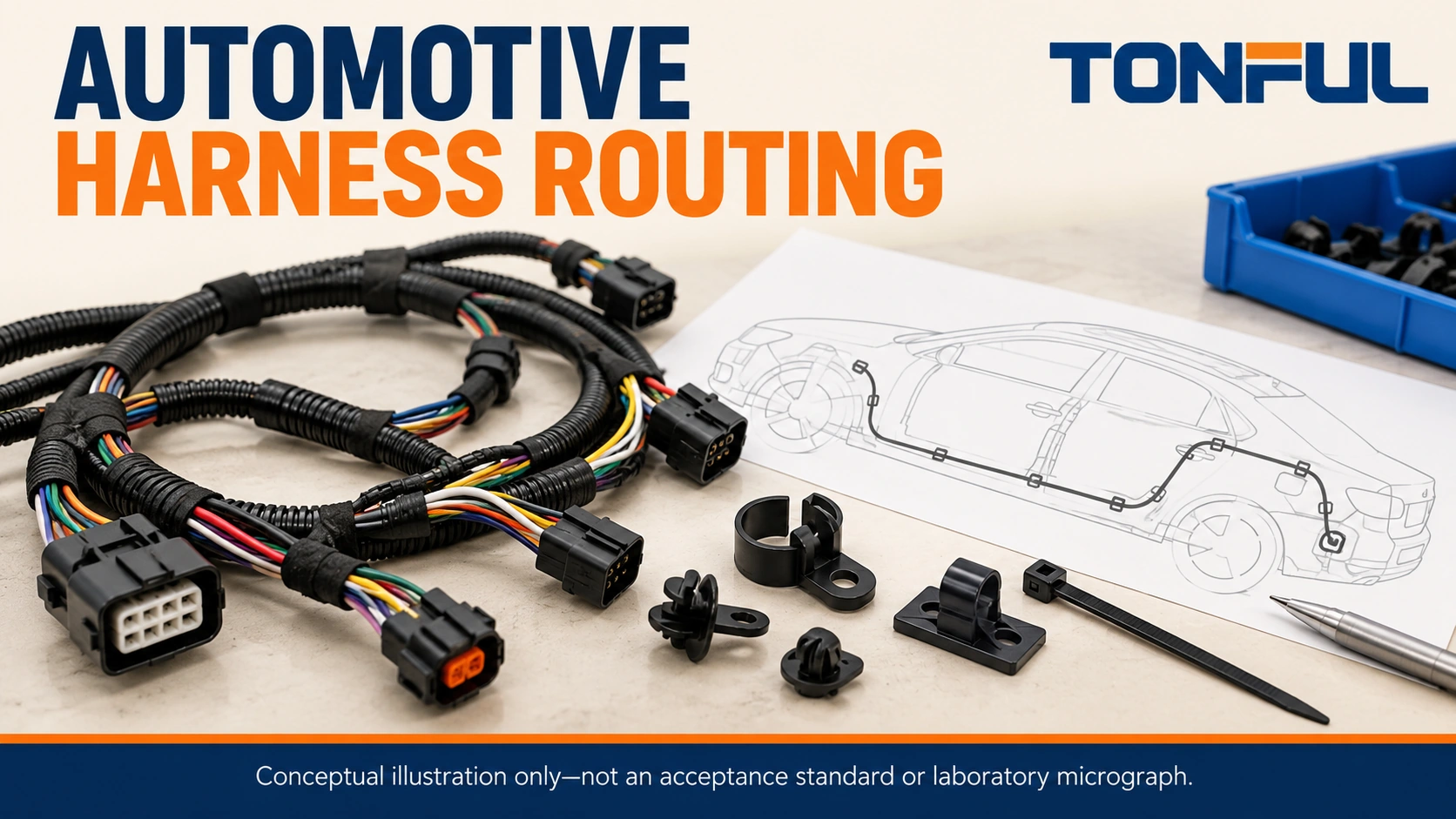
An automotive harness can pass a bench continuity test and still fail after installation. A branch may touch a hot surface, a connector may carry harness weight, or a clip may release when the vehicle vibrates. Reliable design therefore starts with the installed route and its electrical duty, not simply a list of wire colors and connector names.
Define each branch by circuit function, exposure zone, mechanical interface and verification requirement. This guide focuses on project planning and supplier approval. It does not provide a universal vehicle pinout, a generic “automotive-grade” temperature range or instructions for working on energized high-voltage or safety systems.
On this page: Requirements, Routing, Loads and exposure, Release evidence, TONFUL enquiry.
Map the Vehicle and Circuit Requirements
Identify the actual vehicle configuration
Record platform, market, production range, steering position and installation location. Capture the controlled vehicle drawing, connector end views and applicable revisions. Similar vehicles can have different modules, fuse arrangements and network options. A photograph of an existing harness is useful evidence, but cannot establish every circuit or permitted replacement.
Separate power distribution, motor circuits, sensor inputs, illumination and communication paths. Confirm the required conductor, return path, protection and connector contact for each circuit. A nominal 12 V or 24 V vehicle system does not mean every terminal operates at that voltage. Module references and network interfaces must be identified before any test power is applied.
Use the wire gauge selection guide to connect current, voltage drop and installation conditions. Wire cross-section alone does not establish system ampacity. Evaluate the insulation grade, connector capacity, bundle heating, duty cycle and protective device under the approved application requirements.
Establish safety and system boundaries
Vehicle work should follow the manufacturer-specific service procedure and be performed by appropriately qualified personnel. Steering-column and occupant areas may include SRS wiring; do not probe SRS circuits or apply external power to unidentified cavities. Follow the specified isolation, waiting and restoration instructions without substituting a universal delay.
High-voltage propulsion circuits, battery connections and safety-critical controls need their own authorized procedures, equipment and validation responsibilities. Do not use a low-voltage harness checklist as permission to service those systems. Resistance and continuity measurements require a safely isolated circuit; an ohmmeter must not be connected to an energized path.
Design the Installed Route
Define clearance, support and assembly access
Create a route drawing with fixed references, branch lengths and connector orientations. Identify nearby sharp edges, moving mechanisms, fasteners and service points. Check the route through the complete intended motion, not just the parked position. A protective sleeve should not be used to excuse continuous contact with an unacceptable edge.
Specify clip and grommet part numbers, mounting interfaces and permitted locations. Panel thickness, hole size and edge direction can affect retention. Avoid transferring bundle weight or assembly pull into contacts. Review slack and service loops so that they permit installation without allowing movement into a heat source or rotating component.
Account for the assembly sequence. A branch that fits after a panel is removed may be impossible to install on the production line. Check connector access, latch engagement, fastener tools and removal clearance with representative parts. Use harness protection planning to define localized covering rather than adding bulk across the entire route.
Treat flexing branches differently
Door, hatch and seat branches experience movement that a static harness does not. Identify bend and torsion zones, restraint transitions and cable construction appropriate to that duty. Do not assume ordinary fine-stranded wire is qualified for repeated motion. The connector exit should not become the uncontrolled first bend point.
Record minimum and maximum positions, available space and interference with trim or seals. A trial should include realistic assembled geometry. If the harness rubs only at the end of travel, a test confined to the center position will miss the mechanism. Preserve those observations before adjusting the prototype so that the drawing change has an identifiable reason.

| Route zone | Main question | Evidence to retain |
|---|---|---|
| Near heat source | Ambient, radiant and loaded-conductor heating? | Location, operating duty and temperature measurements |
| Moving door or seat | Bend, torsion and restraint transitions? | Motion geometry and monitored endurance results |
| Panel penetration | Edge condition, grommet and sealing boundary? | Interface drawing and installed inspection |
| Exposed underside | Fluids, debris and mechanical contact? | Exposure specification and protection evaluation |
| Module interface | Latch, strain relief and access? | Connector seating and installation trial |
| Service branch | Safe removal and repeatable restoration? | Service procedure and reinspection record |
Separate Electrical, Thermal and Mechanical Validation
Electrical loads are not the entire environment
Define supply operating conditions, protection, polarity and circuit-specific behavior from customer or OEM documents. Include abnormal supply conditions where required by the approved plan. A terminal intended for a low-current input must not be treated as a direct motor-load contact. Bench supplies require confirmed connections, current limiting and suitable breakout fixtures.
ISO 16750-2:2023 addresses electrical loads for road-vehicle electrical and electronic equipment and does not cover electromagnetic compatibility. Use the applicable project requirements to decide relevance, conditions and acceptance; citing the standard does not prove that a TONFUL harness or vehicle has complied with it.
Mechanical and climatic requirements need separate applicable documents and plans. Electronic interfaces may also need customer-approved EMC and ESD evaluation. Passing component tests does not establish complete-vehicle EMC compliance. Keep the source and responsibility for each requirement visible in the validation matrix.
Heat and vibration require representative fixtures
Thermal evaluation should identify measurement locations, circuit loading, ambient conditions and adjacent heat sources. Added tape, tubing and close bundling can change heat dissipation. Record stabilized behavior where required and examine connectors as well as wire surfaces. Do not substitute an insulation manufacturer’s maximum temperature for an acceptable installed temperature rise.
Vibration testing needs the specified fixture, restraint spacing, harness mass, orientation and excitation conditions. A rigid laboratory clamp can suppress the movement that occurs in the vehicle. Conversely, an unrealistic loose fixture can introduce unrelated damage. Include connector retention, covering migration and relevant electrical monitoring in the agreed acceptance criteria.
Record fluid agents, concentrations, exposure time and recovery conditions when chemical compatibility matters. Inspect insulation, seals, labels and adhesive systems afterward. Salt, cleaning fluid and water exposure are not interchangeable tests. Any ingress claim must identify the exact assembly, mating state and test boundary, including open cable ends.
Monitor meaningful failure modes
Set baseline electrical and dimensional results before aging. The harness continuity testing guide distinguishes opens, shorts and miswires, but a basic continuity pass cannot establish contact heating or mechanical retention. Additional measurements should follow the circuit risk and approved acceptance documents.
For intermittent faults, state the monitor’s coverage and detection capability. Retain the first interruption event rather than only the final reading. Inspect wear locations before teardown and separate a primary route defect from secondary heat or mechanical damage. A replaced specimen cannot be used to silently remove the original failure from the report.

Build the Sample and Production Release Record
Allocate samples before testing
Agree sample quantity and selection basis with the responsible customer or engineering authority. Identify whether specimens undergo sequential tests or independent exposures. Reserve unaged references and destructive-analysis samples where needed. State how conditioning, invalid tests and authorized retests are handled before execution begins.
Use production-intent components and identify any prototype deviations. A hand-built harness can establish routing feasibility without demonstrating serial-production capability. The manufacturing process guide connects drawing review, assembly instructions, inspection and final testing. Verify first-piece checks after relevant changes in tooling, material or program revision.
Copyable automotive release record
Include a production installation trial in the release review. Observe how operators route the branch, engage each clip and confirm connector seating with the surrounding parts present. Record inaccessible checks, forced assembly and any need to twist a connector to reach its mating half. Where multiple variants share a workstation, verify labeling and mistake-proofing against the actual variant mix. An installation that succeeds only after an engineer manually rearranges the prototype needs a drawing or process correction. Retain the corrected trial result and update training materials so that the approved route is repeatable beyond the original sample builder.
| Record field | Required entry |
|---|---|
| Vehicle scope | Platform, market, production range and configuration |
| Harness definition | Part, revision, circuit map and approved deviations |
| Electrical duty | Load, return, protection and channel conditions |
| Route | Branch geometry, supports, clearances and service access |
| Materials | Wire, contacts, seals, coverings and lot identity |
| Sample plan | Quantity, allocation, baseline and destructive specimens |
| Test setup | Fixtures, instruments, calibration and monitoring |
| Results | Initial, aged and failure evidence with limit source |
| Production control | Work instruction, inspection and program revisions |
| Release | Approved application, unresolved items, reviewer and date |

Review changes at the interface level. A different terminal plating, insulation formulation, seal or clip may affect existing results even if the circuit map is unchanged. Define customer notification, revalidation and inventory disposition. Do not mix revised and previously approved constructions under one indistinguishable label.
Receiving inspection should verify the delivered revision, labels, packaging and agreed sample checks. Field returns need traceable lot identity and preserved installation evidence. A wiring replacement should not erase the information needed to determine whether the fault arose from manufacture, routing, vehicle damage or an unauthorized modification.
Work With TONFUL on a Defined Automotive Harness
Share the vehicle drawings, connector list, circuit duty, route constraints and required approval documents through TONFUL’s enquiry channel. Ask for a construction proposal and identify which validation activities belong to the supplier, customer and vehicle integrator.
Release only the application and revision supported by the reviewed evidence. Avoid treating a sample continuity pass, an “automotive” material description or an attractive routing photograph as complete vehicle approval. The strongest RFQ makes electrical, installation and production requirements measurable before manufacture begins.