
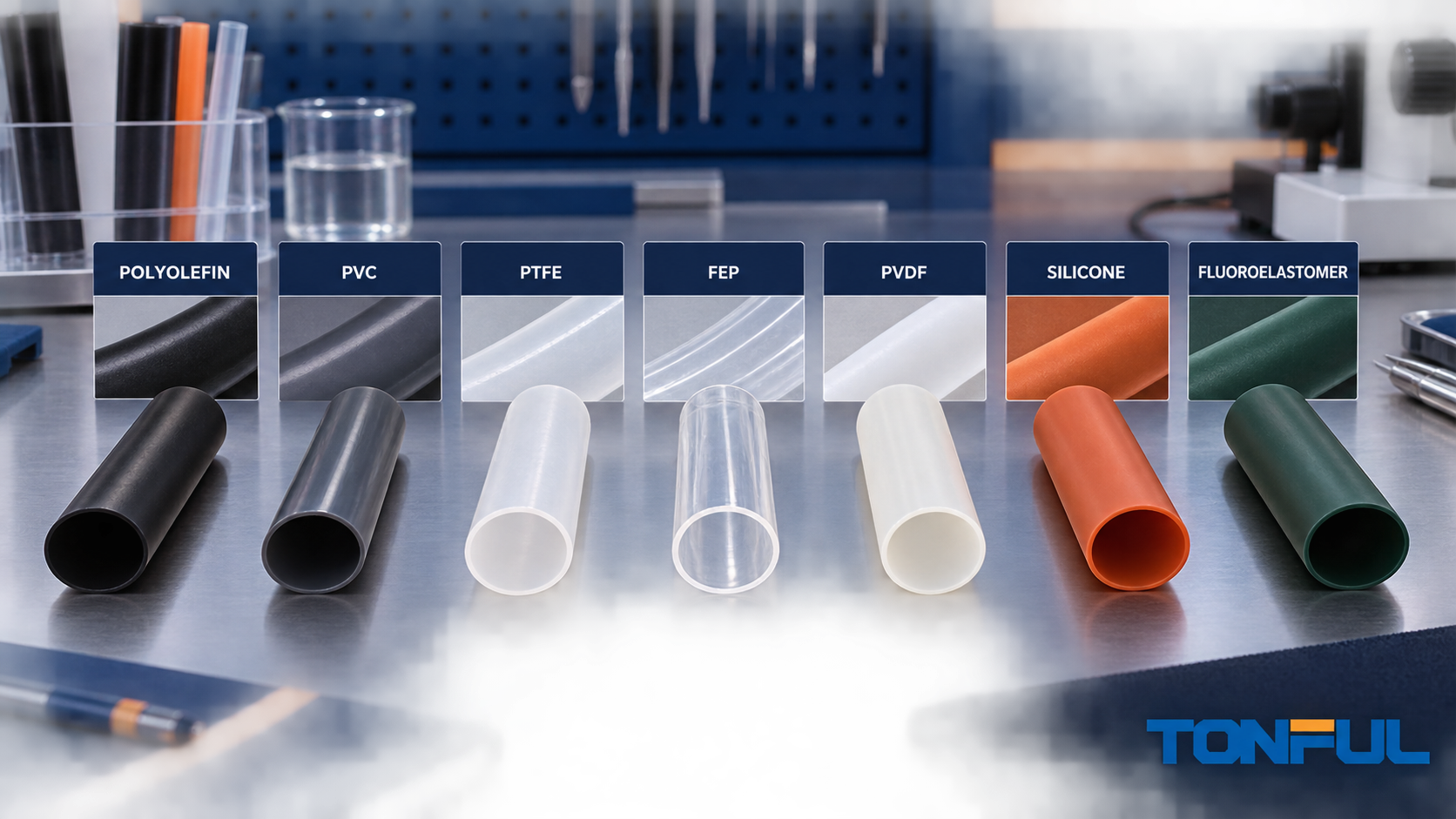
Selecting a heat shrink tubing material is not a contest to find the polymer with the highest catalog temperature. The correct material must survive the real service environment, recover without damaging the assembly, provide the required flexibility and mechanical protection, and carry evidence that applies to the exact product, size and color. Cost, availability, printing, adhesive compatibility and production equipment also affect the decision.
This heat shrink tubing material guide compares seven major families at an engineering level. The descriptions are selection starting points, not universal ratings. Formulation, cross-linking, additives, pigmentation, wall construction and test method can materially change performance within one family. Use the selected manufacturer’s drawing and test documents for final approval.
On this page: Decision criteria | Material profiles | Process compatibility | Evidence matrix | Release workflow
Compare Materials by the Same Decision Criteria
Before naming a polymer, define the conditions it must meet:
- Continuous and short-duration service temperature at the tubing location.
- Minimum installation temperature and the heat needed for complete recovery.
- Contact with fuels, oils, hydraulic fluids, coolants, cleaners, solvents, water or salt.
- Flexing, vibration, abrasion, sharp edges and required bend transition.
- Sunlight, weathering, humidity and storage exposure.
- Electrical-insulation role, recovered wall and completed-system requirements.
- Flame, smoke, toxicity, halogen or agency evidence required by the project.
- Transparency, color identification, printing and marking durability.
- Adhesive or sealant need and compatibility with every substrate.
- Production method, cycle time, rework, packaging and supply continuity.
Do not combine distinct temperatures in one field. Continuous operating range describes service. Shrink onset indicates where recovery begins. Full-recovery conditions describe the installation process. A high-temperature polymer can require a process that is unacceptable for a nearby connector, solder joint, battery cell, adhesive or wire insulation.
The TONFUL heat shrink tubing buying guide places material selection within the wider decisions for geometry, wall, ratio, process and validation.

Compare the complete application and exact product rather than choosing a polymer from one catalog value.
Material Family Profiles
Cross-Linked Polyolefin
Polyolefin offers a broad balance of flexibility, electrical insulation, color availability, processing and cost. It is widely used for wire harnesses, splice covering, identification and adhesive-lined tubing. Its broad use does not make all grades equivalent. General-purpose, flame-retardant, halogen-free, UV-stabilized, fluid-resistant and high-ratio formulations can have different evidence and application limits.
Polyolefin is often the first family evaluated when the environment is moderate and a wide size or color range matters. Confirm the specific operating and recovery conditions, wall, longitudinal change, fluid response and flame or agency status. Black color alone does not prove outdoor stabilization, and one recognized series does not extend recognition to every polyolefin tube a supplier sells.
PVC
PVC heat shrink tubing may support flexible coverings, sleeves, battery-pack wrapping, labels or selected electrical applications. Formulation and plasticizer system strongly influence flexibility, recovery behavior, aging and compatibility. PVC products may use different manufacturing and heating windows from cross-linked polyolefin.
Evaluate PVC where low-profile flexibility, color, clarity or commercial requirements make it appropriate, but request the actual product data. Confirm whether the application restricts halogens, smoke, additives or plasticizer migration. Do not infer flame performance or regulatory compliance from the polymer name.
PTFE
PTFE is considered for elevated-temperature, chemical and low-friction applications. Its recovery process can require much more heat than ordinary general-purpose tubing, so the substrate and production equipment become central selection constraints. Thin components, sensitive insulation and electronics can be damaged before the PTFE tube completes recovery if the process is not designed correctly.
Request the exact expansion ratio, supplied and recovered dimensions, recovery method, wall, service conditions and qualification. TE Connectivity’s AT053 product family illustrates why PTFE offerings must be reviewed at part-number level: construction, dimensions and documents vary within a family. That page is an external example, not evidence for a TONFUL product.
FEP
FEP can be useful where transparency, chemical exposure and elevated-temperature service are important. Transparent tubing can support visual inspection or encapsulation, but clarity does not establish sealing, biocompatibility, electrical approval or long-term optical performance. Confirm recovery temperature, wall, longitudinal change, environmental stress cracking and interaction with the substrate.
FEP and PTFE should not be treated as interchangeable “Teflon-type” products. They differ in processing, mechanical behavior and available constructions. Use precise polymer identification and avoid using a trademark as a generic material specification.
PVDF
PVDF may offer an attractive combination of toughness, abrasion behavior, chemical resistance and selected flame performance. It can be used in electrical, industrial and identification applications where a general-purpose tube does not provide the required balance. As with every family, results depend on grade, pigmentation, wall and test method.
Verify low-temperature flexibility, recovery process, fluid exposure and marking compatibility. If a project requests low smoke, flame or rail-related evidence, identify the exact standard and covered product rather than relying on PVDF’s general reputation.
Silicone
Silicone heat shrink tubing may be selected for flexibility and performance across demanding temperature conditions. Its soft, elastic nature can be useful around sensitive or moving assemblies, yet the same softness can affect abrasion resistance, handling, cutting and dimensional measurement. Surface chemistry can also influence adhesion and printing.
Specify hardness or mechanical properties where they matter, along with tear behavior, recovered dimensions, process conditions and fluid exposure. Medical, food-contact or biocompatibility claims require dedicated documentation for the exact formulation; they cannot be inferred because the product is silicone.
Fluoroelastomer
Fluoroelastomer tubing may be evaluated for fuel, oil, hydraulic-fluid and elevated-temperature environments. It is often considered for engine, industrial and aerospace locations where fluid aging is a major risk. The term still covers multiple formulations. Require exact polymer identification, fluid-aging data, mechanical results and service conditions.
“Viton” is a trademark associated with specific fluoroelastomer products and should not be used as a generic substitute for any fluoroelastomer. A supplier must substantiate the actual material source if a branded polymer is specified.
The TONFUL types of heat shrink tubing guide explains how these material names combine with wall type, ratio, thickness, function and supply form.
Quick Material Comparison
| Material family | Common reason to evaluate | Process question | Evidence priority |
|---|---|---|---|
| Polyolefin | Broad harness, insulation, identification and dual-wall availability | Does the exact grade recover safely on the assembly? | Dimensions, temperature definitions, fluids, flame/agency scope |
| PVC | Flexible, colored, clear or packaging-style applications | Is the heat process and formulation compatible with the substrate? | Additives, aging, flame and regulatory documents |
| PTFE | High temperature, chemicals and low friction | Can production safely achieve full recovery? | Recovery method, dimensions, qualification and fluid data |
| FEP | Transparency and selected chemical/temperature needs | Will clarity and dimensions remain acceptable after recovery? | Optical, recovery, fluid and electrical evidence |
| PVDF | Toughness, abrasion and selected flame/chemical requirements | Does the grade meet flex and marking needs? | Exact grade, flame method, chemical and mechanical tests |
| Silicone | Flexibility across demanding temperatures | Can it be handled, cut and inspected repeatably? | Hardness, tear, dimensions, fluid and special-use documents |
| Fluoroelastomer | Fuel, oil and elevated-temperature exposure | Is the formulation and recovery process controlled? | Polymer identity, fluid aging, temperature and mechanical evidence |
This table deliberately omits universal temperature numbers. Publishing one value per material would hide differences among grades and could cause an engineer to use a service value as an installation limit.
Use the TONFUL heat shrink tubing range to identify candidate supply families, then request the exact drawing and evidence rather than transferring this editorial comparison into a product claim.
Recovery Process and Assembly Compatibility
Separate Tubing Capability From Substrate Capability
The tube is only one element of the assembly. Wire insulation, connector seals, solder, adhesive, plating, labels and nearby electronics may have lower process-temperature limits. Validate the complete thermal exposure, not only the nominal heat-source setting. Air temperature at a nozzle, surface temperature and polymer temperature are not automatically equal.
Metal terminals and busbars can act as heat sinks, producing incomplete recovery beside overheated polymer. Transparent fluoropolymers may reveal the substrate but still require controlled circumferential heating. Silicone or elastomeric products may deform under measurement pressure. The process plan should therefore define equipment, fixture, sequence, endpoint and inspection for the selected material.

Conceptual thermal boundary; verify the process limit of every component from controlled documentation.
Evaluate Adhesive as a Separate Material
In dual-wall tubing, the outer polymer and inner adhesive have separate functions. The outer wall’s environmental reputation does not prove that the liner bonds to PVC wire insulation, cross-linked cable jackets, metals, fluoropolymers or silicone. Request adhesive identity or compatibility evidence where needed and test cleaned production substrates.
For moisture protection, condition and test the completed joint. Adhesive flow at the tube end does not prove that internal voids are absent. The marine heat shrink tubing guide gives application context, but project approval must stay tied to the tested product and joint.
Build a Material Evidence Matrix
UL Solutions states that its insulating tubing testing and certification program covers submitted tubing products under applicable electrical, mechanical and flammability requirements. Verify the exact category, file and designation. Do not convert a supplier’s general UL logo into evidence that every material, color and size is recognized.
| Evidence field | Required entry |
|---|---|
| Product identity | Manufacturer, series, part number, revision, material and color |
| Dimensional control | Expanded ID, recovered ID, recovered wall and longitudinal change |
| Temperature definitions | Service range, shrink onset, full-recovery condition and test method |
| Mechanical evidence | Tensile, elongation, abrasion, tear or other project-required results |
| Fluid/chemical evidence | Media, concentration, time, temperature and acceptance criteria |
| Electrical evidence | Test method, wall, conditioning, specimen and system boundary |
| Flame/smoke evidence | Standard edition, specimen orientation, result and covered product |
| Environmental evidence | UV, humidity, thermal aging or other required conditioning |
| Compliance documents | Exact scope of restricted-substance or certification records |
| Assembly validation | Substrate, process, sample quantity, results, deviations and approver |
RoHS or REACH documentation does not replace flame, electrical or mechanical testing. UL 94 and VW-1 are not interchangeable labels. An IP rating generally belongs to a tested enclosure or completed interface under defined conditions, not automatically to an adhesive-lined tube by itself.

Conceptual record map with blank evidence fields; it does not show test results or product approval.
Material Selection and Release Workflow
- Define the application, substrate and failure consequences.
- Record service and installation environments separately.
- Shortlist materials by the complete requirement set, not maximum temperature.
- Select real product series and sizes with controlled drawings.
- Review material-, size-, color- and construction-specific evidence.
- Test fit, recovery and process margin on tolerance-limit assemblies.
- Complete required environmental, electrical and mechanical validation.
- Approve the exact product, process, packaging and change-control scope.
For purchasing, compare accepted installed cost. A specialty polymer may cost more per meter but solve a necessary fluid or temperature problem. It may also require slower heating, specialized equipment or more inspection. Conversely, specifying a premium fluoropolymer where polyolefin meets the approved requirement adds cost and process complexity without evidence of added project value.
The bulk heat shrink tubing sourcing guide covers lot traceability, samples, packaging and supplier controls after the material is selected.
Discuss Heat Shrink Materials With TONFUL
Send TONFUL the service and installation temperatures, exposed fluids, substrate materials, diameter range, wall and sealing needs, required evidence, color or printing, packaging and expected volume. TONFUL can discuss candidate material families and samples within its documented supply range. Final approval should name the exact part and remain limited to the validated assembly and process.