
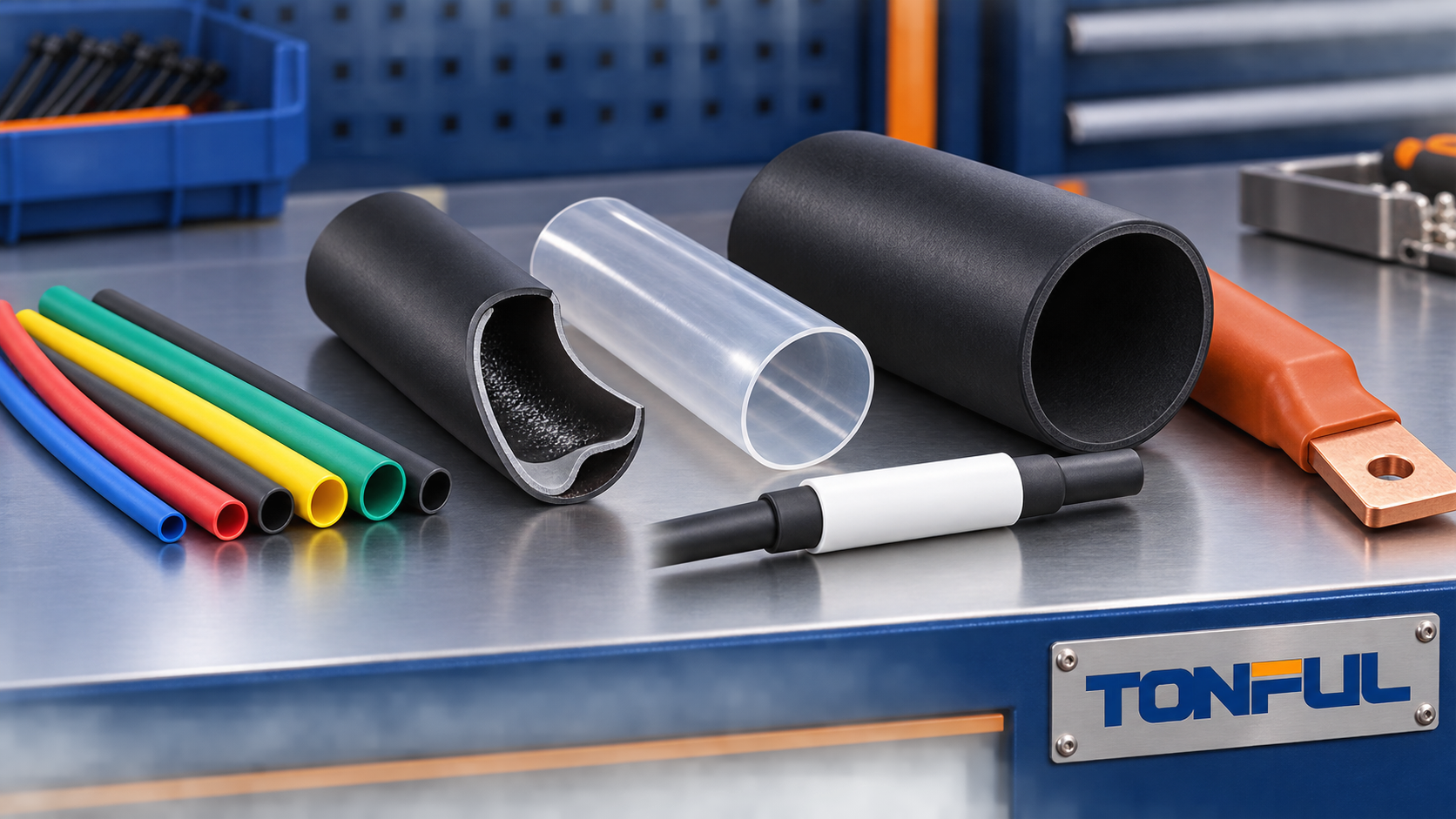
Heat shrink tubing is often described with one label such as “polyolefin,” “3:1” or “dual wall,” but those terms belong to different classification dimensions. Material identifies the polymer family. Single- or dual-wall describes construction. A shrink ratio describes dimensional recovery. Thin, medium or heavy wall describes an installed construction within a product family. Printable, busbar and cable-repair tubing describe functions or applications. One product may therefore be a black, 3:1, adhesive-lined, medium-wall polyolefin tube intended for cable sealing.
This guide organizes the main types of heat shrink tubing without treating overlapping categories as mutually exclusive. It helps engineers and buyers define the product they need before comparing dimensions, evidence and commercial offers. Product names alone do not establish temperature, voltage, flame, fluid, ultraviolet or sealing performance; those claims must match the exact series, size, color and supporting document.
On this page: Classification dimensions | Materials | Wall construction | Ratio and wall | Functional types | Selection record
Classify Tubing on Separate Dimensions
The quickest way to prevent specification errors is to classify every candidate in the same order.
| Classification dimension | Common options | What it answers |
|---|---|---|
| Material | Polyolefin, PVC, PTFE, FEP, PVDF, silicone, fluoroelastomer | What polymer behavior is available? |
| Wall construction | Single wall, dual wall, adhesive-lined, sealant-lined | Does the product only recover, or also fill and bond? |
| Shrink ratio | 2:1, 3:1, 4:1 and product-specific higher ratios | What diameter transition can the size accommodate? |
| Recovered wall class | Thin, medium, heavy | What installed profile and mechanical protection are intended? |
| Function | Insulation, sealing, identification, abrasion protection, strain transition | What task must the tubing perform? |
| Application family | Harness, marine, cable repair, busbar, aerospace, telecom | Which system requirements and validation apply? |
| Supply form | Spool, stick, cut piece, printed sleeve, kit | How will production receive and control it? |
A buyer should not request “3:1 tubing” and expect suppliers to infer the material, adhesive, wall, dimensions and environment. Likewise, “marine grade” or “automotive grade” is not a complete technical type. Convert marketing descriptions into measurable product fields and an approved application test.
The TONFUL heat shrink tubing product page introduces available material and construction discussions. Confirm each requested capability against a controlled model-level document before using it in a drawing or catalog.

Conceptual classification aid showing why one heat shrink product can belong to several overlapping categories.
Material Families
Cross-Linked Polyolefin
Polyolefin is widely used for general electrical insulation, harnessing, identification and adhesive-lined products. It is available in many colors, ratios and wall constructions. This breadth is also why the word “polyolefin” is insufficient: formulations differ in flexibility, flame behavior, temperature range, fluid resistance, UV stabilization, adhesive compatibility and agency coverage.
Request the exact compound family, product drawing, installation conditions and required reports. Do not assume a black tube is UV resistant, a flame-retardant version is halogen-free, or a dual-wall version carries the same recognition as a single-wall product.
PVC
PVC heat shrink products may be considered for flexible covering, battery packs, packaging, labels or selected electrical assemblies. Their behavior depends on formulation, plasticizer, wall construction and processing. Compare actual recovery and operating conditions rather than applying polyolefin heat settings. Confirm restricted-substance documentation, flame evidence and any migration or compatibility concern with the underlying material.
PTFE, FEP and PVDF
Fluoropolymer families are considered where temperature, chemical exposure, transparency, abrasion or low friction justify them. PTFE may require a substantially different recovery process from ordinary polyolefin. FEP can support transparent encapsulation in selected designs. PVDF can provide a different balance of toughness, flame and chemical properties. These statements describe selection reasons, not universal ratings.
For each candidate, check the exact recovery window, continuous service range, wall, dimensional tolerance, fluid data and qualification. Excessive installation heat can damage the cable or component even when the tube itself is suitable for high-temperature service.
Silicone and Fluoroelastomer
Silicone tubing may be useful where flexibility and high- or low-temperature behavior are important. Fluoroelastomer products may be evaluated for fuel, oil and elevated-temperature exposure. Neither material name establishes a generic aerospace, medical or engine-compartment approval. Obtain formulation-specific mechanical, fluid-aging, temperature and compliance evidence.
The separate heat shrink tubing material guide compares these families by engineering decision rather than by a single maximum-temperature number.

Material-family examples only; verify the exact formulation, product data and required approval evidence.
Wall Construction and Adhesive
Single-Wall Tubing
Single-wall tubing consists of a recoverable polymer wall without a separate internal adhesive. It is often chosen for compact insulation, color coding, light abrasion protection and strain transition. The final fit depends on the substrate and recovery range. Close contact is not the same as a tested environmental seal, especially over multi-wire bundles, steps or irregular surfaces.
Single-wall products can be thin or relatively robust, flexible or semi-rigid, transparent or opaque. Their type must still include material, ratio, recovered wall and required performance.
Dual-Wall Adhesive-Lined Tubing
Dual-wall tubing combines a recoverable outer layer with an internal adhesive or sealant. Heating causes the outer wall to recover and the liner to flow into available gaps. This construction can improve strain transition and moisture protection around compatible cable jackets, splices and connector backshells.
The assembly must be validated. Adhesive chemistry, substrate cleanliness, surface energy, gap size, heating profile and recovered compression affect the result. Visible adhesive at the ends may be a useful process indicator but does not prove that internal voids are absent. The single-wall versus dual-wall heat shrink guide explains where each construction is appropriate.
Sealant-Lined and Specialty Multilayer Products
Some cable-accessory systems use mastics, sealants or multiple functional layers rather than a simple hot-melt adhesive. Treat those as system-specific products. Follow the accessory drawing for overlap, cleaning, abrasion, grounding, stress-control components and installation sequence. A general dual-wall tube must not be substituted into a qualified power-cable system merely because both products contain a liner.
Shrink Ratio and Recovered Wall
2:1 and 3:1 Tubing
A nominal 2:1 product commonly suits relatively uniform diameters and straightforward insulation. A 3:1 product can cover a wider transition, such as passing over a splice and recovering toward the cable jacket. The nominal ratio is only a family description; select with the guaranteed minimum expanded ID and maximum recovered ID for the exact size.
4:1 and Higher-Ratio Tubing
Higher ratios can help when the tube must pass over a bulky connector or irregular feature. They may also change recovered wall, stiffness, adhesive volume, heating time and cost. Confirm a real size table before specifying 4:1 or 6:1. Do not calculate a hypothetical recovered diameter and assume that a supplier manufactures that combination.
The TONFUL heat shrink ratio guide should be consolidated with other overlapping ratio content so buyers reach one maintained English reference.
Thin-, Medium- and Heavy-Wall Types
These labels are relative to product families; there is no single universal thickness boundary that applies to every manufacturer and material. Thin-wall tubing supports low-profile, flexible work. Medium-wall tubing can add mechanical protection and adhesive volume. Heavy-wall tubing is considered for demanding cable protection and underground or industrial environments when the system specification supports it.
Heavier construction requires more heat and produces a stiffer installed transition. Check whether the cable can bend safely beside the recovered sleeve and whether the heating process is compatible with the underlying insulation.
Functional and Application-Specific Types
Printable Identification Sleeves
Identification sleeves are designed around print quality, recovered readability, position and traceability. Specify print method, approved ribbon or ink, character size, contrast, abrasion or fluid resistance, serialization and orientation after shrinking. A printable sleeve may be based on polyolefin or another material; “printable” is a function, not the polymer identity.
Harness and Splice Protection
Harness tubing may organize, insulate or protect wires. Splice tubing must also accommodate the barrel or joint geometry, sharp edges and diameter transition. Define coverage beyond the joint, but do not invent a universal overlap. The correct length and position come from the splice design, strain path and qualification plan.
Marine and Outdoor Tubing
Marine and outdoor labels should translate into specific water, salt, sunlight, temperature, corrosion and mechanical requirements. Adhesive-lined construction may be valuable, but the completed splice must be assessed. The marine heat shrink tubing guide provides application context; the exact product and installation still require approval.
Busbar and Power-Cable Tubing
Busbar tubing and heavy-wall cable sleeves belong to electrical systems with controlled insulation coordination, geometry and installation. Do not apply a generic dielectric-strength value to claim a system voltage. Specify conductor shape, phase spacing, edge radius, wall, recovery, creepage strategy and the required system-level tests.
Aerospace and Other Qualified Types
Aerospace, rail, nuclear, medical and other controlled applications may use material specifications, qualified product lists or customer-specific approvals. A polymer name or test report from a related product does not establish qualification. Match the exact specification slash sheet, product designation, size, color and source status where required.
UL Solutions notes that its insulating tubing program covers submitted products under applicable electrical, mechanical and flammability requirements, including heat-shrinkable constructions and meltable liners. Certification must be verified for the offered product; it is not inherited by every tube from the same factory.

Application examples require product- and assembly-specific approval; the illustration does not establish a rating.
Supply Form Is Part of the Type
Continuous spools support flexible cutting but require control of length, joints, winding and storage. Standard sticks can simplify handling for larger diameters. Pre-cut pieces reduce internal cutting but need tight length, count and packaging control. Printed sleeves require artwork revision and sequence control. Kits improve field availability but must preserve item identity and replacement rules.
For bulk supply, define lot labels, spool or bag quantity, permitted joints, cut tolerance, color, print, storage, shelf-life basis and change notification. The bulk heat shrink tubing sourcing guide covers these commercial and quality controls.
Build a Complete Type Selection Record
Use a record that prevents one classification field from standing in for another.
| Record field | Required entry |
|---|---|
| Function and application | What the tubing must do and where it is installed |
| Product identity | Manufacturer, series, part number, revision and color |
| Material | Exact polymer or compound family supported by documentation |
| Wall construction | Single, dual, adhesive/sealant type and recovered wall |
| Dimensions | Minimum expanded ID, maximum recovered ID and longitudinal change |
| Ratio | Nominal ratio verified against the actual dimensions |
| Environment | Temperature, fluids, UV, water, abrasion, vibration and flexing |
| Electrical/flame evidence | Applicable standard, report/file and covered model |
| Installation | Equipment, process window, fixtures and acceptance criteria |
| Supply | Spool, stick, cut, print, packaging, lot traceability and storage |
| Validation status | Sample IDs, tests, deviations, approver and date |
Do not release a type because its catalog name sounds correct. Confirm that its dimensions fit production tolerances, the recovery process is safe for the assembly and the evidence covers the offered configuration.
Discuss Heat Shrink Tubing Types With TONFUL
Send TONFUL the application, substrate and pass-over diameters, wall and sealing need, environment, required standards, color or printing, cut length, packaging and volume. TONFUL can discuss candidate types and samples within its documented range. Final release should identify the exact series and remain limited to the validated assembly and production process.