
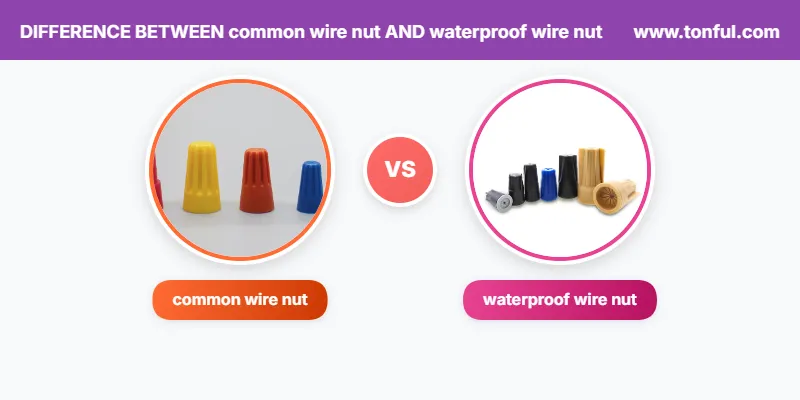
Selecting the appropriate wire connector is fundamental to electrical safety and system reliability. Wire nuts remain the most widely used electrical connectors in residential and commercial installations, but understanding the critical differences between common (standard) wire nuts and waterproof variants ensures proper application selection, code compliance, and long-term performance. This comprehensive comparison guide examines construction differences, performance characteristics, application requirements, and selection criteria to help electrical professionals and contractors make informed decisions.
Understanding Wire Nut Fundamentals
Wire nuts, also known as twist-on wire connectors, create mechanical and electrical connections between two or more conductors through a spring-loaded internal mechanism housed within an insulated shell. The basic design consists of a thermoplastic outer shell that provides insulation and environmental protection, combined with an internal metal spring—typically square-wire or conical—that grips conductors when rotated clockwise onto pre-stripped wire ends.
Standard wire nuts dominate indoor electrical installations due to their simplicity, reliability, and cost-effectiveness. They excel in controlled environments where moisture exposure is minimal and ambient conditions remain relatively stable. However, outdoor installations, wet locations, and harsh environments demand specialized protection that standard wire nuts cannot provide, necessitating waterproof alternatives with enhanced sealing mechanisms.

Construction and Material Differences
Standard Wire Nut Construction
Common wire nuts utilize straightforward construction optimized for dry, indoor environments. The outer shell consists of durable thermoplastic materials—typically polypropylene or nylon—engineered to withstand temperatures from -40°F to 221°F and provide electrical insulation up to 600V. The shell design varies by manufacturer, featuring either smooth cylindrical bodies, ribbed surfaces for improved grip, or winged flanges that facilitate hand-tightening without tools.
The internal spring mechanism represents the critical functional component. Square-wire springs provide superior grip strength and conductor retention compared to conical designs, distributing pressure evenly across all wire strands to create low-resistance electrical connections. The spring’s live-action design expands as the connector rotates, accommodating slight variations in wire bundle diameter while maintaining consistent contact pressure. Standard wire nuts contain no sealing compounds or moisture barriers, relying entirely on the plastic shell for environmental protection.
Waterproof Wire Nut Construction
Waterproof wire nuts incorporate multiple layers of protection to prevent moisture infiltration and environmental degradation. The outer housing uses UV-resistant, impact-resistant thermoplastic compounds formulated to withstand extended outdoor exposure without cracking, fading, or becoming brittle. Housing walls are typically thicker than standard units, providing enhanced mechanical protection and improved temperature stability.
The defining characteristic of waterproof wire nuts is the integrated sealing system. Three primary sealing technologies dominate the market:
Silicone-Filled Connectors: Pre-filled with non-hardening silicone sealant that surrounds conductors upon insertion, creating a moisture barrier that prevents water wicking along wire strands. The silicone compound remains flexible across extreme temperature ranges (-40°F to 400°F), accommodating thermal expansion and contraction without compromising seal integrity.
Gel-Filled Connectors: Utilize dielectric gel compounds that provide superior moisture exclusion and corrosion protection. The gel formulation offers self-healing properties, sealing minor punctures or gaps that might develop over time. These units excel in direct burial applications and permanent submersion scenarios.
Rubber Gasket Sealed Connectors: Feature precision-molded rubber gaskets at the wire entry point that compress around individual conductors, creating a mechanical seal independent of chemical compounds. This design allows visual inspection of seal integrity and provides reliable performance in applications involving repeated thermal cycling.

Performance Characteristics Comparison
| Performance Factor | Standard Wire Nuts | Waterproof Wire Nuts |
|---|---|---|
| Moisture Resistance | None – moisture infiltration causes corrosion | IP65-IP68 rated, prevents water ingress |
| Temperature Range | -40°F to 221°F (standard applications) | -40°F to 400°F (high-performance units) |
| UV Resistance | Limited – degrades with prolonged sun exposure | UV-stabilized compounds prevent degradation |
| Corrosion Protection | Minimal – relies on dry environment | Excellent – sealant prevents oxidation |
| Installation Time | 10-15 seconds per connection | 15-25 seconds (requires proper sealing technique) |
| Reusability | Theoretically reusable (not recommended) | Single-use only – seal compromised upon removal |
| Cost per Unit | $0.10-$0.30 | $0.50-$1.50 (3-5x standard cost) |
| Vibration Resistance | Good with proper installation | Excellent – sealant dampens vibration |
| Chemical Resistance | Limited to mild household chemicals | Resistant to oils, solvents, and corrosive agents |
| Code Compliance | NEC Article 110.14 (dry locations only) | NEC Article 110.11 & 300.5 (wet location rated) |
The performance gap between standard and waterproof connectors becomes critical in challenging environments. Standard wire nuts exposed to moisture experience rapid spring corrosion, increased connection resistance, and eventual failure—typically within 6-24 months in wet conditions. Waterproof units maintain connection integrity for 10-20 years in the same environments, justifying their higher initial cost through extended service life and reduced maintenance requirements.
Application Guidelines and Selection Criteria
When to Use Standard Wire Nuts
Common wire nuts remain the optimal choice for indoor electrical installations where environmental conditions stay controlled and moisture exposure is negligible. Appropriate applications include:
Residential Interior Wiring: Junction boxes, outlet and switch connections, light fixture installations, and appliance circuits in climate-controlled living spaces. Standard connectors provide reliable performance at minimal cost for these applications.
Commercial Building Systems: Office buildings, retail spaces, and industrial facilities with HVAC-controlled environments. Interior distribution panels, control circuits, and equipment connections benefit from the ease of installation and cost-effectiveness of standard units.
Temporary Installations: Construction site temporary power, testing setups, and troubleshooting scenarios where connections may require frequent modification. The reusability advantage (though limited) makes standard wire nuts practical for non-permanent applications.
Low-Voltage Systems: Thermostat wiring, doorbell circuits, and communication systems operating below 50V where moisture-related failures pose minimal safety risks. However, even low-voltage outdoor applications benefit from waterproof protection to prevent nuisance failures.
When to Use Waterproof Wire Nuts
Waterproof connectors become mandatory for any installation involving potential moisture exposure, outdoor environments, or harsh operating conditions. Critical applications include:
Outdoor Lighting Systems: Landscape lighting, security lights, pathway illumination, and architectural accent lighting require waterproof wire connectors to prevent moisture-induced failures. Above-ground installations typically require IP67 rating minimum, while ground-level or buried connections demand IP68 protection.
Irrigation and Sprinkler Systems: Valve box connections, controller wiring, and sensor circuits operate in perpetually damp environments where standard connectors fail rapidly. Gel-filled waterproof units provide optimal performance for these applications.
Marine and Coastal Installations: Dock lighting, boat lifts, and coastal property electrical systems face salt spray, high humidity, and corrosive atmospheres. Marine-grade waterproof connectors with enhanced corrosion resistance prevent premature failure in these demanding conditions.
HVAC and Refrigeration: Condensate drain pump wiring, outdoor condenser unit connections, and evaporator coil circuits experience temperature extremes and condensation exposure. Waterproof connectors prevent moisture-related failures that could disable climate control systems.
Pool and Spa Equipment: Pump motors, heaters, lighting, and control systems require waterproof connections per NEC Article 680. The combination of moisture exposure and electrical hazard makes proper connector selection critical for safety.
Direct Burial Applications: Underground wiring for landscape features, remote buildings, and utility connections must use waterproof connectors rated for continuous submersion per NEC Article 300.5(B). Standard connectors violate code requirements and fail inspection in these applications.

Installation Technique Comparison
Standard Wire Nut Installation
Proper installation of common wire nuts follows a straightforward procedure that requires no specialized tools:
- Wire Preparation: Strip insulation 5/8″ to 3/4″ from conductor ends using wire strippers calibrated to the appropriate gauge. Ensure all conductors in the bundle are stripped to identical lengths.
- Wire Alignment: Hold stripped conductors parallel with ends perfectly even. Staggered wire ends prevent proper spring engagement and create high-resistance connections.
- Pre-Twisting (Optional but Recommended): Using lineman’s pliers, twist the conductor bundle clockwise 2-3 complete turns. Pre-twisting ensures uniform bundle diameter and facilitates connector threading.
- Connector Application: Thread the wire nut onto the conductor bundle with firm clockwise rotation until tight resistance is felt. The connector should require noticeable force for the final 1-2 turns, indicating proper spring engagement.
- Verification: Visually confirm no bare copper remains exposed beyond the connector skirt. Perform individual pull tests on each conductor—properly installed connectors resist 10-15 pounds of pull force without wire slippage.
Waterproof Wire Nut Installation
Waterproof connector installation requires additional steps to ensure proper sealing:
- Environment Preparation: Work in dry conditions whenever possible. If installing in wet environments, temporarily dry the work area and keep connector packages sealed until immediately before use.
- Wire Preparation: Strip conductors to manufacturer-specified length (typically 5/8″ to 3/4″). Inspect insulation for nicks or damage—compromised insulation allows water wicking that bypasses the seal.
- Wire Cleaning: Wipe conductor surfaces with electrical contact cleaner to remove oxidation, oils, or contaminants that could interfere with sealing compound adhesion.
- Pre-Twisting: Mandatory for waterproof connectors. Twist conductors 3-4 complete turns to create a unified bundle that will displace sealant evenly during insertion.
- Connector Application: Push the twisted bundle firmly into the connector while rotating clockwise. Continue rotation until the connector bottoms out against wire insulation—this ensures conductors penetrate fully through the sealing compound and engage the internal spring.
- Seal Verification: Inspect the wire entry point to confirm the rubber gasket or sealant completely surrounds each conductor with no visible gaps. Slight sealant squeeze-out indicates proper insertion depth.
- Orientation: Position waterproof connectors with wire entry pointing downward when possible to prevent water accumulation at the seal interface.
For detailed installation guidance specific to outdoor applications, consult our comprehensive waterproof wire nuts installation guide.
Size Selection and Wire Capacity
Both standard and waterproof wire nuts use color-coding systems to indicate wire capacity, though manufacturers may vary slightly in their specifications. Understanding proper sizing prevents connection failures and ensures code compliance.
Standard Wire Nut Size Chart
| Color Code | Wire Gauge Capacity | Typical Applications |
|---|---|---|
| Gray | 2× #18-16 AWG | Thermostat wiring, low-voltage controls |
| Blue | 2-3× #16-14 AWG | Light fixtures, switch legs, receptacle pigtails |
| Orange | 2-3× #14-12 AWG | General lighting circuits, 15A branch circuits |
| Yellow | 2-4× #14-12 AWG or 2-3× #10 AWG | 20A circuits, multiple conductor bundles |
| Red | 3-4× #14-10 AWG or 2× #8 AWG | Large appliance circuits, multi-wire bundles |
| Green | 3-5× #14-10 AWG | Grounding conductor bundles |
Waterproof Wire Nut Sizing Considerations
Waterproof connectors follow similar color coding but require special attention to capacity ratings because the internal sealant occupies space that would otherwise accommodate conductors. Always verify the specific manufacturer’s capacity chart—waterproof units typically accommodate one fewer conductor than equivalent-sized standard connectors.
Mixed-gauge connections (e.g., connecting 14 AWG to 12 AWG) require careful verification that the specific combination appears on the manufacturer’s approved list. The sealant compound can interfere with proper spring engagement on dissimilar wire sizes if the connector isn’t specifically rated for that combination.
For comprehensive sizing guidance, refer to our detailed article on how to choose the right size waterproof wire nut for AWG.

Cost Analysis and Value Considerations
Initial Cost Comparison
Standard wire nuts represent one of the most economical electrical components, with bulk pricing ranging from $0.10 to $0.30 per unit depending on size and quantity. A typical residential installation might use 50-100 connectors, representing a material cost of $5-30 for the entire project.
Waterproof wire nuts cost significantly more—typically $0.50 to $1.50 per unit, or 3-5 times the price of standard connectors. This price differential reflects specialized materials, sealing compounds, enhanced quality control, and IP rating certification costs. For outdoor installations requiring 20-30 waterproof connections, material costs increase by $20-40 compared to standard connectors.
Lifecycle Cost Analysis
The true cost comparison extends beyond initial purchase price to include failure rates, replacement costs, and service call expenses:
Standard Wire Nuts in Appropriate Applications: When used in dry, indoor environments, standard connectors provide 20+ years of reliable service with essentially zero failure rate. The low initial cost and long service life make them highly cost-effective for their intended applications.
Standard Wire Nuts in Wet Locations (Code Violation): Moisture exposure causes rapid degradation—typical failure occurs within 6-24 months. Each failed connection requires a service call ($75-150), replacement parts, and potential damage to connected equipment. A single service call costs more than upgrading to waterproof connectors initially.
Waterproof Wire Nuts in Outdoor Applications: Despite higher initial cost, waterproof connectors deliver 10-20 years of maintenance-free service in harsh environments. The elimination of moisture-related failures, reduced service calls, and extended equipment life provide substantial long-term value that far exceeds the modest upfront investment.
Total Cost of Ownership Comparison
| Scenario | Initial Cost (20 connections) | Failure Rate (5 years) | Service Call Costs | Total 5-Year Cost |
|---|---|---|---|---|
| Standard wire nuts (indoor) | $6 | <1% | $0 | $6 |
| Standard wire nuts (outdoor – improper) | $6 | 60-80% | $900-1,200 | $906-1,206 |
| Waterproof wire nuts (outdoor) | $30 | <5% | $0-75 | $30-105 |
The analysis clearly demonstrates that using appropriate connectors for the application environment provides overwhelming cost advantages over the system lifecycle.
Code Compliance and Safety Standards
National Electrical Code Requirements
The NEC establishes clear requirements for wire connector selection based on installation environment:
Article 110.11 – Deteriorating Agents: Requires that equipment and materials be suitable for the environment in which they are installed. Standard wire nuts fail this requirement in wet locations, outdoor environments, and corrosive atmospheres.
Article 110.14 – Electrical Connections: Mandates that conductor splicing devices be identified for the specific use and installed per manufacturer instructions. Using standard wire nuts in wet locations violates this requirement even if the installation technique is correct.
Article 300.5(B) – Wet Locations: Specifies that underground installations and wet location wiring must use connectors specifically rated for continuous moisture exposure. Only waterproof connectors with appropriate IP ratings satisfy this requirement.
Article 680 – Swimming Pools, Spas, and Similar Installations: Requires enhanced protection for electrical connections near water features. Waterproof connectors are mandatory for any wiring within the defined zones around pools and spas.
Inspection and Liability Considerations
Electrical inspectors routinely fail installations using standard wire nuts in outdoor or wet locations. The violation is obvious during inspection and requires complete rework, causing project delays and additional labor costs. Beyond code compliance, using inappropriate connectors creates liability exposure—moisture-related failures that cause fires, equipment damage, or injuries expose contractors to negligence claims when proper waterproof connectors were readily available and specified by code.
Professional contractors protect their reputation and limit liability by specifying waterproof connectors for any questionable application. The minimal cost difference provides substantial risk mitigation and demonstrates adherence to industry best practices.
Common Mistakes and How to Avoid Them
Standard Wire Nut Errors
Undersizing: Using connectors too small for the wire bundle creates inadequate spring engagement, high-resistance connections, and overheating. Always verify capacity on the manufacturer’s chart rather than estimating based on color alone.
Insufficient Tightening: Stopping rotation before the connector fully engages allows wires to pull free under thermal cycling or vibration. Continue tightening until firm resistance is felt—the connector should require noticeable force for the final turns.
Exposed Copper: Leaving bare conductor visible beyond the connector skirt creates shock hazards and code violations. If copper remains exposed, remove the connector and trim wire ends before reinstalling.
Waterproof Wire Nut Errors
Incomplete Insertion: Failing to push wires completely through the sealing compound prevents proper spring engagement and compromises the moisture seal. Continue pushing and rotating until the connector bottoms against wire insulation.
Contaminated Sealing Surfaces: Installing waterproof connectors with dirty, oily, or oxidized conductor surfaces prevents proper sealant adhesion. Always clean conductors with electrical contact cleaner before installation.
Reuse Attempts: Removing and reinstalling waterproof connectors compromises the seal and depletes sealing compound. These are single-use components—always install fresh connectors for permanent connections.
Wrong IP Rating: Using IP65 connectors (splash-resistant) in applications requiring IP68 (submersion-rated) leads to premature failure. Match the IP rating to actual environmental conditions, not best-case scenarios.
For comprehensive troubleshooting guidance, see our detailed article on common waterproof wire nut problems.

Product Selection and Sourcing Considerations
Quality Indicators
Not all wire nuts deliver equivalent performance. Professional-grade connectors exhibit these quality characteristics:
UL Listing: Underwriters Laboratories certification (UL 486C for standard, UL 486D for waterproof) verifies the connector meets safety and performance standards. Never use uncertified connectors in permanent installations.
Consistent Color Coding: Reputable manufacturers maintain consistent color-to-capacity relationships across product lines. Inconsistent coding indicates quality control issues.
Spring Quality: Premium connectors use high-grade spring steel with consistent tension. Inferior springs lose grip strength over time, allowing connections to loosen.
Housing Material: Quality thermoplastic compounds resist impact, temperature extremes, and UV degradation. Cheap materials become brittle, crack, or discolor with age.
Clear Capacity Marking: Professional products include capacity information printed on the connector body or packaging, not just color coding.
TONFUL Electric Wire Nut Solutions
TONFUL Electric manufactures comprehensive ranges of both standard and waterproof wire nuts engineered for professional electrical installations. Our product lines feature:
Standard Wire Nuts: UL-listed connectors with square-wire spring mechanisms, impact-resistant thermoplastic housings, and consistent color coding. Available in sizes from gray (18-16 AWG) through red (14-8 AWG) with clear capacity markings.
Waterproof Wire Nuts: IP67 and IP68 rated connectors with silicone or gel-filled sealing systems. Temperature-rated from -40°F to 400°F with UV-resistant housings for extended outdoor service life. Available in standard color coding with enhanced capacity charts for wet location applications.
Specialized Solutions: Heat shrink terminals for vibration-prone applications, assorted connector kits for contractors requiring multiple sizes, and marine-grade waterproof connectors for coastal installations.
For B2B procurement inquiries, bulk pricing, technical specifications, and application engineering support, contact our sales team to discuss your specific project requirements.
Making the Right Choice: Decision Framework
Selecting between standard and waterproof wire nuts requires systematic evaluation of installation conditions:
Decision Criteria Checklist
Environmental Assessment:
- Will connections be exposed to moisture (rain, splash, condensation)?
- Is the installation location outdoors or in an unconditioned space?
- Will temperature extremes exceed -40°F to 221°F?
- Is UV exposure possible?
- Are corrosive chemicals or salt spray present?
Code Compliance Verification:
- Does NEC Article 110.11 require wet location rating?
- Is this a direct burial application per Article 300.5?
- Are pool/spa proximity rules (Article 680) applicable?
- Will the installation pass electrical inspection with standard connectors?
Lifecycle Cost Analysis:
- What is the cost of a service call to replace failed connectors?
- How accessible are the connections for future maintenance?
- What is the expected service life requirement?
- Does equipment warranty require proper environmental protection?
Risk Assessment:
- What are the consequences of connection failure (safety, liability, downtime)?
- Is this a critical system requiring maximum reliability?
- Does the application involve high-value connected equipment?
If you answer “yes” to any environmental assessment question or any code compliance question, waterproof connectors are required. If lifecycle costs or risk factors are significant, waterproof connectors provide superior value despite higher initial cost.
Conclusion
The choice between common and waterproof wire nuts is not merely a cost decision—it represents a fundamental commitment to electrical safety, code compliance, and long-term system reliability. Standard wire nuts deliver exceptional value and performance in their intended applications: dry, indoor, controlled environments where they provide decades of maintenance-free service. However, attempting to extend their use into wet locations, outdoor environments, or harsh conditions creates code violations, safety hazards, and costly failures.
Waterproof wire nuts, while more expensive initially, provide the only code-compliant solution for outdoor installations, wet locations, and challenging environments. Their specialized sealing systems, enhanced materials, and IP-rated protection deliver reliable performance that eliminates moisture-related failures and extends system service life far beyond what standard connectors can achieve in these conditions.
Professional electrical contractors and facility managers recognize that connector selection directly impacts installation quality, inspection outcomes, and long-term maintenance costs. Investing in appropriate connectors for each application—standard for indoor work, waterproof for outdoor and wet locations—demonstrates technical competence, ensures code compliance, and protects both reputation and liability exposure.
TONFUL Electric provides comprehensive wire connector solutions for every application, backed by technical support, quality certifications, and the manufacturing expertise that professional installers demand. Whether you’re specifying components for a single project or establishing supply chains for ongoing operations, our engineering team assists with product selection, code compliance verification, and application-specific recommendations.
Frequently Asked Questions
Q: Can I use standard wire nuts outdoors if I wrap them with electrical tape?
A: No. Electrical tape is not a substitute for proper waterproof connectors and this practice violates NEC Article 110.11. Tape degrades under UV exposure, temperature cycling, and moisture infiltration, providing no reliable long-term protection. Standard wire nuts with tape will fail electrical inspection in wet locations and create safety hazards as moisture penetrates the connection. Always use properly rated waterproof connectors for outdoor applications—the minimal additional cost prevents code violations and ensures reliable performance.
Q: Are waterproof wire nuts reusable like standard connectors?
A: No. Waterproof wire nuts are designed for single-use applications only. Removing a waterproof connector depletes the internal sealing compound, damages rubber gaskets, and deforms the spring mechanism in ways that cannot be restored. Reusing waterproof connectors compromises both the moisture seal and electrical connection integrity, creating failure risks that negate their protective benefits. Always install fresh waterproof connectors for permanent connections—the cost of a new connector is insignificant compared to the failure risks of reuse.
Q: How do I know what size wire nut I need for my application?
A: Wire nut sizing depends on the number of conductors and their gauge (AWG). Check the manufacturer’s capacity chart printed on the package—this chart lists approved wire combinations by gauge and quantity. For example, an orange wire nut typically handles 2-3 conductors of 14-12 AWG. Never rely solely on color coding, as manufacturers may vary slightly in their specifications. When connecting mixed gauges (like 14 AWG to 12 AWG), verify that specific combination appears on the approved list. For waterproof connectors, note that internal sealing compound reduces capacity compared to equivalent-sized standard connectors.
Q: What’s the difference between IP67 and IP68 waterproof ratings?
A: IP67 connectors withstand temporary immersion up to 1 meter depth for 30 minutes, making them suitable for above-ground outdoor installations with rain and splash exposure. IP68 connectors survive continuous submersion beyond 1 meter (manufacturer specifies exact depth and duration), required for direct burial, permanent wet locations, or installations in areas with standing water. For typical outdoor lighting and irrigation valve boxes, IP67 provides adequate protection. For pond pumps, direct burial, or locations that may flood, specify IP68-rated connectors. Our detailed IP67 vs IP68 comparison guide provides comprehensive selection criteria.
Q: Why do waterproof wire nuts cost so much more than standard connectors?
A: Waterproof connectors cost 3-5 times more than standard units due to specialized materials, sealing compounds, enhanced manufacturing processes, and IP rating certification testing. The housing uses UV-resistant, impact-resistant compounds; internal springs require corrosion-resistant materials; and silicone or gel sealing compounds add significant material cost. Additionally, each batch undergoes submersion testing to verify IP rating compliance. However, lifecycle cost analysis demonstrates that waterproof connectors deliver superior value in outdoor applications—a single service call to replace failed standard connectors costs more than the initial investment in proper waterproof units.
Q: Can I use waterproof wire nuts for indoor installations?
A: Yes. Waterproof wire nuts function perfectly in indoor applications and provide superior connection reliability in high-humidity areas like basements, bathrooms, and laundry rooms. However, they’re not required by code for standard indoor work, and the higher cost is unnecessary for dry locations. Many contractors use waterproof connectors for all outdoor equipment connections (HVAC condensers, well pumps, etc.) even when the connection point is technically indoors, as this provides extra protection against condensation and moisture migration.
Q: How long do waterproof wire nuts last in outdoor applications?
A: Quality waterproof wire nuts from reputable manufacturers like TONFUL Electric provide 10-20 years of reliable service in outdoor environments when properly installed. Service life depends on environmental severity—coastal installations with salt spray exposure may see 10-12 years, while protected outdoor locations in moderate climates can exceed 20 years. Standard wire nuts in the same outdoor conditions typically fail within 6-24 months due to moisture infiltration and spring corrosion. The extended service life of waterproof connectors justifies their higher initial cost through eliminated maintenance and replacement expenses.
Q: What happens if I use the wrong size wire nut?
A: Undersized wire nuts create high-resistance connections that generate heat, accelerate insulation degradation, and may cause fires. The spring cannot grip conductors properly, allowing wires to pull free under thermal cycling or vibration. Oversized wire nuts fail to engage the spring mechanism adequately, creating loose connections with similar failure modes. Both scenarios violate NEC Article 110.14 requirements for proper conductor splicing. Always verify the specific wire combination (gauge and quantity) appears on the manufacturer’s approved capacity chart before installation. When in doubt, consult our wire nut sizing guide for detailed selection criteria.