
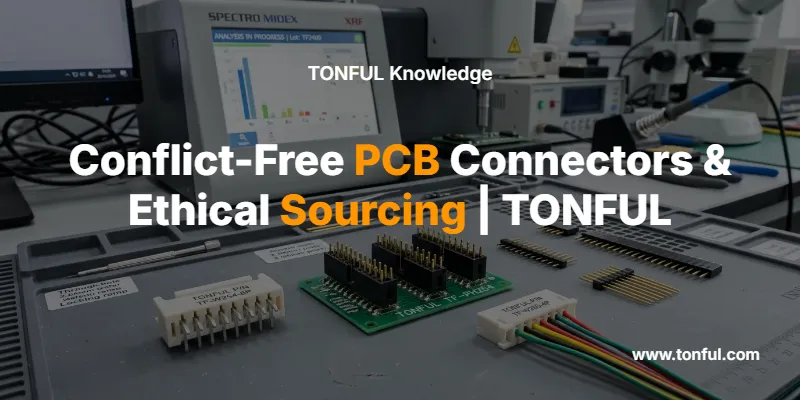
As global supply chains face increasing scrutiny over ethical practices, procurement professionals and engineers must ensure that every component — down to the tin plating on a PCB connector pin — is sourced responsibly. At TONFUL Electric, conflict-free tin plating is not a marketing slogan; it is an operational standard embedded in our manufacturing DNA. This article explains the regulatory landscape, our due-diligence framework, and the concrete steps we take to deliver PCB connectors that meet the highest ethical and technical benchmarks.

What Are Conflict Minerals and Why Do They Matter?
Conflict minerals refer to tin (Sn), tantalum (Ta), tungsten (W), and gold (Au) — collectively known as 3TG. These metals are essential to electronics manufacturing: tin is used in solder and connector plating, tantalum in capacitors, tungsten in vibration motors, and gold in high-reliability contact finishes. The problem arises when 3TG minerals are mined in conflict-affected regions — primarily the Democratic Republic of the Congo (DRC) and adjoining countries — where profits from extraction fund armed groups, perpetuate human rights abuses, and destabilize communities.
For PCB connectors specifically, tin is the most relevant conflict mineral. It serves as the primary plating material on pin headers, female headers, wafer connectors, and box headers, providing corrosion resistance and excellent solderability. This makes conflict-free tin plating a critical concern for any responsible manufacturer.
Regulatory Framework: Dodd-Frank Section 1502 and EU Conflict Minerals Regulation
U.S. Dodd-Frank Act Section 1502
Enacted in 2010, Section 1502 of the Dodd-Frank Wall Street Reform and Consumer Protection Act requires all U.S. publicly traded companies to:
- Conduct a Reasonable Country of Origin Inquiry (RCOI) to determine whether 3TG minerals in their products originated from covered countries.
- Perform due diligence on the source and chain of custody if minerals may be conflict-sourced.
- File a Conflict Minerals Report (Form SD) with the SEC as a public disclosure.
While the law directly applies to SEC-listed issuers, it has a powerful flow-down effect: OEMs require their Tier 1 suppliers to certify compliance, who in turn require the same of Tier 2 and Tier 3 suppliers like connector and terminal manufacturers.
EU Conflict Minerals Regulation (2021)
Since January 2021, the EU regulation requires importers of tin, tantalum, tungsten, and gold above certain volume thresholds to conduct supply chain due diligence aligned with the OECD Guidance. In October 2025, the European Commission recognized the RMI’s RMAP as the first compliant due-diligence scheme under this regulation.

Conflict-Free vs. Conventional Tin Plating: A Technical Comparison
Not all tin plating is created equal. The table below compares conflict-free tin plating — as practiced by TONFUL — with conventional tin plating that lacks verified sourcing.
| Parameter | Conflict-Free Tin Plating (TONFUL) | Conventional Tin Plating |
|---|---|---|
| Tin Source Verification | RMAP-conformant smelters only | Unknown or unverified smelters |
| CMRT Filing | Annual Conflict Minerals Reporting Template submitted | Rarely or never filed |
| Traceability | Full chain-of-custody from smelter to finished connector | Limited or no traceability |
| Plating Purity | ≥ 99.9% Sn, certified conflict-free | Purity may vary; origin unknown |
| Regulatory Compliance | Dodd-Frank §1502, EU CMR, OECD Guidance | May fail OEM compliance audits |
| Audit Readiness | Documentation available on request | Documentation gaps common |
| Cost Impact | Slight premium (2–5%) for verified sourcing | Lower upfront cost; higher compliance risk |
| Customer Acceptance | Accepted by Tier 1 automotive, industrial, and consumer OEMs | May be rejected during supplier qualification |
For engineers evaluating automotive PCB connectors or high-speed connectors, conflict-free tin plating also ensures consistent plating quality — because verified smelters operate under stricter process controls that translate into tighter thickness tolerances and fewer defects.
TONFUL’s Conflict-Free Tin Plating Process
Step 1: Smelter Qualification
We source tin exclusively from smelters listed on the Responsible Minerals Initiative (RMI) conformant smelter list. Each smelter undergoes an independent third-party RMAP audit that verifies responsible sourcing practices aligned with the OECD Due Diligence Guidance. Our approved smelter list is reviewed annually and cross-referenced against the latest RMI publications.
Step 2: Incoming Material Verification
Every batch of tin ingot or tin plating solution arriving at our facility is accompanied by:
- Certificate of Analysis (CoA) confirming ≥ 99.9% purity
- Smelter identification and RMAP conformance status
- Lot traceability number linked to the smelter’s chain-of-custody records
Step 3: Electroplating Process
Our PCB connector plating lines use bright or matte tin electroplating depending on the application. Connector terminals pass through a series of cleaning, activation, plating, and rinsing stages under automated process control. Thickness targets typically range from 1–3 µm for standard connectors and up to 5 µm for harsh-environment applications.
Step 4: Post-Plating Inspection
We employ X-ray fluorescence (XRF) thickness measurement, solderability testing (per J-STD-002), and adhesion testing to verify that every production lot meets specifications. For a deeper look at our quality control philosophy, see our guide on crimp terminal quality control and safety testing standards.

Supply Chain Transparency and the CMRT Process
Transparency is the cornerstone of ethical sourcing. TONFUL participates in the Conflict Minerals Reporting Template (CMRT) process — the standardized industry tool developed by the RMI for declaring smelter information across multi-tier supply chains.
How Our CMRT Process Works
- Data Collection — Our procurement team collects smelter declarations from all metal suppliers quarterly.
- Smelter Cross-Referencing — Each declared smelter is checked against the RMI conformant and active smelter lists.
- Gap Remediation — If a smelter is not RMAP-conformant, we engage the supplier to either transition to a conformant smelter or encourage the smelter to undergo an RMAP audit.
- Customer Reporting — We provide completed CMRTs to OEM customers upon request, supporting their own Dodd-Frank and EU CMR compliance obligations.
This process applies to all product lines containing 3TG metals, including our FPC/FFC connectors, wafer connectors, and terminals and connectors.
Connector Plating Options: Tin, Gold, and Silver Compared
For procurement teams evaluating plating specifications, the choice of contact finish affects both performance and ethical sourcing complexity. All three common plating metals — tin, gold, and silver — fall under 3TG scrutiny.
| Property | Tin (Sn) | Gold (Au) | Silver (Ag) |
|---|---|---|---|
| 3TG Classification | Yes — conflict mineral | Yes — conflict mineral | No — not classified as 3TG |
| Typical Thickness | 1–5 µm | 0.05–1.27 µm (flash to hard gold) | 1–5 µm |
| Contact Resistance | Moderate (requires wipe action) | Excellent (lowest, most stable) | Very good (tarnishes but retains conductivity) |
| Solderability | Excellent | Good (requires flux) | Excellent |
| Cost | Low | High | Medium |
| Best Use Case | Standard pin headers, solderable tails | High-reliability contacts, high-speed signals | Power connectors, RF applications |
| RMAP Smelter Verification | Required | Required | Not required (but recommended) |
For most high-volume PCB connector applications — from female headers to SMT and THT connectors — conflict-free tin plating offers the best balance of performance, cost, and compliance. Detailed guidance on plating selection for automotive applications is available in our automotive terminal plating guide: tin vs. silver vs. gold.

Industry Certifications Supporting Ethical Sourcing
TONFUL’s commitment to conflict-free tin plating is reinforced by a comprehensive quality and environmental management framework:
- ISO 9001:2015 — Quality management system ensuring consistent manufacturing processes
- ISO 14001:2015 — Environmental management system governing waste, emissions, and chemical handling
- IATF 16949 — Automotive quality standard for customers sourcing automotive electrical connectors
- RoHS & REACH Compliance — Ensuring hazardous substance restrictions are met across all product lines, as detailed in our article on halogen-free electrical tape and RoHS/REACH compliance
- UL Recognition — Component safety certification for connectors and terminals

Why OEMs and Distributors Choose TONFUL for Conflict-Free PCB Connectors
Procurement teams at automotive, industrial, and consumer electronics OEMs increasingly treat conflict-free sourcing as a non-negotiable supplier qualification criterion. Here is why TONFUL stands out:
- Single-source accountability — We manufacture connectors, wire terminals, heat shrink terminals, and cable assemblies in-house, simplifying your supply chain auditing.
- Documented traceability — Every lot of tin-plated connectors can be traced back to the RMAP-conformant smelter.
- Rapid CMRT response — Our compliance team provides completed CMRTs within 5 business days of request.
- Vendor consolidation benefits — By sourcing PCB connectors alongside automotive connectors, blade fuses, and electrical tools from one manufacturer, you reduce audit burden and total cost. Learn more in our article on vendor consolidation for electrical components.
Frequently Asked Questions
What does “conflict-free tin plating” mean?
Conflict-free tin plating means the tin used to plate PCB connector terminals is sourced exclusively from smelters that have been independently audited and verified — through programs like the RMI’s RMAP — to not fund armed conflict or contribute to human rights abuses in the DRC and adjoining countries.
Is TONFUL required to comply with Dodd-Frank Section 1502?
While Section 1502 directly applies to U.S. SEC-listed companies, TONFUL voluntarily aligns with its requirements because our OEM customers — many of which are publicly traded — require conflict-free sourcing documentation from all suppliers in their chain.
How can I verify that TONFUL’s connectors use conflict-free tin?
Request our latest CMRT (Conflict Minerals Reporting Template) from your TONFUL sales representative. The CMRT identifies every smelter in our tin supply chain and its RMAP conformance status.
Does conflict-free tin plating affect connector performance?
No. In fact, tin sourced from RMAP-conformant smelters often meets tighter purity specifications (≥ 99.9% Sn), which can result in more uniform plating thickness and improved solderability compared to tin of unverified origin.
Which TONFUL connector products use conflict-free tin plating?
All tin-plated PCB connectors across our product lines — including pin headers, female headers, box headers, wafer connectors, and FPC/FFC connectors — use conflict-free tin plating as standard.
What is the cost difference between conflict-free and conventional tin plating?
The cost premium for verified conflict-free tin plating is typically 2–5% at the material level. At the finished connector level, the impact is minimal — generally less than 1% of total component cost — while the compliance value and risk reduction are substantial.
TONFUL Electric is committed to responsible manufacturing across our full product range — from PCB connectors and automotive terminals to heat shrink tubing and cable ties. Contact our team to request a CMRT or discuss your ethical sourcing requirements.