
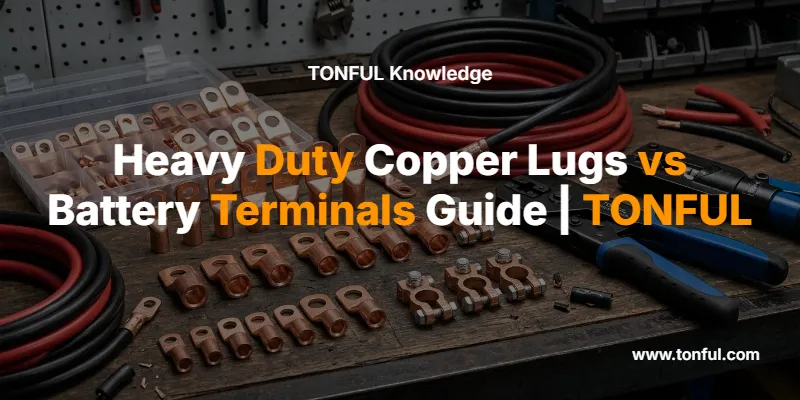
Every automotive ground terminal in your vehicle serves one critical purpose: completing the electrical circuit back to the battery. Yet the choice between a heavy duty copper lug and a standard battery terminal can mean the difference between a rock-solid ground path and a high-resistance connection that causes voltage drops, flickering lights, or even thermal runaway. This guide breaks down both connector types so engineers, fleet managers, and procurement teams can specify the right automotive ground terminal for every application.

Why Automotive Grounding Matters
In a negative-ground vehicle, the chassis itself acts as the return conductor. The battery negative cable connects to the engine block or frame rail, and every electrical load—from the ECU to the headlights—returns current through that path. A poorly chosen or improperly installed automotive ground terminal introduces resistance into this path. Even 0.1 Ω of extra resistance on a 100 A starter circuit creates a 10 V drop—enough to prevent cranking in cold weather.
Key consequences of inadequate grounding include:
- Voltage instability across the entire electrical system
- Premature alternator failure from compensating for voltage drop
- EMI/RFI noise interfering with ECU, ABS, and infotainment modules
- Overheating at the connection point, risking wire insulation damage
Understanding the structural differences between copper lugs and battery terminals is the first step toward specifying the correct automotive ground terminal for your application.
Heavy Duty Copper Lugs: Structure and Specifications
A heavy duty copper lug is a compression or crimp-on ring terminal manufactured from seamless 99.9% pure ETP (Electrolytic Tough Pitch) copper tubing. The barrel accepts a stripped cable end, while the tongue (palm) features a bolt hole for stud-mount connections.

Key Specifications
| Parameter | Typical Range |
|---|---|
| Material | C11000 ETP copper (99.9% purity) |
| Conductivity | ≥ 100% IACS |
| Wall Thickness | 1.5–3.0 mm (heavy duty) |
| Wire Range | 8 AWG – 4/0 AWG (up to 535 MCM for industrial) |
| Bolt Hole Sizes | #10, 1/4″, 5/16″, 3/8″, 1/2″ |
| Surface Finish | Bare copper or electro-tin plated (2–5 µm) |
| Standards | UL 486A-486B, CSA C22.2, IEEE 837 |
Heavy duty variants feature thicker barrel walls (≥ 2.0 mm) than standard lugs, providing superior crush resistance and lower contact resistance under vibration. For corrosive environments—battery compartments, marine, underhood—tin-plated copper terminals are the preferred choice, offering galvanic protection without sacrificing conductivity.
For a detailed sizing reference, see our Heavy Duty Copper Lugs Sizing Guide.
Battery Terminals: Structure and Types
Battery terminals are specialized connectors designed to clamp directly onto a battery post (top-post, side-post, or stud). Unlike lugs, they incorporate a clamping mechanism—either a bolt-and-nut compression collar or a military-style wing nut—that grips the tapered battery post.
Common types include:
| Type | Post Shape | Material | Typical Use |
|---|---|---|---|
| Top-Post Clamp | SAE tapered cone | Lead, copper, brass | Passenger vehicles, light trucks |
| Side-Post Bolt | GM-style threaded | Lead alloy, tin-plated brass | GM vehicles, some imports |
| Military / Stud | Flat stud with bolt | Copper, brass | Heavy equipment, marine |
| Flag / Right-Angle | SAE tapered cone | Lead, copper | Space-constrained installations |
Lead-based battery terminals have been the traditional choice due to their malleability—lead deforms to fill gaps against the battery post, creating a conforming contact surface. However, lead’s conductivity is only ~7% IACS compared to copper’s 100% IACS, which is why high-performance and heavy duty applications increasingly favor copper or brass alternatives.
Head-to-Head Comparison
The table below summarizes the critical differences that engineers and procurement teams should evaluate when selecting an automotive ground terminal:

| Feature | Heavy Duty Copper Lug | Battery Terminal |
|---|---|---|
| Primary Function | Cable-to-stud/busbar connection | Cable-to-battery-post connection |
| Conductivity | ≥ 100% IACS (copper) | 7% IACS (lead) / 65% IACS (brass) / 100% IACS (copper) |
| Installation | Hydraulic/mechanical crimp or solder | Bolt-clamp, compression collar |
| Vibration Resistance | Excellent (crimped joint, no moving parts) | Moderate (clamp may loosen) |
| Corrosion Resistance | Good (tin-plated) to moderate (bare copper) | Moderate (lead oxidation) to good (tin-plated copper) |
| Temperature Range | –40 °C to +150 °C | –40 °C to +105 °C (lead softens at higher temps) |
| Reusability | Single-use (crimped) | Reusable (bolt-clamp) |
| Wire Gauge Range | 8 AWG – 535 MCM | Typically 8 AWG – 4/0 AWG |
| Relevant Standards | UL 486A, IEEE 837 | SAE J1908, SAE J163 |
| Best For | Chassis/frame ground points, busbar connections, high-current distribution | Direct battery post connections |
Key takeaway: Copper lugs and battery terminals are not interchangeable—they serve different points in the grounding circuit. A complete automotive ground terminal system typically uses battery terminals at the battery posts and copper lugs at every chassis ground point, starter bolt, and engine block stud.
Installation Best Practices
Crimping Copper Lugs
Proper crimping is the single most important factor in lug performance. An under-crimped lug increases resistance; an over-crimped lug fractures the conductor strands.

Follow these steps for a reliable crimp:
- Strip cable insulation to the exact barrel depth (verify with the lug’s inspection window)
- Select the correct die set matching lug manufacturer specifications — see our guide on crimp die selection (JA, JC, HX)
- Full-cycle crimp using a ratcheting hydraulic or mechanical crimper
- Inspect through the inspection window — all strands must be visible and compressed
- Verify with pull-force testing per UL 486A requirements — see Crimp Pull Force Testing Guide
For a deeper dive into crimp quality, read our article on why crimp terminals fail and our 5 common crimp overheating mistakes.
Battery Terminal Installation
- Clean the battery post with a wire brush to expose bare metal
- Position the terminal and tighten the bolt/clamp to manufacturer torque specifications
- Apply dielectric grease or anti-corrosion spray to the assembled connection
- Re-torque after 24 hours — lead terminals will cold-flow and loosen
Application Selection Guide
| Application | Recommended Connector | Wire Gauge | Notes |
|---|---|---|---|
| Battery negative to engine block | Battery terminal + copper lug | 2 AWG – 4/0 AWG | Terminal at battery post; lug at engine block stud |
| Battery negative to chassis/frame | Battery terminal + copper lug | 4 AWG – 2 AWG | Lug bolted to clean frame rail |
| Engine block to frame ground strap | Copper lug (both ends) | 4 AWG – 8 AWG | Use braided ground strap for vibration isolation |
| Amplifier / auxiliary ground | Copper lug | 4 AWG – 8 AWG | Direct chassis bolt; sand paint to bare metal |
| ECU / sensor ground bus | Automotive terminals | 14 AWG – 10 AWG | Single-point grounding to prevent ground loops |
For a full catalog of TONFUL’s wire terminal and terminals & connectors product lines, visit our manufacturer pages.
Common Mistakes to Avoid

| Mistake | Consequence | Prevention |
|---|---|---|
| Using undersized wire gauge | Excessive voltage drop, overheating | Match wire gauge to circuit’s max current draw |
| Bare copper lug on aluminum surface | Galvanic corrosion (dissimilar metals) | Use tin-plated lugs or bimetallic transition washers |
| Bolting to painted/coated chassis | High resistance at contact surface | Sand/grind to bare metal; apply anti-corrosion compound after assembly |
| Skipping pull-force verification | Undetected under-crimps that fail under vibration | Test per UL 486A standards |
| Reusing old battery terminals with deformed clamps | Poor contact area, intermittent connection | Replace with new terminals; inspect for cracks |
| Using open barrel terminals in exposed locations | Moisture ingress and corrosion | Use closed barrel or heat-shrink sealed terminals |
FAQ
What is the difference between a copper lug and a battery terminal?
A copper lug is a crimp-on ring terminal that bolts to a stud or busbar, while a battery terminal is a clamp-style connector that grips directly onto a battery post. Both are used in automotive grounding systems, but at different connection points.
Can I use a copper lug directly on a battery post?
No. Battery posts are tapered (SAE standard), and copper lugs have flat bolt holes. You need a proper battery terminal clamp for the post, then use copper lugs at the engine block, chassis, and other stud-mount ground points.
Should I choose tin-plated or bare copper lugs for automotive grounding?
For underhood and battery compartment locations, tin-plated copper lugs are recommended. The tin layer (2–5 µm) provides a corrosion barrier without significantly affecting conductivity. For dry indoor panels, bare copper is sufficient.
What gauge wire should I use for the main battery ground?
For most passenger vehicles, 2 AWG to 4/0 AWG is standard for the main negative cable. Heavy duty trucks and high-output alternator setups may require 1/0 AWG or larger. Always calculate based on maximum starting current and cable length.
How do I test an automotive ground terminal for proper connection?
Perform a voltage drop test: with the engine cranking, measure voltage across the ground connection using a multimeter. A reading above 0.2 V indicates excessive resistance. See our crimp terminal quality control guide for detailed testing procedures.
TONFUL Electric manufactures a complete range of heavy duty copper lugs, automotive terminals and connectors, and electrical tools for B2B customers worldwide. Contact our engineering team for custom specifications, OEM/ODM programs, and volume pricing.