
Bearing adapter sleeves are precision-engineered fastening components that enable secure mounting of tapered bore bearings onto cylindrical or stepped shafts. In industrial machinery, where alignment precision and operational reliability directly impact productivity and maintenance costs, proper adapter sleeve selection and sizing can mean the difference between seamless operation and costly downtime. This comprehensive guide provides procurement managers and maintenance engineers with the technical knowledge needed to specify, size, and install bearing adapter sleeves correctly for demanding industrial applications.

What Are Bearing Adapter Sleeves?
A bearing adapter sleeve is a cylindrical mounting device with a tapered outer surface designed to interface between a straight shaft and a bearing with a tapered bore. The sleeve features a longitudinal slot that allows it to compress radially when tightened, creating a secure interference fit. This design eliminates the need for shaft machining or keyways in many applications, significantly reducing installation complexity and cost.
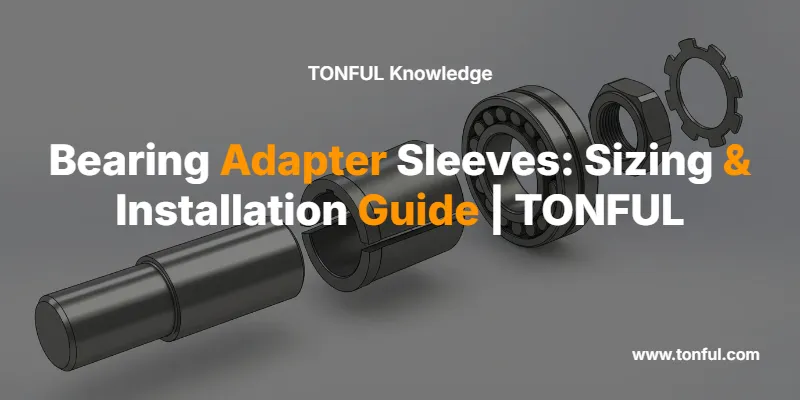
The assembly typically consists of three components: the slotted adapter sleeve itself, a threaded locknut, and a locking device (either a lock washer or lock plate). When the locknut is tightened, it drives the tapered sleeve onto the shaft while simultaneously drawing the bearing’s tapered bore onto the sleeve’s outer taper, creating a rigid, self-centering connection that can handle both radial and moderate axial loads.
Understanding Adapter Sleeve Series and Standards
Bearing adapter sleeves are manufactured according to international standards, primarily ISO 2982-1 for metric dimensions and ANSI/ABMA Std. 8.2 for inch series. Understanding the designation system is crucial for correct specification and procurement.
Series Designation System
The prefix letter(s) indicate the sleeve type and dimensional characteristics:
| Series Prefix | Description | Taper Ratio | Typical Applications |
|---|---|---|---|
| H2 | Standard metric series for smaller shafts | 1:12 | Light to medium industrial equipment, pumps, fans |
| H3 | Standard metric series for medium shafts | 1:12 | General industrial machinery, conveyors, gearboxes |
| H23 | Combined H2/H3 range | 1:12 | Versatile applications across equipment types |
| H30 | Heavy-duty series with increased load capacity | 1:12 | Mining equipment, steel mills, heavy conveyors |
| H31 | Extended heavy-duty series | 1:12 | Large industrial machinery, cement plants |
| H32 | Extra heavy-duty for largest shafts | 1:12 | Primary crushers, ball mills, kiln drives |
| HA | Asymmetric design for specific bearing types | 1:12 | Applications requiring axial positioning |
| HE | Extended length for enhanced load distribution | 1:12 | High-load applications, vibrating machinery |
| SNW/SNP | US inch dimensions (AISI standard) | 1:12 | North American equipment, retrofit applications |
The numeric portion following the prefix indicates the shaft diameter. For example, H3120 designates an H3 series sleeve for a 100mm shaft diameter (the “20” in the designation corresponds to the bearing bore series).

Critical Dimensions for Proper Sizing
Accurate sizing of bearing adapter sleeves requires understanding five critical dimensions:
Primary Dimensional Parameters
| Dimension | Symbol | Description | Measurement Method |
|---|---|---|---|
| Shaft Diameter | d1 | Nominal bore diameter of the sleeve | Measure shaft with micrometer or vernier caliper |
| Sleeve Length | L | Overall axial length of the sleeve | Reference manufacturer specifications |
| Outer Diameter | Dm | Maximum diameter at sleeve’s large end | Must match bearing bore requirements |
| Locknut Width | C or C1 | Axial width of the locknut | Determines locking device type (C1 uses lockplate) |
| Thread Size | G | Locknut thread specification | Must match sleeve threading |
Taper Ratio Specifications
The taper ratio defines the rate of diameter change along the sleeve’s length. Two standard ratios exist:
| Taper Ratio | Angle | Primary Use | Advantages |
|---|---|---|---|
| 1:12 | 2° 23′ 9″ | Standard industrial applications (most common) | Easier installation/removal, self-centering |
| 1:30 | 0° 57′ 18″ | Specialized precision applications | Higher load capacity, more precise positioning |
The 1:12 taper is by far the most common in industrial machinery and is the standard for H-series adapter sleeves. The 1:30 taper is typically found in specialized precision equipment and certain withdrawal sleeve designs.

Step-by-Step Sizing Methodology
Proper adapter sleeve selection follows a systematic process that ensures compatibility across all interface points.
Step 1: Measure Shaft Diameter Precisely
Use calibrated measuring instruments—micrometers for shafts under 100mm, vernier calipers for larger diameters. Measure at multiple points along the intended mounting location to verify shaft straightness and detect any out-of-round conditions. The shaft diameter must fall within the tolerance range specified for the adapter sleeve bore (typically ISO h tolerance for metric sleeves).

Step 2: Verify Bearing Compatibility
Adapter sleeves work exclusively with bearings that have tapered bores, typically designated with a “K” suffix in the bearing part number (for example, 22215K or 1310K). The bearing’s taper must match the sleeve’s outer taper—both must be 1:12 for standard applications. Verify the bearing’s bore designation matches the sleeve’s outer diameter specifications.
Common bearing types compatible with adapter sleeves include:
- Self-aligning ball bearings (1200K, 2200K series)
- Spherical roller bearings (22200K, 23000K series)
- Tapered roller bearings (certain designs)
Step 3: Check Shaft Tolerance and Surface Finish
The shaft surface where the adapter sleeve mounts must meet specific requirements:
- Surface finish: Ra 1.6 μm (63 μin) or better
- Tolerance: ISO h9 or h11 for metric shafts, similar for inch shafts
- Straightness: Within 0.02mm per 100mm of length
- Surface condition: Free from burrs, rust, paint, or contamination
Poor shaft preparation is a leading cause of premature bearing failure and inadequate clamping force.
Step 4: Determine Required Axial Space
Calculate the total axial space required for the complete assembly:
- Adapter sleeve length (L)
- Locknut width (C or C1)
- Lock washer or lockplate thickness
- Any required spacer rings for axial positioning
For stepped shafts, an L-shaped spacer ring is often used in conjunction with the adapter sleeve to achieve precise axial positioning of the bearing.
Step 5: Verify Load Capacity
Adapter sleeves are designed to handle both radial and moderate axial loads. However, the transmitted torque capacity must be verified against the application requirements. The clamping force generated by the tapered interface creates friction that transmits torque—this capacity depends on:
- Shaft diameter
- Sleeve length
- Taper angle
- Coefficient of friction (affected by lubrication during installation)
- Locknut tightening torque
Consult manufacturer load tables or use the formula: Torque capacity (Nm) ≈ 0.6 × d1² × μ, where d1 is shaft diameter in mm and μ is the coefficient of friction (typically 0.12-0.15 for properly lubricated installations).
Installation Best Practices
Correct installation procedure is essential for achieving design performance and service life. Improper installation accounts for a significant percentage of premature bearing failures in industrial machinery.

Pre-Installation Preparation
- Clean all components thoroughly: Remove preservative coatings, dirt, and debris from the shaft, sleeve bore, sleeve outer surface, and bearing bore.
- Apply appropriate lubrication: Use a light machine oil or the bearing manufacturer’s recommended lubricant on:
- Contact surface between sleeve and shaft
- Contact surface between sleeve outer taper and bearing bore
- Locknut threads
- Inspect components: Check for damage, burrs, or dimensional defects. Verify that all components (sleeve, locknut, locking device) are from the same matched set.
Installation Sequence
Step 1: Slide the adapter sleeve onto the shaft at the intended mounting position. Ensure the threaded end faces the direction from which the locknut will be installed.
Step 2: Position the bearing with its tapered bore over the adapter sleeve’s tapered outer surface. Push the bearing onto the sleeve by hand as far as possible.
Step 3: Thread the locknut onto the sleeve. Hand-tighten until resistance is felt.
Step 4: Using a hook spanner wrench or appropriate installation tool, tighten the locknut to the specified torque. This simultaneously:
- Drives the sleeve onto the shaft
- Draws the bearing onto the sleeve’s outer taper
- Reduces the bearing’s internal clearance to the proper operating value
Step 5: Install the lock washer or lockplate according to the design:
- For lock washers (MB type): Bend one tab into the locknut slot and another against the shaft or adjacent component
- For lockplates (MS type): Secure the plate with fasteners and bend tabs to lock the nut
Tightening Torque Specifications
Proper locknut torque is critical. Under-tightening results in insufficient clamping force and potential slippage; over-tightening can damage threads or create excessive bearing preload. General torque guidelines:
| Shaft Diameter (mm) | Approximate Locknut Torque (Nm) |
|---|---|
| 20-30 | 15-30 |
| 35-50 | 40-80 |
| 55-80 | 100-200 |
| 85-120 | 250-450 |
| 130-200 | 500-1000 |
Always consult manufacturer specifications for exact values, as torque requirements vary with sleeve series and design.
Hydraulic Installation Method
For larger adapter sleeves (typically above 100mm shaft diameter), hydraulic installation using oil injection is recommended. This method significantly reduces the force required and ensures uniform distribution of the sleeve on the shaft. Sleeves designed for hydraulic installation feature oil holes and distribution grooves. The process involves:
- Connecting a hydraulic pump to the sleeve’s oil injection port
- Pumping oil under pressure (typically 5-20 MPa) to create a thin oil film
- Advancing the sleeve and bearing while maintaining pressure
- Tightening the locknut to specification
- Releasing hydraulic pressure, allowing the oil film to dissipate
This method is particularly valuable in field service conditions where heavy presses are unavailable.
Industrial Applications and Use Cases
Bearing adapter sleeves find extensive use across diverse industrial sectors where reliable shaft-to-bearing connections are critical.
Material Handling and Conveyor Systems
Conveyor drive drums, idler rollers, and gearbox output shafts commonly use adapter sleeves for bearing mounting. The ability to position bearings at any point along a plain shaft simplifies design and reduces manufacturing costs. In heavy-duty applications, H30 and H31 series sleeves provide the load capacity needed for bulk material handling in mining and aggregate operations.
Pumps and Compressors
Centrifugal pumps, particularly in chemical processing and water treatment, benefit from adapter sleeves’ ease of maintenance. When bearing replacement is required, the entire bearing and sleeve assembly can be removed without disturbing shaft alignment or requiring shaft removal. This significantly reduces downtime in critical process applications.
Mining and Mineral Processing
Crushers, grinding mills, and vibrating screens subject bearings to extreme loads and harsh operating conditions. H32 series adapter sleeves, combined with heavy-duty spherical roller bearings, provide the robust mounting solution these applications demand. The self-aligning capability of spherical roller bearings, combined with the secure mounting of adapter sleeves, accommodates the shaft deflection common in large mining equipment.
Steel and Metal Processing
Rolling mills, continuous casters, and material handling equipment in steel plants operate in high-temperature, contaminated environments. Adapter sleeves allow for rapid bearing replacement during planned maintenance windows, minimizing production interruptions. The use of heat-resistant materials and protective coatings in associated wiring and sensing systems complements the mechanical reliability of properly installed adapter sleeves.
Cement and Aggregate Production
Kiln drives, clinker coolers, and raw material mills in cement plants rely on large-diameter adapter sleeves (often H31 and H32 series) to mount bearings on shafts that may exceed 500mm in diameter. The harsh, abrasive environment and continuous operation schedules make the ease of maintenance provided by adapter sleeves particularly valuable.
Agricultural and Food Processing
Grain handling equipment, milling machinery, and processing line conveyors use adapter sleeves for sanitary, easy-to-clean bearing installations. The absence of keyways eliminates crevices where contaminants can accumulate, supporting food safety requirements.
Maintenance, Inspection, and Troubleshooting
Proactive maintenance of adapter sleeve assemblies extends bearing life and prevents unexpected failures.
Routine Inspection Procedures
Visual Inspection (Monthly or per equipment schedule):
- Check for locknut loosening or lock washer/plate damage
- Inspect for oil leakage around the bearing seals
- Look for discoloration indicating overheating
- Verify that cable management systems and protective sleeving on associated sensors remain intact
Vibration Monitoring (Continuous or periodic):
- Establish baseline vibration signatures for each bearing location
- Monitor for increases in vibration amplitude or changes in frequency spectrum
- Elevated vibration often indicates bearing wear, misalignment, or inadequate sleeve clamping
Temperature Monitoring:
- Normal bearing operating temperatures typically range from 40-70°C above ambient
- Temperatures exceeding 90°C indicate potential problems requiring investigation
Common Problems and Solutions
Problem: Bearing runs hot despite proper lubrication
- Cause: Excessive bearing preload from over-tightened locknut
- Solution: Remove assembly, verify shaft and sleeve dimensions, reinstall with correct torque
Problem: Bearing exhibits excessive axial play
- Cause: Insufficient locknut torque or improper initial installation
- Solution: Check locknut torque; if correct, disassemble and inspect for worn or damaged components
Problem: Sleeve rotates on shaft (fretting marks visible)
- Cause: Inadequate clamping force, contaminated surfaces during installation, or undersized sleeve
- Solution: Verify shaft diameter, surface finish, and proper lubrication procedure; consider upgrading to next heavier series
Problem: Difficulty removing sleeve during maintenance
- Cause: Corrosion, fretting, or lack of proper dismounting procedure
- Solution: Use hydraulic removal method if available; apply penetrating oil and allow time for penetration; use proper pullers—never hammer directly on sleeve or bearing
Replacement Criteria
Replace adapter sleeves when:
- Visible cracks or deformation are present
- Thread damage prevents proper locknut engagement
- Fretting or galling on bore or outer taper surfaces exceeds 0.1mm depth
- Sleeve has been removed and reinstalled more than 3-4 times (material fatigue concern)
Bearings and sleeves should generally be replaced as matched sets to ensure proper fit and performance.
Selecting the Right Supplier
When sourcing bearing adapter sleeves for industrial applications, several factors distinguish quality suppliers from commodity vendors.
Quality Indicators
- Standards compliance: Verify ISO 2982-1 or ANSI/ABMA certification
- Material specifications: High-grade carbon steel (typically equivalent to AISI 1045 or better) with appropriate heat treatment
- Surface treatment: Corrosion-resistant plating (zinc, phosphate, or black oxide) for extended service life
- Dimensional accuracy: Tolerances meeting or exceeding standard specifications
- Complete assembly: Matched locknut and locking device included with each sleeve
Technical Support Capabilities
Quality suppliers provide:
- Engineering assistance for application-specific sizing
- Load capacity calculations and verification
- Installation training and documentation
- Cross-reference data for bearing compatibility
- Availability of custom sizes for non-standard applications
TONFUL Electric offers comprehensive bearing adapter sleeve solutions with precision manufacturing capabilities and technical support to ensure optimal performance in demanding industrial environments. Our engineering team can assist with proper sizing, material selection, and installation procedures for your specific application requirements.
Frequently Asked Questions
Q: Can I reuse an adapter sleeve after removing it from a shaft?
A: While technically possible for sleeves in excellent condition, it’s generally not recommended for critical applications. Each installation cycle work-hardens the material and may create micro-deformations. If reuse is necessary, carefully inspect for cracks, thread damage, and surface condition. Replace if any defects are found. For high-reliability applications, always use new sleeves.
Q: What’s the difference between an adapter sleeve and a withdrawal sleeve?
A: Adapter sleeves are installed by tightening a locknut that drives the assembly onto the shaft. Withdrawal sleeves are removed by tightening a locknut that pulls the sleeve off the shaft during dismounting. Withdrawal sleeves are typically used in applications where frequent bearing replacement is anticipated or where access for installation is limited. Both serve the same basic function of mounting tapered bore bearings on cylindrical shafts.
Q: Can adapter sleeves be used on stepped shafts?
A: Yes, adapter sleeves work well on both plain (uniform diameter) and stepped shafts. When used on stepped shafts, an L-shaped spacer ring is typically employed to provide axial positioning and a shoulder for the bearing to seat against. This configuration facilitates precise bearing location and simplifies installation and removal.
Q: How do I determine if my bearing is compatible with adapter sleeves?
A: Check the bearing designation for a “K” suffix, which indicates a tapered bore (for example, 22215K, 1310K, or 23030K). The taper must match the sleeve—standard is 1:12. Verify the bearing’s bore size matches the adapter sleeve’s outer diameter specifications. Self-aligning ball bearings and spherical roller bearings are the most common types used with adapter sleeves.
Q: What causes adapter sleeve assemblies to loosen during operation?
A: Loosening typically results from insufficient initial tightening torque, vibration in the application, or thermal cycling. Ensure the locknut is tightened to the manufacturer’s specified torque using calibrated tools. Verify that the lock washer or lockplate is properly installed and secured. In high-vibration applications, periodic inspection and retightening during the initial break-in period (first 100-200 operating hours) may be necessary.
Conclusion
Bearing adapter sleeves represent a critical interface in industrial machinery, directly impacting equipment reliability, maintenance efficiency, and operational costs. Proper sizing requires careful attention to shaft dimensions, bearing compatibility, load requirements, and installation procedures. By following the systematic approach outlined in this guide—from precise measurement and series selection through proper installation and ongoing maintenance—engineers and maintenance professionals can ensure optimal performance and service life from their bearing installations.
The versatility of adapter sleeves, combined with their ease of installation and maintenance, makes them the preferred mounting solution across diverse industrial applications. Whether you’re specifying components for new equipment or maintaining existing machinery, understanding the technical details of adapter sleeve sizing and application will contribute to more reliable, cost-effective operations.
For technical assistance with bearing adapter sleeve selection, custom sizing requirements, or application-specific engineering support, contact TONFUL Electric’s technical team. We provide comprehensive solutions for industrial electrical and mechanical components, backed by rigorous quality standards and extensive application experience.
About TONFUL Electric: TONFUL Electric is a leading B2B manufacturer of electrical components and industrial fastening solutions, serving industries worldwide with precision-engineered products for demanding applications. Our product portfolio includes electrical terminals and connectors, wire harness assemblies, industrial tools, and mechanical fastening systems designed to meet the highest standards of quality and performance.