
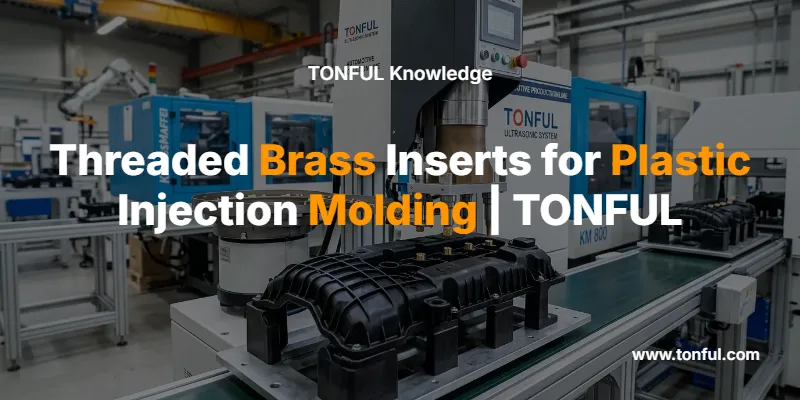
Threaded brass inserts have become indispensable fastening solutions in modern plastic injection molding, offering engineers a reliable method to create strong, reusable threaded connections in plastic assemblies. Unlike plastic threads that degrade with repeated use, brass inserts provide permanent metal threads that withstand high torque loads and countless assembly cycles. This comprehensive guide examines the engineering principles, installation methods, and best practices for specifying and implementing brass inserts in your plastic components.
Understanding Brass Inserts: Engineering Fundamentals
Brass inserts are precision-machined metal fasteners designed to be embedded into plastic parts, creating robust threaded anchor points. Manufactured from high-grade brass alloys such as CDA C360 (free-cutting brass) per ASTM B16 standards, these components offer an optimal balance of machinability, strength, corrosion resistance, and thermal conductivity. The external surface features specialized knurling patterns—diamond knurls, straight knurls, or helical knurls—that bite into the surrounding plastic matrix, preventing rotation and pull-out under load.
The fundamental advantage of brass inserts lies in their material properties. Brass is soft enough to be pressed into thermoplastics like ABS without cracking the host material, yet strong enough to maintain thread integrity under repeated fastening cycles. The thermal conductivity of brass (approximately 120 W/m·K) makes it ideal for heat-staking and ultrasonic installation methods, where controlled heat transfer is critical for proper embedment without excessive plastic degradation.

Types of Threaded Brass Inserts
Engineers must select the appropriate insert type based on installation method, plastic material characteristics, and performance requirements. The following table summarizes the primary categories:
| Insert Type | External Features | Installation Method | Best Applications | Typical Torque Resistance |
|---|---|---|---|---|
| Ultrasonic/Heat-Set | Diamond or straight knurls, tapered lead-in | Ultrasonic welding or thermal insertion | Thermoplastics (ABS, PC, Nylon), post-molding installation | 15-40 in-lbs (M3-M6) |
| Press-In | Aggressive knurling, expansion features | Mechanical press, manual or automated | Thermosets, medium-soft thermoplastics, lower-volume production | 10-25 in-lbs |
| Molded-In | Undercut features, knurls, or hexagonal geometry | Placed in mold before injection | High-volume production, maximum retention strength | 40-80 in-lbs |
| Self-Tapping | External threads, sharp cutting edges | Driven directly into pilot hole | Prototyping, field repairs, low-stress applications | 5-15 in-lbs |
| Expansion | Slotted body with expansion mechanism | Press-in with spreading action | Applications requiring post-installation adjustment | 12-30 in-lbs |
Ultrasonic and heat-set inserts dominate post-molding applications due to their superior installation speed and consistent performance. The tapered lead-in pilot diameter ensures precise alignment, while the knurling pattern creates a mechanical interlock as the plastic re-solidifies around the insert. These inserts work exceptionally well with amorphous thermoplastics that have lower glass transition temperatures.
Molded-in inserts deliver the highest pull-out and torque resistance because the plastic completely encapsulates the insert geometry during the injection process. However, this method requires careful mold design, precise insert placement fixtures, and adds cycle time. For automotive electrical connectors and high-vibration applications, molded-in inserts provide unmatched reliability.

Installation Methods: Engineering Considerations
Ultrasonic Insertion
Ultrasonic installation employs high-frequency vibration (typically 20-40 kHz) to generate frictional heat at the insert-plastic interface. The vibration energy melts a thin layer of plastic around the knurls, allowing the insert to embed while the pneumatic driver applies controlled downward force. Critical parameters include amplitude (vibration intensity), weld time (typically 0.5-2.0 seconds), hold time, and feed rate.
Advantages: Fast cycle time (1-3 seconds), excellent repeatability, minimal thermal damage to surrounding plastic, suitable for automated production.
Limitations: Requires specialized ultrasonic equipment (capital investment $15,000-$50,000), sensitive to plastic material variations, not suitable for glass-filled plastics above 30% content.
Thermal/Heat-Staking Installation
Thermal installation uses a heated insertion tip (typically 200-350°C depending on plastic type) to soften the plastic as the insert is pressed into a pre-molded pilot hole. The brass insert acts as a heat sink, transferring thermal energy to the plastic interface. After insertion, a brief hold time allows the plastic to cool and solidify around the knurling.
Advantages: Lower equipment cost than ultrasonic, works with a wider range of plastic materials including glass-filled compounds, simple process control.
Limitations: Slower cycle time (3-8 seconds), potential for plastic degradation if temperature is excessive, requires temperature calibration for different plastic types.
Molded-In Installation
Molded-in installation places inserts into the injection mold cavity before plastic injection. The molten plastic flows around the insert, completely encapsulating it. Insert placement can be manual (low volume) or automated using pick-and-place systems with vacuum grippers.
Advantages: Highest pull-out strength (2-3× higher than post-molding methods), excellent torque resistance, no secondary operation required.
Limitations: Increased mold complexity and cost, longer cycle time, risk of insert displacement during injection, requires careful gate placement to avoid flow-induced movement.

Press-In Installation
Press-in inserts use mechanical force alone, without heat or vibration. The insert is driven into an undersized pilot hole, with the knurling cutting into the plastic to create retention. This method works best with softer plastics and thermoset materials.
Advantages: No specialized equipment required, suitable for low-volume production and field installation, works with thermosets.
Limitations: Lower retention strength, risk of plastic cracking if hole size is incorrect, inconsistent results with harder plastics.
Material Specifications and Standards
Brass insert quality directly impacts assembly reliability. The following table outlines key material specifications:
| Standard | Region | Brass Alloy Designation | Composition | Key Properties |
|---|---|---|---|---|
| ASTM B16 | USA | C360 (Free-Cutting Brass) | 61.5% Cu, 35.5% Zn, 3% Pb | Excellent machinability, good corrosion resistance |
| DIN 17660 | Europe | CuZn39Pb3 (CW614N) | 58-60% Cu, 39% Zn, 2.5-3.5% Pb | High-speed machining capability |
| JIS H3100 | Japan | C3604 | 57-61% Cu, Zn balance, 2.5-3.7% Pb | Superior thread accuracy |
| ISO 426 | International | CuZn39Pb2 | 58-61% Cu, 38-41% Zn, 1.6-2.5% Pb | General purpose applications |
For applications requiring lead-free compliance (RoHS, REACH), alternative alloys such as C36000 (lead-free brass) or aluminum alloys can be specified, though these may require adjusted installation parameters. The material selection should also consider the operating environment—marine applications benefit from higher copper content for improved corrosion resistance, while electrical terminals and connectors may prioritize electrical conductivity.

Design Guidelines for Boss and Pilot Hole
Proper boss design is critical for insert performance. The boss is the raised cylindrical feature in the plastic part that receives the insert. Inadequate boss design leads to cracking, sink marks, or insufficient retention strength.
Boss Design Parameters
| Parameter | Recommended Value | Rationale |
|---|---|---|
| Boss OD / Insert OD Ratio | 2.0 – 2.5 : 1 | Provides adequate material for stress distribution |
| Boss Height / Insert Length Ratio | 1.1 – 1.3 : 1 | Allows flush installation with material above insert |
| Pilot Hole Diameter (Ultrasonic) | Insert OD – 0.15mm to – 0.25mm | Creates interference for proper knurl engagement |
| Pilot Hole Diameter (Thermal) | Insert OD – 0.10mm to – 0.20mm | Slightly looser for heat expansion |
| Wall Thickness Around Boss | ≥ 2.0mm minimum | Prevents sink marks and maintains structural integrity |
| Draft Angle | 0.5° – 1° | Facilitates part ejection from mold |
The pilot hole depth should equal or slightly exceed the insert length. For blind holes, ensure adequate clearance at the bottom (minimum 0.5mm) to prevent bottoming out during installation. Chamfers on the pilot hole entry (15-30° × 0.3mm) guide the insert and prevent plastic shearing.
Performance Specifications: Torque and Pull-Out Strength
Engineers must verify that selected inserts meet application load requirements. Performance testing should follow standardized protocols to ensure reliability.
Typical Performance Values
| Insert Size | Installation Method | Pull-Out Strength (N) | Torque-Out Strength (N·m) | Recommended Screw Torque (N·m) |
|---|---|---|---|---|
| M3 × 5.0mm | Ultrasonic | 400-600 | 1.2-1.8 | 0.4-0.6 |
| M4 × 6.0mm | Ultrasonic | 600-900 | 2.0-3.0 | 0.8-1.2 |
| M5 × 8.0mm | Ultrasonic | 900-1400 | 3.5-5.0 | 1.5-2.0 |
| M6 × 10.0mm | Ultrasonic | 1400-2000 | 5.0-7.5 | 2.0-3.0 |
| M4 × 6.0mm | Molded-In | 1200-1800 | 4.0-6.0 | 1.2-1.8 |
| M5 × 8.0mm | Molded-In | 1800-2800 | 7.0-10.0 | 2.0-3.0 |
*Values are typical for ABS plastic with 30% glass fill. Actual performance varies with plastic type, boss geometry, and installation quality.
The recommended screw torque should be 30-50% of the insert’s torque-out strength to provide adequate safety margin. Over-torquing can strip threads or cause insert rotation, while under-torquing may result in joint loosening under vibration. For critical applications like custom wire harness assemblies, torque verification during assembly is essential.

Troubleshooting Common Installation Issues
| Problem | Symptoms | Root Cause | Solution |
|---|---|---|---|
| Insert not flush | Insert protrudes above surface | Pilot hole too shallow, excessive knurl height | Increase pilot hole depth by 0.3-0.5mm, verify insert specification |
| Plastic cracking | Radial cracks around boss | Excessive interference, installation force too high | Increase pilot hole diameter by 0.05mm, reduce press force or ultrasonic amplitude |
| Insert rotation | Insert spins during screw tightening | Insufficient knurl engagement, smooth pilot hole | Decrease pilot hole diameter, increase knurling depth, verify installation parameters |
| Thread stripping | Screw strips internal threads | Excessive screw torque, insert too short | Reduce torque to specification, use longer insert, increase screw diameter |
| Plastic melting/burning | Excessive flash, discoloration | Temperature too high, dwell time too long | Reduce thermal tip temperature by 20-30°C, decrease ultrasonic amplitude, shorten weld time |
| Low pull-out strength | Insert pulls out under load | Inadequate knurl engagement, wrong plastic type | Verify pilot hole diameter, test with different insert style, consider molded-in method |
For applications requiring quality control and safety testing, implement statistical process control (SPC) on installation parameters and conduct periodic destructive pull-out testing on sample parts.
Application-Specific Considerations
Automotive Applications
Automotive components face extreme temperature cycling (-40°C to +120°C), vibration (10-2000 Hz), and chemical exposure. Specify brass inserts with deeper knurling and consider molded-in installation for under-hood applications. Thread-locking compounds (medium-strength anaerobic adhesives) provide additional security against vibration-induced loosening.
Electronics Enclosures
EMI shielding effectiveness depends on continuous electrical contact. Brass inserts provide reliable grounding points for shielding gaskets and covers. Ensure the insert is flush or slightly recessed to maintain gasket compression. For sensitive electronics, ultrasonic installation minimizes thermal stress compared to heat-staking.
Medical Devices
Biocompatibility and sterilization compatibility are paramount. Verify that brass alloy composition meets ISO 10993 requirements. Autoclave sterilization (121°C, 15 psi, 20 minutes) can cause differential thermal expansion—design bosses with adequate clearance to prevent stress cracking. Consider stainless steel inserts for implantable devices.
Consumer Products
Cost optimization drives insert selection in consumer goods. Self-tapping inserts offer the lowest installed cost for low-stress applications. For products requiring field serviceability, specify inserts rated for minimum 10 assembly cycles without thread degradation.
Sourcing and Quality Assurance
When sourcing brass inserts from China manufacturers, verify the following quality parameters:
- Material certification: Request mill test reports confirming alloy composition per ASTM B16 or equivalent
- Dimensional inspection: Critical dimensions (thread pitch, knurl diameter, length) within ±0.05mm tolerance
- Thread quality: Class 2B (inch) or 6H (metric) thread tolerance, verified with go/no-go gauges
- Surface finish: Knurling depth 0.15-0.30mm, uniform pattern without burrs or sharp edges
- Plating specification: If specified, tin or zinc plating thickness 3-8μm per ASTM B545
TONFUL Electric maintains ISO 9001:2015 certification and implements 100% automated optical inspection (AOI) on critical dimensions. Our electrical tool manufacturing capabilities include custom insert designs optimized for your specific plastic material and installation equipment.
Brass vs. Alternative Materials
While brass remains the dominant material for threaded inserts, engineers should understand the trade-offs with alternative materials:
| Material | Advantages | Disadvantages | Best Applications |
|---|---|---|---|
| Brass (C360) | Optimal balance of cost, strength, machinability, thermal conductivity | Contains lead (RoHS concern), moderate corrosion resistance | General purpose, high-volume production |
| Stainless Steel (303) | Superior corrosion resistance, higher strength, lead-free | Higher cost (2-3×), more difficult to machine, lower thermal conductivity | Marine, food processing, medical |
| Aluminum (6061) | Lightweight (1/3 density of brass), lead-free, good corrosion resistance | Lower strength, softer threads wear faster | Aerospace, weight-critical applications |
| Lead-Free Brass | RoHS/REACH compliant, similar properties to leaded brass | Slightly reduced machinability, 10-15% cost premium | EU/California markets, consumer electronics |
For detailed material selection guidance specific to electrical applications, refer to our comprehensive guide on copper vs brass terminals.
Frequently Asked Questions
Q: What is the minimum wall thickness required around a brass insert boss?
A: The minimum recommended wall thickness is 2.0mm for most thermoplastics. Thinner walls risk sink marks, warping, and reduced structural integrity. For glass-filled materials, increase to 2.5-3.0mm to accommodate higher shrinkage rates.
Q: Can brass inserts be installed in glass-filled plastics?
A: Yes, but with limitations. Glass content above 30% can interfere with ultrasonic installation due to reduced energy transmission. Thermal installation or molded-in methods work better for highly filled materials. Increase pilot hole tolerance by 0.05mm to accommodate the harder matrix.
Q: How do I prevent insert rotation during screw installation?
A: Ensure adequate knurl engagement by using the correct pilot hole diameter (typically insert OD minus 0.15-0.25mm). Verify installation parameters—insufficient ultrasonic energy or thermal dwell time results in poor knurl bite. Consider inserts with asymmetric or helical knurling for higher torque resistance.
Q: What’s the expected service life of a brass insert?
A: Properly installed brass inserts typically withstand 50-100+ assembly/disassembly cycles before thread wear becomes significant. Service life depends on screw material (hardened steel wears brass faster), torque level, and presence of thread lubricants. For applications requiring unlimited cycles, consider stainless steel inserts or helicoil-style thread reinforcement.
Q: Are brass inserts compatible with all plastic types?
A: Most thermoplastics (ABS, PC, Nylon, PP, PVC) accept brass inserts well. Thermosets require press-in or molded-in methods since they cannot be re-melted. Very soft plastics (LDPE, TPU) may not provide sufficient support—consider larger diameter inserts or alternative fastening methods. Crystalline plastics (POM, PEEK) require precise temperature control during thermal installation.
Conclusion
Threaded brass inserts represent a mature, cost-effective technology for creating robust threaded connections in plastic injection molded parts. Success requires careful attention to insert type selection, boss design, installation method, and quality verification. By following the engineering guidelines presented in this guide, designers can achieve reliable assemblies that withstand demanding mechanical loads and environmental conditions throughout the product lifecycle.
For custom brass insert solutions, installation equipment recommendations, or application-specific engineering support, contact TONFUL Electric’s technical team. Our expertise in precision fastening components and electrical connector manufacturing ensures optimal performance for your most challenging applications.