
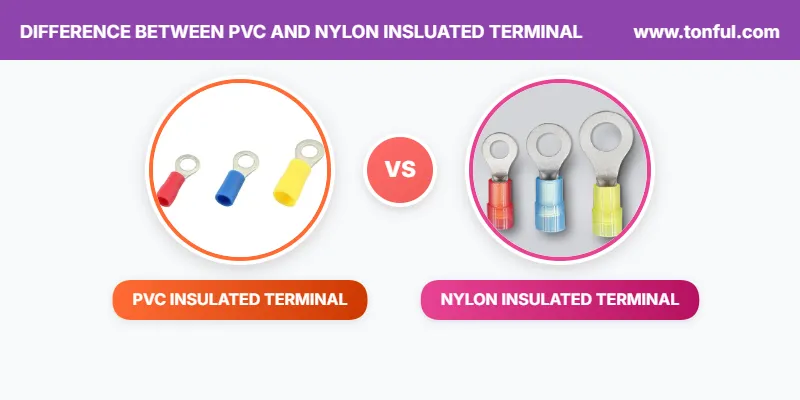
Selecting the right insulated terminal can determine whether your electrical connections deliver decades of reliable service or fail prematurely under environmental stress. PVC (vinyl) and nylon insulated terminals dominate the electrical connector market, yet many professionals struggle to understand when each material provides optimal performance. The wrong choice leads to brittle connections, premature insulation failure, and costly system downtime—particularly in demanding automotive, marine, and industrial applications.
This comprehensive comparison guide examines the critical differences between PVC and nylon insulated terminals, analyzing material properties, performance characteristics, application requirements, and selection criteria. Whether you’re an electrical contractor specifying components for a commercial project, an automotive technician building custom harnesses, or a marine electrician working in corrosive environments, understanding these fundamental differences ensures proper material selection, code compliance, and long-term connection reliability.
Understanding Insulated Terminal Fundamentals
Insulated terminals combine two essential components: a conductive metal barrel (typically electrolytic copper) that creates the electrical connection, and a protective insulation sleeve that prevents short circuits, provides environmental protection, and facilitates safe handling. The insulation material dramatically affects terminal performance, with PVC and nylon representing the two most common choices for general-purpose electrical connections.
The metal barrel—whether configured as a ring terminal, spade terminal, butt splice, or quick disconnect—provides the actual electrical pathway. Quality terminals use electrolytic copper with tin or silver plating to prevent oxidation and ensure low-resistance connections. The barrel design includes a wire crimp section that mechanically secures the conductor and an insulation crimp section that provides strain relief by gripping the wire’s outer jacket.
The insulation sleeve serves multiple critical functions beyond basic electrical isolation. It protects against accidental contact with live conductors, prevents short circuits when terminals are positioned in close proximity, identifies wire gauge capacity through standardized color coding, and provides environmental protection against moisture, chemicals, and physical abrasion. The insulation material’s properties—temperature tolerance, chemical resistance, mechanical strength, and aging characteristics—determine the terminal’s suitability for specific applications.

Material Composition and Properties
PVC (Polyvinyl Chloride) Insulated Terminals
PVC insulated terminals—often referred to as vinyl terminals in the electrical industry—feature protective sleeves manufactured from polyvinyl chloride, one of the world’s most widely produced synthetic polymers. PVC’s unique chemical composition distinguishes it from other plastics: approximately 57% chlorine by weight, with the remainder consisting of carbon and hydrogen. This high chlorine content provides inherent flame resistance but also contributes to specific performance limitations.
The manufacturing process for PVC insulation involves compounding PVC resin with plasticizers (to improve flexibility), stabilizers (to prevent degradation), and colorants (for wire gauge identification). The resulting material exhibits moderate flexibility at room temperature, good electrical insulation properties, and excellent resistance to moisture and many common chemicals. However, the plasticizers that provide flexibility gradually migrate out of the material over time, causing PVC to become progressively more brittle—a process significantly accelerated by heat, UV exposure, and mechanical stress.
PVC terminals typically operate within a temperature range of -10°C to 75°C (14°F to 167°F), with performance degrading rapidly outside these limits. In cold environments, PVC loses flexibility and becomes susceptible to cracking under mechanical stress. At elevated temperatures, plasticizer migration accelerates, and the material may soften or deform. These temperature limitations make PVC terminals suitable primarily for indoor, climate-controlled applications where environmental conditions remain relatively stable.
Nylon (Polyamide) Insulated Terminals
Nylon insulated terminals utilize polyamide polymers—a family of engineering thermoplastics known for exceptional mechanical properties, chemical resistance, and thermal stability. Unlike PVC, nylon contains no chlorine and requires no plasticizers to achieve flexibility. The material’s molecular structure features repeating amide linkages that create strong intermolecular hydrogen bonds, resulting in superior tensile strength, impact resistance, and dimensional stability compared to PVC.
The nylon used in electrical terminals is typically PA66 (Nylon 6,6) or PA6 (Nylon 6), both offering excellent electrical insulation properties combined with outstanding mechanical performance. Nylon’s semi-crystalline structure provides a unique combination of toughness and rigidity, allowing terminals to withstand repeated insertion/removal cycles, vibration exposure, and mechanical abuse without cracking or deforming. The material’s natural translucency (ranging from semi-transparent to opaque depending on formulation) allows visual inspection of crimp quality—a significant advantage during installation and quality control.
Nylon terminals operate reliably across a much broader temperature range than PVC: -40°C to 105°C (-40°F to 221°F) for standard grades, with some specialized formulations rated to 130°C (266°F). This extended temperature capability makes nylon terminals essential for automotive under-hood applications, industrial equipment with elevated operating temperatures, and outdoor installations experiencing extreme seasonal temperature variations. Critically, nylon maintains flexibility and impact resistance throughout its entire temperature range, whereas PVC becomes brittle in cold conditions.

Performance Characteristics Comparison
| Performance Factor | PVC Insulated Terminals | Nylon Insulated Terminals |
|---|---|---|
| Operating Temperature Range | -10°C to 75°C (14°F to 167°F) | -40°C to 105°C (-40°F to 221°F) |
| Cold Weather Performance | Becomes brittle, prone to cracking | Maintains flexibility and impact resistance |
| Heat Resistance | Softens above 75°C, plasticizer migration | Stable to 105°C+, no plasticizer degradation |
| Mechanical Strength | Moderate – adequate for static applications | Superior – withstands vibration and repeated stress |
| Tensile Strength | Lower – single crimp design typical | Higher – supports double-crimp construction |
| Impact Resistance | Poor when aged or cold-exposed | Excellent across entire temperature range |
| UV Resistance | Poor – degrades and becomes brittle | Good – maintains integrity longer outdoors |
| Chemical Resistance | Good for water, acids, alkalis | Excellent for oils, solvents, fuels |
| Aging Characteristics | Plasticizer loss causes brittleness | Minimal degradation over time |
| Crimp Inspection | Opaque – cannot verify crimp quality | Semi-translucent – visual crimp verification |
| Installation Ease | Standard single crimp | Double-crimp capability for enhanced security |
| Moisture Resistance | Good – but wire ends remain exposed | Good – but wire ends remain exposed |
| Flame Resistance | Self-extinguishing (chlorine content) | Burns slowly, may release fumes |
| Cost per Unit | $0.05-$0.15 (baseline) | $0.08-$0.25 (20-40% premium) |
| Typical Service Life (Indoor) | 10-15 years | 15-25 years |
| Typical Service Life (Outdoor) | 2-5 years (degrades rapidly) | 10-15 years |
The performance comparison reveals that nylon terminals deliver superior characteristics across most critical parameters, with PVC offering advantages primarily in initial cost and flame resistance. The temperature performance gap represents the most significant practical difference—PVC’s limited range restricts its use to climate-controlled environments, while nylon’s extended capability enables reliable operation in automotive, outdoor, and industrial applications experiencing temperature extremes.
Mechanical strength differences become critical in vibration-prone applications. Nylon’s superior tensile strength and impact resistance prevent the insulation cracking and terminal loosening that plague PVC terminals in automotive, marine, and industrial equipment. The double-crimp design commonly used with nylon terminals—crimping both the wire barrel and insulation barrel separately—provides enhanced pull-out resistance and strain relief that single-crimp PVC terminals cannot match.
Chemical resistance patterns differ significantly between materials. PVC excels in applications involving water, acids, and alkalis, making it suitable for general indoor electrical work. Nylon’s superior resistance to petroleum products, solvents, and fuels makes it essential for automotive applications where exposure to engine oil, transmission fluid, gasoline, and brake fluid is inevitable. Neither material provides complete corrosion protection since both leave wire ends exposed to environmental factors—for maximum corrosion resistance, heat shrink terminals with adhesive lining provide superior sealing.
Application Guidelines and Selection Criteria
When to Use PVC Insulated Terminals
PVC insulated terminals remain the optimal choice for cost-sensitive indoor applications where environmental conditions stay controlled and mechanical stress remains minimal. Their lower cost and adequate performance in benign environments make them economically attractive for specific use cases:
- Residential Interior Wiring: Indoor junction boxes, appliance connections, and general household electrical repairs in climate-controlled living spaces. PVC terminals provide reliable performance for decades when protected from temperature extremes, UV exposure, and mechanical abuse. Standard residential applications rarely experience the environmental stresses that cause PVC degradation.
- Commercial Building Systems: Office buildings, retail spaces, and light commercial facilities with HVAC-controlled environments. Interior lighting circuits, receptacle connections, and low-voltage control systems benefit from PVC terminals’ cost-effectiveness when installation locations remain dry and temperature-stable.
- Low-Voltage Applications: Thermostat wiring, doorbell systems, security system connections, and communication circuits operating below 50V. The reduced electrical stress in low-voltage applications minimizes heat generation, extending PVC terminal service life even in marginal environmental conditions.
- Temporary Installations: Construction site temporary power, testing setups, and troubleshooting scenarios where connections may require frequent modification. PVC terminals’ lower cost makes them practical for non-permanent applications where long-term durability is less critical than immediate functionality.
- Budget-Constrained Projects: Large-scale installations where component costs significantly impact project economics and environmental conditions justify PVC’s limitations. When properly applied in suitable environments, PVC terminals deliver acceptable performance at minimum cost.
When to Use Nylon Insulated Terminals
Nylon insulated terminals become essential for applications involving temperature extremes, mechanical stress, chemical exposure, or outdoor environments. Their superior performance characteristics justify the cost premium in demanding applications:
- Automotive Electrical Systems: Under-hood wiring harnesses, engine compartment connections, and chassis electrical systems experience temperature extremes (-40°C to 125°C), vibration, and exposure to oils, fuels, and road chemicals. Nylon terminals’ temperature capability, mechanical strength, and chemical resistance make them mandatory for reliable automotive electrical connections. For comprehensive automotive terminal solutions, explore our automotive electrical connectors product line.
- Marine and Coastal Installations: Boat electrical systems, dock wiring, and coastal property installations face salt spray, high humidity, temperature cycling, and UV exposure. While neither PVC nor nylon provides complete corrosion protection, nylon’s superior UV resistance and mechanical durability significantly extend service life in marine environments. For maximum marine protection, consider waterproof wire connectors with IP67/IP68 ratings.
- Industrial Equipment: Manufacturing machinery, process control systems, and industrial automation equipment subject terminals to vibration, temperature variations, and chemical exposure. Nylon terminals’ mechanical strength prevents loosening under vibration, while their chemical resistance protects against industrial solvents, cutting oils, and cleaning agents.
- Outdoor Installations: Landscape lighting, security systems, outdoor equipment controls, and any wiring exposed to weather conditions. Nylon’s UV resistance and temperature range enable reliable outdoor performance, though proper waterproof protection remains essential for wet locations. Refer to our guide on waterproof wire nuts for outdoor connection best practices.
- HVAC and Refrigeration: Outdoor condenser unit wiring, evaporator connections, and control circuits experience temperature extremes from -40°C (refrigeration) to 80°C+ (condenser compartments). Nylon terminals maintain reliability across these temperature ranges where PVC would fail rapidly.
- High-Vibration Environments: Heavy equipment, off-road vehicles, and machinery installations where continuous vibration threatens connection integrity. Nylon’s superior mechanical properties and double-crimp capability prevent the terminal loosening and insulation cracking that cause intermittent electrical failures in vibration-prone applications.

Installation Techniques and Best Practices
Crimp Tool Selection and Technique
Proper crimping technique is essential for both PVC and nylon terminals, though nylon’s double-crimp design requires additional attention. Quality ratcheting crimpers with terminal-specific dies ensure consistent, reliable connections that meet electrical and mechanical specifications.
Tool Requirements: Use ratcheting crimpers with color-coded dies matching terminal insulation colors (red for 22-18 AWG, blue for 16-14 AWG, yellow for 12-10 AWG). Ratcheting mechanisms prevent incomplete crimps by requiring full compression before releasing. Avoid pliers-style crimpers that cannot apply consistent pressure and frequently produce inadequate crimps. For professional installations, invest in quality crimping tools calibrated to industry standards.
PVC Terminal Crimping: Strip wire insulation to the length specified by the terminal manufacturer (typically 5/16″ to 3/8″). Insert the stripped wire fully into the terminal barrel until insulation meets the barrel entrance. Position the terminal in the appropriate crimper die nest, ensuring the barrel aligns with the crimper jaws. Squeeze the crimper handles completely until the ratchet releases—partial crimps create high-resistance connections prone to overheating and failure. The completed crimp should show a uniform “B-crimp” or “oval crimp” profile with no sharp edges that could cut wire strands.
Nylon Terminal Double-Crimping: Nylon terminals typically feature two distinct crimp zones: a wire barrel that crimps onto the conductor and an insulation support barrel that crimps onto the wire’s outer jacket. This double-crimp design provides superior strain relief and pull-out resistance. Strip wire to the specified length, insert fully into the terminal, and perform two separate crimps—first on the wire barrel (closer to the terminal end), then on the insulation support barrel (closer to the wire). The insulation crimp should compress the wire jacket without cutting through it, creating mechanical strain relief that prevents wire pull-out under tension or vibration.
Crimp Quality Verification: Perform pull tests on completed crimps—properly crimped terminals should withstand 15-25 pounds of pull force without wire slippage. Nylon terminals’ semi-translucent insulation allows visual inspection of crimp quality, confirming that wire strands are fully captured within the barrel and the crimp profile appears uniform. PVC terminals’ opacity prevents visual verification, making pull testing essential for quality assurance.
Common Installation Errors and Prevention
- Undersized Terminal Selection: Using terminals rated for smaller wire gauges than the actual conductor creates inadequate crimp compression, high-resistance connections, and potential overheating. Always verify the wire gauge using a proper AWG gauge and select terminals specifically rated for that conductor size. Color coding provides guidance but should never substitute for actual gauge verification.
- Insufficient Wire Stripping: Stripping too little insulation prevents full wire insertion into the terminal barrel, reducing contact area and creating high-resistance connections. Conversely, stripping too much insulation leaves bare copper exposed beyond the terminal, creating shock hazards and potential short circuits. Follow manufacturer specifications precisely—typically 5/16″ to 3/8″ for most terminal types.
- Incomplete Crimping: Releasing crimper handles before the ratchet mechanism completes the cycle produces weak crimps with inadequate compression. These connections exhibit high resistance, generate excessive heat, and may pull apart under mechanical stress. Always squeeze ratcheting crimpers until they release automatically, indicating full compression has been achieved.
- Wrong Crimp Die Selection: Using incorrect crimper dies (e.g., blue die on yellow terminals) produces improperly shaped crimps that fail to adequately compress the terminal barrel. Match die color to terminal color, or verify die specifications match the terminal’s wire gauge rating. Professional crimpers include die identification markings to prevent mismatches.
- Nylon Terminal Single-Crimping: Crimping only the wire barrel on double-crimp nylon terminals eliminates the strain relief benefit and allows wire pull-out under tension. Always perform both wire barrel and insulation support crimps as designed. The insulation crimp is not optional—it provides critical mechanical support that prevents connection failure in vibration-prone applications.
For detailed crimping guidance, consult our comprehensive article on how to crimp heat shrink terminals correctly, which covers techniques applicable to all insulated terminal types.
Size Selection and Color Coding Standards
Both PVC and nylon insulated terminals follow industry-standard color coding to indicate wire gauge capacity, though manufacturers may vary slightly in their specific ratings. Understanding proper sizing prevents connection failures and ensures code compliance.
Standard Color Coding and Wire Gauge Capacity
| Color Code | Wire Gauge Range (AWG) | Stud/Tab Size (Ring/Spade) | Typical Applications |
|---|---|---|---|
| Red | 22-18 AWG | #6, #8, #10 studs | Light-duty connections, low-current circuits, signal wiring |
| Blue | 16-14 AWG | #8, #10, 1/4″ studs | General automotive, lighting circuits, 15A branch circuits |
| Yellow | 12-10 AWG | #10, 1/4″, 5/16″ studs | Heavy-duty automotive, 20A circuits, appliance connections |
| Non-Insulated | 8-6 AWG and larger | 1/4″, 5/16″, 3/8″, 1/2″ studs | Battery cables, high-current applications, grounding conductors |
Material-Specific Sizing Considerations
- PVC Terminal Capacity: Standard PVC terminals accommodate the wire gauge ranges indicated by their color coding. However, PVC’s lower mechanical strength limits its suitability for applications involving multiple insertion/removal cycles or significant mechanical stress. When connections require frequent disconnection (maintenance access points, test equipment), consider nylon terminals even if PVC would be adequate for the electrical load.
- Nylon Terminal Capacity: Nylon terminals follow identical color coding but offer superior performance within those ratings. The double-crimp design available on many nylon terminals provides enhanced current-carrying capacity and mechanical strength compared to equivalent-sized PVC terminals. For critical connections—battery circuits, starter motor wiring, high-vibration equipment—specify nylon terminals even when PVC ratings appear adequate.
- Mixed-Gauge Connections: When connecting dissimilar wire gauges (e.g., 14 AWG to 12 AWG using a butt splice), select terminals rated for the largest conductor in the connection. Verify that the specific gauge combination appears on the manufacturer’s approved capacity chart. Some terminal designs accommodate mixed gauges better than others—consult manufacturer specifications rather than assuming compatibility.
- Stud Size Selection: Ring terminals and spade terminals must match the stud or screw size they connect to. Undersized terminals create loose connections with high contact resistance; oversized terminals cannot fit over the stud. Common automotive and marine applications use #10 (3/16″) and 1/4″ studs, while industrial equipment may use 5/16″ or 3/8″ studs for high-current connections. For comprehensive terminal selection guidance, refer to our wire terminal manufacturer technical resources.

Cost Analysis and Value Considerations
Initial Cost Comparison
PVC insulated terminals represent the most economical choice for general electrical connections, with bulk pricing typically ranging from $0.05 to $0.15 per terminal depending on type, size, and quantity. A typical automotive harness repair or residential electrical project might use 20-50 terminals, representing a material cost of $1-7.50 for PVC terminals.
Nylon insulated terminals cost 20-40% more than equivalent PVC terminals, with pricing typically ranging from $0.08 to $0.25 per unit. The same project using nylon terminals would cost $1.60-12.50 in materials—a difference of $0.60-5.00 per project. This modest absolute cost difference often becomes the deciding factor for budget-conscious applications, particularly when environmental conditions appear benign and long-term durability is not critical.
However, this initial cost comparison ignores critical factors that dramatically affect true project economics: failure rates, replacement costs, service call expenses, and equipment downtime. A lifecycle cost analysis reveals that material selection based solely on initial purchase price frequently produces the highest total cost of ownership.
Lifecycle Cost Analysis
The true economic comparison extends beyond initial purchase price to encompass failure rates, replacement labor, and consequential costs:
- PVC Terminals in Appropriate Applications (indoor, climate-controlled, minimal mechanical stress): When used within their design limitations, PVC terminals provide 10-15 years of reliable service with essentially zero failure rate. The low initial cost combined with long service life in suitable environments makes PVC highly cost-effective for residential interior wiring, commercial building systems, and low-voltage applications. A $5 terminal investment delivers a decade of maintenance-free operation—excellent value.
- PVC Terminals in Inappropriate Applications (automotive, outdoor, temperature extremes, vibration): Environmental stresses outside PVC’s capabilities cause rapid degradation. Typical failure modes include insulation cracking (exposing live conductors), brittleness-induced terminal breakage, and connection loosening due to thermal cycling. Failure rates of 30-50% within 2-5 years are common in harsh environments. Each failed connection requires diagnostic time ($50-100), replacement parts ($5-15), and labor ($75-150), plus potential equipment damage from electrical faults. A single service call costs 10-20 times the initial material savings from choosing PVC over nylon.
- Nylon Terminals in Demanding Applications (automotive, marine, industrial, outdoor): Despite 20-40% higher initial cost, nylon terminals deliver 15-25 years of reliable service in harsh environments. The elimination of premature failures, reduced service calls, and extended equipment life provide substantial long-term value. The $2-5 additional upfront investment per project prevents $200-500 in failure-related costs over the system lifecycle.
Total Cost of Ownership Comparison (5-Year Analysis)
| Application Scenario | Terminal Type | Initial Cost (30 terminals) | Failure Rate (5 years) | Replacement Costs | Total 5-Year Cost |
|---|---|---|---|---|---|
| Indoor residential wiring | PVC | $4.50 | <2% | $0-25 | $4.50-29.50 |
| Indoor residential wiring | Nylon | $6.00 | <1% | $0 | $6.00 |
| Automotive under-hood | PVC | $4.50 | 40-60% | $300-600 | $304.50-604.50 |
| Automotive under-hood | Nylon | $6.00 | <5% | $0-75 | $6.00-81.00 |
| Marine/coastal installation | PVC | $4.50 | 50-70% | $400-750 | $404.50-754.50 |
| Marine/coastal installation | Nylon | $6.00 | 5-10% | $50-150 | $56.00-156.00 |
| Industrial equipment | PVC | $4.50 | 30-50% | $250-500 | $254.50-504.50 |
| Industrial equipment | Nylon | $6.00 | <5% | $0-75 | $6.00-81.00 |
The analysis demonstrates that using appropriate terminals for the application environment provides overwhelming cost advantages over the system lifecycle. The modest 20-40% initial cost premium for nylon terminals becomes insignificant compared to the 10-100x cost of premature failures when PVC is used inappropriately.
Code Compliance and Industry Standards
Electrical Code Requirements
The National Electrical Code (NEC) and various international standards establish requirements for electrical connections that indirectly affect terminal material selection:
- NEC Article 110.14 – Electrical Connections: Requires that conductor splicing and termination devices be identified for the specific use and installed per manufacturer instructions. This includes temperature ratings—terminals must be rated for the maximum temperature they will experience in service. PVC terminals’ 75°C limitation restricts their use in high-temperature environments, while nylon’s 105°C rating provides broader applicability.
- NEC Article 110.11 – Deteriorating Agents: Mandates that equipment and materials be suitable for the environment in which they are installed. Using PVC terminals in outdoor, high-temperature, or chemically aggressive environments where they will degrade rapidly violates this requirement. Material selection must account for actual environmental conditions, not best-case scenarios.
- UL 486A-486B Standards: Underwriters Laboratories standards for wire connectors specify performance requirements including temperature cycling, current-carrying capacity, and mechanical strength. Quality terminals from reputable manufacturers like TONFUL Electric meet or exceed these standards, with test reports available upon request.
Automotive and Marine Standards
- SAE J1128 – Automotive Wiring: Society of Automotive Engineers standards specify requirements for automotive electrical components, including terminals. Nylon terminals’ temperature range, vibration resistance, and chemical resistance align with SAE requirements for under-hood applications, while PVC terminals typically meet specifications only for interior cabin wiring.
- ABYC E-11 – Marine Electrical Standards: American Boat and Yacht Council standards require that marine electrical components resist corrosion, withstand vibration, and maintain integrity in damp environments. While neither PVC nor nylon provides complete corrosion protection (both leave wire ends exposed), nylon’s superior mechanical properties and UV resistance better satisfy ABYC requirements for marine applications.
Common Problems and Troubleshooting
PVC Terminal Failure Modes
- Insulation Cracking and Brittleness: The most common PVC terminal failure results from plasticizer migration and UV degradation causing the insulation to become brittle and crack. Cracks expose live conductors, creating shock hazards and potential short circuits. This failure mode accelerates dramatically in outdoor installations, high-temperature environments, and applications with frequent temperature cycling. Prevention requires limiting PVC terminals to indoor, climate-controlled applications or replacing them with nylon alternatives in harsh environments.
- Cold-Temperature Brittleness: PVC loses flexibility below -10°C (14°F), becoming susceptible to impact damage and stress cracking. Terminals installed in unheated spaces, outdoor locations, or cold-climate vehicles may crack during winter months when subjected to vibration or mechanical stress. Symptoms include intermittent electrical connections, visible insulation cracks, and terminal breakage. Solution: Replace with nylon terminals rated for extended temperature range.
- Heat-Induced Softening: Temperatures exceeding 75°C cause PVC insulation to soften and deform, potentially allowing terminals to slip off studs or short circuit against adjacent conductors. Common in automotive under-hood applications, near heat-generating equipment, or in poorly ventilated enclosures. Prevention requires using nylon terminals in any application where ambient or conductor temperatures may exceed 75°C.
Nylon Terminal Failure Modes
- Moisture Absorption: Nylon’s molecular structure allows limited moisture absorption (typically 1-2% by weight), which can slightly reduce electrical insulation properties in extremely humid environments. However, this rarely causes practical problems in typical applications. For applications requiring absolute moisture exclusion (permanent submersion, direct burial), specify heat shrink terminals with adhesive lining rather than standard nylon terminals.
- Incomplete Double-Crimp: The most common nylon terminal installation error involves crimping only the wire barrel while neglecting the insulation support crimp. This eliminates the strain relief benefit and allows wire pull-out under tension or vibration. Symptoms include intermittent connections, terminals sliding off wires, and visible wire movement within the terminal. Solution: Always perform both wire barrel and insulation support crimps as designed.
- Chemical Incompatibility: While nylon resists most automotive and industrial chemicals, certain strong acids, bases, and chlorinated solvents can degrade the material over extended exposure. If terminals will contact aggressive chemicals, verify compatibility with manufacturer specifications or consider specialized terminal materials for extreme chemical environments.
General Terminal Problems
- Undersized Terminal Selection: Using terminals rated for smaller wire gauges than the actual conductor creates inadequate crimp compression, high-resistance connections, and overheating. The terminal may appear properly installed but exhibits elevated temperature during operation, discoloration from overheating, or eventual failure from thermal stress. Correction requires replacing with properly sized terminals verified against manufacturer capacity charts.
- Corrosion at Wire-Terminal Interface: Both PVC and nylon terminals leave wire ends exposed to environmental factors at the terminal entrance. In corrosive environments (marine, road salt, industrial chemicals), copper oxidation occurs at this interface, increasing connection resistance and potentially causing failure. Prevention strategies include: (1) applying dielectric grease to wire ends before terminal installation, (2) using tin-plated copper terminals that resist oxidation, or (3) specifying fully sealed heat shrink terminals for maximum corrosion protection.
- Vibration-Induced Loosening: Continuous vibration can cause terminals to loosen on studs or work free from crimp connections, particularly when single-crimp PVC terminals are used in high-vibration applications. Symptoms include intermittent electrical operation, visible terminal movement, and eventual complete disconnection. Solutions include: (1) upgrading to double-crimp nylon terminals for superior strain relief, (2) using lock washers or thread-locking compound on threaded connections, (3) applying strain relief to wire harnesses to minimize vibration transmission to terminals.

Product Selection and Quality Indicators
Quality Characteristics of Professional-Grade Terminals
Not all insulated terminals deliver equivalent performance, even when manufactured from the same base materials. Professional-grade terminals exhibit these quality indicators:
- UL Listing and Certification: Underwriters Laboratories certification (UL 486A-486B for wire connectors) verifies that terminals meet safety and performance standards through rigorous testing. UL-listed terminals undergo evaluation for temperature cycling, current-carrying capacity, mechanical strength, and flammability. Never use uncertified terminals in permanent installations—the modest cost savings is not worth the safety risks and potential code violations.
- Consistent Color Coding: Reputable manufacturers maintain consistent color-to-capacity relationships across all product lines. Inconsistent color coding indicates poor quality control and raises questions about whether terminals actually meet their rated specifications. TONFUL Electric maintains strict color coding standards across all terminal products to prevent installation errors.
- Barrel Material and Plating: Quality terminals use electrolytic copper barrels with tin or silver plating to prevent oxidation and ensure low-resistance connections. Inferior terminals may use brass or copper-clad steel that exhibits higher resistance and corrosion susceptibility. Tin plating provides excellent corrosion protection for most applications; silver plating offers even lower contact resistance for critical high-current connections.
- Insulation Material Consistency: Professional-grade terminals use virgin polymer compounds with consistent material properties. Low-quality terminals may use recycled materials or inconsistent formulations that result in variable performance, premature aging, and unpredictable failure modes. Material consistency ensures that every terminal in a batch performs identically.
- Crimp Barrel Design: Quality terminals feature barrel designs optimized for specific wire types and sizes, with internal serrations or knurling that enhances wire grip. The barrel wall thickness must be sufficient to withstand crimping forces without splitting while thin enough to achieve proper compression. Inferior terminals may exhibit barrel cracking, inadequate compression, or poor wire retention.
- Dimensional Accuracy: Professional terminals maintain tight dimensional tolerances ensuring consistent fit with standard crimping tools and proper mating with studs, tabs, or receptacles. Dimensional inconsistency causes crimping difficulties, loose connections, and installation problems.
TONFUL Electric Insulated Terminal Solutions
TONFUL Electric manufactures comprehensive ranges of both PVC and nylon insulated terminals engineered for professional electrical installations across automotive, marine, industrial, and commercial applications. Our product lines feature:
- PVC Insulated Terminals: UL-listed connectors with high-purity PVC insulation, electrolytic copper barrels with tin plating, and consistent color coding. Available in ring terminals, spade terminals, butt splices, quick disconnects, and specialty configurations covering wire gauges from 22 AWG through 10 AWG. Ideal for indoor residential, commercial, and light-duty applications where cost-effectiveness is prioritized.
- Nylon Insulated Terminals: Premium connectors featuring PA66 nylon insulation with superior temperature range (-40°C to 105°C), mechanical strength, and chemical resistance. Double-crimp designs provide enhanced strain relief and pull-out resistance for demanding applications. Semi-translucent insulation allows visual crimp inspection for quality assurance. Available in complete range of terminal types and wire gauges for automotive, marine, and industrial use.
- Heat Shrink Terminals: For applications requiring maximum environmental protection, our heat shrink terminal line features dual-wall construction with adhesive lining that creates waterproof seals when heated. Ideal for marine, outdoor, and corrosive environments where standard insulated terminals provide inadequate protection.
- Terminal Assortment Kits: Professional assorted boxes containing organized selections of commonly used terminal types and sizes, enabling technicians to maintain comprehensive inventories without excessive stock investment. Available in PVC-only, nylon-only, or mixed configurations tailored to specific trade requirements.
- Custom Solutions: For OEM applications, fleet maintenance programs, or specialized industrial requirements, TONFUL Electric provides custom terminal solutions including proprietary designs, private labeling, and application-specific material formulations. Our engineering team collaborates with customers to develop optimized terminal solutions for unique requirements.
For technical specifications, application engineering support, bulk pricing, and B2B procurement inquiries, contact our sales team to discuss your specific project requirements.
Making the Right Choice: Decision Framework
Selecting between PVC and nylon insulated terminals requires systematic evaluation of application conditions, performance requirements, and economic factors:
Decision Criteria Checklist
Environmental Assessment:
- Will terminals be exposed to temperatures below -10°C or above 75°C?
- Is the installation location outdoors or in an unconditioned space?
- Will terminals experience UV exposure from sunlight?
- Are chemicals, oils, fuels, or solvents present in the environment?
- Is high humidity or moisture exposure possible?
Mechanical Stress Evaluation:
- Will the installation experience continuous vibration?
- Do connections require frequent disconnection/reconnection?
- Is the application subject to impact or mechanical abuse?
- Will wire harnesses experience flexing or movement during operation?
Electrical Requirements:
- What is the maximum current the connection will carry?
- What is the maximum voltage present?
- Will the conductor generate significant heat during operation?
- Are there specific code or standard requirements (NEC, SAE, ABYC)?
Economic Considerations:
- What is the expected service life requirement?
- How accessible are connections for future maintenance?
- What are the consequences of connection failure (safety, downtime, repair costs)?
- Is this a one-time installation or part of ongoing production/maintenance?
Decision Logic:
- If you answer “yes” to ANY environmental assessment question → Nylon terminals required
- If you answer “yes” to ANY mechanical stress question → Nylon terminals strongly recommended
- If maximum temperature exceeds 75°C or minimum temperature below -10°C → Nylon terminals mandatory
- If application is automotive under-hood, marine, or industrial → Nylon terminals standard practice
- If application is indoor residential/commercial with minimal stress → PVC terminals acceptable
When in doubt, specify nylon terminals. The modest cost premium provides substantial insurance against premature failure, and nylon terminals perform excellently in all applications where PVC would be adequate—the reverse is not true.
Conclusion
The choice between PVC and nylon insulated terminals fundamentally impacts electrical system reliability, maintenance costs, and long-term performance. While both materials serve the essential function of providing electrical insulation and physical protection, their dramatically different performance characteristics make them suitable for distinctly different applications.
PVC insulated terminals deliver cost-effective performance in benign environments—indoor residential and commercial installations with climate control, minimal mechanical stress, and protection from UV exposure. Their lower cost makes them economically attractive for these applications, and when properly applied within their design limitations, PVC terminals provide reliable service for 10-15 years. However, attempting to extend PVC terminal use into harsh environments—automotive, marine, outdoor, or high-temperature applications—creates a false economy. The initial cost savings evaporate rapidly when premature failures generate service calls, equipment damage, and system downtime costing 10-100 times the original material investment.
Nylon insulated terminals represent the professional standard for demanding applications. Their extended temperature range (-40°C to 105°C), superior mechanical strength, excellent chemical resistance, and UV stability enable reliable operation in automotive under-hood environments, marine installations, industrial equipment, and outdoor systems where PVC terminals fail rapidly. The 20-40% cost premium for nylon terminals becomes insignificant when evaluated against lifecycle costs—the elimination of premature failures and extended service life (15-25 years in harsh environments) provide overwhelming economic value beyond the modest upfront investment.
Professional electrical contractors, automotive technicians, and marine electricians recognize that terminal material selection directly impacts installation quality, customer satisfaction, and long-term reputation. Specifying appropriate terminals for each application—PVC for benign indoor environments, nylon for demanding conditions—demonstrates technical competence, ensures code compliance, and protects both professional reputation and liability exposure.
TONFUL Electric provides comprehensive insulated terminal solutions for every application, backed by UL certification, rigorous quality control, and technical support that professional installers demand. Whether you’re specifying components for a single repair, establishing supply chains for fleet maintenance operations, or developing OEM electrical systems, our engineering team assists with material selection, application optimization, and custom solution development.
Frequently Asked Questions
Q: Can I use PVC terminals in automotive under-hood applications?
A: No. Automotive under-hood environments routinely experience temperatures from -40°C (cold climate winter starting) to 125°C+ (near exhaust manifolds and turbochargers), far exceeding PVC’s -10°C to 75°C rating. PVC terminals will become brittle in cold weather and soften/deform in high heat, leading to connection failures. Additionally, under-hood exposure to engine oil, transmission fluid, gasoline, and other petroleum products degrades PVC insulation. Always use nylon insulated terminals for automotive under-hood wiring—their -40°C to 105°C rating, chemical resistance, and mechanical strength make them essential for reliable automotive electrical connections. For comprehensive automotive terminal solutions, explore our automotive electrical connectors product line.
Q: Are nylon terminals worth the extra cost for indoor residential wiring?
A: For standard indoor residential applications in climate-controlled environments, PVC terminals provide adequate performance at lower cost. However, nylon terminals offer advantages even in residential settings: (1) superior mechanical strength prevents damage during installation, (2) semi-translucent insulation allows visual crimp inspection, (3) extended service life (15-25 years vs 10-15 years for PVC), and (4) better performance in high-humidity areas like basements, bathrooms, and laundry rooms. Many professional electricians use nylon terminals exclusively to simplify inventory and ensure consistent quality across all applications. The modest cost difference ($1-2 per typical residential project) is negligible compared to the benefits.
Q: How can I tell if a terminal is PVC or nylon?
A: Visual and physical inspection reveals material differences: (1) Appearance – PVC terminals are typically opaque with glossy, bright colors; nylon terminals are semi-translucent to opaque with more muted colors and slight surface gloss. (2) Flexibility – PVC feels softer and more flexible at room temperature; nylon feels firmer and more rigid. (3) Temperature – PVC becomes noticeably brittle when cold; nylon maintains flexibility. (4) Burn Test (destructive) – PVC burns with a yellow flame with green base, produces white smoke with strong acrid chlorine odor, and self-extinguishes when flame is removed; nylon burns slowly with blue flame, produces less smoke, and continues burning after flame removal. (5) Manufacturer Marking – Quality terminals include material identification on packaging or technical documentation.
Q: Can I crimp nylon terminals with standard crimpers designed for PVC terminals?
A: Yes, with important caveats. Standard ratcheting crimpers with color-coded dies work for both PVC and nylon terminals of equivalent wire gauge ratings. However, nylon terminals’ double-crimp design requires performing two separate crimps—one on the wire barrel and one on the insulation support barrel. Single-crimping a double-crimp nylon terminal eliminates the strain relief benefit and compromises connection reliability. Ensure your crimper can access both crimp zones, and always complete both crimps as designed. For professional installations, invest in quality crimping tools with appropriate dies for your terminal types. Proper crimping technique is detailed in our guide on how to crimp heat shrink terminals correctly.
Q: Do nylon terminals provide better corrosion protection than PVC terminals?
A: No. Both PVC and nylon terminals leave wire ends exposed to environmental factors at the terminal entrance, providing essentially equivalent (minimal) corrosion protection. Neither material prevents moisture infiltration along wire strands or protects the wire-terminal interface from oxidation. Nylon’s advantage in corrosive environments comes from superior UV resistance and mechanical durability, not inherent corrosion protection. For applications requiring true corrosion protection—marine environments, direct burial, permanent wet locations—specify heat shrink terminals with adhesive-lined dual-wall construction that creates waterproof seals, or use waterproof wire connectors with IP67/IP68 ratings for complete environmental sealing.
Q: What’s the maximum temperature rating for nylon insulated terminals?
A: Standard nylon (PA66/PA6) insulated terminals are rated for continuous operation from -40°C to 105°C (-40°F to 221°F), significantly exceeding PVC’s -10°C to 75°C range. Some specialized high-temperature nylon formulations extend this to 130°C (266°F) for extreme applications. This extended temperature capability makes nylon terminals essential for automotive under-hood wiring, industrial equipment with elevated operating temperatures, and outdoor installations experiencing extreme seasonal variations. The temperature rating applies to both ambient temperature and conductor temperature—ensure the terminal’s rating exceeds the maximum temperature the connection will experience during operation, including heat generated by current flow through the conductor.
Q: Can I use heat shrink tubing over standard insulated terminals for extra protection?
A: Yes, applying heat shrink tubing over insulated terminals provides additional environmental protection, strain relief, and insulation. This technique is common in marine and automotive applications where extra protection is desired but dedicated heat shrink terminals are not available. Use adhesive-lined (dual-wall) heat shrink tubing sized to fit over the completed terminal assembly, extending coverage from the terminal barrel onto the wire insulation by at least 1/2″. Heat uniformly with a heat gun until the tubing shrinks completely and adhesive flows from both ends, creating moisture seals. However, this adds installation time and cost—for applications requiring maximum environmental protection, dedicated heat shrink terminals with integrated adhesive-lined insulation provide superior performance and easier installation.
Q: Are there environmental concerns with PVC terminals?
A: PVC’s high chlorine content (57% by weight) raises environmental and safety concerns in certain contexts. When PVC burns, it releases hydrochloric acid and potentially toxic dioxins, creating hazardous fumes and corrosive smoke. This makes PVC problematic in enclosed spaces, aircraft, rail vehicles, and other applications where fire safety is critical. Additionally, PVC manufacturing and disposal involve environmental concerns related to chlorine chemistry. Nylon terminals avoid these issues—they contain no chlorine and produce less toxic combustion products. For applications with stringent fire safety requirements or environmental regulations, specify nylon or other halogen-free terminal materials. However, for standard residential and commercial electrical work, UL-listed PVC terminals meet all applicable safety standards and pose no unusual hazards when properly applied.