
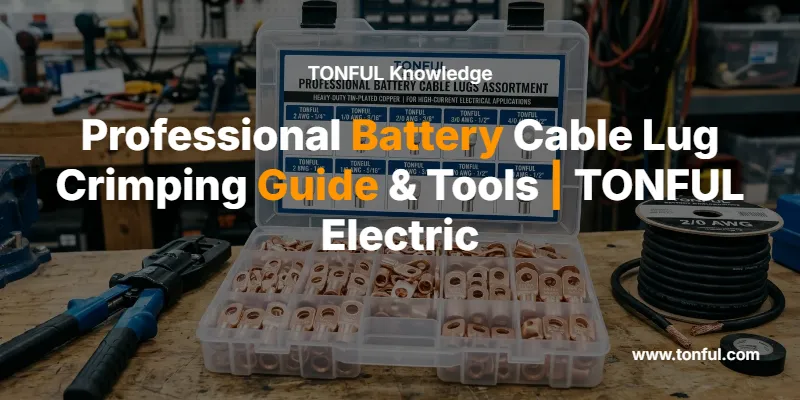
Battery cable lugs serve as the critical connection point in high-current electrical systems, from automotive applications to industrial power distribution and renewable energy installations. A properly crimped battery cable lug ensures minimal resistance, prevents voltage drop, and maintains electrical integrity under extreme conditions. This comprehensive guide covers the technical specifications, tools, procedures, and quality standards required to achieve factory-grade crimped connections that meet UL 486A-486B and ABYC E-11 standards.
Understanding Battery Cable Lugs: Types and Applications
Battery cable lugs are copper or aluminum terminals designed to terminate large-gauge conductors (typically 8 AWG to 4/0 AWG) in high-amperage circuits. Unlike standard crimp terminals used in lower-current applications, battery cable lugs must withstand sustained currents exceeding 100 amperes while maintaining electrical integrity across temperature extremes and mechanical vibration.
Common Battery Cable Lug Types
| Lug Type | Configuration | Typical Applications | Current Rating |
|---|---|---|---|
| Ring Terminal Lug | Closed circular eye | Battery posts, bus bars, grounding points | 100-600A |
| Spade/Fork Lug | Open U-shaped fork | Quick-disconnect applications | 80-400A |
| Pin/Stud Lug | Straight barrel with pin | Welding equipment, heavy machinery | 150-800A |
| Offset Lug | Angled barrel design | Tight-space installations | 100-500A |

Battery Cable Lug Material Specifications
Copper vs. Aluminum Lugs
| Property | Copper Lugs | Aluminum Lugs |
|---|---|---|
| Conductivity | 100% IACS (58 MS/m) | 61% IACS (35 MS/m) |
| Weight | Heavier (8.96 g/cm³) | Lighter (2.70 g/cm³) |
| Corrosion Resistance | Excellent with tin plating | Requires protective coating |
| Cost | Higher initial cost | Lower material cost |
| Thermal Expansion | Lower coefficient | Higher expansion rate |
| Recommended Use | Marine, automotive, solar | Utility, overhead transmission |
Tin-plated copper terminals provide superior corrosion resistance in humid environments and prevent oxidation that increases contact resistance over time. The tin layer (typically 5-10 microns thick) maintains low contact resistance and ensures long-term reliability in outdoor and marine applications.
Essential Tools for Crimping Battery Cable Lugs
Crimping Tool Selection
Proper crimping requires specialized tools capable of generating sufficient compression force to create a gas-tight, cold-welded connection. The tool selection depends on cable gauge, lug type, and production volume.
Comparison: Manual vs. Hydraulic Crimping Tools
| Feature | Manual Crimping Tools | Hydraulic Crimping Tools |
|---|---|---|
| Force Generation | 1-3 tons (mechanical advantage) | 8-16 tons (hydraulic pressure) |
| Wire Gauge Range | 8 AWG to 1/0 AWG | 8 AWG to 4/0 AWG |
| Crimp Profile | Hex, indent | Hex, indent, W-crimp |
| Operator Fatigue | High on large gauges | Minimal |
| Portability | Excellent | Moderate (battery-powered models available) |
| Cost Range | $40-$150 | $80-$400 |
| Best For | Occasional use, field repairs | Production environments, heavy gauges |
For professional applications requiring consistent quality on cables 2 AWG and larger, hydraulic crimpers deliver superior compression uniformity and reduce operator fatigue. Battery-powered hydraulic models combine portability with professional-grade crimping force, making them ideal for mobile service technicians and field installations.

Required Equipment Checklist
- Crimping tool with appropriate die sets (hex or indent profile)
- Cable stripper rated for heavy-gauge wire (rotary or adjustable blade type)
- Wire cutters capable of cutting through large conductors
- Heat gun (for heat-shrink terminal applications, 500-750°F)
- Digital calipers (verify strip length and lug dimensions)
- Multimeter (continuity and resistance testing)
- Pull-test gauge (verify crimp mechanical strength)
- Safety equipment (cut-resistant gloves, safety glasses)
TONFUL offers complete automotive electrical connector kits that include properly matched crimping tools and terminal assortments for professional mechanics.
Step-by-Step Battery Cable Lug Crimping Procedure
Pre-Crimping Preparation
1. Cable and Lug Selection
Match the lug barrel size precisely to the cable gauge. Oversized lugs result in weak crimps with high resistance; undersized lugs damage conductor strands and reduce current capacity.
Wire Gauge to Lug Size Reference Table
| Cable Size (AWG) | Conductor Diameter | Lug Barrel ID | Stud Hole Size | Typical Current Rating |
|---|---|---|---|---|
| 8 AWG | 3.26 mm (0.128″) | 4.0-4.5 mm | 1/4″ (M6) | 40-60A |
| 6 AWG | 4.11 mm (0.162″) | 5.0-5.5 mm | 5/16″ (M8) | 55-75A |
| 4 AWG | 5.19 mm (0.204″) | 6.0-6.5 mm | 3/8″ (M10) | 70-95A |
| 2 AWG | 6.54 mm (0.258″) | 7.5-8.0 mm | 3/8″ (M10) | 95-130A |
| 1/0 AWG | 8.25 mm (0.325″) | 9.5-10.0 mm | 1/2″ (M12) | 150-200A |
| 2/0 AWG | 9.27 mm (0.365″) | 11.0-11.5 mm | 1/2″ (M12) | 175-230A |
| 3/0 AWG | 10.40 mm (0.410″) | 12.5-13.0 mm | 5/8″ (M16) | 200-265A |
| 4/0 AWG | 11.68 mm (0.460″) | 14.0-14.5 mm | 5/8″ (M16) | 230-305A |
2. Cable Preparation and Stripping
Strip insulation to match the lug barrel depth—typically 1/2″ to 5/8″ for most battery cable lugs. Use a rotary cable stripper or adjustable blade stripper to remove insulation without nicking conductor strands.
Critical Stripping Guidelines:
- Never cut or remove individual conductor strands
- Strip length should allow full barrel insertion with no exposed conductor
- Inspect stripped end for strand damage; re-cut if necessary
- Twist conductor strands lightly (hand-tight only) to consolidate strands

Crimping Execution
3. Die Selection and Tool Setup
Select crimping dies that match both the lug size and the cable gauge. Most professional crimpers use hex dies (creating a hexagonal crimp profile) or indent dies (creating multiple compression points along the barrel).
Die Selection Chart
| Cable Size | Hex Die Code | Indent Die Positions | Crimp Force Required |
|---|---|---|---|
| 8-6 AWG | 6 mm | 2 positions | 2-3 tons |
| 4-2 AWG | 8 mm | 2-3 positions | 3-5 tons |
| 1/0-2/0 AWG | 10 mm | 3-4 positions | 6-8 tons |
| 3/0-4/0 AWG | 13 mm | 4-5 positions | 10-12 tons |
4. Conductor Insertion
Insert the stripped conductor fully into the lug barrel until all strands reach the barrel stop. Verify that no strands protrude from the barrel entry point and no conductor is visible between the insulation and lug barrel entry.
5. Crimp Application
Position the crimping tool die over the lug barrel crimp zone (typically marked on the lug or specified in manufacturer documentation). For hex crimpers, center the die on the barrel. For indent crimpers, follow the manufacturer’s specified crimp sequence (typically starting from the conductor entry end and working toward the lug palm).
Critical Crimping Parameters:
- Apply full tool stroke/pressure—partial crimps create high-resistance connections
- For ratcheting tools, complete the full ratchet cycle
- For hydraulic tools, pump until the pressure relief valve activates
- Maintain perpendicular tool alignment to prevent uneven compression

Post-Crimp Inspection and Testing
6. Visual Inspection
A properly crimped lug exhibits:
- Uniform compression across the entire barrel length
- No cracks or splits in the lug barrel
- No conductor strands protruding from either end
- Clear die impression marks (hex pattern or indent marks)
- No insulation trapped in the crimp zone
7. Mechanical Pull Test
Professional installations require pull-testing to verify crimp integrity. Industry standards specify minimum pull-out forces based on conductor size:
| Cable Size | Minimum Pull Force | Test Method |
|---|---|---|
| 8 AWG | 100 lbs (445 N) | UL 486A-486B |
| 4 AWG | 200 lbs (890 N) | UL 486A-486B |
| 2 AWG | 300 lbs (1335 N) | UL 486A-486B |
| 1/0 AWG | 450 lbs (2000 N) | UL 486A-486B |
| 4/0 AWG | 750 lbs (3340 N) | UL 486A-486B |
Apply steady tension for 60 seconds; the conductor must not pull out or show more than 1/16″ movement.
8. Electrical Resistance Testing
Measure the resistance across the crimped connection using a low-resistance ohmmeter (milliohm meter). A proper crimp should exhibit resistance values consistent with the conductor material and length, with minimal additional resistance from the crimp itself (typically less than 0.1 milliohms for copper connections).
9. Heat-Shrink Sealing (Recommended)
Apply adhesive-lined heat shrink tubing over the crimped connection to provide environmental sealing, strain relief, and insulation. Heat-shrink terminals integrate this protection into the lug design, making them ideal for marine wiring applications and outdoor installations.

Common Crimping Mistakes and How to Avoid Them
Critical Errors That Compromise Connection Quality
1. Insufficient Crimp Compression
Partial tool strokes or incorrect die selection result in loose crimps with high contact resistance. Always complete the full crimping cycle and verify die compatibility with lug specifications.
2. Over-Crimping
Excessive compression can fracture conductor strands and crack the lug barrel, creating failure points. Follow manufacturer torque specifications and use calibrated tools.
3. Incorrect Strip Length
Too short: conductor doesn’t reach barrel stop, reducing contact area. Too long: exposed conductor creates short-circuit risk. Measure strip length against lug barrel depth before cutting.
4. Strand Damage During Stripping
Nicked or cut strands reduce effective conductor cross-section and create stress concentration points. Inspect stripped ends and re-cut if damage is visible.
5. Contamination in Crimp Zone
Oil, dirt, or oxidation on conductor strands or inside lug barrels increases contact resistance. Clean both surfaces before crimping, especially when working with copper vs brass terminals.
Installation Torque Specifications
After crimping, battery cable lugs must be properly torqued to terminal posts or bus bars. Under-torquing creates high-resistance connections that overheat; over-torquing can strip threads or crack lugs.
Recommended Installation Torque Values
| Stud Size | Copper Lug Torque | Aluminum Lug Torque | Thread Type |
|---|---|---|---|
| 1/4″ (M6) | 75-90 in-lb (8.5-10 Nm) | 60-75 in-lb (6.8-8.5 Nm) | UNC/Metric |
| 5/16″ (M8) | 120-150 in-lb (13.5-17 Nm) | 100-120 in-lb (11-13.5 Nm) | UNC/Metric |
| 3/8″ (M10) | 200-250 in-lb (22-28 Nm) | 160-200 in-lb (18-22 Nm) | UNC/Metric |
| 1/2″ (M12) | 300-350 in-lb (34-40 Nm) | 240-280 in-lb (27-32 Nm) | UNC/Metric |
| 5/8″ (M16) | 400-500 in-lb (45-56 Nm) | 320-400 in-lb (36-45 Nm) | UNC/Metric |
Use a calibrated torque wrench and apply torque in a single smooth motion. Re-torque connections after 24 hours of initial operation to compensate for material settling. For critical applications, implement a regular inspection schedule to verify connection integrity.
Industry Standards and Compliance
Professional battery cable lug installations must comply with relevant electrical codes and industry standards:
- UL 486A-486B: Wire connectors and soldering lugs for use with copper conductors
- ABYC E-11: AC and DC electrical systems on boats (marine applications)
- SAE J1127: Low voltage battery cable specifications (automotive)
- IEC 61238: Compression and mechanical connectors for power cables
- NEC Article 110.14: Electrical connections requirements
TONFUL battery cable lugs are manufactured to meet these international standards, ensuring reliable performance in demanding applications. Our heavy-duty copper lugs undergo rigorous testing including salt spray corrosion testing (ASTM B117), thermal cycling, and mechanical pull tests to verify compliance.
Application-Specific Considerations
Automotive and Heavy-Duty Vehicle Applications
Battery cable connections in vehicles must withstand extreme vibration, temperature cycling (-40°F to +200°F), and exposure to oils and chemicals. Use tin-plated copper lugs with heat-shrink terminals for maximum reliability. For commercial trucks, heavy-duty truck combination switches and electrical systems require properly crimped connections to prevent voltage drop issues.
Solar and Renewable Energy Systems
High voltage EV battery terminals and solar installations demand UV-resistant materials and corrosion protection. Select lugs with appropriate current ratings for continuous DC loads, accounting for temperature derating factors. Battery bank connections require equal-length cables with matched crimps to ensure balanced current distribution.
Marine and Outdoor Applications
Marine environments require waterproof wire connectors and sealed crimp connections. Use marine-grade tinned copper lugs and apply adhesive-lined heat shrink for complete environmental sealing. Follow ABYC standards for all below-deck and bilge area connections.
Industrial and Welding Equipment
Welding cable terminations and industrial power distribution require lugs rated for continuous high-current operation. Verify that lug temperature ratings match application requirements, and use heavy-duty copper lugs designed for sustained loads exceeding 200 amperes.
Troubleshooting Crimped Connections
Diagnosing Connection Problems
| Symptom | Probable Cause | Solution |
|---|---|---|
| Excessive heat at connection | High contact resistance from poor crimp | Re-crimp with proper tool and die |
| Conductor pull-out | Insufficient compression or wrong lug size | Replace lug, verify size match, full crimp cycle |
| Voltage drop under load | Oxidation or contamination in crimp | Clean and re-crimp; use tin-plated lugs |
| Visible corrosion | Moisture ingress | Apply heat-shrink sealing; use marine-grade lugs |
| Intermittent connection | Vibration loosening or cracked lug | Replace lug; verify installation torque |
For persistent issues, consult TONFUL’s technical support team or reference our comprehensive wire terminal applications guide.
FAQ: Battery Cable Lug Crimping
Q: Can I use a hammer-style crimper for battery cable lugs?
A: Hammer crimpers work for occasional light-duty applications (8-4 AWG), but hydraulic or ratcheting crimpers provide more consistent compression and are required for professional installations and larger gauges.
Q: Should I solder battery cable lugs after crimping?
A: No. Modern crimping standards (UL 486A-486B, NASA-STD-8739.4) prohibit soldering crimped connections. Solder creates a brittle transition zone and can wick up the conductor strands, reducing flexibility. A proper crimp creates a gas-tight cold-weld that outperforms soldered connections. Learn more about solder vs crimp comparisons.
Q: How do I know if my crimp is good enough?
A: Perform three checks: (1) Visual inspection for uniform compression and no cracks, (2) Pull test meeting UL 486A minimum force requirements, (3) Resistance measurement showing less than 0.1 milliohms additional resistance. Professional installations should document all three tests.
Q: What’s the difference between hex crimp and indent crimp?
A: Hex crimps use a six-point die that compresses the entire barrel circumference simultaneously, creating a hexagonal profile. Indent crimps use a narrow die that creates multiple compression points along the barrel length. Both methods are acceptable when properly executed with matched dies; hex crimps are more common for battery cable applications.
Q: Can I reuse a battery cable lug if I need to remake the connection?
A: No. Once crimped, the lug barrel is permanently deformed and cannot provide proper compression if re-crimped. Always use a new lug when remaking connections. Cut off the old lug and prepare a fresh cable end.
Q: Do I need special lugs for aluminum cable?
A: Yes. Aluminum conductors require lugs specifically rated for aluminum (marked AL or AL/CU for dual-rated lugs). Aluminum oxidizes rapidly, requiring special crimp profiles and anti-oxidant compounds. Never use copper-only lugs on aluminum conductors. Refer to our copper vs brass terminals guide for material compatibility.
Conclusion: Achieving Professional-Grade Battery Cable Connections
Properly crimped battery cable lugs form the foundation of reliable high-current electrical systems. By selecting appropriately sized lugs, using professional-grade crimping tools with matched dies, following systematic preparation and crimping procedures, and verifying connections through pull-testing and resistance measurement, you can achieve factory-grade results that meet or exceed industry standards.
TONFUL Electric manufactures a complete range of automotive terminals and connectors, wire terminals, and electrical tools designed for professional installers and OEM applications. Our products comply with international standards and undergo rigorous quality testing to ensure reliable performance in demanding environments.
For technical specifications, bulk purchasing options, or application-specific recommendations, contact TONFUL’s engineering team or explore our comprehensive terminals and connectors catalog. Invest in quality components and proper installation techniques to ensure your electrical systems deliver maximum performance and longevity.
Related Resources: