
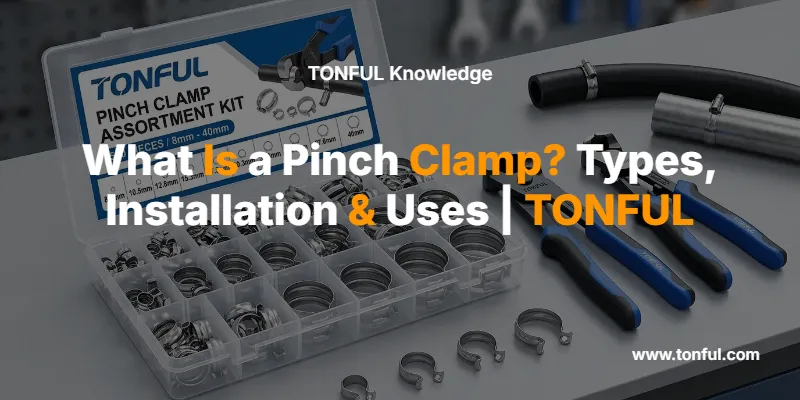
Pinch clamps, also known as ear clamps or single-ear clamps, are specialized fastening devices designed to secure hoses, tubing, and flexible pipes onto barbed fittings. These stainless steel clamps feature one or more protruding “ears” that, when crimped with a specialized tool, create a uniform 360-degree compression seal around the connection point. Unlike traditional worm gear clamps that rely on threaded mechanisms, pinch clamps provide a permanent, tamper-proof seal that is particularly valued in applications requiring leak-proof connections under pressure or vibration.
In industrial and automotive settings, pinch clamps have become the preferred choice for securing fluid lines, coolant hoses, fuel systems, and pneumatic connections. Their compact profile, corrosion resistance, and ability to maintain consistent clamping force make them indispensable across manufacturing, plumbing, HVAC, and marine applications.

Understanding Pinch Clamp Design and Working Principle
Pinch clamps operate on a simple yet effective mechanical principle. The clamp consists of a circular stainless steel band with one or more raised tabs (ears) positioned at strategic points around the circumference. When the installer positions the clamp over a hose-to-fitting connection and applies compressive force to the ear using a specialized crimping tool, the ear deforms permanently, drawing the band tighter and creating uniform radial pressure around the entire hose circumference.
The key advantage of this design lies in its stepless compression mechanism. Unlike worm gear clamps that create localized pressure points at the screw housing, pinch clamps distribute clamping force evenly across the full 360-degree contact area. This prevents hose deformation, reduces the risk of stress concentrations that can lead to leaks, and maintains seal integrity even when subjected to thermal cycling, vibration, or pressure fluctuations.
Modern pinch clamps incorporate interlocking band designs that prevent the clamp from opening once crimped, ensuring a permanent connection that cannot loosen over time. This tamper-proof characteristic makes them particularly suitable for safety-critical applications in automotive fuel systems, medical equipment, and pressurized fluid handling systems.
Types of Pinch Clamps
Single-Ear Pinch Clamps
Single-ear pinch clamps feature one protruding tab and represent the most common configuration. These clamps are ideal for standard hose connections in automotive cooling systems, plumbing applications, and general industrial use. The single-ear design allows for quick installation in confined spaces where access is limited to one side of the connection.
Double-Ear Pinch Clamps
Double-ear clamps incorporate two opposing ears positioned 180 degrees apart. This configuration provides enhanced clamping force distribution and is preferred for high-pressure applications or larger diameter hoses where a single ear might not generate sufficient compression. Double-ear clamps are commonly used in heavy-duty truck cooling systems, industrial hydraulic lines, and marine engine installations.
Stepless Ear Clamps
Stepless ear clamps represent an advanced design that eliminates gaps in the band structure, providing truly continuous 360-degree compression. These premium clamps are manufactured from a single piece of stainless steel with no perforations or slots that could create weak points. Stepless designs are specified for critical applications including fuel injection systems, emissions control components, and medical fluid handling where even microscopic leaks are unacceptable.

Pinch Clamp vs. Other Clamp Types: Comprehensive Comparison
| Feature | Pinch Clamp | Worm Gear Clamp | T-Bolt Clamp | Spring Clamp |
|---|---|---|---|---|
| Installation | Requires crimping tool | Screwdriver/socket | Wrench/socket | Hand installation |
| Reusability | Single-use | Reusable | Reusable | Reusable |
| Pressure Distribution | 360° uniform | Localized at screw | Uniform | Variable with temperature |
| Profile Height | Low (5-8mm) | High (12-15mm) | Very high (15-20mm) | Medium (8-12mm) |
| Tamper Resistance | Permanent seal | Easily loosened | Easily loosened | Can be removed by hand |
| Vibration Resistance | Excellent | Good (can loosen) | Excellent | Good |
| Cost per Unit | Low | Medium | High | Low |
| Installation Speed | Fast (5-10 sec) | Moderate (20-30 sec) | Slow (30-45 sec) | Very fast (2-5 sec) |
| Best Applications | Automotive, plumbing, permanent installations | General purpose, maintenance access required | High-pressure turbo/intercooler | Coolant systems, temporary connections |
The comparison reveals that pinch clamps excel in applications requiring permanent, tamper-proof connections with minimal installation time. Their low profile makes them ideal for tight spaces where automotive electrical connectors and hose assemblies must coexist in crowded engine compartments.
Industrial Applications of Pinch Clamps
Automotive Industry
Pinch clamps are extensively used throughout modern vehicles for securing coolant hoses, heater hoses, vacuum lines, and emissions control tubing. Their ability to maintain seal integrity through extreme temperature cycles (-40°C to +150°C) and constant vibration makes them the OEM standard for most automotive manufacturers. In fuel systems, stepless pinch clamps provide the leak-proof connections required to meet stringent emissions regulations.
The automotive aftermarket also relies heavily on pinch clamps for repair and maintenance operations. Professional technicians use crimping tools specifically designed for automotive pinch clamp installation, ensuring proper compression without over-crimping that could damage the hose or under-crimping that might allow leaks.
Plumbing and HVAC Systems
In residential and commercial plumbing, pinch clamps secure PEX tubing to brass and poly fittings, creating permanent connections that meet building codes for concealed installations. The stainless steel construction provides corrosion resistance in both potable water and drainage applications. HVAC contractors use pinch clamps for condensate drain lines, refrigerant hose connections, and ductwork transitions where air-tight seals are critical for system efficiency.
The permanent nature of pinch clamp connections provides an advantage over threaded compression fittings in applications where future access is limited, such as behind finished walls or above ceilings. Once properly installed with a calibrated crimping tool, pinch clamps require no maintenance or periodic retightening.
Medical and Laboratory Equipment
Medical device manufacturers specify pinch clamps for IV tubing, dialysis equipment, and laboratory fluid handling systems where sterility and leak prevention are paramount. The smooth interior surface of stepless pinch clamps prevents bacterial colonization and allows for effective sterilization. Unlike reusable clamps that might harbor contaminants, single-use pinch clamps can be disposed of with the tubing after each patient procedure.

Food and Beverage Industry
Beverage dispensing systems, brewery equipment, and food processing lines use food-grade stainless steel pinch clamps (typically 316 stainless) to connect silicone and sanitary hoses to process equipment. The clamps must meet FDA requirements for food contact surfaces and withstand frequent cleaning with caustic chemicals and high-temperature sanitizing procedures.
Pinch clamps in food applications are often specified as stepless designs to eliminate crevices where bacteria or product residue might accumulate. The permanent seal also prevents tampering or accidental disconnection that could compromise product safety or quality.
Marine and Off-Road Applications
Marine engine installations subject hose connections to constant vibration, salt water exposure, and temperature extremes. Marine-grade pinch clamps manufactured from 316 stainless steel provide superior corrosion resistance compared to 304 stainless or zinc-plated alternatives. Boat builders use pinch clamps for raw water cooling systems, bilge pump hoses, and fuel lines where waterproof wire connectors and secure hose connections are equally critical for safety.
Off-road vehicles and agricultural equipment similarly benefit from pinch clamps’ vibration resistance and ability to maintain seal integrity in dusty, muddy environments where threaded clamps might seize or corrode.
Pinch Clamp Material Specifications
| Material Grade | Composition | Corrosion Resistance | Temperature Range | Typical Applications |
|---|---|---|---|---|
| 304 Stainless Steel | 18% Cr, 8% Ni | Good (freshwater, mild chemicals) | -40°C to +200°C | Automotive, general industrial, plumbing |
| 316 Stainless Steel | 16% Cr, 10% Ni, 2% Mo | Excellent (saltwater, acids) | -40°C to +400°C | Marine, food processing, chemical handling |
| 301 Stainless Steel | 16% Cr, 6% Ni | Good (standard environments) | -40°C to +150°C | Cost-sensitive automotive applications |
The molybdenum content in 316 stainless steel provides significantly enhanced resistance to chloride corrosion, making it the mandatory choice for marine applications and chemical processing environments. For standard automotive and plumbing applications, 304 stainless steel offers an excellent balance of performance and cost-effectiveness.
Quality pinch clamps should be manufactured from continuous coil stock with consistent thickness (typically 0.6-0.8mm for automotive sizes) and uniform heat treatment to ensure proper spring-back characteristics during crimping. Inferior clamps made from recycled or inconsistent material may crack during installation or fail to maintain clamping force over time.

How to Select the Correct Pinch Clamp Size
Proper pinch clamp sizing is critical for achieving a leak-proof seal without damaging the hose. The clamp must be sized to match the outer diameter of the hose after it has been installed on the fitting, not the hose’s nominal size or the fitting diameter.
Sizing Methodology
- Measure the installed hose outer diameter using calipers after the hose is fully seated on the barbed fitting.
- Add 1-2mm to account for hose compression during crimping.
- Select the clamp size range that encompasses this measurement.
For example, if a hose measures 18mm OD when installed on the fitting, select a clamp with a range of 16-19mm or 17-20mm. Most pinch clamps are available in 2-3mm size increments to accommodate standard hose sizes.
Standard Pinch Clamp Size Chart
| Clamp Size Range (mm) | Typical Hose Applications | Common Industries |
|---|---|---|
| 7-9 | 1/4″ vacuum lines, small medical tubing | Automotive, medical |
| 9-12 | 5/16″ fuel lines, coolant bypass hoses | Automotive, small engines |
| 12-15 | 3/8″ heater hoses, PEX tubing | Automotive, plumbing |
| 15-18 | 1/2″ coolant hoses, hydraulic lines | Automotive, industrial |
| 18-21 | 5/8″ radiator hoses, water supply lines | Automotive, HVAC |
| 21-25 | 3/4″ coolant hoses, pool equipment | Automotive, marine |
| 25-32 | 1″ industrial hoses, large coolant lines | Heavy equipment, industrial |
| 32-40 | 1-1/4″ process hoses, large water lines | Industrial, food processing |
When working with heat shrink terminals and wire connections in the same assembly, ensure adequate clearance between electrical components and hose clamps to prevent chafing or short circuits.
Installation Tools and Techniques
Required Tools
Professional pinch clamp installation requires a dedicated crimping tool designed specifically for ear clamps. These tools fall into three categories:
- Manual Pinch Clamp Pliers: Hand-operated tools with parallel jaws that compress the ear uniformly. Suitable for clamps up to 25mm and occasional use. Quality tools feature ratcheting mechanisms that prevent premature release and ensure complete crimping.
- Ratcheting Pinch Clamp Tools: Professional-grade tools with compound leverage and ratchet mechanisms that guarantee proper compression. These tools cannot be opened until the ear is fully crimped, eliminating the possibility of incomplete installation. A single tool typically handles all sizes from 8mm to 40mm.
- Hydraulic Crimping Tools: For production environments or large-diameter clamps (40mm+), hydraulic tools provide consistent crimping force with minimal operator effort. These tools are common in automotive manufacturing plants and heavy equipment assembly operations.

Installation Best Practices
- Inspect components: Verify the hose has no cuts or damage and the fitting barbs are clean and undamaged.
- Lubricate if necessary: For tight-fitting hoses, apply a small amount of compatible lubricant to ease installation.
- Position clamp first: Slide the pinch clamp onto the hose before installing the hose on the fitting.
- Seat hose completely: Ensure the hose is fully inserted onto the fitting with all barbs engaged.
- Position clamp correctly: Center the clamp over the barbed section, typically 3-5mm from the fitting shoulder.
- Orient ear for access: Rotate the clamp so the ear is accessible to the crimping tool.
- Crimp decisively: Apply steady pressure until the tool’s ratchet releases, indicating complete crimping.
- Verify installation: Visually inspect the crimped ear—it should be compressed to approximately 50% of its original height with no cracks.
Common installation errors include positioning the clamp too far forward (beyond the barbs), over-crimping that cracks the ear or cuts the hose, and under-crimping that leaves the connection loose. Unlike wire terminals that can be tested with a pull test, pinch clamp quality is primarily verified through visual inspection and pressure testing of the complete system.
Advantages and Limitations of Pinch Clamps
Key Advantages
- Uniform Clamping Pressure: The 360-degree compression eliminates pressure points that can damage hoses or create leak paths, extending hose life and improving reliability.
- Low Profile Design: With a height of only 5-8mm, pinch clamps fit in confined spaces where bulkier worm gear or T-bolt clamps cannot be accommodated.
- Tamper-Proof Security: Once crimped, pinch clamps cannot be loosened without cutting, providing security for safety-critical systems and preventing unauthorized modifications.
- Fast Installation: Experienced installers can crimp a pinch clamp in 5-10 seconds, significantly faster than threading and torquing traditional clamps.
- Vibration Resistance: The permanent mechanical deformation provides superior resistance to loosening under vibration compared to threaded fasteners.
- Cost-Effective: Pinch clamps typically cost 30-50% less than equivalent T-bolt clamps and comparable to basic worm gear clamps, while offering superior performance.
Limitations and Considerations
- Single-Use Nature: Pinch clamps must be cut off and replaced during maintenance, increasing long-term costs in applications requiring frequent service access. For systems needing regular inspection, reusable automotive connectors and worm gear clamps may be more economical.
- Tool Dependency: Installation requires a specialized crimping tool, creating a barrier for DIY users or field repairs where tools may not be available.
- Inspection Difficulty: Unlike threaded clamps where torque can be verified, pinch clamp installation quality depends on visual inspection and installer technique.
- Limited Adjustability: Once crimped, pinch clamps cannot be repositioned or adjusted, requiring complete replacement if the initial installation is incorrect.
- Material Compatibility: Some soft hoses (silicone, certain rubber compounds) may be damaged by the high localized pressure at the crimped ear, requiring careful material selection.
Quality Standards and Certifications
Professional-grade pinch clamps should meet or exceed relevant industry standards:
- SAE J1508: Specifies performance requirements for low-pressure hose clamps used in automotive applications, including corrosion resistance, tensile strength, and temperature cycling.
- DIN 3017: European standard defining dimensions, materials, and testing procedures for hose clamps, widely referenced in industrial applications.
- ASTM F2098: Standard specification for stainless steel clamps for securing hose to fittings, covering material composition, mechanical properties, and corrosion resistance.
- FDA 21 CFR 177.2600: For food contact applications, pinch clamps must be manufactured from FDA-compliant stainless steel grades.
Quality manufacturers provide material certifications, lot traceability, and test data demonstrating compliance with applicable standards. When sourcing pinch clamps for critical applications, verify that the supplier can provide documentation of material composition (mill certificates) and performance testing results.
TONFUL Electric manufactures pinch clamps meeting international quality standards, with rigorous quality control processes ensuring consistent performance across production lots. Our terminals and connectors and clamping products undergo comprehensive testing including salt spray exposure, tensile strength verification, and pressure cycle testing.
Frequently Asked Questions
Q: Can pinch clamps be reused after removal?
A: No, pinch clamps are designed for single-use installation. The crimping process permanently deforms the metal, and attempting to reuse a pinch clamp will not provide adequate clamping force. Always use a new clamp when servicing hose connections.
Q: What’s the difference between 304 and 316 stainless steel pinch clamps?
A: 316 stainless steel contains molybdenum, providing superior corrosion resistance in marine environments and chemical applications. For standard automotive and plumbing use, 304 stainless steel offers excellent performance at lower cost. Choose 316 for saltwater exposure or acidic environments.
Q: How do I know if a pinch clamp is properly crimped?
A: A properly crimped ear should be compressed to approximately 50% of its original height, with smooth deformation and no cracks or splits. The clamp should not rotate on the hose when twisted by hand, and the hose should not slide off the fitting with moderate pulling force.
Q: Can I install pinch clamps without a special tool?
A: While it’s technically possible to crimp a pinch clamp with pliers or other improvised tools, this approach rarely achieves proper compression and may damage the clamp or hose. Professional crimping tools cost $20-50 for manual versions and ensure reliable installation.
Q: What size pinch clamp do I need for 1/2″ hose?
A: Measure the outer diameter of the hose after it’s installed on the fitting, not the nominal hose size. A 1/2″ hose typically measures 16-18mm OD when installed, requiring a 15-18mm or 16-19mm pinch clamp depending on the specific hose and fitting combination.
Q: Are pinch clamps better than worm gear clamps?
A: Pinch clamps offer advantages in permanent installations requiring low profile, tamper resistance, and fast installation. Worm gear clamps are preferable when reusability and field adjustability are needed. The best choice depends on your specific application requirements. For related electrical connections, consider our heat shrink terminals for similar permanent, reliable connections.
Conclusion
Pinch clamps represent a highly effective solution for securing hoses and tubing in applications demanding reliable, permanent connections. Their combination of uniform clamping pressure, compact design, and cost-effectiveness has made them the standard choice across automotive, plumbing, industrial, and marine applications. While the single-use nature and tool requirements may present limitations in some scenarios, the performance advantages typically outweigh these considerations for permanent installations.
When selecting pinch clamps for your application, prioritize proper sizing, appropriate material grade for the operating environment, and quality manufacturing that meets relevant industry standards. Professional installation with calibrated crimping tools ensures optimal performance and longevity.
For comprehensive electrical connection solutions including wire terminals, automotive connectors, cable ties, and professional-grade electrical tools, TONFUL Electric offers a complete range of products backed by rigorous quality standards and technical support. Our commitment to manufacturing excellence ensures that every component meets the demanding requirements of modern industrial and automotive applications.