
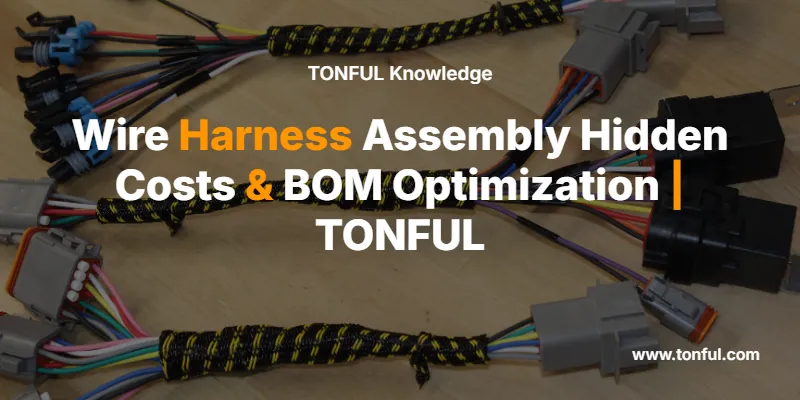
Wire harness assembly represents a critical component in modern manufacturing, yet many procurement managers and engineers underestimate its true cost impact. Beyond the obvious material expenses listed in your bill of materials (BOM), hidden costs can inflate your total expenditure by 30-50%. Understanding and optimizing these costs is essential for maintaining competitive pricing while ensuring quality and reliability.
Understanding the True Cost Structure of Wire Harness Assembly
The total cost of wire harness assembly extends far beyond raw material prices. A comprehensive cost analysis reveals multiple layers of expenses that often escape initial budgeting. Material costs typically account for 50-65% of the total harness cost, with copper wire alone representing 30-50% of material expenses. However, the remaining costs—labor, tooling, testing, and overhead—create significant financial impact that demands careful management.
Labor costs vary dramatically based on geographic location and assembly complexity. In China, assembly labor ranges from $6-8 per hour per worker, while Vietnam and Mexico offer rates of $3-5 per hour. A single harness can require 3-8 hours of manual assembly time, translating to substantial labor expenses across production volumes. The precision required for modern high-density connectors, with some automotive applications using over 700 connectors per harness, further increases labor intensity and associated costs.

The Hidden Cost Categories in Wire Harness Manufacturing
Material Cost Variables Beyond the BOM
While your BOM lists component quantities and unit prices, several material-related costs remain hidden until production begins. Copper price volatility presents a primary concern, with prices fluctuating based on global market conditions. As of 2025, high-grade copper trades at approximately $71,990 per ton, but these prices change daily, creating budgeting uncertainty for long-term contracts.
Insulation and protection materials add 10-20% to material costs, yet specifications vary widely in price. Standard PVC insulation costs approximately $0.10 per meter, while heat-resistant FLRY or GXL insulation for engine bay applications costs $0.30 per meter—a 200% premium. Choosing appropriate insulation requires balancing performance requirements against cost implications, and incorrect initial specifications can necessitate expensive redesigns.
Material waste represents another hidden cost factor. Inefficient cutting patterns, incorrect wire length calculations, and scrap from rework can increase material consumption by 5-15% beyond theoretical BOM requirements. Advanced harness design software can reduce this waste through optimized nesting algorithms and precise length calculations, but many manufacturers still rely on manual processes that generate excessive scrap.
Labor and Assembly Efficiency Costs
Assembly time directly correlates with labor costs, yet time estimates often prove optimistic during actual production. Complex harnesses with multiple branches, varied connector types, and tight routing requirements take significantly longer to assemble than simple point-to-point designs. Each additional connector, splice, or branch point adds incremental assembly time that compounds across production volumes.
Training costs for assembly personnel represent a substantial but often overlooked expense. New workers require 2-4 weeks of training to achieve acceptable quality levels for complex harnesses. High turnover rates in manufacturing facilities necessitate continuous training investment, with some facilities experiencing 20-30% annual turnover that creates perpetual training costs.
Rework and quality defects generate some of the most expensive hidden costs in wire harness manufacturing. A single misrouted wire, incorrect crimp, or damaged connector can require complete harness disassembly and reassembly. Industry data suggests that rework costs can reach 5-10% of total production costs when quality control processes are inadequate. Implementing robust testing procedures, including continuity testing and pull testing for crimp terminals, reduces these costs significantly.

Tooling and Equipment Costs
Specialized tooling requirements create significant upfront and ongoing costs. Crimping tools for different terminal types, wire strippers, heat shrink application equipment, and testing devices represent substantial capital investments. A complete wire harness assembly workstation can require $5,000-15,000 in tooling, depending on harness complexity and production volume.
Tool maintenance and calibration costs accumulate over time. Crimping dies wear with use and require periodic replacement to maintain quality standards. Calibration of testing equipment ensures accuracy but adds recurring costs. Many manufacturers underestimate these ongoing expenses, budgeting only for initial tool purchase without accounting for lifecycle costs.
Connector-specific tooling presents particular challenges. Different connector families require dedicated insertion and extraction tools, with some specialized automotive connectors requiring proprietary tooling available only from the connector manufacturer. This creates vendor lock-in and limits flexibility in component sourcing.
BOM Optimization Strategies for Cost Reduction
Component Standardization and Consolidation
Reducing component variety in your BOM delivers multiple cost benefits. Each unique part number adds complexity to procurement, inventory management, and assembly processes. By standardizing on fewer wire terminal types, connector families, and wire specifications, you can achieve volume discounts, reduce inventory carrying costs, and simplify assembly procedures.
Connector standardization proves particularly valuable. Instead of specifying unique connectors for each application, identify connector families that can serve multiple purposes. For example, standardizing on waterproof wire connectors with appropriate IP ratings can eliminate the need for separate connector types for different environmental conditions, reducing both procurement complexity and assembly training requirements.
Wire gauge consolidation reduces inventory while maintaining performance. Many designs specify wire gauges based on maximum current capacity with minimal margin, creating numerous wire sizes in a single harness. By consolidating to fewer wire gauges with appropriate current capacity, you can reduce inventory SKUs and simplify assembly, though this must be balanced against the cost of using slightly oversized wire in some circuits.

Material Selection and Substitution
Strategic material selection can significantly reduce costs without compromising performance. Copper-clad aluminum (CCA) wire offers an emerging alternative to pure copper, providing 30% cost savings and 40% weight reduction. CCA wire costs approximately $45,000 less per ton than pure copper, though it requires specialized crimping tools that add 10-15% to processing costs. For applications where weight reduction provides value, such as automotive or aerospace harnesses, CCA wire delivers net cost benefits.
Insulation material selection requires careful analysis of actual environmental requirements. Many designs specify premium insulation materials throughout the entire harness when only specific sections require enhanced temperature or chemical resistance. By using standard PVC insulation in benign environments and reserving premium materials for critical areas, you can reduce material costs by 15-25% without compromising reliability.
Heat shrink terminals versus standard insulated terminals present another optimization opportunity. While heat shrink terminals provide superior environmental sealing, they cost more and require additional assembly time. For connections in protected environments, standard insulated terminals offer adequate performance at lower cost. Conversely, using heat shrink terminals in harsh environments eliminates the need for additional sealing measures, potentially reducing overall costs.
Design for Manufacturing (DFM) Principles
Implementing DFM principles during the design phase prevents costly manufacturing problems. Simple design modifications can dramatically reduce assembly time and improve quality. Consistent wire routing, adequate service loops, and logical connector placement reduce assembly complexity and minimize errors.
Modular harness design enables parallel assembly and simplifies testing. Instead of building the entire harness as a single assembly, designing submodules that can be assembled and tested independently improves efficiency and quality. This approach also facilitates inventory management, as common submodules can be built to stock and assembled into final configurations based on demand.
Wire length optimization through accurate digital modeling eliminates waste and reduces material costs. Advanced harness design software calculates precise wire lengths including routing paths, connector entry angles, and service loops. This eliminates the traditional practice of adding excessive length “just in case,” which can increase wire costs by 10-20% while creating assembly challenges due to excess wire that must be managed.
Cost Comparison: Traditional vs. Optimized BOM Approach
| Cost Category | Traditional BOM | Optimized BOM | Savings |
|---|---|---|---|
| Material Costs (per harness) | $85.00 | $68.00 | 20% |
| Labor Time (hours) | 6.5 | 4.2 | 35% |
| Labor Cost @ $7/hr | $45.50 | $29.40 | 35% |
| Tooling (amortized per unit) | $3.20 | $2.10 | 34% |
| Testing Time (minutes) | 25 | 15 | 40% |
| Rework Rate | 8% | 2% | 75% |
| Total Cost per Harness | $142.30 | $105.20 | 26% |
This comparison demonstrates the cumulative impact of BOM optimization across multiple cost categories. While material savings of 20% provide immediate benefits, the compounding effects of reduced labor time, simplified tooling, and improved quality deliver total cost reductions exceeding 25%.

Advanced BOM Management Techniques
Digital Thread Integration
Modern wire harness manufacturing benefits enormously from digital continuity between design, quoting, and production. Enterprise resource planning (ERP) systems integrated with harness design software ensure BOM accuracy and enable real-time cost tracking. This integration eliminates manual data entry errors that can introduce incorrect components or quantities into the BOM, preventing costly production delays and rework.
Automated BOM validation through AI-powered tools identifies design omissions and errors before production begins. These systems detect missing components, improper wire selections, and configuration mistakes that would otherwise become expensive problems during assembly. Early detection of BOM errors saves thousands of dollars in avoided rework and schedule delays.
Version control for BOMs prevents costly mistakes when designs evolve. Many manufacturers struggle with BOM version management, leading to situations where production uses outdated component specifications or quantities. Integrated digital systems maintain BOM synchronization across design revisions, ensuring that procurement, production, and quality control all reference the current specification.
Supplier Relationship Optimization
Strategic supplier partnerships deliver cost benefits beyond simple price negotiation. Focused supply chains with fewer, more strategic suppliers improve communication, increase priority status, and enable collaborative cost reduction initiatives. Rather than sourcing each component from the lowest-cost supplier, developing relationships with key suppliers for electrical terminals, automotive connectors, and wire creates opportunities for volume discounts, consignment inventory, and joint value engineering.
Early supplier involvement in design processes identifies cost-saving opportunities before BOM finalization. Suppliers possess deep knowledge of their product capabilities and can suggest alternative components or specifications that deliver equivalent performance at lower cost. This collaborative approach also ensures component availability and manufacturability, preventing situations where specified components face long lead times or allocation.
Supplier quality performance directly impacts total cost of ownership. While a supplier may offer lower unit prices, poor quality that generates high defect rates and rework costs ultimately increases total expenses. Evaluating suppliers based on total cost of ownership rather than unit price alone leads to better sourcing decisions and lower overall costs.
Predictive Cost Modeling
Advanced cost modeling tools enable accurate cost prediction before committing to production. Modern harness design software incorporates cost estimation modules that calculate material costs, labor time, and manufacturing overhead based on design specifications. This allows engineers to evaluate cost implications of design decisions in real-time, facilitating cost-conscious design choices.
Scenario analysis through cost modeling reveals optimization opportunities. By modeling different component selections, assembly sequences, and manufacturing approaches, engineers can identify the most cost-effective solution before investing in tooling and production setup. This analytical approach prevents costly mistakes and enables data-driven decision-making.
Real-time material cost tracking adjusts BOM costs based on current commodity prices. Since copper and other raw materials fluctuate significantly, static BOM costs quickly become inaccurate. Systems that incorporate current material pricing provide accurate cost information for quoting and profitability analysis, preventing situations where quotes based on outdated costs result in unprofitable production.
Material Cost Breakdown for Typical Automotive Wire Harness
| Component Category | Percentage of Material Cost | Cost per Harness | Optimization Potential |
|---|---|---|---|
| Copper Wire | 35% | $29.75 | Medium (CCA substitution) |
| Connectors & Housings | 25% | $21.25 | High (standardization) |
| Terminals & Contacts | 15% | $12.75 | Medium (volume consolidation) |
| Insulation & Sleeving | 12% | $10.20 | High (selective specification) |
| Heat Shrink Tubing | 5% | $4.25 | Medium (selective use) |
| Cable Ties & Fasteners | 4% | $3.40 | Low (already optimized) |
| Electrical Tape & Wrapping | 2% | $1.70 | Low (minimal cost) |
| Protective Components | 2% | $1.70 | Medium (design optimization) |
| Total Material Cost | 100% | $85.00 | Overall: 20-25% |
This breakdown illustrates where cost reduction efforts deliver maximum impact. Focusing on high-percentage, high-optimization-potential categories like connectors and insulation yields better results than attempting to reduce costs in already-optimized low-percentage categories.

Implementation Roadmap for BOM Optimization
Successful BOM optimization requires systematic implementation rather than ad-hoc changes. Begin with comprehensive current-state analysis, documenting existing BOM structure, component variety, material costs, and manufacturing processes. This baseline enables measurement of improvement and identifies high-impact optimization opportunities.
Prioritize optimization initiatives based on potential savings and implementation complexity. Quick wins like component standardization and material substitution in non-critical applications deliver immediate benefits while building organizational support for more complex initiatives. More involved changes like design restructuring or supplier consolidation require longer implementation timelines but deliver sustained benefits.
Establish cross-functional teams including design engineering, manufacturing, procurement, and quality assurance. BOM optimization affects multiple departments, and successful implementation requires input and buy-in from all stakeholders. Regular review meetings ensure alignment and address implementation challenges as they arise.
Implement changes incrementally with thorough validation. Rather than redesigning entire product lines simultaneously, optimize one harness family at a time, validating performance and cost savings before expanding to other products. This approach manages risk while demonstrating value, building confidence in the optimization process.
Measuring and Sustaining BOM Optimization Results
Establish clear metrics to track optimization success. Key performance indicators should include total BOM cost, component count, supplier count, assembly time, first-pass yield, and total cost per harness. Regular reporting of these metrics maintains focus on continuous improvement and identifies areas requiring additional attention.
Implement design rules and standards that embed optimization principles into future designs. Rather than optimizing each design individually, establish component libraries, approved vendor lists, and design guidelines that ensure new designs incorporate optimization principles from inception. This prevents regression and sustains improvement over time.
Conduct regular BOM reviews to identify new optimization opportunities. As component technologies evolve, material prices change, and manufacturing capabilities improve, new cost reduction opportunities emerge. Quarterly or semi-annual BOM reviews ensure your harness designs remain optimized against current conditions rather than historical assumptions.
Foster a culture of cost consciousness throughout the organization. When engineers, procurement specialists, and manufacturing personnel understand cost drivers and actively seek optimization opportunities, improvement becomes continuous rather than episodic. Training, recognition programs, and cost visibility tools support this cultural transformation.
FAQ: Wire Harness Assembly BOM Optimization
Q: What percentage of wire harness cost can typically be reduced through BOM optimization?
A: Comprehensive BOM optimization typically reduces total harness costs by 20-30%. Material costs can be reduced by 15-25% through standardization and strategic substitution, while labor costs can decrease by 30-40% through design simplification and improved manufacturing processes. The exact savings depend on the starting point and the thoroughness of optimization efforts.
Q: How long does it take to implement BOM optimization for an existing product line?
A: Initial optimization of a single harness design typically requires 4-8 weeks, including analysis, redesign, validation testing, and production implementation. Optimizing an entire product line may take 6-12 months depending on product complexity and the number of unique harness designs. However, quick wins like component standardization can deliver savings within weeks.
Q: Will BOM optimization affect product quality or reliability?
A: Properly executed BOM optimization maintains or improves quality and reliability. Standardization reduces assembly errors, while strategic material selection ensures components meet performance requirements. The key is validating that optimized designs meet all functional, environmental, and regulatory requirements through appropriate testing before production implementation.
Q: What software tools are most effective for wire harness BOM optimization?
A: Leading harness design software platforms like Zuken E3.series, Siemens Capital Harness, and Mentor Graphics VeSys provide integrated BOM management, cost estimation, and design optimization capabilities. These tools automate wire length calculations, generate accurate BOMs, and enable cost modeling. Integration with ERP systems ensures data consistency across design, procurement, and manufacturing.
Q: How do I balance cost reduction with supply chain resilience?
A: Effective BOM optimization maintains supply chain resilience through strategic component selection and supplier diversification. While standardization reduces component variety, ensure that critical components have multiple qualified suppliers. Avoid over-dependence on single-source components unless absolutely necessary, and maintain relationships with backup suppliers for key materials like wire terminals and connectors.
Conclusion: The Path to Optimized Wire Harness Assembly
The hidden costs of wire harness assembly extend far beyond the obvious line items in your BOM. Material waste, inefficient labor practices, excessive component variety, and inadequate supplier management compound to create total costs that often exceed initial estimates by 30-50%. However, systematic BOM optimization delivers substantial and sustainable cost reductions while maintaining or improving quality and reliability.
Success requires a comprehensive approach that addresses material selection, component standardization, design for manufacturing, and supplier relationships simultaneously. Digital tools and integrated systems provide the visibility and analytical capabilities necessary for data-driven optimization decisions. Most importantly, fostering a culture of continuous improvement ensures that optimization becomes an ongoing process rather than a one-time initiative.
TONFUL Electric specializes in providing high-quality electrical components optimized for wire harness assembly, including automotive connectors, wire terminals, and complete custom wire harness assemblies. Our engineering team works collaboratively with customers to optimize BOMs, reduce costs, and improve manufacturing efficiency while maintaining the highest quality standards. Contact us to discover how our component solutions and technical expertise can help optimize your wire harness assembly costs.