
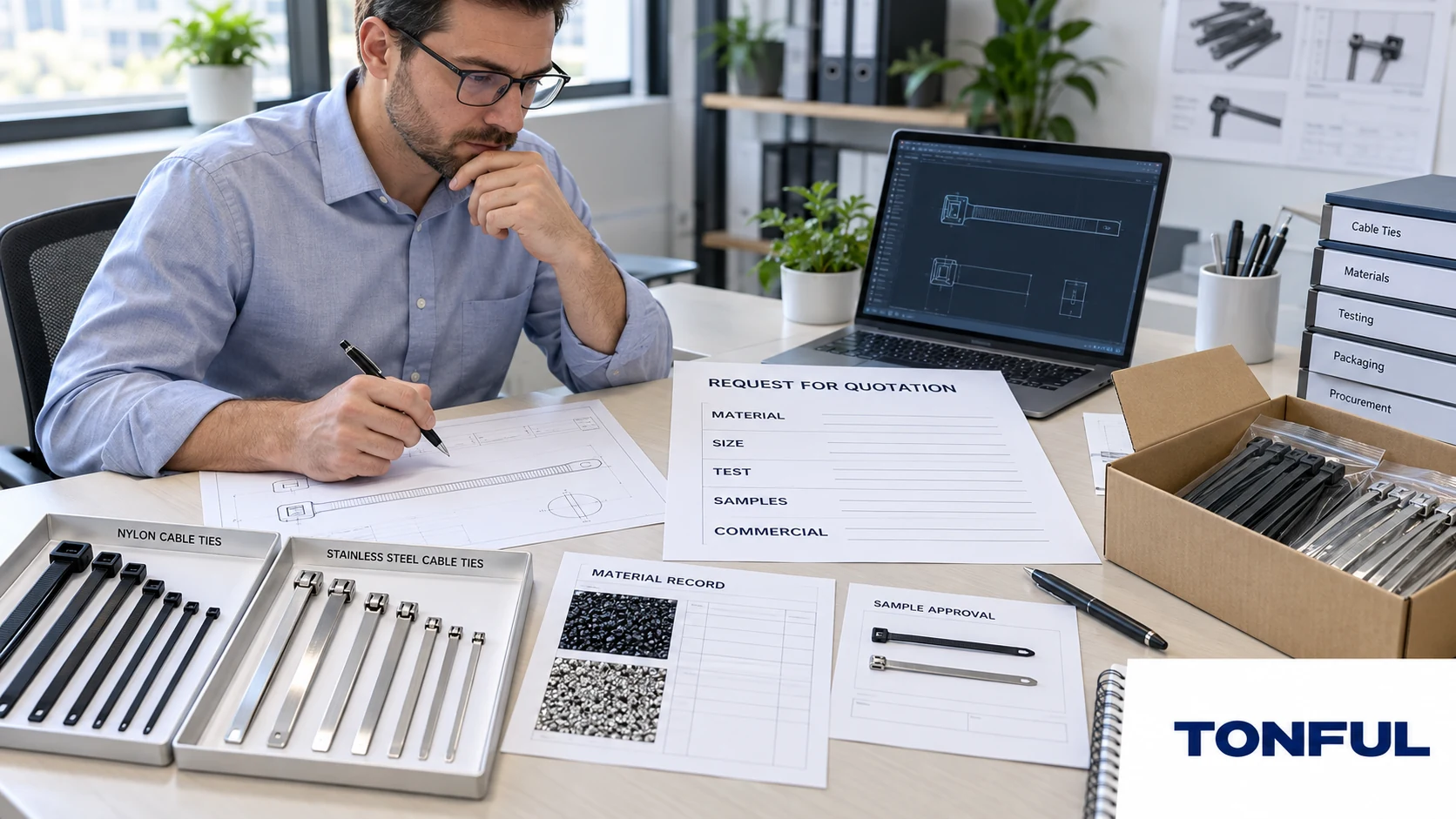
An RFQ that says only “black nylon cable ties, 200 mm, strong enough for automotive use” cannot produce comparable quotations. Suppliers may offer different resin grades, usable bundle ranges, head dimensions, moisture conditions, tools, test methods, packaging and evidence. The lowest quoted unit price may therefore correspond to a different product and a different risk.
This checklist turns an application into a controlled technical and commercial request. It also separates quotation, sample approval and production release. A supplier’s willingness to quote does not prove conformity, and a passing sample does not automatically approve serial supply.
Contents
- Define the Application Before the Part
- Specify the Finished Tie
- Request Evidence, Not Unsupported Claims
- Plan Samples and Validation
- Separate Approval States
- Commercial RFQ Fields
- Supplier Controls and Receiving Plan
- Copyable Cable Tie RFQ Template
- Work With TONFUL
Define the Application Before the Part
Identify whether the tie organizes a bundle, positions it relative to a panel, carries an identification flag or supports wiring under an applicable installation requirement. Provide the assembly drawing, cable or hose construction, minimum and maximum bundle size, routing clearances, installation direction and maintenance access.
Document the actual environment: continuous and short-term temperatures, sunlight, moisture, chemicals, salt, vibration, cleaning and fire context as relevant. Do not substitute a generic phrase such as “industrial grade” for defined exposures. Tell suppliers whether a metal tie’s conductivity or contact with dissimilar metals requires special review.
The application and material guide helps frame the use case. For outdoor work, the solar nylon comparison illustrates why a material-family name alone does not establish installed life.
Specify the Finished Tie
| RFQ field | Buyer entry | Supplier response or evidence |
|---|---|---|
| Product identity | Drawing, revision, existing part or new design | Offered part number and revision |
| Material | PA66, PA12, ETFE, 304/316 or other controlled grade | Grade, additives, color, alloy/coating evidence |
| Design | Standard, releasable, marker, mounting or metal lock | Head/lock drawing and installation direction |
| Dimensions | Overall and usable length, width, thickness, head envelope | Tolerances and measured sample report |
| Bundle range | Minimum, nominal and maximum installed bundle | Approved loop range and sample fit |
| Mechanical | Required property, method, conditioning and limit source | Product-specific report and failure modes |
| Environment | Temperature, UV, fluids, salt, vibration and life goal | Exact product qualification scope |
| Installation | Tool, setting, cutoff and work instruction | Compatible tool and process evidence |
| Mounting | Hole, panel, edge, screw or base geometry | Insertion/retention evidence if applicable |
| Identification | Print, color code, label or traceability | Artwork approval and durability evidence |
IEC 62275:2022 covers metallic, non-metallic and composite cable ties and associated fixing devices for electrical installations. When compliance or classification is requested, identify the applicable edition, exact product, material, color, classification and supporting certificate or test report. Do not treat a generic standards reference as proof of certification for every part in a family.
Dimensions and Strength Are Separate
Nominal length is not usable strap length. Ask for the head envelope, minimum engagement and actual bundle range. Confirm both minimum and maximum production bundles, including sleeve and tape variation. Specify how the tie will be positioned and cut. A catalog loop-tensile figure does not guarantee no insulation damage at the installed tension.
The cable tie tensile strength guide provides background on test definitions. Require the test method, fixture, conditioning, sample quantity, failure mode and acceptance-source document. Do not convert a loop-test result into a universal safe working load.
Material and Construction Changes
Identify characteristics that require prior written approval: resin or alloy source, stabilizer, pigment, regrind policy, coating, head or tooth geometry, lock design, mold cavity, forming tool, conditioning process and manufacturing site. State whether an equivalent material source is allowed and what validation is needed.
Do not demand proprietary formulation details without a technical need, but require enough controlled identity and change notification to protect the approved product. For nylon, include storage and moisture-conditioning expectations; the moisture and storage guide explains why test and delivery states must be distinguished.
Request Evidence, Not Unsupported Claims
Ask the supplier to map every claim to a product, revision, method, report and acceptance source. Material resin data may support screening but do not replace a finished-tie test. A test on a different width, color, lock or manufacturing site may not cover the proposed item.
| Claim or requirement | Evidence to request | Scope question |
|---|---|---|
| Material identity | Certificate, controlled specification, incoming lot link | Does it trace to delivered finished lots? |
| Loop strength | Test report with fixture, conditioning and individual results | Is the exact tie and method covered? |
| UV or temperature | Exposure plan and post-aging mechanical/locking checks | Is duration, load and product configuration relevant? |
| Corrosion | Alloy/coating records and applicable exposure report | Are salt, crevice and mating metals represented? |
| Mount retention | Panel geometry, insertion and retention report | Does the actual substrate match? |
| Compliance | Certificate or listing with model and scope | Is the offered part included and current? |
The supplier should identify deviations explicitly. “Equivalent” should mean the controlled acceptance criteria are met, not merely that the package looks similar. If evidence is unavailable, classify the claim as unverified and decide whether a qualification project is needed before a purchasing decision.
Plan Samples and Validation
Request production-intent samples made with the intended material, tooling, site and process. Name each sample by part, revision, lot and build status. Allocate independent or sequential groups for dimensions, installation, loop tests, environmental conditioning and destructive checks. Retain an untested reference where useful.
Define who approves the sample count and why. Record tool and operator, minimum and maximum bundle configurations, fixture, equipment accuracy, speed, conditioning, invalid-test and retest rules. Acceptance values come from the buyer’s drawing, applicable standard, customer requirement or approved plan, not from a general blog chart.
After tests, review individual values, failure modes and photographs. Averages can hide a weak cavity or lot. Approval must name the application and limits; it must not be extrapolated to all colors, lengths or environments.

Production-intent samples should be linked to the exact drawing, test plan and release decision.
Separate Approval States
| Status | Meaning | Purchase consequence |
|---|---|---|
| Rejected | Mandatory function or evidence failed | No release |
| Conditional | Defined deviation with owner, quantity or time limit and closure plan | Limited purchase only within written boundary |
| Sample approved | Named specimens passed agreed review | Not automatic mass-production approval |
| Production approved | Production-intent process and evidence accepted | Purchase within approved product, site and process scope |
Record who can approve a deviation and when it expires. The supplier must not interpret a sample purchase order as authorization for serial substitution. If an audit is required, use the separate supplier-audit process and keep its conclusion distinct from product validation.
Commercial RFQ Fields
Technical clarity makes quotations comparable; commercial assumptions complete the comparison. Request MOQ and price breaks by annual and release quantities, sample cost and refund conditions, tooling or NRE cost and ownership, sample and production lead times, quote validity, currency, Incoterms and delivery point. Define capacity assumptions, peak-season limits, safety stock and forecast flexibility.
Ask how packaging protects nylon conditioning, metal coating and lot identity. Specify bag quantity, label contents, barcode or customer SKU, carton dimensions and mixed-lot prevention. Confirm shelf-life or storage guidance where applicable, but do not impose a universal expiry without material and packaging evidence.
Define warranty, return, field-claim and replacement boundaries. Clarify responsibility for inspection, installation labor, freight and downtime where contractually relevant. A cheaper tie may create higher total sourcing cost if inspection, scrap, rework and callbacks increase. Request a cost breakdown only to the extent needed for the purchasing decision.
| Commercial input | Buyer specification | Supplier quotation field |
|---|---|---|
| Quantity | Sample, first lot, annual forecast and release size | MOQ and tier price |
| NRE/tooling | Scope, ownership, maintenance and transfer | Cost and milestones |
| Timing | Sample and production target | Lead time and capacity assumption |
| Terms | Currency, trade term, location, validity | Written quotation basis |
| Packaging | Count, label, moisture protection, mixed-lot rule | Pack drawing and cost |
| Service | Warranty, claims, returns and change notice | Proposed terms and exclusions |
Supplier Controls and Receiving Plan
Before release, review material and critical-process controls, molding or forming records, tool maintenance, conditioning, test equipment, calibration, sample selection, reaction plans and lot traceability. For outsourced coating, testing or packaging, identify the responsible sub-supplier and change-notification path.
Define incoming inspection by risk and supplier history: identity, label, lot, dimensions, appearance, locking function and selected mechanical tests. Specify sampling and containment rules. An unchanged SKU does not prove unchanged construction, so retain approved samples or controlled images and compare future deliveries.

A complete RFQ links technical acceptance to quotation assumptions, packaging and controlled production release.
Copyable Cable Tie RFQ Template
Copy the following fields into the buyer’s RFQ or bid-comparison form. Complete buyer-controlled requirements before issue; require the supplier to identify every deviation, assumption and unavailable record instead of silently selecting a substitute.
| RFQ field | Buyer requirement | Supplier response, evidence or deviation |
|---|---|---|
| Buyer/company/project | Company, contact, project and end application | Supplier contact and quotation reference |
| Application and location | Bundle purpose, installation position, indoor/outdoor and service access | Proposed product and application limitations |
| Drawing and revision | Drawing number, revision and controlled attachments | Reviewed revision and offered part revision |
| Material, grade, color and additives | Polymer/alloy, controlled grade, pigment, stabilizer, coating or regrind rule | Material identity and supporting declaration |
| Dimensions and tolerances | Length, usable length, width, thickness, head envelope and critical tolerances | Drawing and measured sample evidence |
| Bundle diameter | Minimum, nominal and maximum production bundle | Approved loop range and fit evidence |
| Mechanical requirement | Required property, test method, conditioning, sample quantity and acceptance source | Report ID, results and failure modes |
| Environmental exposure | Temperature, UV, moisture, chemicals, salt, vibration, cleaning and required life context | Qualification scope and stated exclusions |
| Standard or classification | Applicable edition, classification and project requirement | Certificate/listing/report number and exact covered model |
| Samples and validation | Quantity, production-intent status, allocation, retained reference and approved plan | Lot, site, tool, dates and delivery plan |
| Packaging and label | Bag count, moisture protection, labels, barcode, lot identity and mixed-lot rule | Pack drawing, materials and traceability method |
| MOQ and price breaks | Sample, first lot, release quantities and annual forecast | MOQ, unit prices and quantity tiers |
| Tooling/NRE ownership | Scope, ownership, maintenance, transfer and replacement terms | Cost, milestones and ownership exceptions |
| Lead time | Required sample and production dates | Sample lead time, production lead time and capacity assumptions |
| Change notification | Advance notice, approval authority and revalidation expectations | Proposed notification process and controlled changes |
| Deviations and assumptions | Buyer-approved deviation format and decision owner | Open deviations, unresolved assumptions and closure date |
| Supplier authorization | Required legal entity, responsible person and validity period | Signature, title, response date and quotation validity |
When responses arrive, compare each row as Compliant, Deviation, Not Evaluated or N/A, and record its evidence identifier and owner. N/A requires a written applicability reason. Not Evaluated cannot be treated as conforming and must restrict the approval scope. Requote when a significant technical or commercial assumption changes; otherwise the bids are no longer comparable.
For example, a quote based on unspecified black nylon and a catalog strength claim is not equivalent to one identifying a controlled grade, conditioned test method and lot traceability. Request the missing material declaration, exact test report and packaging basis before comparing prices. Likewise, offering 304 stainless steel when the RFQ specifies 316 is a disclosed material deviation, not an interchangeable commercial alternative.
Keep a revision-controlled bid tabulation showing the RFQ version, supplier response date, exceptions, evidence IDs, price basis, reviewer and release decision. This creates a defensible trail when a design change affects technical approval and quotation validity.
Work With TONFUL
TONFUL’s cable tie range includes polymer, mounting and stainless designs. Share your controlled RFQ, drawings, operating environment, evidence requirements, sample plan, quantity and packaging needs. TONFUL can review available options and clarify deviations; final approval should identify the exact product and production scope.