
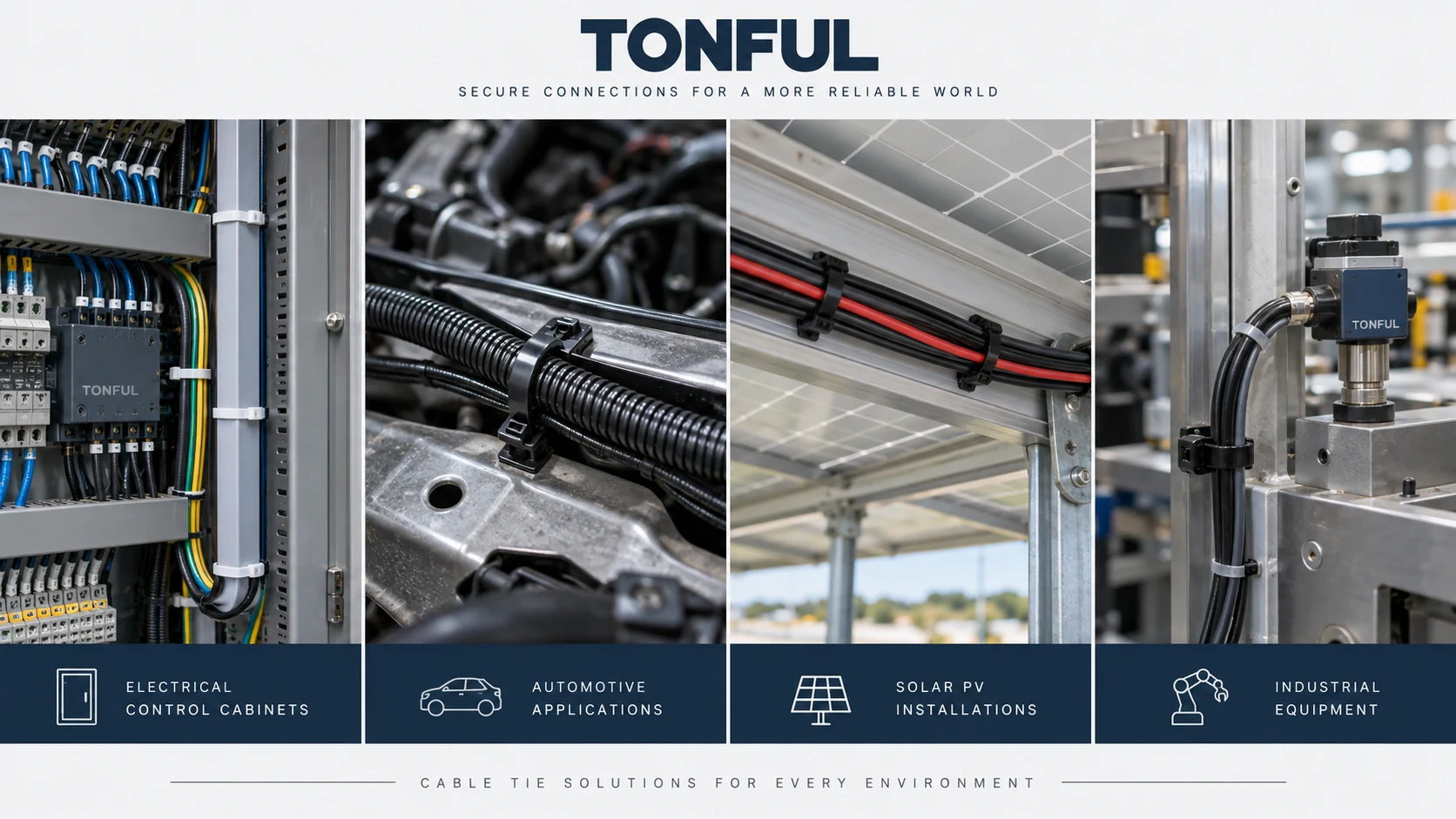
Cable ties bundle wires, position hoses and help attach cables to approved supports. A tie inside a dry cabinet is not selected like one under a solar array or beside a food line. Environment, support function and installation method determine the design.
This guide organizes uses by environment. A loop-tensile number does not prove an installed support’s working load; check exact ratings, markings and project specifications.
Begin With the Function: Bundle, Position or Support
Bundling groups conductors or tubing. Positioning maintains clearance. Primary support carries defined cable or conduit weight. Identification adds a marker; temporary retention aids assembly. Each role needs its own evidence.
The UL cable-tie application guidance distinguishes securing from certain support applications, with product Type and package markings indicating the evaluated scope. A fixing device and installation surface also matter. Do not assume a tie looped around any convenient frame member is a code-accepted support. Consult the applicable equipment instructions, installation rules and authority for the project.
Record bundle range, cable type, route, weight, movement, temperature, moisture, UV, chemicals, access and failure consequence. Small control wires and heavy flexible conduit may need different products. The TONFUL tie-strength guide separates loop results from installed working load.
| Function | Typical use | Failure to prevent | Evidence to request |
|---|---|---|---|
| Bundle | Group wires or tubing | Loose strands, over-compression | Bundle range, material, installation method |
| Position | Maintain clearance | Abrasion, heat contact, interference | Route drawing and installed checks |
| Support | Carry cable/conduit at points | Sagging, fixing pull-out | Rated scope, mount and substrate evidence |
| Identify | Mark a circuit or asset | Unreadable or detached ID | Print durability and traceability |
| Temporary hold | Stage an assembly | Accidental permanent use | Removal method and final inspection |
Control Panels and Factory Equipment
Inside a panel, ties can group conductors into serviceable routes, keep wires clear of terminals and moving mechanisms, and secure protective sleeving. The installer should preserve access to labels, terminals and test points. A tightly cinched bundle can make troubleshooting harder or compress a soft cable jacket. Use tie spacing and tension from the equipment design, not a generic rule copied across every cabinet.
Heat can concentrate near power supplies, drives and contactors even in an indoor panel. Check the local temperature and the tie’s exact marked range. If a cable branch must be reopened during commissioning, a releasable design may reduce unnecessary cutting, but its cycle life still needs product-specific approval. The TONFUL releasable-tie guide distinguishes release mechanisms from ordinary one-way ties.
A mount should be selected with the enclosure substrate. A screw base needs an approved hole and fastener; an adhesive base needs controlled surface preparation and environmental validation. Do not put a tie where a future technician must cut beside live or fragile wiring without adequate access. Good panel organization reduces service risk only if the route, labeling and replacement procedure remain clear.
Automotive and Mobile Equipment
Vehicle ties can hold harness branches on form boards during production, group wires in protective conduit, or position a finished harness on a body panel. A clip may attach to a flange, a fir-tree stem to a controlled hole, or a separate clamp to a bracket. The tie alone should not transfer connector or terminal loads into a vibrating harness. The TONFUL edge-clip guide covers one attachment interface; choose it only when the flange geometry and installation conditions are verified.
Road vibration, door cycles, fluid splash, heat and service handling differ by vehicle location. A tie in a dry cabin does not establish suitability near a hot engine component or underbody road salt. Specify the vehicle and harness revision, bundle mass, panel feature and movement profile. Check the installed assembly for clip migration, insulation abrasion, connector strain and retained slack after testing.
Avoid selecting a tie solely by its declared loop strength. If the fixing back-outs or the cable jacket is crushed, a higher loop number may not solve the failure. Record tool setting and cut-tail condition. For a serviceable branch, define whether the tie and mount may be reused; a damaged hole or flange can make a fresh tie ineffective.
Solar and Other Outdoor Wiring
Solar DC-string cables need routing that prevents sagging, insulation wear and connector strain for the project’s required service period. The U.S. Department of Energy’s PV cable-management best practices documents premature failure of ordinary plastic ties under heat, UV and chemical exposure and discusses alternative supports. It does not certify any TONFUL product or provide a universal tie-spacing or years-of-life guarantee.
An outdoor tie should have exact-product evidence for its actual exposure, including temperature, sunlight, wet/dry cycles and nearby chemicals. Black color by itself is not a UV rating. A metal clip may avoid polymer UV degradation but introduces questions about edge sharpness, corrosion, galvanic contact and cable pressure. The module and racking manufacturer’s instructions define permitted frame attachment points. The TONFUL solar cable-tie material guide addresses polymer choices; installed support still needs a complete route review.
Qualified personnel must manage energized PV work under site safety procedures. Keep cables away from roof surfaces and sharp rails, preserve bend radius and connector slack, and make supports inspectable. A tie that survives laboratory aging does not prove a clip will grip a particular coated frame or that the cable jacket will tolerate movement. Include inspection and replacement access in the original design.

Conceptual application map; the material and fixing method shown are examples, not automatic approval for an industry.
Data Centers and Telecommunications
Ties can organize cable trays, rack branches, patch-cord groups and equipment wiring. The dominant risks may be crushing delicate cable, obstructing airflow, blocking labels or making future changes difficult. For optical fiber and other sensitive cable, follow the cable manufacturer’s bend-radius and compression instructions. A hook-and-loop or releasable system may be preferable where frequent reconfiguration is expected.
Installation location matters. An air-handling space can impose different fire and smoke requirements from an ordinary rack. Do not label every data-center tie “plenum rated” or assume a material flammability rating automatically settles the installation. Verify the exact product’s listing and the applicable code and project specification. The tie should secure the route without replacing an approved tray, clamp or support where one is required.
Identification is also a use, not merely an aesthetic feature. Marker ties or separate labels need to remain legible under handling and cleaning. Define print method, viewing direction, data format and revision control. A color convention should be documented and checked against material or UV requirements; color alone does not prove a tie’s performance.
Marine, Coastal and Chemical Service
Marine and coastal locations combine moisture, salts, vibration and possible dissimilar-metal contact. Stainless steel or a specialized polymer may be candidates, but neither is universally corrosion-proof. Specify water exposure, chloride deposits, temperature, chemicals, cable jacket and the materials of the structure being wrapped. A bare metal band can abrade insulation, while a coating may wear or have a lower environmental limit than the underlying steel.
Use the TONFUL 304 versus 316 guide for alloy comparison, then evaluate the complete band, lock, coating and installation tool. Confirm tail finish and cable contact after tensioning. A tie near a fuel, oil or cleaning chemical needs compatibility evidence for the actual concentration and contact condition; do not infer this from a broad “industrial grade” label.
For chemical plants, map intermittent splash versus continuous contact and the temperature at the tie. Cleanability and inspection may matter as much as retained strength. An inaccessible tie that traps residue can become a maintenance problem even if the base material survives. Consider a dedicated clamp or protected route where a cable tie cannot meet the required exposure and support function.
Food and Pharmaceutical Processing
Ties may secure sensor leads, tubing and temporary identification outside or near process equipment. If a foreign-material control program requires detectable fasteners, select an exact detectable product and validate it in the actual plant’s detection system. The HellermannTyton example of a detectable tie shows such a product category for food and pharmaceutical settings; it does not prove every blue tie is metal-detectable or that TONFUL products have the same composition.
Detection capability depends on fragment size, orientation, detector settings, product background and line conditions. A tie that is visually blue still may not be found if a small fragment enters product. Ask for the facility’s challenge-test plan and retention of results. Also check cleaning chemicals, washdown, temperature and the possibility of fragments from repeated cutting. Place ties where they can be inspected and replaced without contaminating a process zone.
If the facility requires food-contact, hygienic-design or audit evidence, verify the exact scope; a tie touching equipment is not automatically acceptable for direct food contact.
Choose by Evidence, Not by Industry Label
The word “automotive,” “solar,” “marine” or “food grade” in a listing is a starting claim, not the full specification. Ask for the exact part number, drawing, material and color, bundle range, mechanical properties, installation and operating conditions, environmental markings, compatible mount, certification scope where applicable, and lot traceability. Compare candidate products under the same test method and conditioning.
| Application condition | Candidate feature to examine | Verification boundary |
|---|---|---|
| Frequent maintenance | Releasable head or alternate organizer | Reopen cycles and retained grip |
| External UV and heat | Qualified outdoor material or metal clip | Exact-product aging and installed route |
| Vibrating panel | Edge clip, fir tree or fastened base | Substrate fit and movement under load |
| Chemical splash | Compatible polymer or alloy/coating | Named chemical and temperature |
| Sensitive cable jacket | Wider strap or protective interface | Compression and abrasion |
| Detection-controlled plant | Detectable formulation | Facility challenge-test performance |
Do not publish generic temperature or tensile numbers as if they apply to every product in a material family. Even within PA66, stainless steel or ETFE, width, head, coating and manufacturer testing differ. UL’s application guidance emphasizes ratings and markings for the specific product. A separately purchased mount may have a different limitation from the tie loop.
Installation, Inspection and Replacement
Set the tie with the specified tool or hand method, confirm complete head engagement and cut the tail without leaving a sharp edge. Check the minimum and maximum bundle sizes, cable-jacket pressure and clearance from heat, movement and sharp surfaces. A control plan should cover tool setup, part identification and mounting condition, not only a final visual count of ties.
Inspect for fractured heads, strap whitening, loose bundles, displaced clips, adhesive release, corrosion, cut insulation and unreadable markers. If a tie fails, preserve the part, lot, location, tool history and an adjacent good sample before replacing it. The TONFUL moisture and storage guide is relevant when nylon lots behave differently during installation. Field repair should address the first failed interface, not just add a stronger strap.
For a purchasing decision, consider installation labor, access, rework and future replacement as well as unit price. A low-cost tie that needs frequent service can be more expensive than a validated support, but the comparison must use actual project data rather than invented callback rates.

Check the cable, tie and attachment point together; a sound loop cannot compensate for an unsuitable route.
Work With TONFUL
TONFUL’s cable tie range can be screened against a defined application. Send the cable or tubing drawing, bundle size and mass, installation surface, route, environment, required markings, expected maintenance and acceptance-source document. Ask for a controlled specification and production-intent samples for the proposed part.
Approval should name the exact tie, mount, tool and intended environment. If the material, colorant, head, coating or mounting surface changes, review whether the original evidence still applies. An application label is not a substitute for that release decision.