
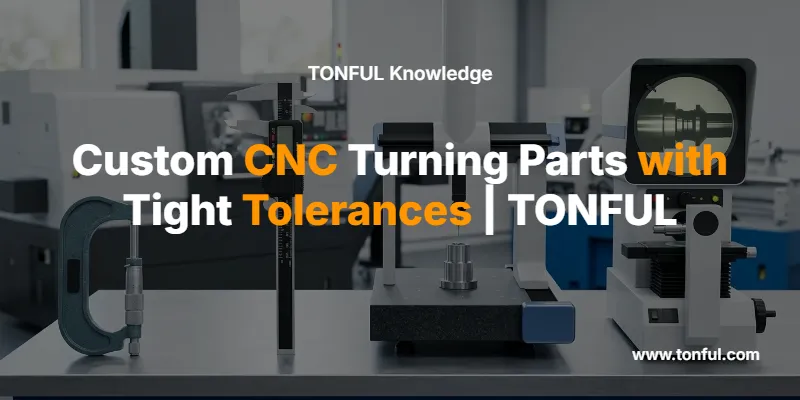
In precision manufacturing, the difference between a functional component and a rejected part often comes down to microns. At TONFUL Electric, we’ve built our reputation on delivering custom CNC turning parts that consistently meet the tightest tolerance specifications demanded by industries ranging from automotive to aerospace. This article reveals the systematic approach we employ to ensure dimensional accuracy, repeatability, and quality in every custom CNC turning part we manufacture.
Understanding Tolerance Requirements in CNC Turning
Tolerance defines the permissible variation in a part’s dimensions. For custom CNC turning parts, achieving tight tolerances—typically ranging from ±0.0001″ to ±0.005″ (±0.0025mm to ±0.127mm)—requires more than just advanced machinery. It demands a comprehensive quality system that integrates design verification, process control, and inspection protocols.

The International Organization for Standardization (ISO) established ISO 2768 as the global benchmark for general tolerances. This standard defines four precision classes that guide our manufacturing specifications:
| Tolerance Class | Description | Typical Application | Linear Tolerance Range |
|---|---|---|---|
| f (Fine) | Highest precision | Aerospace components, medical devices | ±0.05mm to ±0.2mm |
| m (Medium) | Standard precision | Automotive parts, industrial equipment | ±0.1mm to ±0.3mm |
| c (Coarse) | General manufacturing | Non-critical components | ±0.2mm to ±0.5mm |
| v (Very Coarse) | Rough machining | Structural elements | ±0.5mm to ±1.2mm |
At TONFUL, we routinely work within ISO 2768-fH specifications for critical custom CNC turning parts, ensuring that even the most demanding applications receive components that perform flawlessly. This precision extends across our entire product line, from custom stainless steel dowel pins to complex turned components for automotive terminals and connectors.
Our 5-Stage Tolerance Control Process
Stage 1: Design for Manufacturability (DFM) Review
Before any metal is cut, our engineering team conducts a thorough DFM analysis. This critical first step identifies potential tolerance challenges and optimizes part geometry for precision manufacturing. We evaluate:
- Material selection impact: Different materials respond differently to machining forces. Our experience with SS304 vs SS316 stainless steel and brass vs stainless steel allows us to predict and compensate for material-specific behaviors.
- Critical dimension identification: Not every feature requires the tightest tolerance. We work with clients to identify truly critical dimensions, optimizing both cost and quality.
- Tooling accessibility: Complex geometries may require specialized tooling strategies to maintain dimensional accuracy.

Stage 2: Advanced CNC Programming and Simulation
Our CNC programmers utilize sophisticated CAM software to generate tool paths that minimize deflection, thermal expansion, and vibration—the three primary enemies of tight tolerances.
Key programming strategies include:
- Thermal compensation algorithms: CNC machines generate heat during operation, causing dimensional drift. Our machines feature real-time thermal compensation that adjusts tool positions based on temperature sensors throughout the machine structure.
- Tool deflection minimization: By optimizing cutting parameters—feed rates, spindle speeds, and depth of cut—we reduce tool bending that would otherwise compromise dimensional accuracy.
- High-resolution feedback systems: Our CNC turning centers employ linear encoders with 0.0001mm resolution, providing closed-loop position verification for every axis movement.
Before production begins, we run complete simulations to verify tool paths, detect potential collisions, and validate that programmed tolerances are achievable within the part’s geometry and material constraints.
Stage 3: In-Process Monitoring and Control
Quality cannot be inspected into parts—it must be built into the manufacturing process. TONFUL employs Statistical Process Control (SPC) to monitor production in real-time, catching deviations before they result in out-of-tolerance parts.

Our in-process control system includes:
- First article inspection (FAI): The first part from every production run undergoes complete dimensional verification before full production proceeds.
- In-situ metrology: Probe systems mounted directly in CNC machines measure critical dimensions without removing parts from the work-holding fixture, eliminating setup error.
- Automated data collection: Every measurement feeds into our SPC database, generating control charts that reveal trends before processes drift out of specification.
This proactive approach mirrors the quality systems we’ve developed for our custom wire harness assembly and wire terminal manufacturing operations, where consistency across thousands of units is paramount.
Stage 4: Advanced Metrology and Inspection
When parts complete machining, they enter our climate-controlled inspection laboratory where temperature is maintained at 20°C ±1°C—the standard reference temperature for precision measurement. Temperature variations cause material expansion and contraction that can easily exceed tight tolerance bands.
Our inspection capabilities include:
| Inspection Method | Accuracy | Best Application | Measurement Speed |
|---|---|---|---|
| CMM (Coordinate Measuring Machine) | ±0.0025mm | Complex 3D geometries, GD&T verification | Moderate |
| Optical Comparator | ±0.005mm | Profile verification, 2D features | Fast |
| Profilometer | Ra 0.01μm | Surface roughness measurement | Fast |
| Laser Scanner | ±0.01mm | Large parts, reverse engineering | Very Fast |
| Micrometers/Calipers | ±0.01mm | Simple dimensions, production floor checks | Very Fast |

Our CMM systems are particularly critical for verifying Geometric Dimensioning and Tolerancing (GD&T) specifications. These machines use precision probes to capture thousands of data points across a part’s surface, comparing actual geometry against the CAD model to verify features like:
- Concentricity and runout
- Perpendicularity and parallelism
- Position and profile tolerances
- Cylindricity and circularity
This level of inspection capability supports not only our CNC turning operations but also our broader manufacturing portfolio, including terminals and connectors and heat shrink terminals where dimensional precision directly impacts electrical performance.
Stage 5: Documentation and Continuous Improvement
Every custom CNC turning part we produce is accompanied by comprehensive documentation that provides full traceability:
- Inspection reports: Complete dimensional data for all critical features
- Material certifications: Mill test reports verifying material composition and properties
- Process records: Machine parameters, tool identification, and operator verification
- Calibration certificates: Proof that all measuring equipment is traceable to national standards
This documentation satisfies the requirements of AS9100 (aerospace) and ISO 9001 (general manufacturing) quality management systems, certifications that TONFUL maintains through rigorous annual audits.
Beyond individual part documentation, we analyze inspection data across production runs to identify improvement opportunities. When we detect trends indicating process drift—even within tolerance—we proactively adjust parameters to maintain optimal centerline performance.

Material Selection and Its Impact on Tolerances
The material you choose for custom CNC turning parts significantly affects achievable tolerances. Harder materials generally hold tighter tolerances but require more aggressive tooling and slower cutting speeds. Softer materials machine quickly but may deflect under cutting forces.
At TONFUL, our material expertise spans:
- Stainless steels (303, 304, 316): Excellent corrosion resistance with good machinability in 303 grade
- Aluminum alloys (6061, 7075): Lightweight with excellent thermal conductivity, ideal for tight tolerances
- Brass alloys: Superior machinability, commonly used for electrical connectors and terminals
- Carbon steels: Cost-effective for high-volume production with moderate tolerance requirements
- Exotic alloys (Inconel, titanium): Aerospace applications requiring extreme performance
Our material selection guidance, similar to our approach with brass versus stainless steel pneumatic fittings, considers not just machinability but also the end-use environment, required mechanical properties, and total cost of ownership.
The Role of Skilled Operators and Programmers
While advanced equipment provides the foundation for tight tolerance manufacturing, skilled personnel remain irreplaceable. Our CNC programmers and machinists undergo continuous training in:
- Advanced CAM programming techniques
- Tool selection and optimization
- Fixture design for minimal distortion
- Statistical process control interpretation
- Metrology and measurement science
This expertise, combined with our investment in precision electrical tools, ensures that TONFUL can tackle the most challenging custom CNC turning projects with confidence.
Why Tight Tolerances Matter for Your Application
Specifying appropriate tolerances is a balancing act. Unnecessarily tight tolerances increase manufacturing cost without adding functional value. Conversely, loose tolerances may result in assembly problems, reduced performance, or premature failure.
Applications requiring tight tolerances include:
- Mating parts with interference or transition fits: Shaft-to-bearing assemblies, press-fit components
- Sealing surfaces: Hydraulic and pneumatic systems where leakage is unacceptable
- High-speed rotating components: Balance and concentricity directly affect vibration and bearing life
- Precision assemblies: Medical devices, optical systems, and measurement instruments
- Regulatory compliance: Aerospace and automotive industries with mandatory tolerance specifications
Our engineering team works collaboratively with clients to optimize tolerance specifications—tightening where function demands it, relaxing where cost savings are possible without compromising performance.
TONFUL’s Commitment to Precision Manufacturing
Achieving consistent tight tolerances in custom CNC turning parts requires the integration of advanced equipment, proven processes, skilled personnel, and a culture of continuous improvement. At TONFUL Electric, these elements combine to deliver components that meet the most demanding specifications across diverse industries.
Our precision manufacturing capabilities extend beyond CNC turning to encompass a complete range of electrical and mechanical components. Whether you need custom wire harness assemblies, precision terminals, or complex turned parts, TONFUL provides the quality, consistency, and technical support that demanding applications require.
When your project demands custom CNC turning parts with tight tolerances, partner with a manufacturer that has proven processes, advanced capabilities, and an unwavering commitment to quality. Contact TONFUL Electric today to discuss your precision manufacturing requirements.
Frequently Asked Questions
Q: What is the tightest tolerance you can achieve on CNC turned parts?
A: TONFUL routinely achieves tolerances of ±0.0001″ (±0.0025mm) on critical dimensions for custom CNC turning parts. The achievable tolerance depends on part geometry, material, feature size, and length-to-diameter ratio. Our engineering team can evaluate your specific requirements and provide guidance on optimal tolerance specifications during the design review phase.
Q: How do you prevent thermal expansion from affecting part dimensions?
A: We employ multiple strategies: our CNC machines feature real-time thermal compensation systems that adjust tool positions based on temperature sensors; parts are allowed to stabilize to room temperature before final inspection; and our climate-controlled inspection laboratory maintains 20°C ±1°C to ensure measurement accuracy. For production runs, we monitor first-piece and periodic inspections to detect any thermal drift trends.
Q: What documentation do you provide with tight tolerance parts?
A: Every order includes a complete inspection report documenting all critical dimensions, material certifications with mill test reports, process records identifying machines and operators, and calibration certificates for measuring equipment. For customers requiring AS9100 or PPAP documentation, we provide First Article Inspection Reports (FAIR) and full traceability to raw material lot numbers.
Q: How does material selection affect achievable tolerances?
A: Material properties significantly impact tolerance capability. Free-machining materials like 303 stainless steel and brass alloys hold tighter tolerances more easily than work-hardening materials like 316 stainless steel. Aluminum alloys offer excellent dimensional stability due to low cutting forces. Our engineering team can recommend optimal materials based on your tolerance requirements, operating environment, and performance specifications.
Q: What is the difference between ISO 2768-fH and ISO 2768-mK tolerances?
A: These designations reference different parts of the ISO 2768 standard. The letter (f, m, c, v) indicates the tolerance class for linear and angular dimensions, with “f” (fine) being tightest and “v” (very coarse) being loosest. The second letter (H, K, L) applies to geometric tolerances like flatness and perpendicularity. ISO 2768-fH provides the tightest control for precision machined components, while ISO 2768-mK is commonly used for sheet metal fabrication. TONFUL typically manufactures custom CNC turning parts to ISO 2768-fH or tighter specifications when required.