
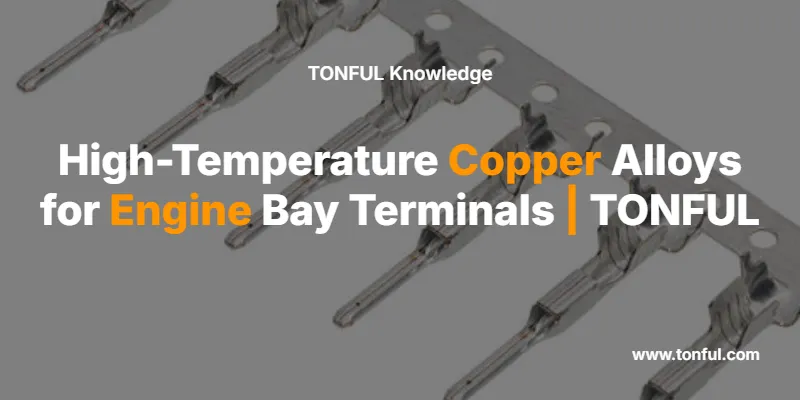
Modern automotive engine bays present one of the harshest environments for electrical components. With temperatures routinely exceeding 150°C near exhaust manifolds and turbochargers, standard copper terminals quickly degrade, leading to connection failures, voltage drops, and costly warranty claims. For automotive OEMs and tier-1 suppliers, selecting the right high-temp automotive terminals isn’t just about meeting specifications—it’s about ensuring long-term reliability in conditions where thermal cycling, vibration, and corrosive exposure converge.
High-temperature copper alloys represent a critical evolution in automotive electrical systems. Unlike pure copper, which softens and loses mechanical strength above 100°C, these engineered alloys maintain their spring force, conductivity, and dimensional stability even when subjected to prolonged exposure at elevated temperatures. This article examines the metallurgical principles, alloy compositions, and performance characteristics that make certain copper alloys indispensable for engine bay applications.

Why Standard Copper Fails in Engine Bay Environments
Pure copper (C11000) offers excellent electrical conductivity at 100% IACS (International Annealed Copper Standard), but its mechanical properties deteriorate rapidly above 100°C. The primary failure mechanism is stress relaxation—the gradual loss of contact force in spring-loaded terminals when exposed to sustained high temperatures. When a crimp terminal loses its spring tension, contact resistance increases, leading to resistive heating, voltage drops, and eventual connection failure.
In automotive applications, this manifests as intermittent electrical faults, sensor malfunctions, and in severe cases, thermal runaway conditions. The Society of Automotive Engineers standard JASO-C400 specifies that automotive terminals must exhibit stress relaxation rates below 15% after 1,000 hours at 150°C—a threshold that pure copper cannot meet.
Beyond stress relaxation, engine bay terminals face additional challenges including thermal cycling (repeated expansion and contraction), vibration-induced fretting corrosion, and exposure to oils, coolants, and road salts. These factors demand materials that combine high conductivity with superior mechanical stability, corrosion resistance, and thermal endurance.
Key Metallurgical Properties for High-Temperature Performance
Selecting the optimal copper alloy for engine bay terminals requires balancing multiple competing properties. The following characteristics define high-performance alloys:
Electrical Conductivity vs. Mechanical Strength
There exists an inverse relationship between conductivity and strength in copper alloys. Pure copper achieves 100% IACS conductivity but offers tensile strength of only 220-240 MPa in annealed condition. High-temperature alloys sacrifice some conductivity (typically 75-85% IACS) to achieve tensile strengths exceeding 500-600 MPa through precipitation hardening or solid solution strengthening.
Stress Relaxation Resistance
This property measures an alloy’s ability to maintain spring force under sustained thermal exposure. Superior alloys retain over 85% of their initial contact force after 1,000 hours at 150°C. The mechanism involves preventing dislocation movement and grain boundary sliding at elevated temperatures through fine precipitate distribution.
Softening Temperature
The temperature at which an alloy loses 50% of its room-temperature hardness defines its practical upper limit. High-performance automotive alloys maintain hardness to 400-500°C, compared to 200-250°C for pure copper. This is achieved through thermally stable precipitates that resist coarsening during exposure.
Thermal Conductivity
While electrical conductivity matters for current-carrying capacity, thermal conductivity determines how effectively a terminal dissipates resistive heating. Alloys with thermal conductivity above 200 W/m·K prevent localized hot spots that accelerate degradation.

Comparative Analysis of High-Temperature Copper Alloys
The following table compares the three most widely used copper alloys for automotive engine bay terminals:
| Property | C18150 (CuCr1Zr) | C19400 (CuFe2P) | Pure Copper C11000 |
|---|---|---|---|
| Composition | Cu + 1% Cr + 0.15% Zr | Cu + 2.1% Fe + 0.15% P | 99.9% Cu minimum |
| Electrical Conductivity | 80% IACS | 65-75% IACS | 100% IACS |
| Tensile Strength (MPa) | 550-600 | 450-500 | 220-240 |
| Stress Relaxation @ 150°C/1000h | <10% | <12% | >30% |
| Softening Temperature | 450-500°C | 400-450°C | 200-250°C |
| Thermal Conductivity (W/m·K) | 320 | 280 | 390 |
| Cost Factor | 2.5-3.0× | 1.8-2.2× | 1.0× (baseline) |
| Typical Applications | EV battery terminals, high-current connectors | General automotive terminals, sensor connectors | Low-temp cabin electronics |
| Plating Compatibility | Excellent (Sn, Ag, Ni) | Excellent (Sn, Ag, Ni) | Excellent (all types) |
C18150: Chromium-Zirconium Copper
C18150 represents the premium tier of high-temperature copper alloys, offering the best balance between conductivity (80% IACS) and mechanical strength (600 MPa tensile). The alloy achieves its properties through precipitation hardening: chromium and zirconium form fine intermetallic precipitates (CuCr₂ and Cu₅Zr phases) that pin dislocations and prevent grain boundary sliding at elevated temperatures.
This alloy excels in the most demanding applications including electric vehicle battery terminals, starter motor connections, and alternator components where both high current capacity and sustained mechanical loading occur. The addition of zirconium specifically improves creep resistance—the gradual deformation under constant stress at high temperature—making C18150 ideal for terminals that must maintain precise contact geometry over 10+ year service lives.

C19400: Copper-Iron-Phosphorus Alloy
C19400 offers a cost-effective alternative for general automotive terminal applications where extreme temperatures (>175°C) are not encountered. The alloy contains approximately 2.1% iron and 0.15% phosphorus, with iron forming fine Fe-Cu precipitates that provide strengthening while phosphorus acts as a deoxidizer and improves corrosion resistance.
This alloy is particularly valued for its excellent formability and stamping characteristics, making it ideal for high-volume production of automotive terminals and connectors. The iron-phosphorus combination provides good stress relaxation resistance up to 150°C, meeting JASO-C400 requirements for most under-hood applications including sensor connectors, fuel injector terminals, and general-purpose harness connections.
C19400’s moderate cost premium (1.8-2.2× pure copper) makes it the workhorse alloy for automotive OEMs seeking to balance performance and cost in high-volume production. Its compatibility with standard stamping dies and excellent plating adhesion further reduce manufacturing complexity compared to higher-alloyed alternatives.
The Critical Role of Terminal Plating in High-Temperature Applications
Even the best copper alloy requires appropriate surface plating to achieve long-term reliability in engine bay environments. Plating serves three essential functions: preventing copper oxidation, reducing contact resistance, and enhancing corrosion protection. The choice of plating material significantly impacts terminal performance and cost.
Tin Plating: The Industry Standard
Tin plating represents the most common finish for automotive electrical connectors, offering an optimal balance of cost, solderability, and corrosion resistance. ASTM B545 specifies tin plating thickness by service class, with Class C (8.0 µm) and Class D (15.0 µm) recommended for engine bay applications.
Tin’s primary advantage is its ability to disrupt surface oxides during mating, ensuring low contact resistance even after thermal cycling. However, tin exhibits fretting corrosion in high-vibration environments—micro-movements generate insulating tin oxide debris that increases resistance over time. To mitigate this, automotive terminals typically incorporate high normal force spring designs and may include nickel underplating to prevent copper diffusion.
Silver Plating: Maximum Conductivity
Silver offers the highest electrical conductivity of all metals (106% IACS) and maintains stable contact resistance across wide temperature ranges. For high-current applications like starter cables and alternator terminals, silver plating (typically 2.5-5.0 µm thickness) reduces resistive losses and improves thermal management.
The primary limitation of silver is its tendency to tarnish when exposed to sulfur compounds, forming insulating silver sulfide layers. In sealed connector systems or applications with high contact forces that penetrate surface films, silver excels. Cost considerations (3-5× tin plating) limit silver to critical high-current applications where its performance justifies the premium.
Gold Plating: Ultimate Reliability
Gold plating provides absolute oxidation resistance and the most stable contact resistance over time, making it the standard for low-current signal circuits in engine management systems, sensor connections, and data transmission applications. Even thin gold flash (0.25-0.75 µm) over nickel underplate prevents oxidation and eliminates fretting corrosion concerns.
The prohibitive cost of gold (10-15× tin plating) restricts its use to selective plating of contact areas in high-reliability applications. Many automotive connectors employ selective gold plating—applying gold only to the mating contact surfaces while using tin on the wire termination areas.

Terminal Design Considerations for Thermal Management
Material selection represents only one aspect of high-temperature terminal design. Geometric factors, contact force, and thermal path engineering significantly influence real-world performance in engine bay installations.
Contact Force and Spring Design
Automotive terminals function as spring contacts that must maintain consistent force across their service life. The spring force must be sufficient to penetrate surface oxides and resist vibration-induced micro-motion, yet not so high that mating requires excessive insertion force. Typical automotive terminals employ contact forces ranging from 5-20 Newtons depending on current rating and connector type.
High-temperature alloys enable thinner material gauges while maintaining required spring forces—C18150 terminals can use 0.4mm material where pure copper would require 0.6mm, reducing both material cost and connector size. The superior stress relaxation resistance ensures that initial contact force degrades minimally over the 15-year automotive design life.
Thermal Path Design
Effective terminal design incorporates thermal management principles to minimize operating temperature. Wide conductor cross-sections reduce resistive heating (P = I²R), while extended surface areas promote convective cooling. Many high-current terminals feature integral heat sinks or extended tabs that conduct heat away from the critical contact interface.
The thermal conductivity of the base alloy directly impacts this heat dissipation capability. C18150’s thermal conductivity of 320 W/m·K allows efficient heat spreading, while lower-conductivity alloys may require larger cross-sections or auxiliary cooling provisions to achieve equivalent thermal performance.
Vibration and Fretting Resistance
Engine bay components experience continuous vibration from engine operation, road inputs, and thermal cycling. This vibration can cause micro-motion at electrical contacts—a phenomenon called fretting—that generates insulating oxide debris and increases contact resistance over time.
High-temperature copper alloys address fretting through two mechanisms: their superior hardness resists wear from micro-motion, and their high contact forces minimize relative movement between mating surfaces. Additionally, proper plating selection (gold for zero fretting, tin with adequate contact force) and connector design (positive locking, anti-vibration features) work synergistically with material properties to ensure long-term reliability.

Application-Specific Alloy Selection Guidelines
Selecting the optimal copper alloy requires matching material properties to specific application requirements. The following guidelines assist engineers in making informed material choices:
High-Current Applications (>30A)
For starter cables, alternator connections, and EV charging terminals, prioritize electrical conductivity and thermal management. C18150 offers the best performance, with its 80% IACS conductivity and excellent thermal conductivity minimizing resistive losses. Consider silver plating for contact surfaces to further reduce resistance. These applications justify the material premium through improved efficiency and reduced thermal stress.
Sensor and Signal Circuits (<5A)
Low-current applications prioritize contact stability and corrosion resistance over conductivity. C19400 provides adequate conductivity (65-75% IACS) while offering excellent formability for complex terminal geometries. Gold plating on contact areas ensures stable resistance over the service life, critical for sensor accuracy and data integrity. The moderate cost of C19400 makes it economical for high-volume production of automotive connector terminals.
General-Purpose Harness Connections (5-30A)
This category encompasses the majority of automotive electrical connections including lighting circuits, solenoid controls, and accessory power. C19400 with tin plating (ASTM B545 Class C or D) represents the industry standard, offering proven reliability at reasonable cost. For applications near exhaust components or turbochargers where temperatures exceed 150°C, upgrade to C18150 or specify thicker tin plating (Class D, 15 µm minimum).
Marine and Severe Corrosion Environments
While not strictly engine bay applications, marine electrical systems face similar thermal challenges combined with extreme corrosion exposure. For these environments, specify C19400 or C18150 with nickel underplate (2.5 µm minimum) and heavy tin topcoat (Class D, 15 µm), or consider silver plating with conformal coating protection. The phosphorus content in C19400 provides enhanced corrosion resistance in marine atmospheres.
Quality Assurance and Testing Standards
Reliable high-temperature terminals require rigorous quality control throughout manufacturing. Industry standards define test methods and acceptance criteria for automotive electrical components:
Stress Relaxation Testing
JASO-C400 specifies stress relaxation testing at 150°C for 1,000 hours with measurement of retained spring force. Acceptable terminals maintain >85% of initial force. This test directly correlates with long-term contact reliability and represents the most critical qualification for engine bay applications.
Salt Spray Testing
ASTM B117 neutral salt spray testing evaluates corrosion resistance of plated terminals. Automotive specifications typically require 96-240 hours exposure without red rust (base metal corrosion) for tin-plated terminals, with longer durations for marine applications. This test validates both plating thickness and adhesion quality.
Thermal Cycling
Automotive terminals must survive repeated thermal cycling from -40°C to +150°C (or higher for exhaust-proximate locations) without mechanical failure or electrical degradation. Typical qualification requires 500-1,000 thermal cycles with electrical resistance monitoring to detect contact degradation.
Crimp Pull Testing
Proper wire-to-terminal crimping ensures mechanical and electrical integrity. Pull testing per IPC/WHMA-A-620 verifies that crimped connections meet minimum retention force requirements—typically 5-10 kg for AWG 18-22 wire depending on terminal design. For more details on crimping standards, see our guide on crimp pull force testing.
Frequently Asked Questions
Q: Can I use standard copper terminals in engine bay applications?
A: Standard pure copper terminals (C11000) are not recommended for sustained exposure above 100°C. They will experience rapid stress relaxation, losing contact force and increasing resistance over time. For engine bay applications, specify high-temperature alloys like C18150 or C19400 that maintain mechanical properties at elevated temperatures.
Q: What’s the difference between C18150 and C19400 copper alloys?
A: C18150 (chromium-zirconium copper) offers higher conductivity (80% IACS) and superior high-temperature performance up to 200°C+, making it ideal for high-current applications and EV components. C19400 (copper-iron-phosphorus) provides a cost-effective solution for general automotive terminals with good performance up to 150°C. C18150 costs approximately 40% more than C19400 but delivers better long-term reliability in extreme conditions.
Q: Is tin or silver plating better for high-temperature terminals?
A: Tin plating (ASTM B545 Class C or D) is the industry standard for most automotive terminals, offering excellent cost-performance balance and good corrosion resistance. Silver plating provides superior conductivity and thermal performance for high-current applications (>50A) but costs 3-5× more and requires sealed connectors to prevent tarnishing. Choose based on current rating and environmental exposure.
Q: How do I prevent terminal corrosion in engine bay environments?
A: Implement a multi-layer protection strategy: (1) Select appropriate base alloy (C19400 or C18150), (2) Specify adequate plating thickness (minimum ASTM B545 Class C for tin, 2.5 µm for silver), (3) Use nickel underplate (2.5 µm) to prevent copper migration, (4) Employ sealed connector housings with environmental seals, and (5) Apply dielectric grease to exposed connections. For comprehensive corrosion prevention, see our article on tin-plated copper terminal standards.
Q: What temperature rating should I specify for engine bay terminals?
A: Specify terminals rated for continuous operation at 150°C minimum for general engine bay locations, 175°C for near-exhaust applications, and 200°C+ for turbocharger-proximate or exhaust gas recirculation (EGR) system connections. Always verify actual operating temperatures through thermal mapping or simulation—peak temperatures can exceed 200°C in some locations.
Q: Can high-temperature terminals be used with standard crimping tools?
A: Yes, C18150 and C19400 terminals use standard automotive crimping tools and dies. However, their higher hardness may require slightly higher crimping forces compared to pure copper. Ensure your crimping tool is properly calibrated and use the correct die set for your terminal series. Always perform pull testing to verify proper crimp quality, especially when transitioning from pure copper to high-temperature alloys.
Conclusion: Engineering Reliability into Automotive Electrical Systems
The transition from pure copper to high-temperature copper alloys represents a fundamental advancement in automotive electrical system reliability. As engine bay temperatures continue to rise with increasing power densities, turbocharging, and electrification, material selection becomes increasingly critical to preventing field failures and warranty claims.
C18150 and C19400 copper alloys deliver the performance characteristics necessary for modern automotive applications: stress relaxation resistance that maintains contact force over 15+ year service lives, thermal stability that prevents softening at elevated temperatures, and sufficient conductivity to minimize resistive losses. When combined with appropriate plating selection and proper terminal design, these materials enable electrical connections that reliably withstand the harsh realities of engine bay environments.
For automotive engineers and procurement professionals, understanding the metallurgical principles and performance trade-offs of high-temperature copper alloys enables informed material selection that balances performance, cost, and manufacturing considerations. Whether designing next-generation EV battery connections or optimizing existing harness designs, the principles outlined in this article provide a foundation for engineering robust, reliable electrical systems.
At TONFUL Electric, we specialize in manufacturing high-quality automotive terminals and connectors using premium copper alloys including C18150 and C19400. Our engineering team works closely with automotive OEMs and tier-1 suppliers to develop custom terminal solutions optimized for specific application requirements. For technical consultation on your high-temperature terminal applications, contact our engineering support team.