
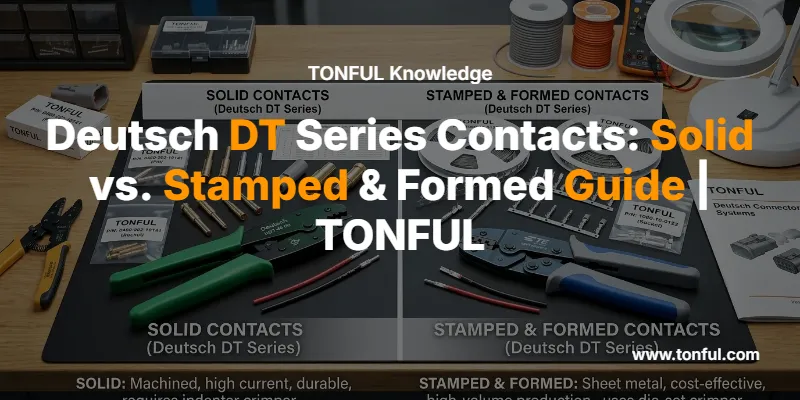
When specifying connectors for automotive, industrial, or marine applications, understanding the differences between solid and stamped & formed contacts in the Deutsch DT Series can significantly impact your project’s performance, cost, and reliability. This comprehensive buyer’s guide examines both contact types to help engineers and procurement professionals make informed decisions.
Understanding Deutsch DT Series Contacts
The Deutsch DT Series represents one of the most widely adopted environmentally sealed connector systems in harsh-environment applications. At the heart of every DT connector lies the contact system—the critical interface that determines electrical performance, mechanical reliability, and overall cost-effectiveness. The DT Series utilizes size 16 contacts rated for 13 amps continuous capacity, accommodating wire gauges from 14 to 20 AWG.

What Are Solid Contacts?
Solid contacts are precision-engineered components manufactured through a cold heading or cold forming process. High-pressure dies shape solid metal stock into precise geometries, followed by heat treatment to enhance mechanical strength. The manufacturing process involves pushing metal under extreme pressure into die cavities, creating contacts with tight tolerances and superior dimensional consistency.
Key Characteristics of Solid Contacts
Solid contacts deliver exceptional performance in demanding applications where reliability cannot be compromised. Their robust construction provides superior mechanical strength, making them ideal for applications subjected to extreme vibration, thermal cycling, and mechanical stress. The manufacturing process produces contacts with precise dimensions and consistent electrical properties across production runs.
These contacts feature thicker base materials compared to stamped alternatives, resulting in enhanced current-carrying capacity and improved resistance to mechanical deformation. The solid construction ensures optimal contact retention force within the connector housing, preventing inadvertent terminal dislodgement during assembly or service life.

What Are Stamped & Formed Contacts?
Stamped and formed contacts are manufactured using high-speed precision stamping equipment that creates contact geometries from flat metal strip stock. A progressive die stamps the contact shape from thin metal sheets, which are then formed into three-dimensional configurations. This manufacturing approach enables high-volume production with excellent repeatability and lower per-unit costs.
Key Characteristics of Stamped & Formed Contacts
Stamped and formed contacts excel in applications where cost optimization and high-volume production are priorities. The stamping process utilizes thinner base materials compared to solid contacts, reducing material costs while maintaining adequate electrical and mechanical performance for most standard applications.
These contacts are typically supplied on reels, facilitating automated assembly processes and reducing handling time in high-volume manufacturing environments. The formed spring fingers in socket contacts provide reliable electrical connection while accommodating slight dimensional variations in mating pin contacts. Deutsch stamped and formed contacts accommodate wire sizes from 10 to 22 AWG and are available with tin, nickel, or gold plating options to match specific environmental and electrical requirements.

Comprehensive Comparison: Solid vs. Stamped & Formed Contacts
| Feature | Solid Contacts | Stamped & Formed Contacts |
|---|---|---|
| Manufacturing Process | Cold heading/forming with heat treatment | High-speed precision stamping from flat strip |
| Material Thickness | Thicker base material (higher gauge) | Thinner material (optimized for cost) |
| Wire Size Range | 12-20 AWG (DT Series Size 16) | 10-22 AWG (broader compatibility) |
| Current Capacity | 13A continuous (Size 16) | 13A continuous (Size 16), up to 25A capable |
| Cost per Unit | Higher (precision manufacturing) | Lower (high-volume stamping) |
| Mechanical Strength | Superior tensile and retention strength | Adequate for standard applications |
| Vibration Resistance | Excellent (20G+ per DT specs) | Good (suitable for most applications) |
| Precision/Tolerances | Tighter tolerances | Standard tolerances |
| Packaging | Bulk or strip packaging | Reel packaging (automation-friendly) |
| Assembly Method | Manual or semi-automated crimping | Automated high-volume crimping |
| Best Applications | Heavy-duty, high-reliability, extreme environments | Cost-sensitive, high-volume production |
| Plating Options | Tin, nickel, gold | Tin, nickel, gold |
| Contact Retention | Higher retention force | Standard retention force |
Performance Comparison in Critical Parameters
Electrical Performance
Both solid and stamped & formed contacts in the Deutsch DT Series deliver 13 amps continuous capacity per size 16 contact, meeting the same electrical specifications. Contact millivolt drop remains consistent at approximately 100 millivolts when using 16 AWG wire, ensuring minimal power loss across the connection.
The key electrical difference emerges in high-current applications or extended service life scenarios. Solid contacts maintain more consistent contact resistance over thousands of mating cycles due to their thicker base material and superior spring characteristics. Stamped contacts perform reliably within their rated specifications but may exhibit slightly higher contact resistance variation after extensive cycling.
Mechanical Durability
Solid contacts demonstrate superior performance in applications involving extreme vibration, shock, and mechanical stress. The Deutsch DT Series withstands sinusoidal vibration levels of 20 G’s at 10 to 2000 Hz without unlocking or unmating, but solid contacts provide additional safety margin in the most demanding environments.
Stamped and formed contacts meet all standard DT Series mechanical specifications and perform reliably in typical automotive, industrial, and marine applications. However, in applications such as off-road vehicles, heavy construction equipment, or high-vibration industrial machinery, solid contacts offer enhanced reliability and longer service life.

Environmental Sealing
Both contact types function within the same Deutsch DT connector housing system, which provides IP68-rated environmental sealing. When properly wired and mated, DT connections withstand immersion under three feet of water without loss of electrical performance or leakage. The contact type selection does not affect the overall environmental sealing performance, which depends primarily on proper housing assembly and seal installation.
Thermal Performance
Deutsch DT connectors operate reliably across a temperature range of -40°C to +125°C, regardless of contact type. Both solid and stamped & formed contacts maintain electrical and mechanical performance throughout this range. In applications with frequent thermal cycling or sustained high-temperature operation, solid contacts may offer marginally better long-term stability due to their thicker construction and superior dimensional stability.
Application-Specific Selection Guide
When to Choose Solid Contacts
- Heavy-Duty Vehicles and Off-Road Equipment: Construction machinery, mining equipment, and agricultural vehicles experience extreme vibration and shock loads. Solid contacts provide the mechanical robustness required for these demanding applications.
- High-Reliability Critical Systems: Engine management systems, transmission controls, and safety-critical circuits benefit from the enhanced reliability and tighter tolerances of solid contacts.
- Low-Volume Custom Applications: Projects requiring smaller quantities or custom configurations often benefit from solid contacts’ superior handling characteristics during manual assembly.
- Extreme Environment Exposure: Applications in marine environments, chemical processing, or extreme temperature conditions leverage solid contacts’ enhanced durability and corrosion resistance.
- Long Service Life Requirements: Equipment designed for 10+ year service life with minimal maintenance benefits from solid contacts’ superior long-term stability.
When to Choose Stamped & Formed Contacts
- High-Volume Production: Automotive OEM harness manufacturing and consumer electronics production benefit from stamped contacts’ lower cost and automation-friendly reel packaging.
- Cost-Sensitive Projects: Applications where connector cost significantly impacts overall project economics should consider stamped & formed contacts without sacrificing reliability.
- Standard Automotive Applications: Passenger vehicle interior circuits, lighting systems, and accessory connections perform reliably with stamped contacts.
- Automated Assembly Processes: Manufacturing facilities with automated crimping and assembly equipment maximize efficiency with reel-packaged stamped contacts.
- Moderate Operating Conditions: Applications with standard vibration levels, temperature ranges, and environmental exposure achieve excellent performance with stamped contacts.

Cost Analysis and ROI Considerations
Initial Purchase Cost
Stamped and formed contacts typically cost 30-50% less than equivalent solid contacts in volume purchases. This cost difference becomes significant in high-volume production scenarios where thousands or tens of thousands of contacts are required. For a typical automotive wire harness requiring 500 connections, the contact cost difference might represent $150-$300 in material savings.
However, solid contacts’ higher initial cost must be evaluated against total cost of ownership. In applications requiring field service, warranty repairs, or where connector failure results in significant downtime costs, the premium for solid contacts represents a small fraction of potential failure costs.
Assembly and Labor Costs
Stamped and formed contacts on reels integrate seamlessly with automated crimping equipment, reducing labor costs in high-volume manufacturing. The reel packaging eliminates bulk handling, orientation, and feeding challenges, potentially reducing assembly time by 20-30% compared to bulk-packaged solid contacts.
For low-volume or custom applications assembled manually, solid contacts’ superior handling characteristics and more forgiving crimping process may actually reduce assembly time and improve first-pass quality, offsetting their higher material cost.
Lifecycle Cost Considerations
Solid contacts’ enhanced durability and reliability can significantly reduce lifecycle costs in applications where connector failure results in expensive service calls, equipment downtime, or warranty claims. A single field service call to replace a failed connector in a remote mining operation or marine vessel can cost hundreds or thousands of dollars—far exceeding the initial cost premium for solid contacts.
Conversely, in applications with easy accessibility and low failure consequences, stamped contacts’ lower initial cost directly translates to improved project economics without meaningful lifecycle cost penalties.
Technical Specifications Comparison Table
| Specification | DT Series Solid Contacts | DT Series Stamped & Formed |
|---|---|---|
| Contact Size | Size 16 (standard) | Size 16 (standard) |
| Continuous Current | 13A per contact | 13A per contact |
| Wire Gauge Range | 12-20 AWG | 10-22 AWG |
| Insulation Diameter | 0.088″ – 0.145″ (2.24-3.68mm) | 0.088″ – 0.145″ (2.24-3.68mm) |
| Contact Resistance | <100 millivolts @ 16 AWG | <100 millivolts @ 16 AWG |
| Operating Temp Range | -40°C to +125°C | -40°C to +125°C |
| Vibration Rating | 20G, 10-2000 Hz | 20G, 10-2000 Hz |
| Mating Cycles | 500+ cycles | 500+ cycles |
| Crimping Method | F-crimp or O-crimp | F-crimp (standard) |
| Plating Options | Tin, nickel, gold | Tin, nickel, gold |
| Packaging Format | Bulk or strip | Reel (automation-ready) |
Installation and Crimping Considerations
Proper crimping technique is critical for both contact types to achieve rated electrical and mechanical performance. Deutsch specifies precise crimp heights and pull-force requirements that must be verified during production setup and monitored throughout manufacturing.
Solid contacts typically require slightly higher crimping forces due to their thicker base material but offer more forgiving crimp windows and better tolerance for minor process variations. Stamped and formed contacts require precise crimp height control to avoid over-crimping (which can damage the thinner material) or under-crimping (which results in inadequate mechanical retention).
Both contact types require proper wire preparation, including precise strip length and clean wire ends free from nicks or strand damage. The wire insulation must seat properly against the contact’s wire seal retention feature to ensure environmental sealing performance. For detailed crimping instructions and best practices, refer to our guide on how to crimp automotive electrical connectors.
Quality Assurance and Testing
Regardless of contact type selection, implementing proper quality assurance procedures ensures reliable connector performance. Critical quality checkpoints include:
- Crimp Pull Testing: Verify that crimped contacts meet minimum pull-force specifications (typically 15-20 lbs for size 16 contacts with 16 AWG wire). Our crimp pull force testing guide provides detailed procedures.
- Crimp Height Measurement: Monitor crimp height to ensure consistency within specified tolerances. Solid contacts typically tolerate slightly wider crimp height variations than stamped contacts.
- Contact Retention Testing: Verify that contacts properly lock into connector housings and meet minimum extraction force requirements.
- Electrical Continuity Testing: Confirm proper electrical connection and measure contact resistance to detect crimping defects. Learn more in our wire harness continuity testing guide.
- Visual Inspection: Examine crimped contacts for proper wire insertion, insulation positioning, and absence of strand cutoff or insulation damage.
Industry Standards and Compliance
Deutsch DT Series connectors and contacts comply with multiple industry standards, ensuring compatibility and performance across diverse applications:
- SAE J1128: Automotive primary wire specifications
- SAE J1939: Heavy-duty vehicle network communications
- IPC/WHMA-A-620: Wire harness manufacturing and acceptance criteria (detailed in our IPC-WHMA-A-620 guide)
- IP68: Ingress protection against dust and water immersion
- UL Recognition: Flammability and electrical safety compliance
Both solid and stamped & formed contacts meet these standards when properly specified and installed. The contact type selection does not affect standards compliance, though solid contacts may provide additional safety margin in the most demanding applications.
Sourcing and Procurement Considerations
When sourcing Deutsch DT Series contacts, several factors influence supplier selection and total acquisition cost:
Authorized Distributors vs. Aftermarket Suppliers: Genuine Deutsch contacts from authorized distributors ensure full compliance with specifications and traceability. Aftermarket alternatives may offer cost savings but require careful validation. Our OEM vs. aftermarket electrical components guide explores this decision in detail.
Minimum Order Quantities: Stamped and formed contacts on reels typically have higher minimum order quantities (often 1,000-5,000 pieces per reel) compared to bulk-packaged solid contacts. This affects inventory investment and obsolescence risk for low-volume applications.
Lead Times and Availability: Standard contact configurations maintain good availability, but custom plating options or non-standard wire size ranges may extend lead times. Planning for 4-8 week lead times for custom specifications is prudent.
Quality Certifications: Reputable suppliers provide certificates of compliance, material certifications, and traceability documentation. This documentation is essential for applications in regulated industries such as aerospace, medical, or defense.
For guidance on sourcing electrical components from China, including quality assurance and supplier evaluation, consult our custom wire harness manufacturer China guide.
Common Mistakes to Avoid
- Selecting Based on Price Alone: Choosing stamped contacts purely for cost savings in applications requiring solid contacts’ enhanced reliability can result in field failures and warranty costs far exceeding initial savings.
- Improper Crimping Tools: Using incorrect or worn crimping tools compromises contact performance regardless of contact type. Invest in proper Deutsch-specified crimping tools and maintain them according to manufacturer recommendations.
- Inadequate Wire Preparation: Nicked strands, incorrect strip length, or contaminated wire ends cause premature failure in both contact types. Implement proper wire preparation procedures and quality checks.
- Mixing Contact Types: Avoid mixing solid and stamped contacts within the same connector unless specifically validated for your application. While both types are mechanically compatible, mixing can create subtle performance variations.
- Ignoring Environmental Factors: Underestimating environmental severity (temperature extremes, chemical exposure, vibration levels) leads to premature contact degradation. When in doubt, specify solid contacts for enhanced reliability margin.
Frequently Asked Questions
Q: Can I use stamped & formed contacts in the same connector housing as solid contacts?
A: Yes, both contact types are mechanically compatible with standard Deutsch DT connector housings and use the same contact retention system. However, mixing contact types within a single connector is not recommended unless specifically validated for your application, as it may introduce subtle performance variations.
Q: What is the typical lifespan difference between solid and stamped & formed contacts?
A: In standard operating conditions, both contact types achieve 500+ mating cycles and 10+ years of service life. Solid contacts demonstrate superior longevity in extreme vibration, thermal cycling, or corrosive environments, potentially extending service life by 20-40% in these demanding applications.
Q: Are stamped & formed contacts less reliable than solid contacts?
A: Not necessarily. Stamped and formed contacts meet the same Deutsch performance specifications and deliver excellent reliability in appropriate applications. The key is matching contact type to application severity—stamped contacts excel in standard applications, while solid contacts provide enhanced reliability margin in extreme environments.
Q: How do I determine which contact type is specified in an existing harness?
A: Visual inspection can identify contact type: solid contacts appear as uniform cylindrical or hexagonal shapes with consistent wall thickness, while stamped contacts show visible seams and formed features. Part numbers also indicate contact type—consult Deutsch documentation or contact your supplier for specific part number identification.
Q: Can I retrofit solid contacts into a harness originally designed with stamped contacts?
A: Yes, solid contacts are drop-in compatible with stamped contacts in the same connector series. Ensure proper crimping tools and procedures for solid contacts, and verify that the wire gauge and insulation diameter fall within solid contact specifications. This upgrade path is common when increasing application severity or reliability requirements.
Q: What plating option should I choose for marine applications?
A: Marine applications benefit from tin or nickel plating for corrosion resistance. Tin plating offers excellent corrosion protection and solderability at moderate cost, while nickel plating provides superior corrosion resistance in harsh saltwater environments. Gold plating is typically reserved for low-current signal circuits requiring maximum reliability. For comprehensive marine wiring guidance, see our marine wire harness assemblies guide.
Conclusion: Making the Right Choice for Your Application
Selecting between solid and stamped & formed contacts in the Deutsch DT Series requires careful evaluation of application requirements, operating environment, production volume, and lifecycle cost considerations. Neither contact type is universally superior—each excels in specific application contexts.
Choose solid contacts when application severity, reliability requirements, or lifecycle cost considerations justify their premium price. Heavy-duty vehicles, critical systems, extreme environments, and low-volume custom applications typically benefit from solid contacts’ enhanced performance characteristics.
Choose stamped & formed contacts when cost optimization and high-volume production are priorities, and operating conditions fall within standard automotive or industrial parameters. These contacts deliver excellent reliability and performance in the vast majority of applications while providing significant cost advantages in volume production.
At TONFUL Electric, we maintain comprehensive inventory of both solid and stamped & formed contacts for Deutsch DT Series connectors, along with complete connector assemblies, crimping tools, and technical support. Our engineering team can assist with contact type selection, crimping process optimization, and quality assurance program development.
For technical specifications, pricing, or application engineering support, contact TONFUL Electric today. We’re committed to helping you achieve optimal connector performance and reliability in your most demanding applications.