
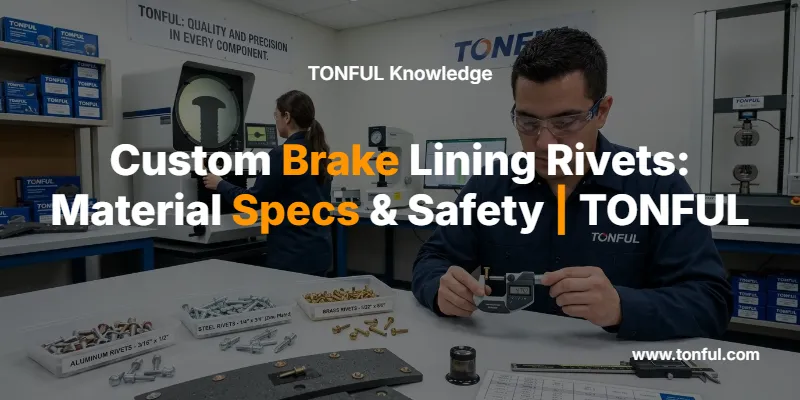
When brake system failure ranks as a leading mechanical cause of highway crashes, the fasteners securing friction material to brake shoes become critical safety components. Custom brake lining rivets must withstand extreme thermal cycling, vibration loads, and shear forces while maintaining consistent clamping pressure throughout the brake assembly’s service life. For automotive manufacturers and brake system suppliers, selecting the right rivet material specification directly impacts product liability, warranty costs, and end-user safety.
This technical guide examines material engineering principles, federal safety standards, and procurement considerations for brake lining rivets in automotive applications.

Understanding Brake Lining Rivet Fundamentals
Brake lining rivets are specialized fasteners that secure friction materials to brake shoes or disc brake pads in automotive and heavy-duty braking systems. Unlike adhesive bonding methods, riveted attachments provide mechanical retention that remains stable across temperature extremes from -40°F to 600°F, resist contamination from brake dust and moisture, and offer visible wear indicators when lining thickness approaches minimum safe levels.
The countersunk rivet head design mates precisely with the counter bore machined into the friction material, creating a flush surface that prevents interference with drum or rotor contact. Federal safety regulations mandate that riveted linings maintain no less than 1/32 inch (0.8mm) material thickness above the rivet head at the thinnest point to prevent metal-to-metal contact that would compromise braking performance.
Industry-standard brake rivets feature semi-tubular construction with a shallow axial hole extending 40-80% of the shank length. This design reduces installation force requirements to approximately one-quarter that of solid rivets while maintaining sufficient shear and tensile strength for safety-critical applications. When properly matched with engineered anvil tooling, the rivet clinches the friction material tightly yet remains removable for relining operations.
Material Specifications for Brake Lining Rivets
Aluminum Alloys: The Industry Standard
Aluminum alloys dominate brake lining rivet applications due to their optimal balance of lightweight construction, functional strength, and cost-effectiveness. The most common specifications include:
Aluminum 5056 offers excellent corrosion resistance and formability with tensile strength of 42,000 psi and shear strength of 28,000 psi. This alloy performs reliably in marine and off-road environments exposed to road salts and moisture.
Aluminum 6061-T6 provides higher strength (45,000 psi tensile) with good machinability and weldability. The T6 temper heat treatment enhances mechanical properties while maintaining adequate ductility for cold heading operations.
Aluminum 1100 represents the most formable option with 99% minimum aluminum content. While offering lower strength (13,000 psi tensile), this alloy excels in applications requiring extreme malleability and serves as a visible wear indicator—the soft aluminum deforms before surrounding brake components fail, providing early warning of excessive stress or overload conditions.
The high corrosion resistance of aluminum alloys makes them ideal for environments with temperature fluctuations, humidity, and chemical exposure common in automotive service. Aluminum’s thermal conductivity (approximately 205 W/m·K) also aids heat dissipation from the friction interface.
Steel Rivets: Maximum Strength Applications
Steel brake lining rivets deliver superior shear and tensile strength for heavy-duty truck, trailer, and industrial equipment applications where brake loads exceed passenger vehicle specifications. Low-carbon steel (AISI 1008-1010) provides adequate strength with good cold-forming characteristics, while medium-carbon grades (AISI 1035-1045) offer higher hardness for extreme-duty applications.
Steel rivets typically feature protective plating—zinc, cadmium, or proprietary coatings—to prevent corrosion in service environments. The higher density of steel (7.85 g/cm³ vs. 2.70 g/cm³ for aluminum) adds minimal weight in brake assemblies but provides substantially higher load-bearing capacity.
Copper and Brass: Specialized Applications
Copper rivets offer the highest electrical and thermal conductivity (401 W/m·K) among common rivet materials. While less common in modern automotive brake systems, copper rivets appear in vintage vehicle restoration, aircraft brake assemblies, and applications where electromagnetic interference concerns dictate non-ferrous fasteners.
Brass rivets (typically C2600-C2700 alloys) combine good corrosion resistance with attractive appearance and moderate strength. The zinc content in brass provides natural lubricity during installation while maintaining adequate mechanical properties for light-duty brake applications. For detailed material comparisons, see our copper vs brass terminals analysis.
Stainless Steel: Corrosion-Critical Environments
Type 304 and 316 stainless steel rivets provide maximum corrosion resistance for marine, chemical processing, and extreme-environment brake systems. The chromium-nickel composition creates a passive oxide layer that self-heals when scratched, ensuring long-term integrity in corrosive atmospheres. The higher material and processing costs limit stainless steel rivets to specialized applications where aluminum alloys prove inadequate.

Material Performance Comparison Table
| Material | Tensile Strength (psi) | Shear Strength (psi) | Density (g/cm³) | Thermal Conductivity (W/m·K) | Corrosion Resistance | Relative Cost |
|---|---|---|---|---|---|---|
| Aluminum 5056 | 42,000 | 28,000 | 2.70 | 205 | Excellent | Low |
| Aluminum 6061-T6 | 45,000 | 30,000 | 2.70 | 167 | Excellent | Low-Medium |
| Aluminum 1100 | 13,000 | 9,000 | 2.71 | 222 | Excellent | Low |
| Low-Carbon Steel | 55,000 | 37,000 | 7.85 | 50 | Poor (requires plating) | Low |
| Stainless 304 | 85,000 | 57,000 | 8.00 | 16 | Excellent | High |
| Copper | 32,000 | 21,000 | 8.96 | 401 | Good | Medium-High |
| Brass (C2700) | 49,000 | 33,000 | 8.53 | 120 | Good | Medium |
Solid vs. Semi-Tubular Rivet Design Comparison
The choice between solid and semi-tubular construction significantly impacts installation requirements, joint strength, and manufacturing economics. Understanding these differences helps procurement teams specify appropriate fasteners for their brake assembly processes.

Solid vs. Semi-Tubular Performance Characteristics
| Characteristic | Solid Rivets | Semi-Tubular Rivets |
|---|---|---|
| Installation Force Required | 100% (baseline) | 25% of solid rivet force |
| Shear Strength | Maximum | 85-90% of solid rivet |
| Tensile Strength | Maximum | 80-85% of solid rivet |
| Installation Speed | Slower | 3-4x faster |
| Tooling Complexity | Higher pressure equipment | Standard pneumatic tools |
| Material Usage | Higher | 15-20% less material |
| Inspection Visibility | Difficult to verify clinch | Easy visual inspection |
| Removability for Relining | Difficult | Designed for removal |
| Cost per Unit | Lower material cost | Lower total installed cost |
| Typical Applications | Structural joints, maximum load | Brake/clutch linings, moderate load |
Semi-tubular rivets have become the industry standard for brake lining attachment because the reduced installation force minimizes friction material damage during riveting operations. The shallow axial hole allows the rivet shank to deform controllably when struck, creating a uniform clinch without cracking the surrounding friction material or distorting the brake shoe backing plate.
For detailed assembly guidance, refer to our comprehensive solid vs semi-tubular rivets assembly technical resource.
Federal Safety Standards and Compliance Requirements
Brake system components fall under stringent federal oversight due to their direct impact on vehicle safety. Understanding applicable standards helps manufacturers ensure regulatory compliance and minimize product liability exposure.
FMVSS 105 and FMVSS 135 Standards
Federal Motor Vehicle Safety Standards (FMVSS) 105 and 135, issued by the National Highway Traffic Safety Administration (NHTSA), establish performance requirements for hydraulic brake systems on passenger vehicles and light trucks. While these standards technically apply only to new vehicle manufacturers, they establish the performance baseline that aftermarket brake components must meet to ensure “like-new” braking capability.
FMVSS 135 (applicable to 2000+ passenger cars and 2002+ light trucks) specifies stopping distance requirements, fade resistance testing protocols, and system integrity standards. Although the regulations do not mandate specific rivet materials or designs, they establish the functional outcomes that brake assemblies must achieve—outcomes directly influenced by rivet quality and installation integrity.
Minimum Lining Thickness Requirements
Federal inspection standards mandate specific minimum lining thickness above fasteners to prevent dangerous metal-to-metal contact:
- Riveted linings: No less than 1/32 inch (0.79mm) above rivet head
- Bonded linings: No less than 2/32 inch (1.59mm) above brake shoe
These measurements must be verified at the thinnest point of the lining. When lining wear exposes rivet heads or backing plates to drum or rotor contact, brake chatter, vibration, and rapid component damage occur. Quality brake lining rivets with proper countersunk head geometry maximize usable lining life while maintaining the required safety margin.
Material Integrity and Inspection Standards
Brake linings and pads must not exhibit cracks or breaks extending to rivet holes, except minor surface cracks that do not impair attachment integrity. During vehicle inspection, technicians verify that mounting hardware including rivets shows no signs of loosening, corrosion, or mechanical damage that could compromise friction material retention.
Heavy-duty vehicle brake systems follow additional standards including FMVSS 121 for air brake systems and TMC Recommended Practice 628 for aftermarket brake lining qualification. These standards incorporate dynamometer testing protocols that subject brake assemblies to repeated thermal cycles and load applications that stress rivet joints under realistic service conditions.

Engineering Considerations for Rivet Selection
Selecting appropriate brake lining rivets requires balancing multiple engineering factors including load requirements, thermal environment, corrosion exposure, and manufacturing process constraints.
Shear and Tensile Load Analysis
Brake lining rivets primarily resist shear forces generated during brake application as friction material attempts to rotate relative to the brake shoe. Secondary tensile loads occur from thermal expansion differentials between friction material and metal backing, as well as vibration-induced cyclic stresses.
For passenger vehicle disc brake applications, typical shear loads per rivet range from 150-300 lbf during normal braking and may spike to 500+ lbf during emergency stops. Heavy-duty truck drum brakes generate substantially higher loads, often exceeding 800 lbf per rivet. Proper rivet selection ensures a safety factor of 3-5x above maximum expected service loads.
Thermal Cycling Performance
Brake friction generates intense localized heating, with surface temperatures reaching 400-700°F during normal operation and exceeding 1000°F during sustained heavy braking. This thermal cycling creates expansion/contraction stresses at the rivet-friction material interface.
Aluminum rivets’ thermal expansion coefficient (23.6 × 10⁻⁶/°C) closely matches many organic and semi-metallic friction materials, minimizing differential expansion stresses. Steel rivets’ lower expansion coefficient (11.7 × 10⁻⁶/°C) may create higher interface stresses in some material combinations, requiring careful friction material formulation to maintain joint integrity.
Corrosion Environment Assessment
Road salt exposure, moisture accumulation, and chemical contamination from brake fluid or hydraulic leaks create aggressive corrosion environments. Aluminum alloys’ natural oxide layer provides excellent protection without additional coating. Steel rivets require zinc plating, cadmium plating, or proprietary corrosion-resistant coatings to achieve acceptable service life.
Marine and off-road applications demand the highest corrosion resistance, often specifying aluminum 5056 or stainless steel rivets despite higher material costs. For related corrosion protection strategies, see our tin-plated copper terminals corrosion standards guide.
Installation Process Compatibility
Manufacturing process constraints often drive rivet selection. Automated high-volume assembly lines favor semi-tubular aluminum rivets that install quickly with standard pneumatic tooling. Low-volume or aftermarket operations may accept the slower installation of solid steel rivets when maximum strength justifies the additional labor cost.
Rivet length must be precisely matched to combined friction material and backing plate thickness. Insufficient length prevents proper clinch formation; excessive length creates protruding tails that interfere with brake drum clearance. Standard rivet lengths range from 0.188″ to 0.625″ in 0.031″ increments, with custom lengths available for specialized applications.

Procurement Considerations for OEM and Aftermarket Suppliers
For automotive manufacturers and brake system suppliers, rivet procurement decisions impact product quality, manufacturing efficiency, and total cost of ownership beyond simple unit price comparisons.
Quality Certification and Traceability
Reputable brake lining rivet manufacturers maintain ISO 9001:2015 certification with full material traceability from raw material receipt through finished product delivery. Certificate of conformance documentation should verify:
- Material composition via spectroscopic analysis
- Dimensional compliance to drawing specifications
- Mechanical property testing (tensile, shear, hardness)
- Surface finish and plating thickness verification
- Lot traceability for recall management
Supplier Qualification Criteria
When evaluating rivets fasteners manufacturers, assess technical capabilities including:
- In-house tooling design for custom head styles and dimensions
- Material range covering aluminum, steel, stainless, copper, and brass
- Production capacity matching your volume requirements (prototype to millions)
- Quality systems with statistical process control
- Engineering support for joint design optimization
TONFUL Electric maintains comprehensive manufacturing capabilities for automotive terminals connectors and brake system fasteners, with engineering teams experienced in application-specific rivet design and material selection.
Total Cost of Ownership Analysis
While unit price drives initial procurement decisions, total installed cost includes:
- Installation labor and equipment amortization
- Scrap rates from installation defects
- Warranty claims from premature failure
- Inventory carrying costs for multiple SKUs
- Supplier management overhead
Semi-tubular aluminum rivets often deliver lower total cost despite higher unit prices compared to solid steel rivets, due to faster installation, lower tooling costs, and reduced friction material damage during assembly. Vendor consolidation with suppliers offering complete wire terminal and fastener product lines can reduce procurement complexity and logistics costs.
Customization and Engineering Support
Standard catalog rivets suit most applications, but specialized brake designs may require custom specifications including:
- Non-standard head styles (oval, truss, brazier)
- Proprietary shank lengths or diameters
- Special materials or plating requirements
- Custom packaging for automated feeding equipment
Manufacturers with in-house tooling design capabilities can develop custom rivet configurations in 10-15 days, enabling rapid prototype iteration and production launch. For complex assemblies requiring multiple fastener types, integrated suppliers offering heavy-duty copper lugs and terminals alongside rivets simplify bill-of-material management.
Frequently Asked Questions
Q: What is the primary difference between solid and semi-tubular brake lining rivets?
A: Semi-tubular rivets feature a shallow axial hole extending 40-80% of the shank length, reducing installation force to approximately 25% of that required for solid rivets. This design enables faster installation with standard pneumatic tools while maintaining 80-90% of solid rivet strength—adequate for brake lining applications where removability for relining is advantageous.
Q: Why are aluminum alloys preferred over steel for most brake lining rivets?
A: Aluminum alloys offer an optimal balance of lightweight construction, excellent corrosion resistance without additional plating, thermal expansion characteristics matching friction materials, and adequate strength for brake applications. Aluminum’s tendency to deform before surrounding components fail also provides visible early warning of excessive stress or wear conditions.
Q: How do I determine the correct rivet length for my brake assembly?
A: Rivet length should equal the combined thickness of friction material and brake shoe backing plate, plus 0.8-1.2 times the rivet diameter for proper clinch formation. For softer materials like aluminum, use the lower multiplier (0.8x); for harder materials like stainless steel, use the higher multiplier (1.2x). Consult manufacturer length selection charts for specific material combinations.
Q: What federal safety standards apply to brake lining rivets?
A: While no federal standard specifically regulates rivet specifications, FMVSS 105 and 135 establish brake system performance requirements that riveted assemblies must meet. Federal inspection standards mandate riveted linings maintain minimum 1/32 inch thickness above rivet heads. Heavy-duty vehicles follow additional FMVSS 121 and TMC RP 628 standards.
Q: Can brake lining rivets be reused during relining operations?
A: No. Brake lining rivets are permanent fasteners designed for single-use installation. The clinching process work-hardens the rivet tail, and removal damages both the rivet and potentially the brake shoe. Always install new rivets when replacing friction material to ensure proper retention strength and safety compliance.
Q: What causes premature brake lining rivet failure?
A: Common failure modes include: incorrect rivet material selection for the load environment, improper installation with insufficient or excessive clinch force, corrosion from inadequate material protection, thermal fatigue from extreme temperature cycling, and using rivets with inadequate shear strength for the application. Quality rivets from certified manufacturers with proper installation procedures minimize these risks.
Conclusion
Custom brake lining rivets represent critical safety components where material specification, design optimization, and manufacturing quality directly impact braking performance and vehicle safety. Aluminum alloys dominate modern applications due to their corrosion resistance, appropriate strength characteristics, and installation efficiency, while steel and stainless options serve specialized high-load and corrosive environments.
Understanding the engineering principles governing rivet selection—including shear load analysis, thermal cycling performance, and federal safety compliance—enables automotive manufacturers and brake system suppliers to specify fasteners that optimize product reliability, manufacturing efficiency, and total cost of ownership.
TONFUL Electric’s comprehensive automotive electrical connectors and fastener manufacturing capabilities support brake system suppliers with quality-certified rivets, engineering consultation, and custom product development. Our ISO 9001:2015 certified facilities deliver consistent quality from prototype through high-volume production, ensuring your brake assemblies meet the most demanding safety and performance standards.
For technical consultation on brake lining rivet specifications for your application, contact TONFUL Electric’s engineering team to discuss material selection, custom design requirements, and procurement solutions tailored to your manufacturing process.