
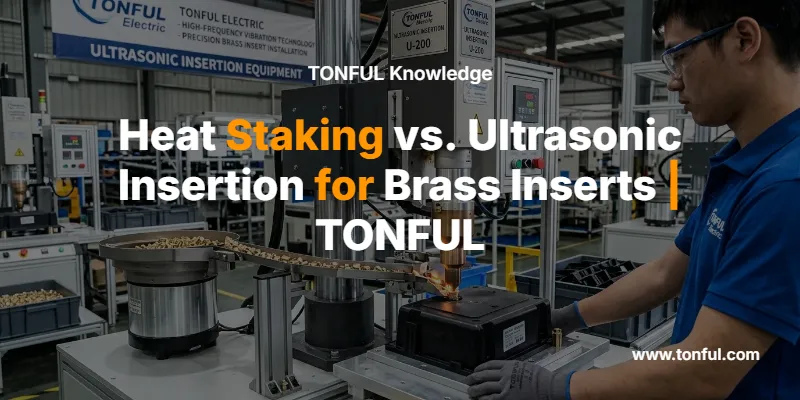
When designing plastic assemblies that require strong, reusable threaded connections, engineers face a critical decision: which installation method delivers optimal performance for brass inserts? Heat staking and ultrasonic insertion represent two dominant post-molding techniques, each offering distinct advantages depending on application requirements, plastic material properties, and production constraints.
This comprehensive guide examines both methods through an engineering lens, providing the technical insights B2B manufacturers need to specify the right brass insert installation process for their plastic injection molding projects.

Understanding Heat Staking Inserts
Heat staking, also known as thermal insertion, employs direct conductive heat transfer to install threaded brass inserts into pre-molded or drilled holes. The process involves heating the metal insert to a precise temperature—typically between 200°C and 350°C depending on the plastic substrate—then pressing it into the mounting hole with controlled force.
The Heat Staking Process
The thermal insertion sequence follows these engineered steps:
- Insert Heating: The brass insert is heated via a thermal arbor or heated tooling fixture, raising its temperature to the plastic’s melting point.
- Controlled Insertion: Pneumatic or servo-driven actuators apply consistent downward force (typically 50-200N) as the heated insert enters the hole.
- Plastic Displacement: Heat conducts from the insert into the surrounding thermoplastic, creating a thin molten layer that flows into the insert’s knurled features.
- Solidification: As the assembly cools (usually 2-5 seconds), the plastic resolidifies around the retention features, creating a mechanical interlock.
The success of heat staking depends heavily on thermal conductivity. Brass terminals and connectors excel in this application due to brass’s thermal conductivity (109 W/m·K), which enables efficient heat transfer while allowing rapid cooling cycles.

Ultrasonic Insertion Technology
Ultrasonic insertion leverages high-frequency mechanical vibrations to generate localized frictional heat at the insert-plastic interface. Operating at standard frequencies of 20 kHz or 40 kHz, ultrasonic equipment converts electrical energy into rapid oscillations that create instantaneous melting without bulk heating of the insert or surrounding part.
The Ultrasonic Installation Process
Ultrasonic insertion follows a distinct mechanism:
- Vibrational Energy Application: An ultrasonic horn or sonotrode contacts the insert, transmitting 20,000 vibrations per second.
- Frictional Heating: Vibrations generate interfacial friction between the metal insert and plastic boss, creating localized temperatures exceeding the plastic’s melting point.
- Dynamic Insertion: Simultaneous pneumatic pressure (typically 30-100N) drives the insert into the hole as plastic melts.
- Rapid Solidification: When vibration stops, the thin molten layer solidifies almost instantly (0.5-2 seconds).
The ultrasonic method excels with amorphous thermoplastics like ABS, polycarbonate, and polystyrene, which exhibit broad glass transition temperatures. These materials respond efficiently to the rapid heating-cooling cycles inherent to ultrasonic welding, requiring less total energy input compared to semi-crystalline plastics.

Heat Staking vs. Ultrasonic Insertion: Technical Comparison
| Parameter | Heat Staking | Ultrasonic Insertion |
|---|---|---|
| Installation Force | 50-200N | 30-100N |
| Cycle Time (single insert) | 3-6 seconds | 1-3 seconds |
| Energy Consumption | Higher (continuous heating) | Lower (pulse energy) |
| Noise Level | Low (< 70 dB) | High (85-95 dB) |
| Equipment Cost | $$$ | $$ |
| Thin-Wall Compatibility | Excellent (low force) | Limited (vibration stress) |
| Process Consistency | Very High | High (requires tuning) |
| Amorphous Plastics | Good | Excellent |
| Semi-Crystalline Plastics | Excellent | Good (requires more energy) |
Performance Metrics Comparison
| Metric | Heat Staking | Ultrasonic Insertion |
|---|---|---|
| Pull-Out Strength | 400-800N (depending on design) | 350-750N |
| Torque Resistance | 3-8 N·m | 2.5-7 N·m |
| Installation Precision | ±0.05mm | ±0.08mm |
| Part Stress Induced | Low | Moderate |
| Multi-Insert Capability | Excellent (multiple heads) | Limited (sequential) |

Material Compatibility and Plastic Selection
Thermoplastic Performance Matrix
| Plastic Type | Heat Staking | Ultrasonic Insertion | Recommended Method |
|---|---|---|---|
| ABS | Good | Excellent | Ultrasonic |
| Polycarbonate (PC) | Good | Excellent | Ultrasonic |
| Nylon (PA6/PA66) | Excellent | Good | Heat Staking |
| Polypropylene (PP) | Excellent | Fair | Heat Staking |
| PBT | Excellent | Good | Heat Staking |
| Acetal (POM) | Good | Fair | Heat Staking |
| Polystyrene (PS) | Good | Excellent | Ultrasonic |
| PC/ABS Blend | Good | Excellent | Either |
The fundamental difference lies in how each plastic type responds to thermal input. Amorphous plastics like ABS and polycarbonate have gradual glass transition zones, making them ideal for the rapid heating-cooling cycles of ultrasonic insertion. Semi-crystalline plastics like nylon and polypropylene have sharp melting points, responding more predictably to the sustained heat of thermal insertion.
Insert Design Considerations
Knurl Patterns and Retention Features
Both installation methods require specifically designed retention features, but optimal geometries differ:
Heat Staking Insert Features:
- Straight or diagonal knurls with 0.15-0.25mm depth
- Undercut barbs for enhanced pull-out resistance
- Tapered or straight body designs
- Larger knurl pitch (0.5-0.8mm)
Ultrasonic Insert Features:
- Aggressive diamond or cross-hatch knurls
- Deeper knurl depth (0.20-0.30mm)
- Sharper knurl angles for friction generation
- Tighter knurl pitch (0.3-0.5mm)
TONFUL Electric manufactures precision brass inserts with application-specific knurl patterns optimized for both installation methods, ensuring maximum torque and pull-out performance.

Application Selection Guide
Choose Heat Staking When:
- Thin-walled parts require low installation forces to prevent cracking or deformation
- Multiple inserts need simultaneous installation (multi-head thermal presses available)
- Semi-crystalline plastics like nylon, PP, or PBT are the substrate material
- Noise-sensitive environments prohibit high-decibel ultrasonic equipment
- Consistent repeatability is paramount across high-volume production
- Sensitive electronics are present that could be damaged by vibration
- Deep pockets or recessed mounting locations limit ultrasonic horn access
Choose Ultrasonic Insertion When:
- Cycle time is critical and fastest installation is required
- Amorphous plastics like ABS, PC, or PS are the substrate
- Energy efficiency drives equipment selection decisions
- Equipment versatility is needed (same welder for insertion and assembly welding)
- Compact parts with simple geometry allow easy horn access
- Lower installation forces are acceptable despite vibration stress
- Standard 20kHz welding equipment is already available in the facility
Cost and Efficiency Analysis
Equipment Investment
Heat Staking Equipment:
- Entry-level manual press: $8,000-15,000
- Semi-automatic thermal press: $25,000-45,000
- Fully automated multi-head system: $60,000-120,000
Ultrasonic Insertion Equipment:
- Basic 20kHz ultrasonic welder: $15,000-30,000
- Dedicated insertion system: $35,000-65,000
- Automated ultrasonic cell: $80,000-150,000
Operating Cost Considerations
| Cost Factor | Heat Staking | Ultrasonic Insertion |
|---|---|---|
| Energy per Insert | 0.05-0.08 kWh | 0.02-0.04 kWh |
| Maintenance Frequency | Low (heating elements) | Moderate (horn wear) |
| Consumable Parts | Thermal tips ($200-500) | Horns/boosters ($800-2000) |
| Operator Training | Minimal | Moderate (tuning required) |
| Quality Control | Visual + pull test | Visual + pull test + weld monitor |
For high-volume production exceeding 100,000 inserts annually, ultrasonic insertion typically offers lower per-part costs despite higher equipment investment. For lower volumes or applications requiring multiple simultaneous inserts, heat staking provides better ROI.
Quality Control and Testing Standards
Both methods require rigorous quality validation to ensure consistent joint strength. TONFUL Electric recommends implementing these quality control protocols:
Pull-Out Testing:
- Minimum specification: 80% of theoretical maximum based on knurl engagement
- Test frequency: Statistical sampling per ISO 2859-1
- Acceptance criteria: Zero failures in sample batch
Torque Testing:
- Installation torque verification against design specifications
- Rotational resistance testing post-installation
- Documented torque values for traceability
Visual Inspection:
- Insert seating depth verification (flush or specified protrusion)
- Plastic boss integrity (no cracks, flash, or deformation)
- Knurl fill verification (complete plastic flow into retention features)
Similar rigorous testing protocols apply across TONFUL’s entire product line, including automotive terminals, electrical connectors, and fastening solutions.
Integration with Manufacturing Workflows
Heat Staking Integration
Heat staking equipment integrates seamlessly into existing assembly lines with minimal disruption. Multi-head thermal presses can install 4-8 inserts simultaneously, making them ideal for complex assemblies like automotive dashboard components, power tool housings, and consumer electronics enclosures.
The low noise profile allows heat staking stations to operate in standard manufacturing environments without additional acoustic isolation, and the gentle installation force permits integration with delicate assemblies containing PCBs or sensitive components.
Ultrasonic Integration
Ultrasonic insertion equipment offers exceptional versatility when facilities already employ ultrasonic welding for plastic assembly. The same power supply and control systems can often support both welding and insertion operations, reducing capital equipment requirements.
However, the high noise levels (85-95 dB) typically necessitate acoustic enclosures or dedicated insertion cells to maintain OSHA-compliant workplace noise exposure limits. This consideration affects facility layout and may increase total implementation costs.
Frequently Asked Questions
Q: Can the same brass insert be used for both heat staking and ultrasonic insertion?
A: While some symmetrical insert designs work adequately with both methods, optimal performance requires method-specific knurl patterns. Heat staking inserts typically feature straighter, less aggressive knurls, while ultrasonic inserts benefit from sharper, deeper knurl geometries that generate more friction. TONFUL offers application-specific insert designs optimized for each installation method.
Q: Which method provides stronger joints?
A: When properly installed with appropriate insert designs, both methods deliver comparable pull-out and torque strength. Heat staking typically produces slightly higher pull-out values (5-10% stronger) due to deeper plastic flow into retention features, but ultrasonic insertion offers faster cycle times. The plastic material and insert design have greater impact on joint strength than installation method alone.
Q: How do I determine the correct hole size for brass inserts?
A: Hole diameter should be 0.05-0.15mm larger than the insert’s nominal outer diameter for heat staking, and 0.08-0.18mm larger for ultrasonic insertion. Boss wall thickness should be at least 1.5× the insert outer diameter to prevent cracking. TONFUL provides detailed installation specifications with each insert product, including recommended hole dimensions, boss geometry, and installation parameters.
Q: Can inserts be installed in glass-filled plastics?
A: Yes, but with important considerations. Glass-filled plastics (typically 15-30% glass content) require higher installation forces and longer cycle times for both methods. Heat staking is generally preferred for glass-filled materials as the sustained heat provides more complete plastic flow. Ultrasonic insertion can work but may require amplitude adjustment and extended weld times. Insert pull-out strength typically increases 20-40% in glass-filled plastics due to enhanced rigidity.
Q: What maintenance do heat staking and ultrasonic insertion equipment require?
A: Heat staking equipment requires periodic replacement of heating elements (typically 5,000-10,000 cycles) and thermal tips (wear-dependent). Ultrasonic equipment requires more frequent maintenance: horn inspection every 50,000 cycles, booster replacement every 200,000-500,000 cycles, and converter servicing annually. Both systems benefit from regular calibration and force verification to maintain consistent installation quality.
Conclusion: Making the Right Choice for Your Application
Selecting between heat staking and ultrasonic insertion for brass insert installation requires careful analysis of multiple engineering factors: plastic material properties, production volume, part geometry, quality requirements, and existing equipment infrastructure.
Heat staking excels in applications demanding gentle installation forces, multi-insert simultaneous installation, semi-crystalline plastic compatibility, and quiet operation. Its proven consistency and lower operator skill requirements make it ideal for high-reliability applications in automotive, medical device, and industrial equipment manufacturing.
Ultrasonic insertion delivers superior cycle times, energy efficiency, and performance with amorphous plastics. When production speed drives equipment selection and facility infrastructure can accommodate noise levels, ultrasonic technology provides compelling advantages for consumer electronics, appliance assembly, and high-volume plastic component production.
TONFUL Electric, as a leading electrical components manufacturer, provides comprehensive technical support for brass insert specification and installation process selection. Our engineering team collaborates with customers to optimize insert designs, recommend installation parameters, and validate joint performance through rigorous testing protocols.
Whether your application requires heat staking inserts, ultrasonic inserts, or other precision fastening solutions, TONFUL delivers the quality, consistency, and technical expertise that B2B manufacturers demand for mission-critical assemblies.
For technical specifications, installation guidelines, and custom brass insert solutions, contact TONFUL Electric’s engineering team or explore our comprehensive product catalog.