
In modern electronics manufacturing, reliable PCB interconnections determine product performance and longevity. Among the various connector solutions available, the box header stands out as a critical component for secure, polarized connections in board-to-board and wire-to-board applications. This comprehensive guide explains how box headers function, their technical specifications, and selection criteria for engineers and procurement professionals.
What Is a Box Header?
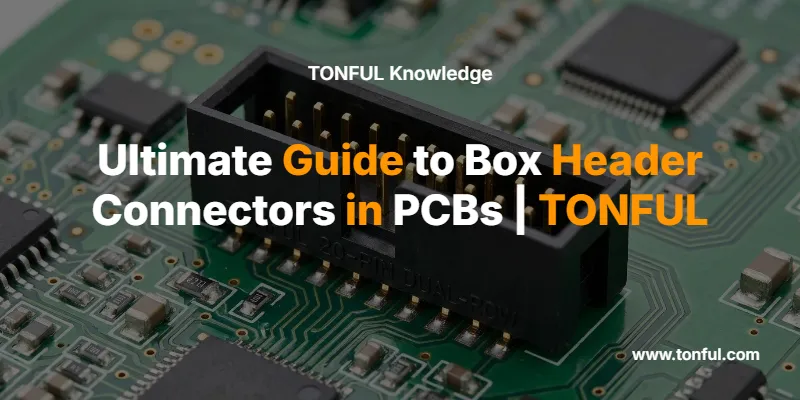
A box header, also known as a shrouded header, is a male PCB connector featuring metal pins surrounded by a protective plastic housing. The defining characteristic is the raised plastic shroud that forms a keyed enclosure around the pin array, preventing incorrect mating and protecting pins from mechanical damage.
Unlike standard pin header connectors, box headers incorporate a polarization feature—typically a square notch or key in the shroud—that ensures the mating connector can only be inserted in the correct orientation. This design is essential for applications where reversed polarity could damage circuits or create safety hazards.

How Box Headers Work: Mechanical and Electrical Principles
Mechanical Function
The box header operates through a precision-engineered mechanical interface. When a compatible connector—typically an IDC (Insulation Displacement Connector) ribbon cable socket or female header connector—approaches the box header, the shroud guides alignment before pin engagement begins.
The polarization key, usually a square notch cut into one corner of the shroud, mates with a corresponding bump or tab on the female connector housing. This mechanical interlock prevents 180-degree rotation errors that would reverse signal polarity. The shroud walls also provide lateral support, preventing pin deflection during insertion and maintaining precise pin-to-socket alignment throughout the connector’s service life.
Electrical Function
Electrically, box headers create reliable current paths through spring-contact interfaces. Each pin consists of a copper alloy post—typically phosphor bronze or brass—plated with tin, gold, or selective gold over nickel. The pins are press-fit or soldered into the PCB, establishing the board-side electrical connection.
When the mating connector engages, spring contacts inside the female housing grip each pin with controlled normal force, typically 50-100 grams per contact. This force creates a gas-tight metal-to-metal interface that resists oxidation and maintains low contact resistance (typically <30mΩ) across temperature cycling and vibration.
The pin pitch—the center-to-center spacing between adjacent pins—determines current capacity and signal integrity. The industry-standard 2.54mm (0.1 inch) pitch supports up to 3A per pin for power applications and signal frequencies exceeding 100MHz with proper PCB layout.

Box Header vs. Pin Header: Key Differences
Understanding when to specify a box header versus a standard pin header is critical for design engineers. The table below summarizes the functional differences:
| Feature | Box Header | Standard Pin Header |
|---|---|---|
| Shroud/Housing | Raised plastic enclosure with polarization key | Minimal or no plastic housing |
| Polarity Protection | Mechanical keying prevents reversed insertion | No inherent polarity protection |
| Pin Protection | Shroud guards pins against bending and damage | Exposed pins vulnerable to mechanical stress |
| Typical Mating Connector | IDC ribbon cable socket, shrouded female header | Jumper wires, unshrouded female headers, DuPont connectors |
| Application Focus | Production assemblies, field-serviceable connections, ribbon cable interfaces | Prototyping, test points, low-volume assemblies |
| Cost | Slightly higher due to molded shroud | Lower material and tooling cost |
| PCB Footprint | Larger due to shroud clearance requirements | Minimal footprint |
For a detailed comparison of design trade-offs and application scenarios, see our comprehensive pin header vs box header guide.
Standard Specifications and Pitch Sizes
Box headers are manufactured to industry-standard specifications that ensure interoperability across manufacturers and applications. Key specifications include:
Pitch Standards
| Pitch Size | Common Applications | Availability |
|---|---|---|
| 2.54mm (0.1″) | General-purpose, Arduino, Raspberry Pi, industrial controls, IDC ribbon cables | Widest ecosystem; industry standard |
| 2.00mm | Compact consumer electronics, space-constrained designs | Moderate availability |
| 1.27mm (0.05″) | High-density applications, miniaturized devices | Specialized suppliers |
| 1.00mm | Ultra-compact mobile devices, wearables | Limited availability |
The 2.54mm pitch remains the global standard for electrical PCB connectors, offering the broadest selection of mating connectors, cable assemblies, and tooling support.
Pin Configuration
Box headers are available in single-row and dual-row configurations:
- Single-row: 2 to 40 pins (typical range: 6-20 pins)
- Dual-row: 4 to 80 pins (typical range: 10-40 pins)
Dual-row configurations provide higher pin density and are preferred for ribbon cable interfaces, where even-numbered pin counts match standard IDC cable widths (10, 16, 20, 26, 34, 40, 50, 64 conductors).
Mounting Types
Box headers are manufactured in two primary mounting styles:
- Through-Hole Technology (THT): Pins extend through PCB holes and are wave-soldered or hand-soldered on the opposite side. THT provides superior mechanical strength for connectors subject to repeated mating cycles or mechanical stress.
- Surface-Mount Technology (SMT): Pins are bent at 90 degrees and soldered to surface pads. SMT box headers reduce PCB real estate and enable automated pick-and-place assembly. For high-volume production considerations, see our guide on SMT vs THT PCB connectors.

Material Specifications and Plating Options
The performance and longevity of box headers depend critically on material selection and surface finish.
Pin Material
Box header pins are manufactured from copper alloys selected for electrical conductivity, mechanical strength, and spring properties:
- Phosphor Bronze (C5191): Excellent spring characteristics and fatigue resistance; preferred for high-cycle applications
- Brass (C2680): Good conductivity and formability; cost-effective for standard applications
- Beryllium Copper (C17200): Superior spring force and conductivity; used in high-reliability aerospace and medical applications
Plating Options
| Plating Type | Thickness | Contact Resistance | Corrosion Resistance | Typical Applications | Cost |
|---|---|---|---|---|---|
| Tin (Sn) | 1-3 μm | 10-30 mΩ | Moderate | General industrial, consumer electronics | Low |
| Gold Flash over Nickel | 0.05-0.13 μm Au over 1.27 μm Ni | 5-15 mΩ | Excellent | High-reliability industrial, automotive | Medium |
| Selective Gold | Gold on contact area, tin on tail | 5-15 mΩ | Excellent | Cost-optimized high-reliability | Medium |
| Hard Gold | 0.76-1.27 μm Au over Ni | 3-10 mΩ | Superior | Aerospace, medical, 500+ mating cycles | High |
TONFUL Electric manufactures terminals and connectors with multiple plating options to meet application-specific requirements and budget constraints.
Housing Material
Box header shrouds are injection-molded from high-temperature thermoplastics:
- PA66 (Nylon 66): UL94 V-0 rated, operating range -40°C to +105°C, excellent mechanical strength
- LCP (Liquid Crystal Polymer): Superior dimensional stability, operating range -40°C to +260°C, low moisture absorption
- PBT (Polybutylene Terephthalate): Good chemical resistance, operating range -40°C to +150°C, cost-effective
All TONFUL box header housings meet UL94 V-0 flammability ratings and RoHS/REACH compliance standards.

Common Applications
Box headers serve critical functions across multiple industries and application domains:
Industrial Control Systems
Box headers provide reliable interconnections in PLCs (Programmable Logic Controllers), motor drives, and sensor networks. The shrouded design protects connections in high-vibration environments and prevents accidental disconnection during maintenance.
Automotive Electronics
Automotive PCB connectors must withstand extreme temperature cycling, vibration, and environmental contamination. Box headers with gold plating and high-temperature housings meet AEC-Q200 automotive qualification standards for ECUs, instrument clusters, and infotainment systems.
Computer Peripherals and Embedded Systems
Box headers are ubiquitous in computer motherboards, where they provide connections for front-panel I/O, USB headers, audio headers, and system fans. The standardized 2.54mm pitch ensures compatibility across generations of hardware.
Development Boards and Prototyping Platforms
Arduino, Raspberry Pi, and similar single-board computers use box headers for GPIO (General Purpose Input/Output) expansion. The shrouded design protects delicate microcontroller pins during repeated prototyping cycles.
Test and Measurement Equipment
Box headers facilitate modular test fixture design, allowing rapid reconfiguration of test points and signal routing without custom cabling.
Selection Criteria for Engineers
Specifying the correct box header requires evaluating multiple technical parameters against application requirements:
1. Pin Count and Configuration
Determine the number of signals, power rails, and ground connections required. Add 10-20% margin for future expansion. Choose dual-row configurations for ribbon cable interfaces; single-row for simple signal breakouts.
2. Current and Voltage Ratings
Standard 2.54mm box headers support 3A per pin (derated to 2A for adjacent pins carrying current simultaneously). For higher current requirements, specify larger pin diameters or multiple parallel pins. Voltage ratings typically reach 500V AC/DC for standard pitch connectors.
3. Mating Cycles
- Low-cycle (<25 insertions): Tin plating acceptable
- Medium-cycle (25-100 insertions): Gold flash recommended
- High-cycle (>100 insertions): Hard gold plating required
4. Environmental Conditions
- Operating temperature: Match housing material to ambient temperature range
- Humidity and contamination: Specify gold plating for corrosive environments
- Vibration and shock: Choose THT mounting for high-vibration applications
5. PCB Assembly Method
- Manual or low-volume: THT provides easier hand assembly and rework
- Automated high-volume: SMT enables pick-and-place automation and reduces assembly cost
6. Mating Connector Compatibility
Verify that the box header pitch, pin count, and shroud dimensions match the intended mating connector. Cross-reference manufacturer datasheets to confirm mechanical and electrical compatibility.

Installation and Assembly Best Practices
Proper installation ensures reliable electrical contact and mechanical durability:
PCB Layout Guidelines
- Pad size: Through-hole pads should be 0.3-0.4mm larger than pin diameter
- Hole size: 0.15-0.25mm larger than pin diameter for easy insertion
- Clearance: Maintain minimum 2mm clearance around shroud footprint for mating connector housing
- Orientation marking: Add silkscreen indicators for pin 1 and connector orientation
Soldering Recommendations
- Wave soldering: Preheat to 100-120°C, wave contact time 3-5 seconds at 250-260°C
- Selective soldering: Nozzle temperature 280-300°C, dwell time 2-4 seconds
- Hand soldering: Iron temperature 300-350°C, contact time <3 seconds per pin
- Reflow soldering (SMT): Follow standard lead-free profile (peak 245-260°C)
Insertion Force and Retention
Typical insertion force ranges from 100-300 grams per pin, depending on pin diameter and plating. Retention force (resistance to withdrawal) should be >50% of insertion force. For THT headers, ensure minimum 1.5mm pin protrusion beyond PCB bottom surface after soldering for adequate mechanical retention.
Quality Standards and Testing
TONFUL Electric manufactures box headers to international quality standards:
- IPC-A-610: Acceptability of Electronic Assemblies
- IPC-2221: Generic Standard on Printed Board Design
- UL94 V-0: Flammability rating for plastic materials
- RoHS: Restriction of Hazardous Substances compliance
- REACH: European chemicals regulation compliance
Standard Tests
- Contact resistance: Measured at 100mA, typically <30mΩ
- Insulation resistance: >1000MΩ at 500V DC
- Dielectric withstanding voltage: 500V AC for 1 minute (no breakdown)
- Durability: 25-500 mating cycles depending on plating specification
- Temperature cycling: -40°C to +105°C, 100 cycles (no mechanical or electrical failure)
- Vibration: 10-2000 Hz, 20G acceleration, 2 hours per axis (no intermittent contact)
- Salt spray: 48-96 hours per ASTM B117 (gold-plated variants)
Frequently Asked Questions
Q: Can I use a box header with a standard female header, or does it require a special shrouded connector?
A: Box headers are mechanically compatible with standard female headers—the pins will mate correctly. However, you lose the polarity protection benefit because unshrouded female headers lack the keying feature. For production assemblies, always use a keyed mating connector (IDC socket or shrouded female header) to prevent installation errors.
Q: What’s the difference between a box header and a shrouded header?
A: These terms are synonymous. “Box header” and “shrouded header” both refer to male pin headers with a protective plastic housing around the pins. Some manufacturers use one term or the other, but they describe the same component.
Q: How do I determine the correct pin length for my PCB thickness?
A: For through-hole box headers, follow this formula: Pin length = PCB thickness + 1.5mm (minimum protrusion) + 3mm (insertion depth into mating connector). For a standard 1.6mm PCB, specify pins with minimum 6.1mm length below the plastic insulator.
Q: Can box headers be used for high-speed signals like USB or Ethernet?
A: Standard 2.54mm pitch box headers are not ideal for high-speed differential signals due to impedance discontinuities and crosstalk. For USB 2.0 (480 Mbps), they may work with short traces (<10cm). For USB 3.0, Ethernet, or other high-speed protocols, specify purpose-designed connectors with controlled impedance and shielding.
Q: Are TONFUL box headers compatible with connectors from other manufacturers?
A: Yes. TONFUL box headers conform to industry-standard dimensions and pitch specifications, ensuring mechanical and electrical compatibility with IDC sockets, female headers, and cable assemblies from major connector manufacturers worldwide.
Conclusion
Box headers provide a robust, cost-effective solution for polarized PCB interconnections across industrial, automotive, consumer, and embedded applications. Their shrouded design prevents installation errors, protects pins from mechanical damage, and ensures reliable electrical contact through thousands of mating cycles.
When selecting a box header, engineers must balance pin count, current capacity, environmental requirements, and assembly method against cost constraints. TONFUL Electric offers a comprehensive range of box header connectors manufactured to international quality standards, with customization options for pitch, plating, and housing materials to meet specific application needs.
For technical specifications, samples, or custom connector solutions, contact TONFUL Electric’s engineering team to discuss your PCB interconnection requirements.