
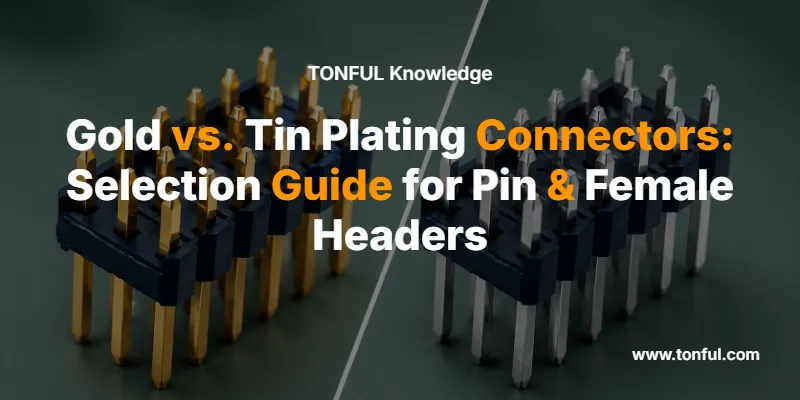
When designing PCB assemblies, the contact plating on pin headers and female headers directly determines connection reliability, service life, and total cost of ownership. Gold and tin represent two fundamentally different approaches to contact protection, each optimized for distinct operating profiles. This engineering guide provides the technical framework B2B procurement managers and design engineers need to specify the correct plating for their application.
The Core Technical Difference: Noble vs. Base Metal Behavior
The choice between gold and tin plating stems from a single material property: nobility. Gold is a noble metal that resists oxidation under atmospheric exposure. Tin is a base metal that forms a surface oxide layer within seconds of air contact. That oxide layer changes everything about how the connector performs.

Gold-plated contacts maintain stable, low contact resistance because the mating surfaces stay clean. The connection requires minimal normal force and tolerates frequent insertion cycles without degradation. Tin-plated contacts require higher mating force to mechanically break through the oxide film during insertion, creating a gas-tight connection. Once properly mated in a static application, tin performs reliably at a fraction of gold’s cost.
Contact Resistance and Electrical Performance
Contact resistance directly impacts signal integrity, power efficiency, and thermal management in PCB connector systems. The plating material determines both the initial resistance value and its stability over the connector’s operational life.
| Property | Gold Plating | Tin Plating |
|---|---|---|
| Initial Contact Resistance | 10-15 mΩ (typical) | 20-30 mΩ (typical) |
| Maximum Specification | ≤20 mΩ | ≤30 mΩ |
| Resistance Stability | Minimal change over cycles | Increases with mating cycles |
| Oxide Layer Impact | None (noble metal) | Requires mechanical wiping |
| Required Normal Force | Low (<100g per contact) | High (>200g per contact) |

Gold’s low and stable contact resistance makes it mandatory for analog signal transmission, where line noise from tin’s oxide disruption would compromise performance. For digital signals operating above 100 MHz, gold plating ensures signal integrity by eliminating resistance fluctuations that introduce jitter.
Mating Cycle Durability: The 50-Cycle Threshold
Connector lifespan in plug-and-unplug applications depends entirely on plating durability. The industry uses the “50:50:50 rule” as a practical threshold: tin plating is economically viable if the application requires fewer than 50 mating cycles, fewer than 50 contacts, and can tolerate contact resistance below 50 milliohms over the product’s lifetime.
| Mating Cycle Requirement | Recommended Plating | Typical Applications |
|---|---|---|
| <30 cycles | Tin | Fixed production equipment, one-time field installation |
| 30-100 cycles | Tin (with caution) or 15μ” gold | Occasional maintenance access, semi-permanent connections |
| 100-500 cycles | 30μ” gold (hard gold) | Development boards, test fixtures, modular systems |
| 500-10,000+ cycles | 30-50μ” hard gold | High-cycle test equipment, frequently reconfigured systems |

Gold withstands thousands of insertion cycles because it does not work-harden or generate abrasive oxide particles during mating. Tin wears rapidly beyond 50 cycles as the soft plating deforms and the oxide layer mechanically abrades the contact surfaces.
Corrosion Resistance and Environmental Durability
Operating environment determines whether tin’s cost advantage survives the product’s service life. Gold’s nobility eliminates corrosion as a failure mode in harsh conditions where tin would degrade rapidly.
Corrosion Mechanisms by Plating Type:
Gold Plating:
- Immune to atmospheric oxidation and tarnish
- Resists salt spray, humidity, and chemical exposure
- Maintains stable contact resistance in industrial atmospheres
- Requires nickel underplate (1.27-2.54 μm) to prevent base metal migration through pores
- Typical thickness: 15μ” (0.38 μm) for <100 cycles, 30μ” (0.76 μm) for high-cycle applications
Tin Plating:
- Forms tin oxide (SnO&emsp2;) immediately upon air exposure
- Susceptible to fretting corrosion under vibration
- Degrades in high-humidity and salt-spray environments
- Requires high normal force to maintain gas-tight seal
- Typical thickness: 2.5-5.0 μm over nickel or copper underplate

Fretting Corrosion: The Silent Killer of Tin Contacts
Fretting corrosion occurs when micro-movements from vibration or thermal cycling continuously expose fresh tin to oxidation. The oxide particles accumulate at the contact interface, progressively increasing resistance until the connection fails. Gold’s immunity to oxidation eliminates this failure mode entirely, making it essential for automotive, aerospace, and industrial applications where vibration is constant.
The Critical Rule: Never Mix Gold and Tin Plating
Mating a gold-plated pin header with a tin-plated female header creates a galvanic cell due to the 1.35V difference in electrode potential (gold: +1.5V, tin: +0.15V). In the presence of humidity, this electrochemical potential accelerates corrosion at the contact interface, forming an insulating layer that causes intermittent or permanent connection failure.
Acceptable Mating Combinations:
- Gold-to-gold: Optimal reliability, highest cost
- Tin-to-tin: Economical for static applications with proper normal force
- Gold-to-tin: Never acceptable – galvanic corrosion guaranteed
When sourcing pin headers and female headers from China manufacturers, verify that mating pairs use identical contact plating. Mixed plating is a common cost-cutting mistake that leads to field failures.
Selective Gold-Tin Plating: The Hybrid Solution
Selective plating applies gold only to the contact mating area while using tin on the solder tail. This approach delivers gold’s reliability where electrical contact occurs while retaining tin’s superior solderability and lower cost for PCB attachment. Selective plating is the most specified option in high-volume production because it optimizes both performance and manufacturing cost.
Selective Plating Structure:
- Contact mating zone: 15-30μ” gold over nickel underplate
- Solder tail: 2.5-5.0 μm tin over copper or nickel
- Transition zone: Controlled boundary between plating regions
TONFUL Electric manufactures terminals and connectors with selective plating capabilities, allowing engineers to specify gold contact zones with tin tails for SMT and through-hole mounting applications.
Application Selection Framework

When Gold Plating Is Required
- High mating cycle count: >100 insertion/removal cycles over product life
- Analog or high-frequency signals: Where contact resistance stability is critical
- Harsh environments: High humidity, salt spray, industrial atmospheres, temperature extremes
- Vibration exposure: Automotive, aerospace, industrial machinery applications
- Fine-pitch connectors: Low normal force designs like 1.27mm and 2.0mm pitch female headers
- Mission-critical systems: Where field failure is unacceptable
When Tin Plating Is Acceptable
- Static connections: <50 mating cycles, permanent or semi-permanent installation
- Controlled environments: Temperature-controlled indoor settings with low humidity
- High normal force designs: Robust contact geometry that maintains gas-tight seal
- Cost-sensitive applications: Where gold’s premium cannot be justified
- Power connections: High-current applications where tin’s conductivity and solderability are advantageous
- Non-critical signals: Digital signals where minor resistance variation is tolerable
For applications involving box headers or wafer connectors in fixed equipment installations, tin plating often provides adequate performance at significantly lower cost.
Cost-Benefit Analysis
| Factor | Gold Plating | Tin Plating |
|---|---|---|
| Material Cost | 10-30× higher than tin | Baseline |
| Plating Process Cost | Higher (controlled thickness) | Lower (thicker deposits) |
| Mating Cycle Life | 500-10,000+ cycles | <50 cycles |
| Maintenance Cost | Minimal | Higher (contact cleaning, replacement) |
| Field Failure Risk | Very low | Moderate to high in harsh environments |
| Solderability | Good (requires flux) | Excellent (native oxide is solderable) |
| Total Cost of Ownership | Lower for high-cycle, harsh-environment applications | Lower for static, controlled-environment applications |
The cost premium for gold plating typically ranges from 15% to 40% of the total connector cost, depending on contact count and plating thickness. For high-reliability applications, this premium is offset by reduced field failures, extended service life, and eliminated maintenance costs.
Manufacturing and Quality Considerations
When specifying plating for automotive terminals and connectors or other demanding applications, verify that the manufacturer controls these critical parameters:
Gold Plating Quality Metrics:
- Thickness uniformity: ±0.5μ” tolerance across contact area
- Nickel underplate thickness: 1.27-2.54 μm minimum
- Hardness: 130-200 Knoop for hard gold (high-cycle applications)
- Porosity: <1% (verified by salt spray testing per ASTM B117)
- Adhesion: No peeling under tape test per ASTM D3359
Tin Plating Quality Metrics:
- Thickness: 2.5-5.0 μm over underplate
- Whisker control: Matte tin or conformal coating to prevent tin whisker growth
- Underplate: Nickel barrier layer to prevent intermetallic compound (IMC) formation
- Solderability: Meets IPC J-STD-002 wetting requirements
TONFUL Electric’s wire terminal manufacturing facilities maintain ISO 9001 quality systems with in-process plating thickness measurement and salt spray testing to ensure consistent contact performance.
Frequently Asked Questions
Q: Can I use tin-plated pin headers with gold-plated female headers to save cost?
No. Mixing gold and tin creates galvanic corrosion that will cause connection failure. Always use matching plating materials on mating contacts. If cost reduction is necessary, specify tin-to-tin for the entire mating pair in applications that meet the 50:50:50 rule criteria.
Q: How do I specify the correct gold plating thickness?
Use 15μ” (0.38 μm) gold for applications with <100 mating cycles in controlled environments. Specify 30μ” (0.76 μm) hard gold for 100-500 cycles or harsh environments. For extreme-duty applications (>500 cycles, severe vibration, salt spray), specify 50μ” (1.27 μm) hard gold over 2.54 μm nickel underplate.
Q: Does gold plating affect solderability?
Gold dissolves into molten solder during reflow, which can cause embrittlement if the gold layer is too thick. Selective gold-tin plating solves this by using tin on the solder tail. For full gold-plated contacts, keep tail plating ≤30μ” and use proper flux to ensure reliable solder joints.
Q: What is the difference between hard gold and soft gold?
Hard gold contains cobalt or nickel hardening agents (typically 0.1-0.3% cobalt) that increase wear resistance for high-cycle applications. Soft gold (pure 24K) is used for wire bonding in semiconductor packaging. For pin headers and female headers, always specify hard gold for the contact area.
Q: Can tin plating be used in automotive applications?
Only in static, sealed connections with high normal force and vibration isolation. Most automotive applications require gold plating due to temperature cycling, vibration, and exposure to humidity and contaminants. Refer to USCAR-2 and USCAR-21 standards for automotive connector plating requirements.
Q: How does conflict-free tin plating affect connector performance?
Conflict-free tin sourcing does not affect electrical or mechanical performance. It addresses supply chain ethics and regulatory compliance (Dodd-Frank Act, EU Conflict Minerals Regulation). Specify conflict-free tin to meet corporate social responsibility requirements without compromising connector quality.
Conclusion: Engineering the Right Choice
The gold versus tin decision for pin headers and female headers is not about which plating is “better” – it is about matching material properties to application requirements. Gold delivers unmatched reliability for high-cycle, harsh-environment, and signal-critical applications where its cost premium is justified by reduced total cost of ownership. Tin provides economical performance for static connections in controlled environments where its limitations do not compromise reliability.
For B2B procurement teams sourcing PCB connectors, the selection framework is straightforward: count the mating cycles, assess the operating environment, evaluate the electrical requirements, and apply the 50:50:50 rule. When the answer is unclear, gold plating is the conservative choice that eliminates the most common connector failure modes.
TONFUL Electric manufactures pin headers, female headers, and complete PCB connector solutions with gold, tin, and selective plating options. Our engineering team provides application-specific plating recommendations backed by salt spray testing, insertion force measurement, and contact resistance verification to ensure your connector specification delivers reliable performance in your target application.