
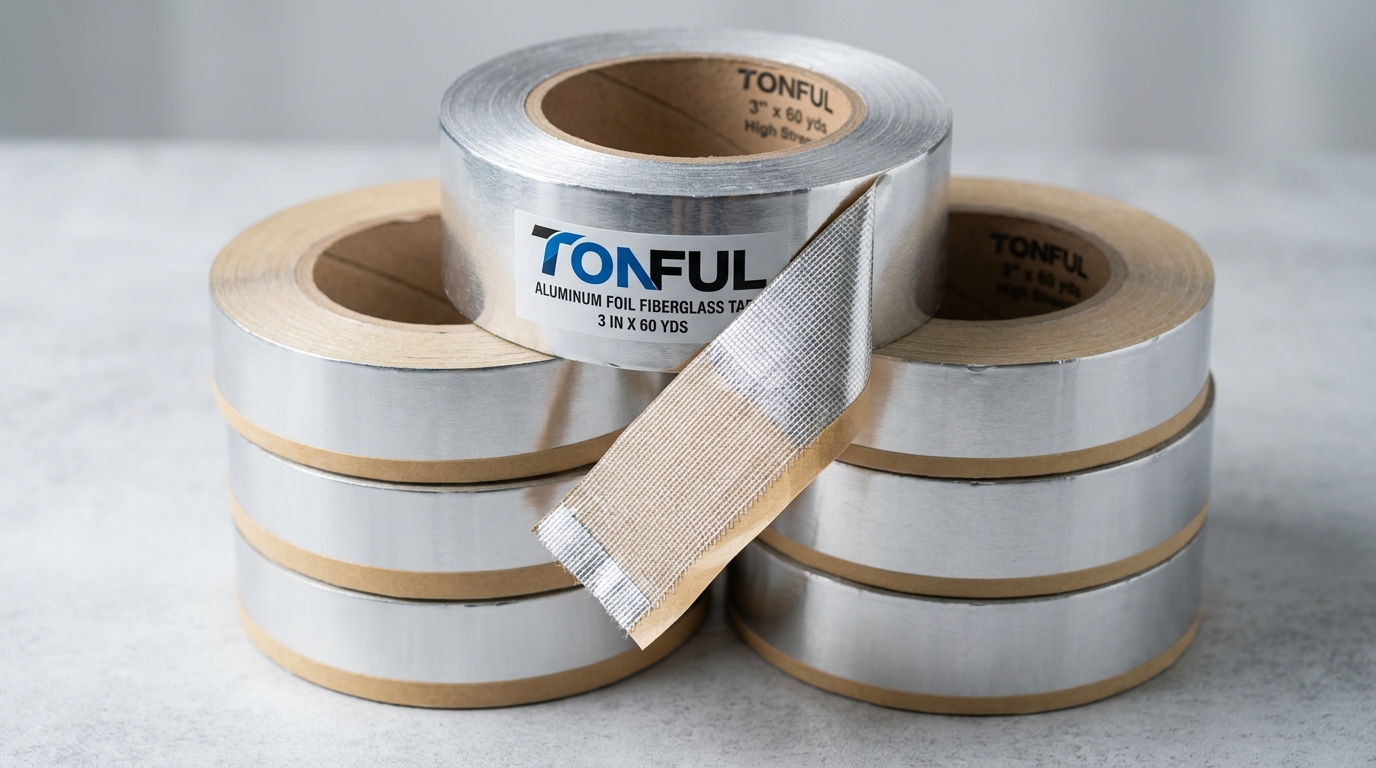
Aluminum foil-fiberglass tape is a high-performance, multi-layer adhesive tape engineered for thermal insulation, vapor sealing, and mechanical protection in demanding industrial environments. It bonds a reflective aluminum foil face to a woven fiberglass cloth backing, then coats the assembly with a high-temperature pressure-sensitive adhesive. The result is a single product that combines radiant heat reflection, tensile reinforcement, flame retardancy, and moisture barrier performance — properties that no plain foil or cloth tape can deliver alone.
At TONFUL Electric, we manufacture this tape in volume for HVAC contractors, automotive harness assemblers, marine yards, and aerospace subcontractors who cannot afford adhesive failure at temperature. This guide explains what the tape is, how it is built, where it outperforms alternatives, and how to specify it correctly for your application. If you are sourcing at scale, you can also review our aluminum foil-fiberglass tape manufacturer page for current specifications and OEM pricing.

How Aluminum Foil-Fiberglass Tape Is Constructed
The tape is a engineered laminate, not a single film. Each layer performs a distinct function, and the performance of the finished roll depends on the weight, weave, and adhesive chemistry of every layer working together.
The aluminum foil face is typically 7–25 micrometers of dead-soft aluminum. Its job is radiant heat reflection — it reflects roughly 97% of incident radiant heat — and it acts as the primary vapor and moisture barrier. The foil is what gives the tape its characteristic silver appearance and its resistance to oxidation, UV, and most mild chemicals.
The fiberglass cloth scrim is woven from continuous E-glass or S-glass filaments, typically in a plain or leno weave at 60–200 g/m². This is the structural backbone. Plain aluminum foil tears easily along a nick; the fiberglass scrim raises tensile strength to 200 N/25mm or higher and stops tear propagation dead. The scrim also gives the tape dimensional stability across temperature swings, preventing the curling and creep that plague unreinforced foil tapes.
The adhesive is the variable that determines service temperature. Solvent acrylic adhesives cover the –30°C to +150°C band and are the workhorse for HVAC and general industrial use. Silicone adhesives extend the ceiling to +260°C and hold their shear strength where acrylic would soften — engine bays, exhaust runs, plasma spray masking. A silicone release liner protects the adhesive until application.
Layer-by-Layer Construction
| Layer | Material | Function | Typical Thickness / Weight |
|---|---|---|---|
| Face | Aluminum foil (dead-soft) | Radiant heat reflection, vapor barrier, UV resistance | 7–25 µm |
| Reinforcement | Woven fiberglass cloth (E-glass) | Tensile strength, tear resistance, dimensional stability | 60–200 g/m² |
| Adhesive | Solvent acrylic or silicone | Bonds to substrate, determines service temperature | 20–60 µm |
| Liner | Silicone-coated release paper | Protects adhesive during storage and slitting | Removed before use |

Key Properties That Drive Specification
Engineers specify this tape because it solves three problems at once that would otherwise require three different products. Understanding the property profile tells you when the tape is the right answer — and when a cheaper alternative would do.
Thermal performance. The aluminum face reflects radiant heat rather than absorbing it, which is a different mechanism than conductive insulation. This is why the tape is wrapped over insulation blankets and pipe lagging: it sends radiant energy back toward the source instead of letting it soak into the substrate. Service temperature depends almost entirely on the adhesive, not the backing — the fiberglass and foil themselves survive well above 500°C, but the adhesive is the limiting element.
Mechanical performance. The fiberglass scrim is what separates this tape from plain foil tape. Tensile strength at or above 200 N/25mm means the tape will not split when pulled around a 90° corner or stretched across a gap. Tear resistance is equally important — a nick in unreinforced foil becomes a running tear under vibration; the scrim arrests that crack.
Barrier performance. The foil is a Class A vapor barrier. Water vapor transmission rate is effectively zero through the foil face, which is critical on cold pipes and ducts where condensation would otherwise saturate the insulation and destroy its R-value within a season. For a deeper look at how this fits into broader harness and cable protection strategy, see our wire harness protection methods guide.
Fire performance. Properly formulated tapes carry a Class 1 flame retardancy rating under UL 723 / ASTM E84, meaning low flame spread and low smoke developed. This is non-negotiable in commercial HVAC, marine, and tunnel applications. For the certification framework that governs flame-retardant tapes more broadly, our flame retardant tape ratings guide (UL 510 / IEC 60454) covers the test methods.

Technical Specifications — TONFUL Standard Grade
The table below is the typical spec sheet for our standard production run. Custom thicknesses, widths, and adhesive chemistries are available for OEM volumes — request a quote through the manufacturer page.
| Property | Standard Value | Test Method / Note |
|---|---|---|
| Backing | Aluminum foil + woven fiberglass cloth | Laminate |
| Adhesive | Solvent acrylic (silicone optional) | — |
| Total thickness | 0.15–0.25 mm | Custom available |
| Service temperature | –30°C to +150°C (acrylic) / up to +260°C (silicone) | Long-term exposure |
| Tensile strength | ≥ 200 N/25mm | ASTM D3759 |
| Radiant heat reflection | ~97% | — |
| Flame retardancy | Class 1 | UL 723 / ASTM E84 |
| Release liner | White silicone paper | Easy release |
| Roll widths | 25 / 48 / 50 / 75 / 100 mm | Custom slitting |
| Roll length | 33 / 50 m | Custom |
These values align with industry benchmarks for reinforced foil tapes — 3M’s 3334 reinforced foil tape, for example, reports 47.3 N/cm tensile and a –40°C to +85°C long-term window under ASTM D3759, and 3M’s 363 glass-cloth foil tape extends service to 316°C with a silicone adhesive.

Where the Tape Is Used
HVAC duct sealing. The single largest application. The tape seals joints and seams on flexible and rigid ductwork, prevents conditioned-air leakage, and acts as a vapor barrier on duct insulation facings. UL 181A-P and UL 181B-FX listings govern this use in North America. Duct leakage of 20–30% is common with poor sealing; a properly applied reinforced foil tape cuts that to single digits.
Pipe and vessel insulation. Wrapped over mineral wool or fiberglass pipe lagging on hot water, steam, and chilled water lines. The foil protects the insulation from moisture and mechanical damage, reflects radiant heat back to the pipe, and provides a clean finish surface. Marine and shipbuilding applications lean heavily on this tape because of the salt-air corrosion resistance and the flame retardancy.
Automotive and engine-bay thermal management. Used as a heat-reflective wrap over wire harnesses, fuel lines, and coolant hoses routed near exhaust manifolds or turbochargers. The silicone-adhesive variant handles sustained temperatures that would melt acrylic adhesives. This fits into the broader thermal protection strategy covered in our high-temperature electrical tape for automotive engines guide.
Aerospace and defense. Plasma spray masking, thermal blanket seaming, protection of control cables and fuel lines from flame and radiant heat. Aerospace specifications often require compliance with FAR 25.853 (flame, smoke, toxicity) and REACH.
Construction and roofing. Seaming insulation board joints, repairing torn vapor barriers, flashing around penetrations. The UV resistance of the foil face allows outdoor exposure where cloth-backed duct tape would fail in weeks.
Wire harness and EMI shielding. As a conductive wrap, the foil layer provides some EMI/RFI shielding for sensitive cables, though it is not a substitute for purpose-built shielding tapes. See our EMI/RFI cable shielding guide (foil vs. braided) for the distinction.
Comparison: Aluminum Foil-Fiberglass Tape vs. Alternatives
Selecting the wrong tape is the most common failure mode we see in the field. The table below maps the trade-offs against the three tapes most often confused with it.
| Property | Aluminum Foil-Fiberglass Tape | Plain Aluminum Foil Tape | FSK Tape | Cloth (Duct) Tape |
|---|---|---|---|---|
| Backing | Foil + woven fiberglass | Foil only | Foil + scrim + kraft | Polyethylene + cloth |
| Tensile strength | ≥ 200 N/25mm | 30–60 N/25mm | 80–120 N/25mm | 40–80 N/25mm |
| Tear resistance | Excellent (scrim arrests tears) | Poor (tears propagate) | Good | Good |
| Service temp (acrylic) | –30°C to +150°C | –30°C to +150°C | –20°C to +120°C | –10°C to +80°C |
| Service temp (silicone) | up to +260°C | up to +260°C | Not typical | Not rated |
| Vapor barrier | Excellent | Excellent | Excellent | Poor |
| Radiant heat reflection | ~97% | ~97% | ~95% | Negligible |
| Flame retardancy | Class 1 (UL 723/E84) | Varies | Class 1 | Usually not rated |
| UV resistance | Excellent | Excellent | Excellent | Poor (degrades in weeks) |
| Typical use | HVAC, pipe, engine, marine | Light HVAC, patching | Duct insulation facing | Temporary repairs |
| Relative cost | Medium-high | Low | Medium | Low |
The pattern is clear: fiberglass reinforcement is what turns a foil tape into a structural material. If your application involves vibration, sharp edges, outdoor exposure, or any meaningful tensile load, the reinforced product pays for itself in avoided rework.

Specifying the Right Tape — What to Tell Your Supplier
A vague purchase order is how buyers end up with the wrong adhesive or an underweight scrim. When you request a quote, specify these seven items explicitly:
- Service temperature — continuous and peak. This fixes the adhesive chemistry.
- Substrate — galvanized steel, copper, EPDM, polyiso board. Low-surface-energy substrates need higher tack.
- Indoor vs. outdoor exposure. Outdoor needs UV-stable foil and edge sealing.
- Regulatory requirements — UL 181A-P/B-FX, UL 723, ASTM E84, FAR 25.853, RoHS, REACH.
- Width and roll length for your dispensing equipment.
- Scrim weight — 60 g/m² for general use, 100–200 g/m² for heavy mechanical service.
- Liner type — standard silicone paper, or printable for private-label retail kits.
For OEMs building private-label electrical kits, our custom electrical tape manufacturing and private labeling guide walks through the MOQ and lead-time math. And if you are comparing tape against other insulation strategies for a harness build, the electrical tape vs. heat shrink tubing comparison is worth a read.
Short FAQ
Is aluminum foil-fiberglass tape the same as foil tape? No. Plain foil tape is a single aluminum film with adhesive — it tears easily and offers no mechanical reinforcement. Foil-fiberglass tape laminates the foil to a woven fiberglass scrim, raising tensile strength roughly four- to six-fold and stopping tear propagation. They look similar on a roll but behave very differently in service.
What is the maximum temperature the tape can handle? It depends on the adhesive. Standard solvent-acrylic grades run continuously at –30°C to +150°C. Silicone-adhesive grades extend to +260°C continuous, with short excursions higher. The foil and fiberglass themselves survive well above 500°C, so the adhesive is always the limiting factor.
Can it be used outdoors? Yes. The aluminum foil face is inherently UV-stable and weather-resistant, unlike cloth-backed duct tapes that degrade in weeks of sunlight. For outdoor ductwork, ensure the tape also meets ASTM C1775 for laminate protective jackets.
Is the tape flame retardant? Properly formulated grades carry a Class 1 rating under UL 723 / ASTM E84, with low flame spread and low smoke developed. Always confirm the specific listing on the data sheet — not every foil-fiberglass tape on the market is rated. For the broader standard framework, see our UL 510 / IEC 60454 guide.
How does it compare to heat shrink tubing for wire protection? They solve different problems. Heat shrink tubing encloses a joint or termination and provides dielectric insulation and environmental sealing. Foil-fiberglass tape wraps over a bundle or along a run to provide radiant heat reflection and mechanical protection. They are complementary, not substitutes — see the tape vs. heat shrink comparison for the decision framework.
What widths and lengths are available? Standard widths are 25, 48, 50, 75, and 100 mm on 33 m or 50 m rolls. Custom widths and log rolls are available for OEM volumes. Core diameters of 38 mm and 76 mm are standard to match common dispensers.
Can TONFUL supply private-label or OEM-spec tape? Yes. We manufacture to customer spec under the TONFUL brand or private label, with custom packaging, printing, and certification. Start at our aluminum foil-fiberglass tape manufacturer page to request a quote.
Aluminum foil-fiberglass tape earns its place in a BOM because it collapses three functions — radiant reflection, tensile reinforcement, and vapor barrier — into one product that holds its spec across temperature swings, vibration, and outdoor exposure. Specify the adhesive to your service temperature, confirm the flame rating, and the tape will outperform any single-function alternative at the joint where it matters. For current specs, certifications, and OEM pricing, contact TONFUL through the manufacturer page.