
What Are Step-Down Butt Connectors?
A step-down butt connector is a specialized electrical splice designed to join two wires of different cross-sections end-to-end. Unlike a standard butt splice—whose uniform internal barrel suits two wires of the same gauge—a step-down connector has a tapered metal ferrule with two distinct internal diameters: a larger bore on one end for the heavier wire and a reduced bore on the other for the lighter wire. This stepped geometry lets each conductor receive a properly compressed, gas-tight crimp without folding, doubling, or shimming the smaller strand.
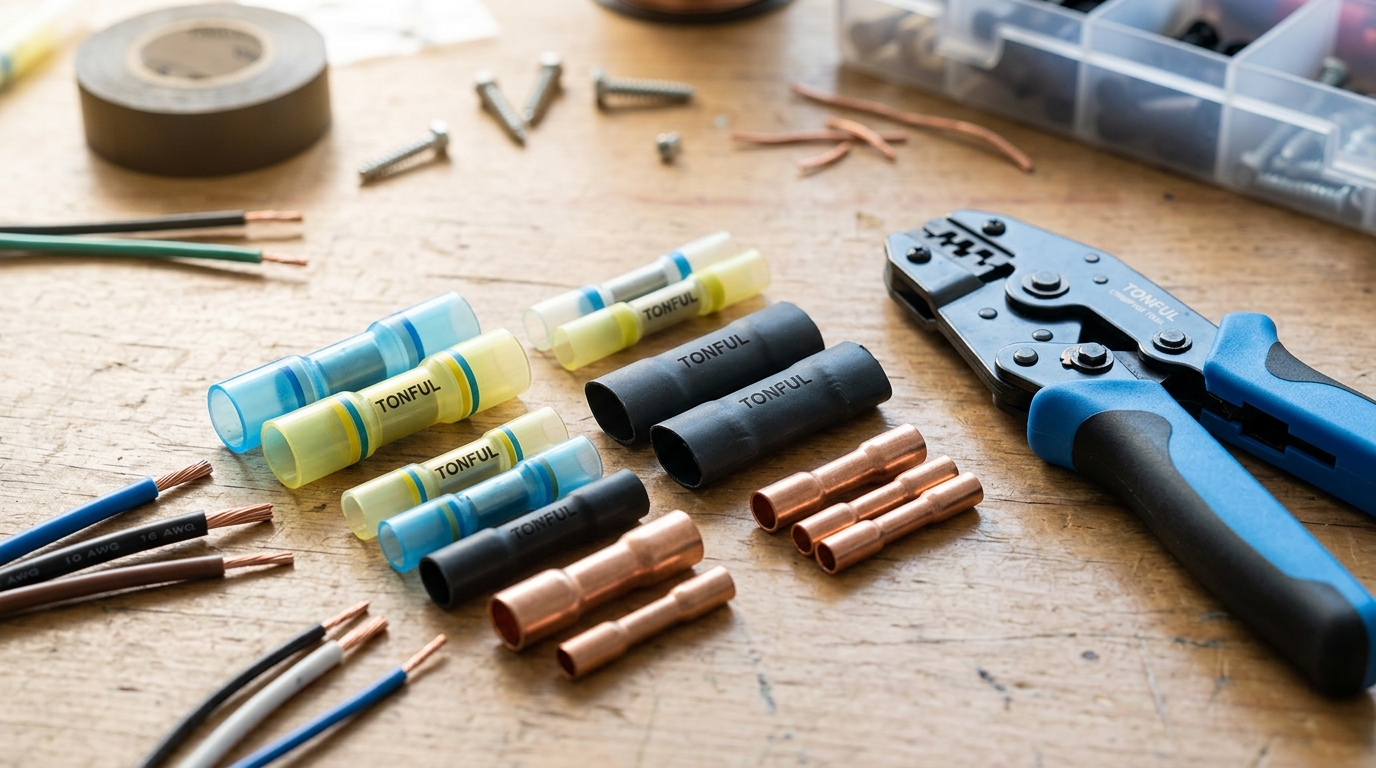
The connector typically consists of a tin-plated copper or brass barrel surrounded by an insulating sleeve—vinyl, nylon, or adhesive-lined heat-shrink tubing depending on the variant. Color-coded stripes on the sleeve indicate which wire gauge goes into each end, taking the guesswork out of installation. TONFUL manufactures step-down butt connectors in all common AWG combinations for automotive, marine, industrial, and HVAC applications.

Why Different Gauges Need a Step-Down Design
When two wires of significantly different gauges are joined in a standard butt connector sized for the larger wire, the smaller conductor sits loosely inside the barrel. Crimping down either leaves a gap—creating high contact resistance and heat—or over-compresses the barrel, damaging the insulation and weakening the metal. Folding the smaller wire to bulk it up is a common field workaround, but it produces an inconsistent, unrepeatable joint that violates most harness manufacturing standards.
A step-down butt connector eliminates these problems. The larger end is precision-sized for the big wire’s cross-section, and the smaller end is reduced to match the thin wire exactly. Both crimps land on material that fits, producing uniform compression, predictable pull strength, and stable contact resistance across the joint.
Types of Step-Down Butt Connectors
Step-down butt connectors come in three primary insulation styles, each suited to different environments.
Non-insulated versions are bare tin-plated copper barrels with no sleeve. They are used where space is tight, where the joint will be wrapped in tape or slid inside heat shrink tubing afterward, or in enclosed equipment where added bulk is undesirable. They are the most economical option and common in appliance manufacturing.
Nylon-insulated versions feature a translucent nylon sleeve crimped alongside the barrel. Nylon offers better durability and temperature resistance than vinyl, and the transparent body lets the installer visually confirm that each wire is fully inserted before crimping. These are the workhorse choice for general automotive electrical connectors and industrial wiring.
Heat-shrink versions use an adhesive-lined polyolefin sleeve that shrinks around the joint when heated, forming a waterproof, environmentally sealed connection. The hot-melt adhesive fills voids and bonds to the wire insulation, blocking moisture, salt, and contaminants. These are the standard for marine, off-road, and outdoor applications where corrosion would quickly destroy an unsealed joint. For a deeper look at heat-shrink variants, see our heat-shrink butt connector applications guide.

| Type | Insulation | Voltage Rating | Max Temp | Best For |
|---|---|---|---|---|
| Non-Insulated | None (bare barrel) | 600 V | 105°C | Space-constrained, enclosed equipment |
| Nylon-Insulated | Translucent nylon sleeve | 600 V | 105°C | General automotive, industrial |
| Heat-Shrink | Adhesive-lined polyolefin | 600 V / 1000 V | 125°C | Marine, outdoor, waterproof sealing |
Step-Down vs. Standard Butt Connectors
The fundamental difference is gauge compatibility. A standard butt connector has one internal diameter and is rated for a narrow gauge range—22–18 AWG (red), 16–14 AWG (blue), or 12–10 AWG (yellow). A step-down connector spans two ranges, bridging the gap between them so the installer never has to compromise on either crimp. For broader context on how butt splices fit into the connector landscape, see our complete guide to types of wire connectors.
| Feature | Standard Butt Connector | Step-Down Butt Connector |
|---|---|---|
| Wire gauge compatibility | Same/similar gauge both ends | Different gauge each end |
| Internal barrel geometry | Uniform diameter | Tapered (two diameters) |
| Typical AWG combos | 22-18, 16-14, 12-10 | 22-18 → 16-14, 16-14 → 12-10 |
| End identification | Solid color sleeve | Color-coded stripes on each end |
| Field workaround needed | Yes (fold small wire) | No |
| Pull-strength consistency | Variable when gauges differ | Consistent on both sides |
| Cost | Lower | Slightly higher |

Common Step-Down Size Combinations
Step-down connectors are manufactured in standard AWG pairings that follow the industry color code. Each end carries the stripe matching the wire gauge it is designed to accept.
| Connector (Large → Small) | Stripe (Large End) | Stripe (Small End) | Typical Application |
|---|---|---|---|
| 12-10 AWG → 16-14 AWG | Yellow | Blue | Battery feed to branch circuit |
| 16-14 AWG → 22-18 AWG | Blue | Red | Switch panel to appliance lead |
| 10 AWG → 16-14 AWG | Yellow | Blue | Main power to lighting circuit |
| 8 AWG → 12-10 AWG | — | Yellow | Primary feed to sub-distribution |
For full cross-reference data, see our crimp terminal color code chart and AWG to metric conversion guide.
Applications
Step-down butt connectors appear wherever a circuit transitions between wire gauges.
Automotive wiring. A 12 AWG feed from the fuse box connects to a 16 AWG lead on an aftermarket accessory—radio, dash cam, LED light bar, or cooling fan. A step-down splice makes that transition in a single crimp without voltage drop or loose fits. Explore our automotive terminals and connectors range.
Marine. Boats routinely run heavy-gauge duplex cable from the battery to a distribution panel, then branch out in lighter gauge to individual loads. Saltwater and humidity demand heat-shrink step-down connectors with adhesive-lined seals. Our marine wire harness assemblies guide covers the environmental requirements in detail.
HVAC. Condenser and air-handler units combine power conductors with thinner control wires. Step-down connectors rated to 105°C handle the thermal cycling inside equipment enclosures.
Industrial equipment. Control panels, motor junction boxes, and machinery often splice panel wiring (16–14 AWG) to device leads (22–18 AWG). Non-insulated or nylon-insulated variants are standard here.

How to Install Step-Down Butt Connectors
Proper installation follows the same crimping principles as any butt splice, with one added step: verifying that each wire enters the correct end.
- Strip both wires to the length marked on the connector body—typically 5–7 mm for nylon types and 8–10 mm for heat-shrink. Remove insulation cleanly without nicking strands.
- Identify the correct end. Match each wire’s gauge to the stripe color on the corresponding side. The larger wire goes into the end with the larger-range stripe; the smaller wire goes into the reduced-bore end.
- Insert and crimp the first wire. Push it in until strands are visible through the inspection hole (nylon types) or flush with the barrel edge. Crimp with a ratcheting tool using the die that matches that wire’s gauge. Our crimp die selection guide covers JA, JC, and HX profiles.
- Repeat on the opposite end with the second wire, switching to the smaller die if the gauge differs.
- For heat-shrink types, apply heat evenly from the center outward until the sleeve contracts fully and adhesive exits both ends.
For a full walkthrough including pull-testing, see how to crimp heat-shrink terminals correctly.

How to Choose the Right Step-Down Butt Connector
Selection comes down to four factors:
- Gauge combination. Confirm both wire AWG values and select a connector whose step range covers both. A wire gauge selection guide helps avoid mismatches.
- Environment. Dry indoor panels can use nylon-insulated. Wet, corrosive, or outdoor locations need heat-shrink with adhesive lining.
- Voltage and temperature. Most step-down connectors are rated 600 V and 105°C (nylon) or 125°C (heat-shrink). Verify against your circuit requirements.
- Insulation preference. Non-insulated for minimal bulk, nylon for visibility and durability, heat-shrink for sealing. Compare options in our insulated vs. non-insulated wire connectors guide.
The most frequent failure is using the wrong die on the smaller-gauge end—either over-crimping and severing strands, or under-crimping and leaving the wire loose. A close second is inserting wires from the wrong ends, which defeats the step-down geometry entirely. Both problems are covered in our analysis of why crimps fail and five common installation mistakes. For context on why crimping is preferred over soldering in vibration-prone environments, see solder vs. crimp.
FAQ
What is a step-down butt connector used for? A step-down butt connector joins two wires of different gauges end-to-end. The larger end accepts the heavier wire and the smaller end accepts the lighter wire, giving each conductor a properly sized, gas-tight crimp.
Can I use a regular butt connector for different wire sizes? It is not recommended. A standard butt connector sized for the larger wire leaves the smaller wire loose, causing high resistance and potential failure. Folding the small wire to bulk it up is inconsistent and violates harness standards. A step-down connector is the engineered solution.
What do the colored stripes mean? The stripes follow the industry color code: yellow for 12–10 AWG, blue for 16–14 AWG, red for 22–18 AWG. Each end of the connector carries the stripe matching the wire gauge it is designed to accept.
Are heat-shrink step-down connectors waterproof? Yes. Heat-shrink variants with adhesive lining form a waterproof, environmentally sealed joint rated to IP67 or better when properly installed. They are the standard choice for marine and outdoor wiring.
Do I need a special crimping tool? No special tool is needed beyond a quality ratcheting crimper with interchangeable dies. Use the die matching each wire’s gauge—you may need to switch dies between the two ends of a step-down connector. See our electrical tools manufacturer catalog.
What AWG combinations are available? Common pairings include 12-10 → 16-14, 16-14 → 22-18, and 10 → 16-14 AWG. TONFUL’s step-down butt connectors cover the full range of standard combinations.
Conclusion
Step-down butt connectors are the purpose-built answer to a problem every electrician, technician, and harness assembler encounters: joining wires of different gauges without compromise. By matching each conductor to a properly sized crimp barrel, they deliver consistent pull strength, stable contact resistance, and long-term reliability that field workarounds cannot match. Whether the application calls for an economical nylon-insulated splice or a waterproof heat-shrink variant for marine use, selecting the right step-down connector—and crimping it correctly—ensures a joint that lasts the life of the circuit. To source step-down butt connectors in bulk, visit TONFUL’s terminals and connectors manufacturer page.