
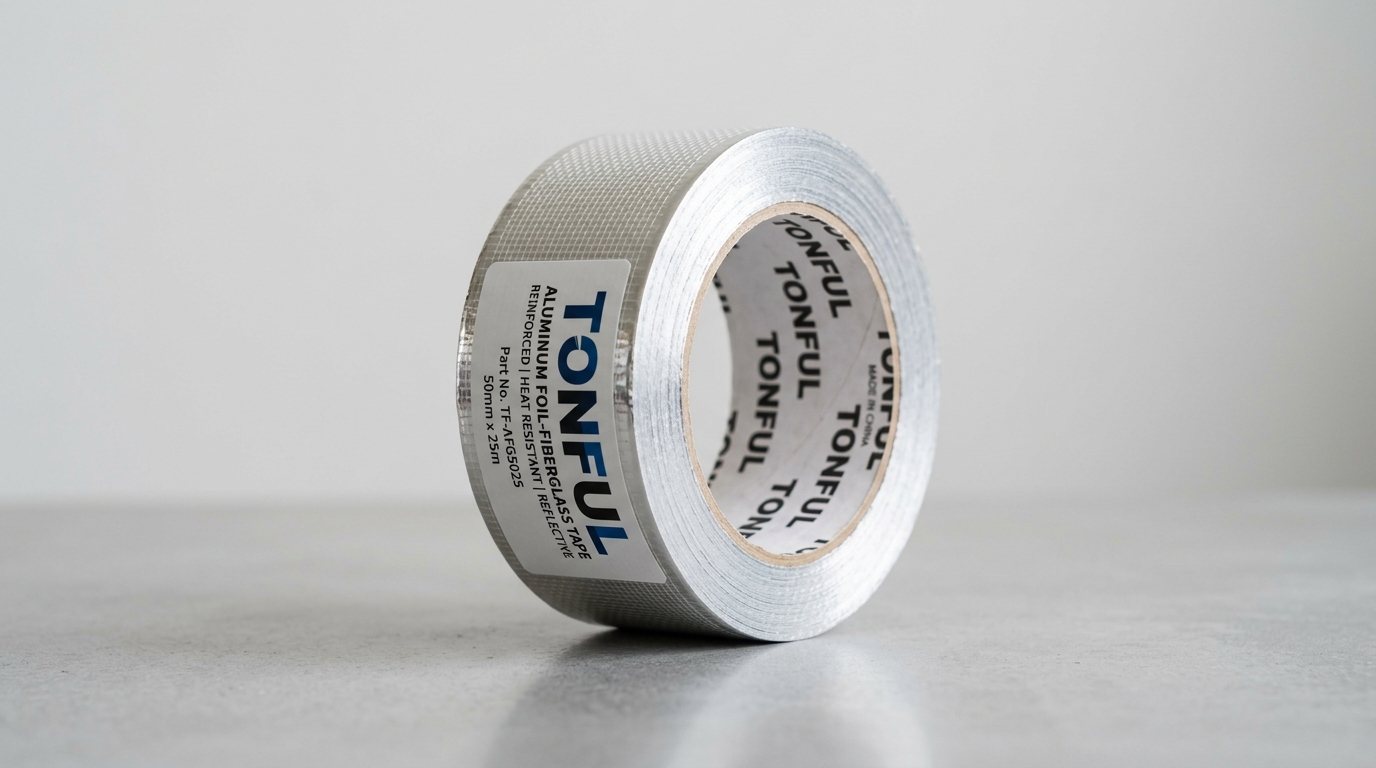
Aluminum foil-fiberglass tape is a reinforced composite adhesive tape built from a layer of dead-soft aluminum foil laminated to a woven fiberglass cloth backing, then coated with a high-performance pressure-sensitive adhesive. It exists because plain aluminum foil tape, on its own, tears easily under tension, creases around irregular profiles, and fatigues when ductwork or engine bays vibrate. The fiberglass scrim solves those problems. The result is a single material that does four jobs at once — reflects radiant heat, blocks vapor and moisture, reinforces seams against mechanical stress, and resists flame at continuous elevated temperatures.
For B2B buyers specifying electrical tape and thermal-management materials, understanding exactly what aluminum foil-fiberglass tape does determines whether an insulation system holds up for twenty years or fails in the first cooling season. This guide breaks down its functions, construction, performance, and selection criteria from an engineering perspective.
Core Functions: What the Tape Actually Does
1. Reflects Radiant Heat
The polished aluminum surface reflects up to 95–97% of incident radiant heat. This is not the same as conducting heat away — the foil sends infrared energy back toward its source, keeping the protected side cooler. In HVAC ductwork, that means conditioned air stays at temperature with less load on the compressor. Around engine bays and exhaust runs, it protects wiring harnesses and sensors from radiant soak that would otherwise degrade insulation over time. For manufacturers building custom wire harness assemblies, this reflectivity is the primary reason the tape gets specified as a thermal shield over sensitive bundles.
2. Acts as a Vapor and Moisture Barrier
Aluminum foil is essentially non-porous. Laminated to fiberglass and sealed with a compatible adhesive, the tape achieves a very low moisture vapor transmission rate (MVTR), blocking humidity, condensation, and steam from penetrating insulation joints. On cold chilled-water lines, this stops condensation from wetting the fiberglass insulation beneath — the failure mode that causes hidden corrosion and R-value collapse. On marine wire harnesses and outdoor enclosures, it keeps salt mist and rain out of splice points.
3. Reinforces Seams Mechanically
The fiberglass cloth — typically an 8×8 or 10×10 mesh per centimeter — gives the tape tensile strength and tear resistance that plain foil cannot match. When wrapped over a duct joint or a pipe elbow, it holds shape under vibration, thermal cycling, and physical contact without splitting. This is why it outperforms standard foil tape in heavy-duty wire harness protection methods where abrasion and movement are constant.
4. Resists Flame and High Temperature
Quality foil-fiberglass tapes use flame-retardant solvent acrylic or silicone adhesives rated for continuous service from roughly −40°C up to 120°C (rubber/acrylic grades) or 150°C and beyond (silicone grades). The fiberglass backing itself is rated to roughly 650°C before it begins to degrade, and the aluminum foil remains stable well past that point. This combination lets the tape meet flame-retardant standards such as UL 510 and IEC 60454 — the same families of standards covered in TONFUL’s broader flame-retardant tape ratings guide.

Construction: How the Layers Work Together
The tape is an engineered laminate, not a single material. Each layer carries a specific function, and the performance of the whole depends on how well those layers are bonded.
| Layer | Typical Material | Primary Function |
|---|---|---|
| Top surface | Dead-soft aluminum foil, 7–25 μm | Radiant heat reflection, vapor barrier, chemical resistance |
| Reinforcement scrim | Woven fiberglass cloth, 8×8 to 14×12 mesh/cm | Tensile strength, tear resistance, dimensional stability |
| Bonding layer | Flame-retardant laminating adhesive | Bonds foil to scrim without delamination under heat |
| Adhesive system | Solvent acrylic or silicone PSA | Permanent adhesion to metal, foil-faced insulation, composites |
| Release liner | Silicone-coated paper or film (some grades) | Protects adhesive until application |
The foil provides reflectivity and impermeability; the fiberglass provides strength and high-temperature stability; the adhesive system determines the service temperature ceiling and the surfaces the tape will bond to. Acrylic adhesives dominate general HVAC and building insulation because they age well and resist UV. Silicone adhesives are reserved for the highest-temperature automotive and industrial exhaust applications where acrylic would smoke off.

Performance Specifications at a Glance
Specifications vary by grade and manufacturer, but the table below reflects typical industrial-grade values that B2B buyers should expect from a quality product such as the TONFUL aluminum foil-fiberglass tape.
| Property | Typical Range | Why It Matters |
|---|---|---|
| Total thickness | 0.12–0.25 mm | Thicker = better puncture resistance and easier handling |
| Aluminum foil thickness | 7–25 μm | Drives reflectivity and barrier performance |
| Fiberglass mesh | 8×8 to 14×12 /cm | Higher mesh = higher tensile strength |
| Tensile strength | 80–200 N/25 mm | Determines resistance to tearing under wrap tension |
| Reflectivity | 92–97% radiant heat | Primary thermal-shielding metric |
| Service temperature (acrylic) | −40°C to +120°C | General HVAC, refrigeration, building insulation |
| Service temperature (silicone) | −40°C to +150°C or higher | Automotive, engine bay, exhaust-adjacent shielding |
| Flame retardancy | UL 510, IEC 60454, ASTM E84 | Code compliance for commercial buildings |
| MVTR | < 0.1 g/m²·day (typical) | Effectively impermeable vapor barrier |
Aluminum Foil-Fiberglass Tape vs. Alternatives
Choosing the right tape means understanding the trade-offs. The comparison table below maps the three most common industrial tapes against each other so specifiers can match the product to the application rather than over- or under-specifying.
| Feature | Aluminum Foil-Fiberglass Tape | Plain Aluminum Foil Tape | Fleece/Cloth Wiring Tape |
|---|---|---|---|
| Radiant heat reflection | Excellent (95–97%) | Excellent (95–97%) | Poor |
| Tensile strength | High (fiberglass reinforced) | Low (tears easily) | Medium |
| Tear resistance | Excellent | Poor | Good |
| Vapor barrier | Excellent | Excellent | Poor |
| Max service temp | Up to 150°C+ | Up to 120°C (acrylic) | Up to 105°C |
| Flame retardancy | High (meets UL 510) | Medium | Low–Medium |
| Conformability | Good | Excellent | Excellent |
| Typical use | HVAC seams, pipe insulation, thermal shielding | Light duct sealing, reflective wrapping | Harness wrapping, noise reduction |
| Cost | Medium–High | Low | Low–Medium |
The pattern is clear: when an application demands heat reflection and mechanical durability in one product, foil-fiberglass is the only option of the three that delivers both. For pure reflection on a clean, flat surface, plain foil tape is cheaper and adequate. For harness abrasion protection where heat reflection is irrelevant, a fleece or cloth tape — see TONFUL’s fleece vs. vinyl harness tape comparison — is the better fit.

Key Applications Across Industries
HVAC and Building Insulation
The dominant application. Foil-fiberglass tape seals joints on fiberglass duct board, secures seams on foil-faced duct wrap, and patches tears in reflective insulation. It maintains the vapor barrier integrity that keeps fiberglass insulation dry and at full R-value, and it reflects conditioned air temperature back into the duct instead of letting it radiate through the jacket. The TONFUL electrical tapes catalog includes grades engineered specifically for this environment.
Automotive and Engine Bay Thermal Shielding
Around exhaust manifolds, catalytic converters, and turbochargers, radiant heat can exceed 200°C at the surface. Foil-fiberglass tape wraps over automotive electrical connectors and wiring to push that radiant load back, extending the life of insulation and preventing connector housings from softening. Silicone-adhesive grades are specified here for their higher continuous-service ceiling. The tape also sees use sealing thermal wraps around exhaust components themselves.
Industrial Pipe and Tank Insulation
On hot process lines, steam pipes, and cryogenic systems, the tape seals the outer jacket of mineral-wool or cellular-glass insulation, preventing water ingress that would destroy thermal performance. Its puncture resistance matters during commissioning and maintenance, when insulation jackets take abuse from foot traffic and tooling.
EMI/RFI Shielding Adjacent Uses
While not a primary EMI gasket, the conductive aluminum layer offers secondary shielding benefit when used to wrap cable bundles — a property discussed in more depth in TONFUL’s EMI/RFI cable shielding guide. For dedicated shielding applications, foil-only or braided solutions are usually more appropriate, but the combined thermal-plus-shielding value of foil-fiberglass tape earns it a place in multi-function harness protection.
Marine and Outdoor Enclosures
The combination of UV-resistant acrylic adhesive, moisture impermeability, and mechanical strength makes the tape a reliable sealer for marine-grade wire harnesses and outdoor junction boxes where salt spray and weathering would degrade standard tapes within a season.

Selection Guide: Matching the Tape to the Job
Specifying the right grade comes down to four questions.
First, what is the continuous service temperature? Below 120°C, an acrylic-adhesive grade is sufficient and more economical. Above 120°C — engine bays, exhaust proximity, industrial ovens — specify a silicone-adhesive grade.
Second, what surface are you bonding to? Metal, foil-faced insulation, and fiberglass board all accept acrylic adhesives well. For low-energy plastics or composites, confirm adhesion with the manufacturer or choose a tackified adhesive system.
Third, how much mechanical stress will the tape see? High-vibration environments and accessible ductwork that gets bumped during maintenance benefit from a heavier fiberglass scrim — 10×10 mesh or higher. Static, protected seams can use a lighter, more conformable grade.
Fourth, what code requirements apply? Commercial HVAC and building insulation almost always require a flame-retardant rating, typically UL 510 or an equivalent IEC standard. Confirm the tape carries the appropriate certification, not just a “flame resistant” marketing claim. TONFUL’s engineering team can verify compliance during specification — reach out through the TONFUL homepage.

Installation Best Practices
Performance depends on installation as much as on material quality. The tape will deliver its rated reflectivity and barrier performance only if the substrate is prepared and the wrap is executed correctly.
Clean the surface of oil, dust, and loose fibers with an appropriate solvent and let it dry fully. Apply the tape at or above the manufacturer’s minimum application temperature — typically around 4°C for acrylic grades — so the adhesive wets out and grabs. Press firmly with a roller or squeegee, working out air pockets that would create skip-bond zones. Overlap seams by at least 25 mm (1 inch) on ductwork and 50 mm on pipe jackets to maintain a continuous vapor barrier. On elbows and irregular profiles, avoid stretching the tape; let the fiberglass scrim conform, and use narrower widths where tight radii would otherwise wrinkle the wider stock.
Short FAQ
Is aluminum foil-fiberglass tape the same as regular aluminum foil tape? No. Regular foil tape is a single layer of aluminum foil with adhesive. Foil-fiberglass tape laminates the foil to a woven fiberglass scrim, giving it far higher tensile strength, tear resistance, and dimensional stability — it survives vibration and physical abuse that would split plain foil tape.
What temperature can aluminum foil-fiberglass tape withstand? Acrylic-adhesive grades typically serve from −40°C to +120°C continuous. Silicone-adhesive grades extend the upper limit to +150°C and beyond. The fiberglass backing itself is stable to roughly 650°C, so the adhesive — not the backing — sets the ceiling. For a deeper comparison of foil tape types and their temperature envelopes, see TONFUL’s existing aluminum foil-fiberglass tape guide.
Can it be used outdoors? Yes, when specified with a UV-resistant acrylic adhesive. Quality grades resist UV, moisture, and weathering for multi-year outdoor service. Confirm the UV rating with the manufacturer for permanent exterior exposure.
Is it flame retardant? Industrial grades typically meet UL 510 and/or IEC 60454 flame-retardant standards. The aluminum foil is non-combustible and the fiberglass scrim is inherently flame resistant, but the adhesive system determines whether the full tape assembly passes code. Always request certification documentation for compliance-critical projects.
Will it stick to fiberglass duct board and foil-faced insulation? Yes — these are its primary substrates. The aggressive acrylic adhesive bonds well to foil-scrim-kraft (FSK) facings, metal, and fiberglass board. For best results, apply to clean, dry surfaces above the minimum application temperature.
Conclusion
Aluminum foil-fiberglass tape does what no single-layer tape can: it reflects radiant heat, blocks vapor, reinforces seams, and resists flame in one engineered laminate. That combination is why it has become the default sealer for HVAC ductwork, industrial pipe insulation, automotive thermal shielding, and marine harness protection. Specifying the right grade — matched to service temperature, substrate, mechanical stress, and code requirement — is what separates an insulation system that lasts decades from one that fails in a season.
For B2B buyers who need consistent, certified material at scale, working directly with a manufacturer removes the quality drift that plagues generic reseller stock. TONFUL Electric produces aluminum foil-fiberglass tape to industrial grade with verifiable flame-retardant certification and OEM customization for width, thickness, and adhesive system. Contact the TONFUL engineering team to specify the correct grade for your application.