
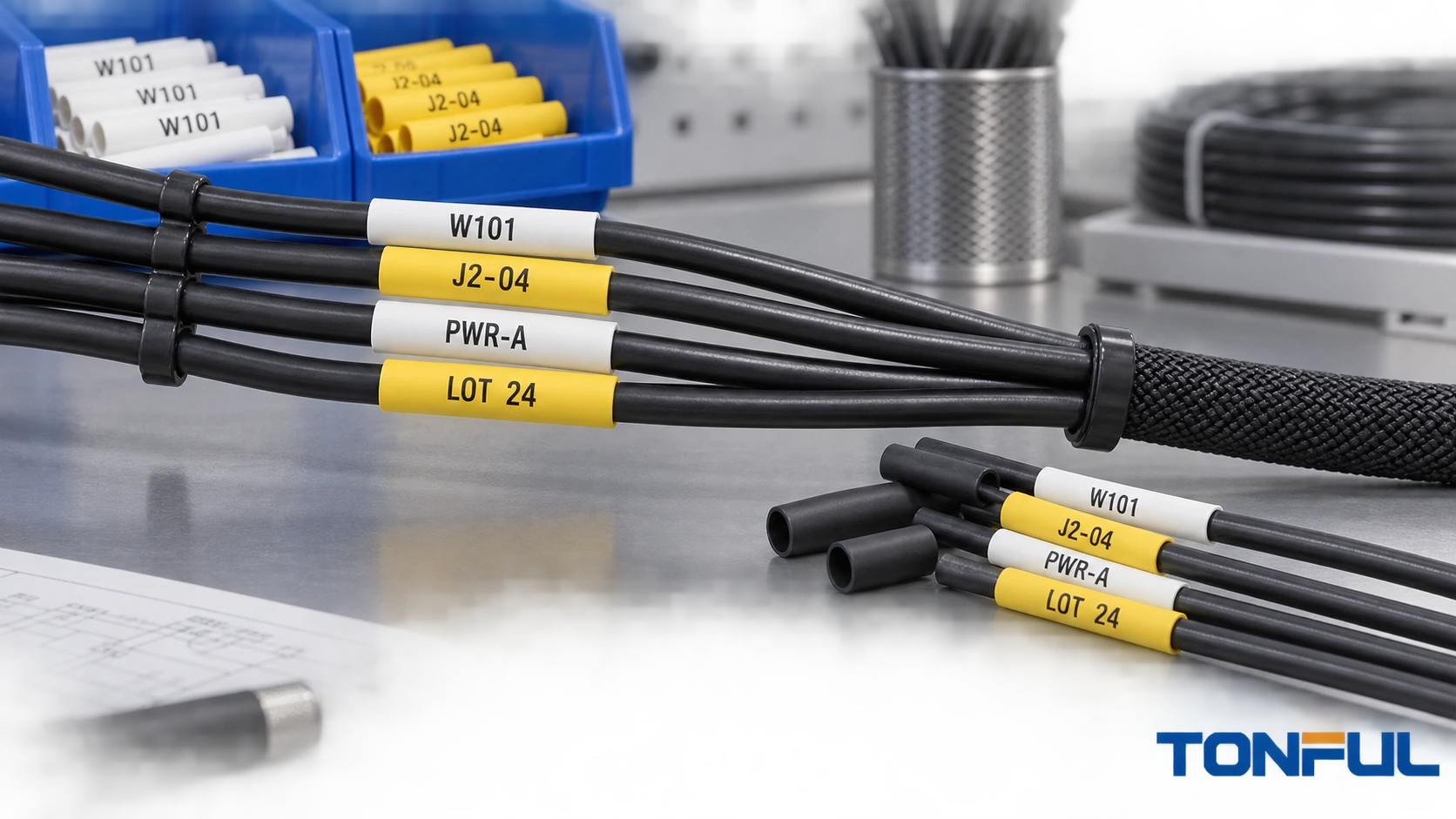
Custom printed heat shrink tubing can turn a wire marker into a durable part of the harness, but a readable sample is not enough to approve a production identification system. The sleeve material, supplied and recovered dimensions, print technology, ribbon or ink, artwork, shrinking process, wire surface and service environment all influence the final mark. Procurement teams therefore need to buy a controlled identification process, not merely tubing with text on it.
This guide covers indirect wire identification applied to heat-shrinkable sleeves. It does not address direct laser marking of wire insulation, adhesive labels, engraved tags or unverified compliance claims. It is intended for OEM harnesses, control cabinets, industrial equipment, transportation and other projects in which wire identity must remain legible through assembly, inspection, service and replacement.
Start With the Identification Requirement
Define what the marker must communicate and who will use it. A short circuit number for assembly has different needs from a serialized asset code scanned during maintenance. Record the controlled source for every printed field rather than allowing an operator to retype engineering data from memory.
| Data field | Example purpose | Control question |
|---|---|---|
| Circuit or wire ID | Electrical drawing reference | Which drawing revision owns the value? |
| From/to designation | Harness routing and service | Is orientation defined at both ends? |
| Connector and cavity | Termination verification | Does the code match the cavity list? |
| Harness or assembly number | Product configuration | Is revision or variant required? |
| Serial, lot or date code | Traceability | Who generates uniqueness and prevents reuse? |
| Barcode or 2D code | Machine-readable lookup | What scanner, size and verification grade apply? |
| Safety or voltage text | Service warning | Is wording controlled by the customer or regulation? |
Do not print more information than the available circumference can present legibly after recovery. If technicians must rotate a dense marker repeatedly, a longer sleeve, two-line format, larger cable marker or separate tag may be more usable. The approved artwork should define text, symbols, orientation, character height, line spacing, quiet zones and permitted abbreviations.
Select the Sleeve Before Designing the Print
Choose the tubing by application and geometry first. Material, color, flame behavior, fluids, temperature, UV exposure and other requirements must come from the drawing or approved specification. The polyolefin versus PVC heat shrink comparison explains why polymer family alone does not prove a finished product’s performance.
Measure the wire or cable outside diameter and any feature the unshrunk sleeve must pass over. Confirm the expanded inside diameter clears the largest feature and the recovered inside diameter fits the smallest target. The heat shrink tubing sizing guide provides the pass-over and recovery method. Excessive recovery can distort characters, concentrate them on one side or shorten the marked zone; insufficient recovery can leave a loose marker that rotates or slides.
Record supplied ID, maximum recovered ID, supplied wall, recovered wall, shrink ratio, longitudinal change and cut length from the product drawing. Do not infer these values from a generic ratio. A nominal 3:1 sleeve from one family is not automatically interchangeable with another 3:1 sleeve.

Conceptual illustration only—not an acceptance standard or laboratory micrograph. Confirm pass-over clearance, recovered fit and print distortion with the controlled product drawing and production-intent wire.
Treat Sleeve, Printer and Ribbon as One System
Thermal transfer is common for production wire markers, but printer model, printhead condition, heat or energy setting, speed, pressure and ribbon chemistry affect transfer and adhesion. Hot stamping, inkjet, impact and laser processes have different controls. A ribbon that prints well on one sleeve surface may smear, fade or transfer poorly on another formulation.
TE Connectivity’s official printable heat-shrink tubing overview shows that identification sleeves are offered as application-specific families for commercial, fluid-resistant, low-fire-hazard, UV and high-temperature needs. Its product pages also specify compatible cable ranges, print method and associated documents for individual products. These examples demonstrate the evidence structure required; they do not validate an unrelated product or TONFUL configuration.
The controlled print recipe should identify:
- sleeve manufacturer, family, size, color and lot;
- printer model, firmware where relevant and resolution;
- ribbon or ink manufacturer, grade, width and lot;
- software, template and database revision;
- print speed, darkness or energy setting and orientation;
- printhead cleaning and replacement criteria;
- approved character set, barcode symbology and scanner;
- inspection frequency and reaction plan.
Store the approved recipe with the part number. If a supplier changes the sleeve surface, pigment, ribbon, printer or software, require documented review and revalidation before normal production.
Design for Readability After Shrinking
The released marker is the installed marker, not the flat printed sleeve. Print can compress circumferentially, move longitudinally and wrap away from the normal viewing direction. Test the smallest and largest approved wire diameters because recovery differs across the range.
Keep critical characters away from sleeve edges, perforations and cut zones. Use sufficient contrast between print and sleeve color. Avoid fonts that make 0/O, 1/I, 5/S or 8/B difficult to distinguish. For two-sided identification, define whether text must repeat, mirror or maintain a specific orientation. For marker ladders or prescored sleeves, confirm that separation does not tear the printed area.

The approved template should control safe print zones, text direction, character distinction and edge clearance before serialized data reaches production.
Visual inspection should occur after printing and after shrinking. Record legibility, contrast, missing pixels, voids, smears, wrinkles, rotation, sleeve damage and position. A marker can look perfect before heating yet become unreadable after full recovery.
Validate Mark Permanence for the Real Environment
SAE International states that SAE AS5942 covers performance requirements for indirect wire and cable markings applied to materials including heat-shrink sleeving, wraparound labels and tie-on tags. The current standard page also identifies printing processes within its scope. Use the applicable edition and purchased requirements; do not claim AS5942 conformance from visual inspection alone.
Build a project validation plan around actual exposures. The acceptance source must be the customer specification, drawing, approved test plan or applicable standard. Do not invent universal rub counts, chemical lists, temperatures or pass limits.
| Validation area | Define before testing | Evidence to retain |
|---|---|---|
| Initial print quality | Sample sizes, wire diameters, artwork and viewing method | Images, inspection results and template revision |
| Shrink process | Heat source, temperature control, dwell and fixture | Process record and post-shrink dimensions |
| Abrasion or rubbing | Tool, force, cycles, direction and acceptance | Raw results and final legibility |
| Fluids and cleaning | Exact fluids, concentration, temperature and exposure | Condition, duration and before/after images |
| Thermal aging | Temperature, time, recovery period and sequence | Initial and aged comparison |
| Humidity or water | Condensation, immersion or humidity condition | Mark, sleeve and adhesion observations |
| UV/weathering | Exposure method and application relevance | Color and legibility change |
| Barcode verification | Scanner, verifier, orientation and required result | Scan logs and failed-code disposition |
Use separate baseline samples when destructive or aging tests prevent later comparison. Define whether one sample receives sequential exposures or each exposure uses a fresh allocation. Record invalid-test rules, replacement-sample authorization and who approves sample quantity. A passing result applies only to the tested combination and defined conditions.

Conceptual validation matrix only—not proof of product compliance. Each condition and acceptance criterion must come from the project’s controlled requirement.
Control Serialized and Variable Data
Variable printing creates risks that ordinary dimensional inspection cannot catch: duplicate serials, skipped numbers, incorrect revisions, mixed jobs and a correct-looking code linked to the wrong harness. Connect the print file to the released bill of materials, wire list or manufacturing execution record where practical.
At job start, verify the part number, template, first printed marker and first installed marker. Challenge the scanner and data rules with known-good and intentionally invalid records. Reconcile issued, printed, scrapped and accepted quantities at job close. Destroy or control rejected serialized markers so they cannot return to production.
For reprints, require authorization and preserve the reason. A replacement marker should not silently create a second physical item with the same unique identity. Define database backup, access permissions and audit trail retention. If operators may edit fields, identify which fields and require independent verification of critical data.

A controlled data path prevents duplicate identities, wrong revisions and unapproved reprints from entering the harness build.
Build Receiving and Production Controls
Incoming inspection should confirm sleeve part number, size, color, lot, packaging, shelf-life information where applicable and the documents specified by the purchase order. Do not assume color alone identifies the material. Quarantine mixed, unlabeled or damaged rolls and ladders.
The bulk heat shrink tubing sourcing guide explains why lot identity and change notification matter for high-volume supply. For printed products, also retain ribbon lots, templates and print recipes. Use a first-piece check after setup, material change, ribbon change, printhead service, software change and extended stoppage. The frequency should follow risk, process evidence and customer requirements.
Production records should connect the accepted marker to the sleeve lot, printing consumable, equipment, recipe, operator, date, job and harness lot. Nonconforming material needs a documented reaction: stop, segregate, identify the last known good check, assess affected quantity, correct the cause and verify restart.
Use a Practical RFQ and Approval Record
Send suppliers a complete specification rather than a sample image. The single-wall versus dual-wall heat shrink comparison helps define whether the marker is an identification sleeve or part of a separate sealing design. Add the identification fields below.
| RFQ or approval field | Required entry |
|---|---|
| Application | Harness, equipment, location and service life expectation |
| Wire range | Minimum/maximum OD and pass-over features |
| Sleeve | Material, color, dimensions, ratio and controlled drawing |
| Marking content | Fixed fields, variable fields, symbols and language |
| Artwork | Font, size, lines, orientation, safe zone and revision |
| Print system | Method, printer, ribbon/ink and approved recipe |
| Environment | Heat, fluids, abrasion, UV, humidity and cleaning |
| Evidence | Standard, customer test plan and acceptance source |
| Traceability | Sleeve lot, consumable lot, job, operator and serial controls |
| Packaging | Sequence, reel/ladder format, labels and mix prevention |
| Approval | Sample IDs, results, deviations, approver and date |
| Change control | Notification and revalidation triggers |
Sample approval is not automatic production approval. Use production-intent materials, data, printer and process. Record the approved scope by sleeve family, size, color, wire range, print system and environment. A change outside that scope needs review.
Common Failure Patterns and Corrective Actions
Smearing immediately after printing points toward an incompatible ribbon, incorrect energy, contamination or handling before the mark stabilizes. Missing print bands can indicate printhead damage, wrinkles or pressure problems. Post-shrink distortion usually requires review of sleeve sizing, artwork margins, recovery and heat uniformity. Field fading or loss after cleaning requires exposure-specific investigation rather than simply increasing print darkness.
Quarantine the affected job, preserve failed and known-good samples, identify all material and equipment lots, compare the released recipe with actual settings and reproduce the failure under controlled conditions. Permanent action might change the sleeve/ribbon combination, artwork, maintenance interval, process window or inspection method. Update the control plan so the same failure mechanism is detected earlier.
The heat shrink ratio guide supports dimensional review across wire sizes. Mark durability testing should be integrated with, not substituted for, verification of the sleeve’s physical and electrical requirements.
Work With TONFUL
TONFUL can discuss custom printed heat shrink tubing for project-specific wire identification and sourcing. Send the wire diameter range, sleeve material and color, artwork, fixed and variable data, print quantity, packaging format, service exposures and required evidence. TONFUL can then review manufacturability and propose samples for approval. Final dimensions, print permanence, standards, lead time and production scope must be confirmed in the quotation, drawing and approved validation plan rather than assumed from this guide.