
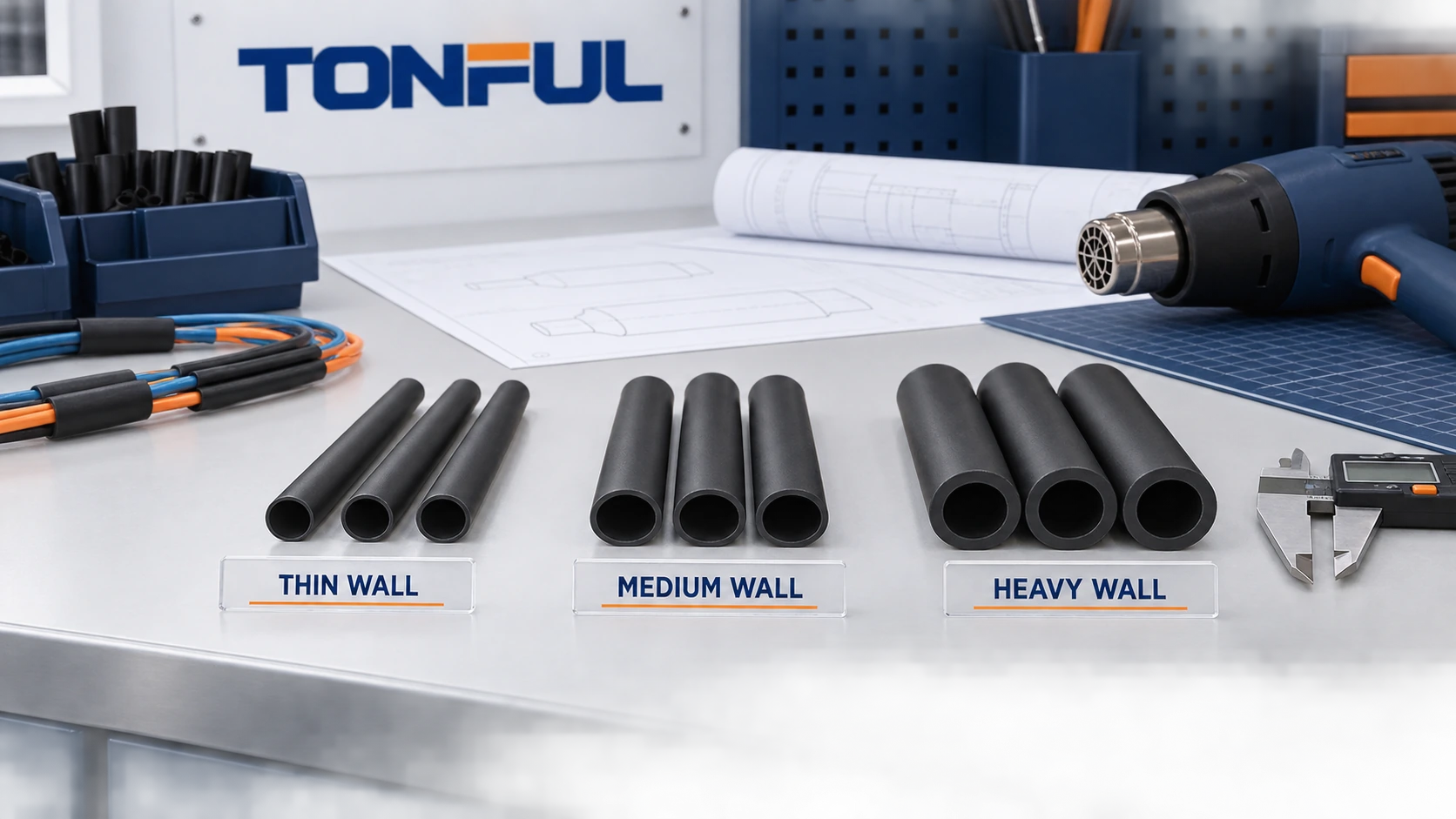
Thin-wall, medium-wall and heavy-wall heat shrink tubing are practical product categories, not universal thickness standards. A supplier may classify products by recovered wall, intended cable range, construction or application. The boundary between categories can therefore differ across product families. Buyers should never approve tubing from the label “heavy wall” alone.
The selection must start with the completed assembly: pass-over geometry, recovered diameter, required wall, electrical insulation system, abrasion, impact, moisture, cable environment and installation heat. This guide explains how each wall class is commonly used, what evidence to request and why thicker is not automatically better.
Quick Comparison
| Decision area | Thin wall | Medium wall | Heavy wall | Approval evidence |
|---|---|---|---|---|
| Typical focus | Wire insulation, identification and light protection | Cable insulation, jacketing and sealing | Rugged cable protection, sealing and mechanical abuse | Exact product data and application drawing |
| Recovered profile | Low bulk and flexible transitions | More wall and protection | Thickest profile within the compared family | Recovered ID and wall tolerances |
| Adhesive availability | Available in some product families | Common coated and uncoated options | Common sealed constructions | Liner identity and substrate compatibility |
| Installation energy | Often lower, but product-specific | Greater mass may require more controlled heat | Thick sections and large diameters can demand substantial heat | Approved time-temperature window |
| Mechanical behavior | Useful where space and flexibility matter | Balanced cable protection | Often selected for abrasion and harsh handling | Assembly-level mechanical test |
| Electrical role | Component or wire insulation when rated | Cable accessories and insulation restoration | Low-voltage insulation and rugged outer protection in some families | System design and product-specific rating |

Wall class narrows the product family; recovered dimensions and validated assembly performance determine approval.
Wall Class Is Not the Same as Single or Dual Wall
“Thin,” “medium” and “heavy” describe relative wall construction. “Single wall” and “dual wall” describe whether the product is a single polymer layer or includes an inner adhesive or sealant layer. A thin-wall product can be adhesive lined, and a heavy-wall product can be supplied coated or uncoated. These classification axes overlap.
The single-wall versus dual-wall guide explains the sealing distinction. For the current comparison, record both fields: wall class and liner construction. Also record material, shrink ratio, size, color, product revision and supplied form. Without these identifiers, “medium-wall black tube” is not a controlled specification.
The wall value may be nominal, minimum or maximum and may apply only after unrestricted recovery. Wall on an actual cable can vary with recovery percentage, ovality, adhesive flow and local geometry. Ask the supplier how the published wall was measured and whether the drawing controls the finished assembly or only free-recovered tubing.
Thin-Wall Heat Shrink Tubing
Thin-wall tubing is commonly considered for wire jacketing, color coding, identification, light abrasion protection, component insulation and low-profile harness transitions. Its smaller recovered profile can help where connectors, clips, conduits or adjacent wires limit space. A flexible thin wall can also reduce stiffness at a transition.
Thin wall does not mean low performance. Materials and formulations can provide specialized temperature, fluid, flame or electrical properties. Conversely, a thin product with an attractive data sheet may still be unsuitable if the assembly needs impact resistance, thick insulation restoration or robust environmental sealing.
The main risks are inadequate recovered fit, insufficient wall for the mechanical duty, edge damage and overestimating electrical capability. If adhesive lined, a thin wall may show sealant at the ends, but visible flow is not proof of a qualified moisture seal. Verify overlap, substrate preparation, adhesive compatibility and environmental conditioning.
TE Connectivity’s official electrical heat shrink tubing overview distinguishes thin-, medium- and heavy-wall product groups and identifies wire jacketing and color coding as typical thin-wall uses. It is a useful classification example, not a cross-brand thickness standard.
Medium-Wall Heat Shrink Tubing
Medium-wall tubing often serves cable jacketing, insulation, low- or medium-voltage accessory protection, splices and terminations. It can provide more mechanical robustness than thin-wall tubing without the bulk of a heavy-wall product. Coated and uncoated versions may exist within one product family, so procurement must preserve the suffix or construction identifier.
Evaluate the cable diameter range rather than selecting only by nominal cable size. The expanded inside diameter must pass over the largest feature, while the maximum recovered inside diameter must fit the smallest surface with the intended recovery margin. Wall, sealant and longitudinal change must then remain acceptable across the full application range.
TE’s official MWTM medium-wall product page demonstrates why exact-product evidence matters: the family contains many diameters, recovered walls, lengths and coated or uncoated variants. Its listed dimensions and qualifications apply to that product family and should not be copied as generic medium-wall limits.
Medium wall is not automatically a medium-voltage insulation system. Voltage class depends on the product, cable accessory design, installation and applicable test program. Where the tubing forms part of a joint or termination, approve the complete accessory system rather than treating one sleeve as a stand-alone rating.
Heavy-Wall Heat Shrink Tubing
Heavy-wall or thick-wall tubing is commonly screened for demanding cable repair, rugged splices, exposed cable transitions, underground protection and harsh industrial environments. Greater recovered wall can improve resistance to abrasion, impact and mechanical abuse when the formulation and assembly are suitable. Adhesive-lined versions can support environmental sealing over irregular shapes.
The tradeoffs are bulk, stiffness, weight, installation energy and access. A thick sleeve may not fit inside a connector backshell or cable tray. It can create a rigid transition that moves stress into the cable. Large diameters may need an oven, torch system approved by the manufacturer or controlled high-output heating instead of a small hand heat gun.
Heavy wall does not automatically mean waterproof, direct burial, high voltage, UV resistant or flame retardant. Each claim needs product-specific evidence. The heavy-wall underground cable guide addresses soil, water, utilities and burial-system boundaries separately.

Compare free-recovered specimens and production assemblies because recovery percentage and geometry affect the observed wall.
Recovered Wall, Shrink Ratio and Fit
Wall class and shrink ratio answer different questions. Shrink ratio describes the relationship between expanded and recovered diameter. It does not state recovered wall, insulation level or mechanical strength. A higher-ratio thin-wall product can still have less recovered wall than a lower-ratio heavy-wall product.
Use the heat shrink size guide to check the largest pass-over feature and smallest recovered surface. Then verify wall and recovery on production-intent parts. Record expanded ID minimum, recovered ID maximum, wall tolerance, recovered length and longitudinal change. Do not use a nominal diameter as if it were a guaranteed limit.
For irregular splices, measure the barrel, conductor insulation, transition and any branch or braid. Confirm that the tubing follows the contour without bridging or trapping voids. If adhesive is present, define acceptable flow, coverage and end condition. Too much recovery margin can increase wall and length change while creating an unnecessarily stiff assembly.
Electrical Insulation and Mechanical Protection
If tubing is part of an insulation system, document conductor voltage, overvoltage environment, cable insulation, required dielectric test, creepage or clearance context, pollution, temperature and aging sequence. A material dielectric-strength value cannot be converted directly into a universal voltage rating. The test specimen, thickness, electrodes and conditioning differ from a real joint.
Mechanical requirements should identify the threat: abrasion, impact, cut-through, crush, flexing, pulling, vibration or handling. Test the actual assembly with controlled fixtures and acceptance criteria. A thick wall may resist one threat yet produce an unacceptable bend transition. A thin wall may perform adequately when the harness is routed and supported away from contact.
Use cross-sections where wall distribution, adhesive coverage or damage is uncertain. Mark the section location, sample ID, size, recovery process and scale. A conceptual drawing can explain inspection points, but it must not be presented as a laboratory micrograph or acceptance standard.
Sealing and Environmental Exposure
Environmental sealing depends on more than wall thickness. The liner must wet compatible substrates, fill gaps and remain functional after thermal cycling, fluids, flexing and aging. Cleanliness, oxidation, cable-jacket chemistry and process temperature can control the outcome. An uncoated heavy-wall tube may provide excellent mechanical protection without forming a moisture seal.
Define the exposure: splash, immersion, condensation, underground water, salt, cleaners, oils, fuels, UV, ozone or chemicals. Specify duration, temperature, pressure and post-conditioning tests. IP ratings, direct-burial claims and manufacturer immersion tests are not interchangeable. Apply only evidence tied to the exact product and assembly configuration.

Route the application by its dominant risks, then verify every remaining requirement on the selected product.
Installation Process and Thermal Budget
Thicker tubing normally contains more material to heat, but recovery conditions remain product-specific. Establish a thermal budget for the cable insulation, connector, adhesive, splice, shielding and nearby components. Record heat source, set point, airflow, distance, motion, part temperature if required, dwell and cooling.
The heat gun, oven and infrared process guide helps compare heating methods. Thin wall can recover quickly and overheat if the operator dwells. Heavy wall can look recovered outside while remaining incomplete at a thick transition. Rotate or fixture the assembly as required and inspect the full circumference.
Validate worst cases: minimum and maximum cable size, largest mass, cold-start equipment, end-of-shift temperature, difficult access and permitted rework. Define start-up checks, sampling, reaction plan and revalidation after product, size, equipment or process changes.
Production-Intent Validation Matrix
| Test area | Controlled inputs | Required record |
|---|---|---|
| Identity | Manufacturer, product, size, liner, lot and revision | Label, drawing and certificate link |
| Dimensions | Expanded ID, recovered ID, wall and length change | Raw measurements and instrument ID |
| Installation | Substrate, heat source, time, temperature and fixture | Approved process window |
| Electrical | Assembly geometry, conditioning and test method | Result and acceptance source |
| Mechanical | Threat, fixture, load/cycles and endpoint | Failure mode and disposition |
| Sealing | Surface preparation, adhesive flow and exposure | Leak/ingress result and section evidence |
| Environment | Thermal, UV, fluid or burial conditions | Initial, aged and change values |

A common record structure allows candidates from different wall classes to be compared without hiding different test conditions.
The heat shrink tubing testing guide provides further sample-allocation and evidence controls. Keep unaged references, allocate destructive samples separately and preserve failures. Do not replace a failed sample unless the approved plan defines invalid-test criteria.
Selection Rules for Buyers and Engineers
Choose a verified thin-wall product when low profile, flexibility, marking or light protection controls the decision and the exact product meets all other requirements. Choose medium wall when cable insulation, jacketing or sealing needs more robust construction without unnecessary heavy-wall bulk. Choose heavy wall when harsh mechanical or environmental duty is demonstrated and the assembly can tolerate its size, stiffness and installation process.
Do not purchase by wall label alone. The RFQ should state expanded and recovered dimensions, wall requirement, liner, substrate, environment, electrical role, mechanical test, installation limits, color, printing, packaging, annual volume and change-notification rules. If the supplier proposes an alternative wall class, require a documented deviation and equivalent validation plan.
Work With TONFUL
Send TONFUL the cable or assembly drawing, pass-over diameter, recovered surface range, required wall, liner need, electrical and mechanical duty, exposure list, installation process, standards and annual volume. TONFUL can discuss suitable thin-, medium- or heavy-wall heat shrink options and production-intent samples. Confirm every rating and qualification for the exact quoted product before release.
—