
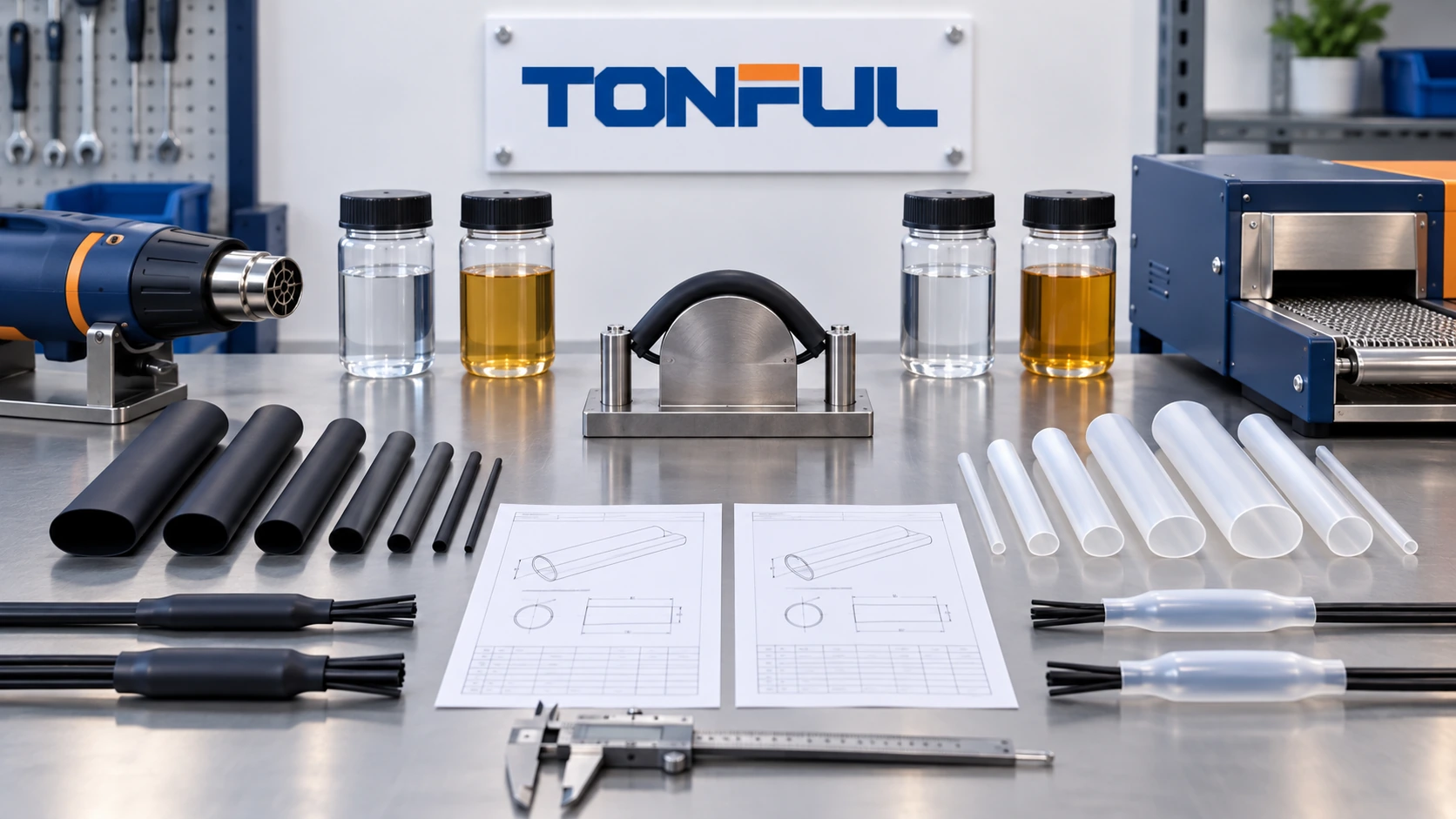
Choosing between polyolefin and PVC heat shrink tubing requires more than comparing material names or unit price. “Polyolefin” covers many cross-linked formulations, while PVC performance depends on resin, plasticizer, stabilizers, pigments, wall design and processing. Two tubes in the same material family can have different temperature, flame, fluid, flexibility and electrical evidence.
Polyolefin is widely used for wire insulation, identification, strain transitions and environmental protection. PVC heat shrink can offer flexibility, a smooth appearance, color options and application-specific cost advantages. Neither family is automatically better. The right selection is the exact product that matches the drawing, environment, installation process and required approvals.
On this page: Quick comparison | Formulation | Temperature | Mechanical | Environment | Compliance | Validation
Quick Comparison
| Decision area | Cross-linked polyolefin tubing | PVC heat shrink tubing | Evidence to request |
|---|---|---|---|
| Product range | Many thin-, medium-, heavy- and dual-wall constructions | Commonly thin, flexible general-purpose constructions; other designs exist | Exact manufacturer series and drawing |
| Flexibility | Flexible to semi-rigid depending on formulation | Often selected for flexible covering and appearance | Bend/flex test on final assembly |
| Installation | Product-specific recovery conditions | Product-specific recovery conditions; sensitive substrates may drive selection | Qualified heating window and equipment |
| Longitudinal change | Varies by product and recovery amount | Can differ significantly by formulation and process | Measured production sample |
| Fluids and chemicals | Highly formulation-dependent | Highly formulation-dependent | Named-fluid test with conditions |
| Flame performance | Flame-retardant and non-flame-retardant products exist | Flame-retardant and non-flame-retardant products exist | Exact classification and report scope |
| Halogen status | Some products are halogen-free; not universal | PVC contains chlorine by polymer chemistry | Requested material declaration and fire requirements |
| Sealing | Single-wall and adhesive-lined options widely available | Product-specific; do not assume a liner | Construction drawing and assembly seal test |
Use the table to frame an RFQ, not to approve a substitute. Product data must be compared under the same test method, specimen condition and units. “Chemical resistant,” “flame retardant” or “outdoor grade” is not a complete specification.

The material family starts the comparison; the exact formulation, construction and test evidence finish it.
Compare Formulation, Not Only the Polymer Name
Heat-recoverable polyolefin tubing is commonly cross-linked so it can be expanded during manufacture and later recover toward its original dimensions when heated. Formulation changes can alter flexibility, recovery behavior, flame performance, fluid resistance, color stability and mechanical properties. Single-wall and adhesive-lined products should be treated as different constructions even when the outer wall uses a similar polymer.
PVC tubing includes resin plus additives that control flexibility, heat stability, processing, color and other properties. Plasticizer type and amount can influence low-temperature behavior, migration, hardness and long-term compatibility with adjacent materials. A generic PVC statement cannot establish performance for a named product.
The heat shrink tubing material guide compares broader families including fluoropolymers, silicone and fluoroelastomer. For this two-material decision, request the manufacturer series, exact product code, color, wall type, supplied and recovered dimensions, material specification and revision-controlled datasheet.
TE Connectivity’s official TUGA polyolefin product family identifies an irradiated modified polyolefin construction and notes product-specific dimensional behavior relative to many PVC-based materials. HellermannTyton’s LVR PVC product page is an example of a named 2:1 PVC product with its own technical datasheet. These examples show why material-family generalizations cannot replace exact product documents.
Temperature and Installation Process
Separate operating temperature from recovery temperature. Operating limits describe the approved service range under stated conditions. Recovery conditions describe the energy needed to install the tube. A lower recovery temperature can help protect temperature-sensitive components, but only when the tube still reaches full, uniform recovery and the completed assembly passes its requirements.
Do not copy a temperature from another product in the same material family. Record minimum shrink behavior, full recovery condition, maximum installation exposure for the substrate, continuous and short-term service temperatures, cold-storage condition and thermal-aging test. Where soldering, welding or molding occurs nearby, evaluate the actual local profile.
The heat source also matters. A heat gun creates local airflow and depends on distance, angle and motion. An oven can improve circumferential uniformity but heats the entire assembly. Infrared absorption varies with color and surface. The heat gun, oven and infrared guide helps teams choose a process, but each material/product combination needs a qualified recipe.
Track scorching, gloss change, bubbles, splitting, incomplete recovery and substrate deformation. Do not use an uncalibrated heat-gun dial as tube-temperature evidence. Define the measurement method and acceptable process window with production-intent parts.
Flexibility, Abrasion and Dimensional Behavior
Compare flexibility at assembly temperature and after aging, not by squeezing a room-temperature sample. A soft PVC tube may support routing around bends, while a semi-rigid polyolefin can provide a firmer transition. However, wall thickness, recovered fit and additives may have as much influence as the polymer family.
Test the final harness or component for minimum bend, repeated flexing, edge abrasion, cut-through and strain transfer where relevant. A stiff sleeve edge can move bending into the adjacent conductor. A very soft tube may not protect against a sharp bracket. Neither outcome is visible from a material name.
Longitudinal change affects cut length, print position, overlap and alignment. Measure it at minimum and maximum approved substrate diameters using the production heating method. Do not assume that one polyolefin or PVC product represents the family. The heat shrink size guide provides a controlled sizing method.

Mechanical selection should use recovered production samples because flexibility, wall, fit and longitudinal movement interact.
Fluids, UV and Environmental Exposure
Create a location-specific exposure list. Potential conditions include water, humidity, oils, fuels, cleaners, plasticizers from neighboring materials, road salts, sunlight, ozone and industrial chemicals. State concentration, temperature, duration, splash or immersion mode, drying and the properties measured afterward.
Do not infer broad chemical resistance from one successful fluid test. PVC and polyolefin formulations can swell, harden, soften, crack, discolor or lose electrical/mechanical performance differently. Clear and colored versions may also use different additive packages. Request test reports for the exact product and condition.
Outdoor use requires more than black color. Confirm UV stabilization and weathering evidence for the named product, plus temperature cycling, water exposure and mechanical conditions. For an adhesive-lined polyolefin construction, verify liner compatibility with the substrate and environment. The single-wall versus dual-wall guide explains why an outer-wall comparison alone cannot decide sealing performance.
Flame, Smoke, Halogen and Compliance Evidence
Do not use “PVC is flame retardant” or “polyolefin is halogen-free” as blanket rules. Both material families include products with different flame classifications. Some polyolefin formulations intentionally contain flame-retardant systems; halogen-free status must be documented. PVC contains chlorine, but the smoke, acidity, toxicity and flame performance of a completed product must still be evaluated using the required methods.
UL 224 recognition, UL 94 classification, VW-1 results, railway smoke requirements and low-smoke/zero-halogen claims are not interchangeable. They use different specimens, orientations, conditioning and endpoints. Record the applicable standard edition, exact product/color/size range, file or report number and limitations. Do not extend one result to an unlisted formulation.
Environmental declarations need the same discipline. RoHS and REACH documentation addresses regulated-substance obligations and does not prove flame, dielectric, temperature or mechanical performance. Ask for a current declaration tied to the supplied product and supply chain.
| Claim | Minimum evidence field | Common mistake |
|---|---|---|
| Flame retardant | Method, specimen, classification and exact product scope | Treating every color/size as covered |
| Halogen-free | Definition, threshold, method and declaration scope | Assuming all polyolefin is halogen-free |
| Low smoke | Required smoke method and result | Substituting a flammability test |
| RoHS/REACH | Current supplier declaration and product identity | Treating compliance as performance approval |
| Voltage use | Product and assembly electrical evidence | Using dielectric strength as a universal rating |

Each published claim needs product-specific evidence; one declaration or test category cannot substitute for another.
Cost, Supply and Processing Decisions
Compare total installed cost, not only price per meter. Include usable yield, cut scrap, changeover time, recovery cycle, energy, operator training, inspection, rework, packaging, minimum order, color availability and traceability. A lower-priced PVC product may be attractive for a controlled general-purpose application; a polyolefin construction may reduce variants or support a different environment. The answer depends on verified project data.
Request samples from production-intent material and packaging. Evaluate ease of cutting, print quality, blocking on reels, deformation during storage, installation consistency and defect rate. The bulk heat shrink sourcing guide explains usable-yield and lot-control decisions.
Supplier changes to resin, plasticizer, stabilizer, pigment, flame-retardant package, dimensions, cross-linking, site or test method can affect performance. Define notification and requalification rules before approval. A material-family substitution should never be released from appearance and dimensions alone.
Validate Production-Intent Samples
Build a comparison matrix using identical assembly geometries and project conditions. Keep unaged controls and define independent versus sequential samples. Record lot, color, dimensions, substrate, heat process and operator. Destructive tests need separately allocated samples.
| Verification area | Controlled inputs | Decision evidence |
|---|---|---|
| Identity and dimensions | Product, lot, color and measurement method | Drawing compliance |
| Recovery | Substrate range and heating recipe | Fit, wall and longitudinal change |
| Thermal aging | Temperature, duration and atmosphere | Property retention and defects |
| Flex/abrasion | Fixture, load, counterface and cycles | Damage and electrical continuity |
| Fluid/UV | Exact exposure and sequence | Dimensional, visual and property change |
| Electrical | Electrode/assembly setup and conditioning | Required withstand or insulation result |
| Flame/smoke | Applicable method and specimen | Classification/report scope |
Use the heat shrink testing guide to preserve raw measurements, calibrated equipment, deviations, failures and approvals. If neither candidate has evidence for a critical exposure, do not select the one with the stronger marketing description; close the evidence gap.

A side-by-side validation plan compares both candidates under the same assembly geometry, process and acceptance source.
When to Choose Each Material
Consider a verified polyolefin product when the project needs a construction and evidence set available in that family, such as a particular shrink ratio, adhesive liner, environmental profile, wall design or qualification. Consider a verified PVC product when its flexibility, appearance, process behavior, dimensions, classification and economics match the controlled application.
Do not approve either material when critical data is missing, when the supplier proposes a family-level certificate, or when production samples differ from the tested construction. The most reliable decision is product-specific and application-specific.
Work With TONFUL
Send TONFUL the application, substrate dimensions, operating and installation temperatures, mechanical and chemical exposures, flame/smoke/halogen requirements, colors, printing, validation plan and annual volume. TONFUL can discuss available polyolefin and PVC heat shrink options and production-intent samples. Confirm all ratings, declarations and approval scope for the exact quoted product.
—