
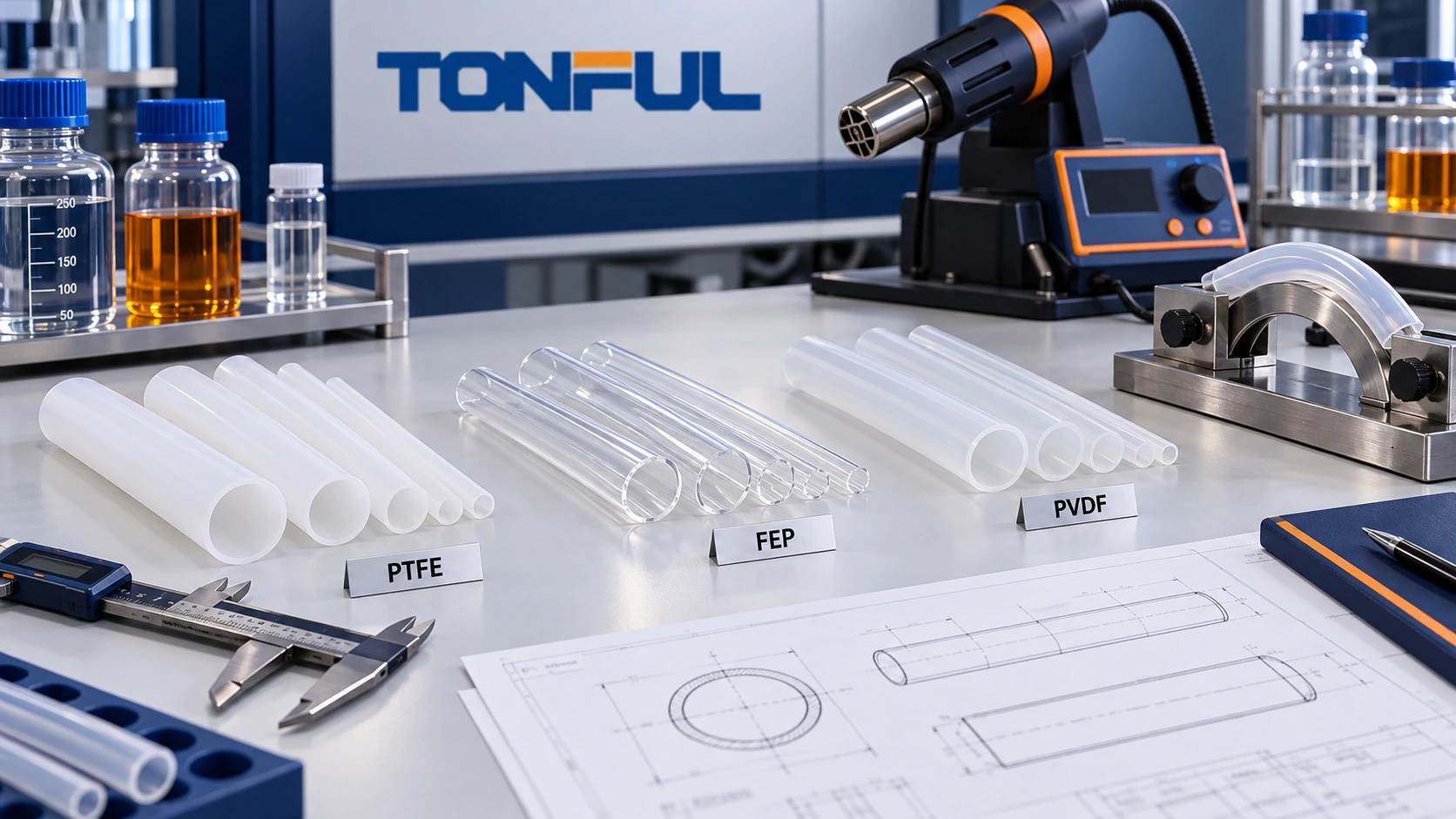
PTFE, FEP and PVDF heat shrink tubing are all fluoropolymer options, but they are not interchangeable. Their formulations, recovery conditions, stiffness, wall construction, clarity, chemical behavior and available qualifications can differ substantially. Selecting only by “high temperature” or “chemical resistant” can damage a component during installation or leave a critical requirement unverified.
The correct comparison starts with the completed assembly: substrate material, largest pass-over feature, smallest recovered surface, thermal limit, flexing, fluids, electrical stress, optical inspection and required standard. This guide explains the evidence engineers and buyers should request without assigning universal ratings to an entire polymer family.
On this page: Quick comparison | Processing | Mechanical | Chemicals | Electrical | Applications | Validation
Quick Comparison
| Decision area | PTFE tubing | FEP tubing | PVDF tubing | Evidence needed |
|---|---|---|---|---|
| Typical selection driver | High-temperature/chemical applications and specialized insulation | Clear processing sleeves, thin-wall protection and specialized insulation | Tough thin-wall protection, abrasion/cut-through and chemical exposure | Exact product specification |
| Recovery process | Often requires a high-energy process; product-specific | Product-specific high-temperature recovery | Product-specific; may be lower than some PTFE/FEP options | Qualified recipe and substrate limit |
| Flexibility | Varies by wall, expansion and product | Often semi-rigid in thin-wall products | Commonly semi-rigid/tough in electrical products | Recovered sample bend test |
| Clarity | Natural/clear products may permit inspection | Frequently selected where high clarity is useful | Translucent/clear grades can support inspection | Optical requirement and aged result |
| Surface behavior | Low surface energy affects bonding | Low surface energy affects bonding/release use | Bonding and liner compatibility remain product-specific | Adhesion/process evidence |
| Shrink ratio and size range | Product-specific | Product-specific | Product-specific | Supplied/recovered dimensions |
These are selection tendencies, not acceptance values. A medical FEP processing sleeve and an electrical PVDF sleeve can have completely different evidence packages. Compare named part numbers under the same project conditions.

Fluoropolymer names identify chemistry families; the product construction and controlled evidence determine suitability.
Understand the Material and Product Construction
PTFE is widely associated with high-temperature capability, chemical resistance and low friction. Heat-recoverable PTFE products use specialized expansion and recovery designs. The exact shrink ratio, wall, dimensional tolerances and recovery method can be narrower than general-purpose polyolefin tubing, so pass-over and process margins need careful review.
FEP is melt-processable and can provide clear, smooth thin-wall tubing. Some FEP heat shrink products are used as temporary processing aids for catheter reflow; others remain as protective or insulating components. Whether the tube is removed or retained is a fundamental requirement that changes contamination, release, wall and validation decisions.
PVDF can provide tough, thin, semi-rigid insulation with chemical and mechanical performance suited to dense electrical assemblies. Cross-linked PVDF heat shrink products may be selected for abrasion, cut-through, high-temperature components and visual inspection. Do not assume all PVDF products share the same flame, outgassing or fluid evidence.
The heat shrink material guide places these options beside polyolefin, PVC, silicone and fluoroelastomer. For a fluoropolymer RFQ, state the exact polymer, cross-linking or construction where relevant, single- or dual-wall design, color, transparency, dimensions and required document revision.
Recovery Temperature and Process Compatibility
Recovery temperature is often the decisive difference. The tube must receive enough energy to recover uniformly, but the substrate, solder joint, adhesive, coating, sensor, cable insulation or medical polymer must remain within its approved exposure. A product’s operating-temperature range does not define a safe installation cycle.
TE Connectivity’s official FEP heat shrink family presents medical processing applications and product-specific dimensional behavior. Its related product records identify controlled recovery conditions for those exact parts. TE’s AT053 PTFE family and RW-175 PVDF family show different constructions, dimensions and intended uses. These pages demonstrate product variation; they do not establish TONFUL ratings.
Build a thermal budget for the assembly. Record heat source, air or surface condition, fixture, distance, exposure time, ramp, rotation and cooling. For an oven, consider all components exposed. For hot air or infrared, assess shadowing and nonuniform absorption. A mandrel or internal pressure used in a reflow operation also changes the process.
Avoid open flame unless the exact industrial product procedure, site controls and qualified process specifically allow it. Fine fluoropolymer tubing and sensitive assemblies generally require controlled equipment. Provide ventilation and follow the product safety documentation; overheating any polymer can create hazardous decomposition products.
Wall, Flexibility, Clarity and Mechanical Behavior
Compare recovered wall at the actual substrate diameter. A thin wall may support compact packaging and flexibility but provide less abrasion reserve than a thicker construction. A semi-rigid sleeve may protect a solder joint while transferring bending to its edge. Define bend and strain-relief behavior for the completed assembly.
Clarity can permit inspection of components, markings, bubbles or reflow condition. Quantify what must be visible and after which conditioning. A clear initial sample may haze, craze, discolor or collect residue after heat, chemicals or sterilization. Optical appearance is not a substitute for dimensional or electrical tests.
Low-friction surfaces can help a processing sleeve release or reduce drag, but they can also make adhesive bonding difficult. If printing, potting, adhesive, overmolding or sealing is required, specify surface preparation and compatibility evidence. Do not apply a generic primer or plasma treatment without reviewing its effect on the tubing and substrate.
Measure longitudinal change, concentricity and wall variation because they affect precision applications. The heat shrink size guide explains tolerance-based fit. Do not select solely from nominal diameter or shrink ratio.

Recovered production samples reveal interactions among wall, stiffness, visibility, dimensional movement and the substrate.
Chemical and Environmental Selection
Replace “chemical resistant” with a named exposure matrix. Record each fluid, concentration, temperature, duration, pressure, splash or immersion mode, sterilization or cleaning cycle, drying and post-exposure measurement. Strong performance against one solvent does not prove suitability for another.
Inspect mass/dimensional change, swelling, cracking, haze, color, tensile behavior and required electrical properties. In processing applications, assess extractables, residue and release behavior. In aerospace or sealed electronics, outgassing evidence may be critical. In medical use, biocompatibility and sterilization validation apply to the exact material, manufacturing process and device contact—not to “FEP” or “PTFE” as a category.
UV, radiation, humidity and thermal cycling should be included when relevant. Radiation can alter polymer properties differently, and a product qualified for one radiation type or dose cannot be generalized. Define service life and acceptable property change through the customer’s approved plan.
Electrical, Flame and Regulatory Evidence
Dielectric strength is a material or specimen result under stated conditions, not an installed voltage rating. The completed sleeve’s wall, defects, electrodes, creepage, contamination, altitude and equipment insulation system all matter. Request the exact test method, thickness, conditioning, breakdown/withstand definition and sample result.
Likewise, flame retardancy, VW-1, UL 94, low smoke, halogen content and aerospace flammability are separate claims. PTFE, FEP and PVDF all contain fluorine; “halogen-free” is therefore not an appropriate family description. If smoke, toxicity or corrosivity matters, specify the required method and acceptance criteria rather than using fluoropolymer as a proxy.
RoHS, REACH and material declarations address restricted substances or chemical obligations and do not establish heat, electrical, flame or medical performance. Product recognition and qualified-product status must be tied to the exact part, color, size and manufacturing scope.
Application-Based Selection
| Application decision | Candidate direction | Questions that decide the product |
|---|---|---|
| High-temperature electrical joint | PTFE or PVDF may be considered | Installation thermal budget, wall, flex and qualification? |
| Catheter or polymer reflow aid | FEP is commonly evaluated | Removable or retained, clarity, release, dimensions and validation? |
| Dense connector or solder-joint protection | Thin-wall PVDF may be considered | Abrasion, cut-through, flame and visual inspection? |
| Chemical-process sensor lead | Any may be possible | Exact chemical, temperature, pressure, flex and sealing? |
| Aerospace harness | Approved product only | Applicable material class, outgassing, flame and traceability? |
| Clear inspection sleeve | FEP, PTFE or clear PVDF products may qualify | Required optical quality before/after exposure? |
The table narrows candidates; it does not approve one. If the substrate cannot tolerate the recovery process, choose a different product or protection method even when the polymer’s service temperature is attractive.

Application names help route the evaluation, but controlled product evidence and assembly validation determine approval.
Cost, Availability and Manufacturing Risk
Compare usable yield and process cost. Include size availability, minimum order, cut precision, scrap, fixture needs, recovery time, energy, operator skill, inspection, rework and lot traceability. A lower-priced tube that requires a narrow high-temperature process can cost more per accepted assembly.
Request production-intent samples from the proposed manufacturing site. Confirm packaging prevents deformation and contamination. Verify lot identification and change notification for resin grade, dimensions, expansion, heat treatment, site, tooling and test method. The bulk sourcing guide provides a purchasing framework.
Capture these requirements in a controlled heat shrink tubing RFQ so suppliers respond to the same dimensions, process conditions, evidence fields and approval boundaries.
Production-Intent Validation Plan
| Verification area | Controlled inputs | Results to retain |
|---|---|---|
| Identity and dimensions | Product, lot, color and measurement method | Supplied/recovered ID, wall and length change |
| Installation | Substrate, heat equipment, fixture and cycle | Actual conditions and visual/dimensional result |
| Thermal exposure | Service profile and sample sequence | Property retention and defects |
| Chemical/cleaning | Exact medium and conditioning | Change, residue and required performance |
| Flex/abrasion | Bend, counterface, load and cycles | Damage location and electrical continuity |
| Electrical | Wall/electrode setup and conditioning | Raw withstand/breakdown result |
| Optical/release | Viewing method or removal process | Haze, residue, damage and acceptance |
Use independent samples where destructive tests would remove evidence needed later. Keep unaged controls, define invalid-test and retest rules, and preserve failures. The heat shrink testing guide explains traceable records.

A common validation matrix makes candidate evidence comparable without importing one product’s values into another material family.
Work With TONFUL
Send TONFUL the application, polymer preference, substrate and pass-over dimensions, wall and clarity needs, installation thermal budget, chemicals, mechanical loads, electrical and flame requirements, documents and annual volume. TONFUL can discuss available fluoropolymer heat shrink options and production-intent samples. Final ratings and qualification scope must be confirmed for the exact quoted product.
—