
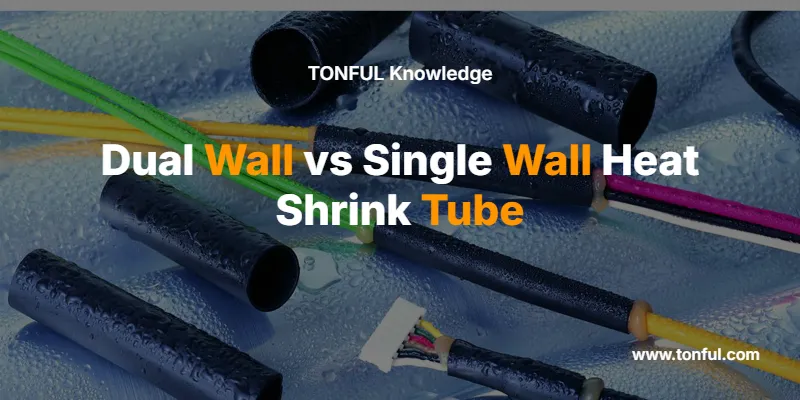
What is Heat Shrink Tubing?

Heat shrink tubing is a thermoplastic sleeve that contracts when heated, creating a protective barrier around wires, connections, and electrical components. When exposed to heat from a heat gun or other controlled heat source, the tubing shrinks to approximately 33-50% of its original diameter, conforming tightly to the underlying material.
Single wall heat shrink tubing consists of one layer of cross-linked polyolefin or other thermoplastic material that provides electrical insulation, abrasion resistance, and basic mechanical protection.
Dual wall heat shrink tubing (also called adhesive-lined or marine-grade tubing) features an outer thermoplastic layer plus an inner hot-melt adhesive lining that melts during heating, creating an environmental seal that blocks moisture, chemicals, salt spray, and contaminants.
Key Structural Differences

| Feature | Single Wall Heat Shrink | Dual Wall Heat Shrink |
|---|---|---|
| Construction | Single thermoplastic layer | Outer thermoplastic + inner adhesive |
| Moisture Protection | Basic (not waterproof) | Excellent (hermetic seal) |
| Environmental Sealing | Minimal | Superior against chemicals, salt, UV |
| Cost per Foot | $0.10-0.50 | $0.30-1.50 |
| Shrink Ratio | 2:1 or 3:1 | 3:1 or 4:1 |
| Installation Time | Fast (1-2 minutes) | Longer (3-5 minutes) |
| Temperature Rating | -55°C to +135°C | -55°C to +150°C |
| Flexibility After Shrinking | Moderate | High (remains flexible) |
| Typical Wall Thickness | 0.25-0.50mm | 0.50-1.00mm |
| Bond Strength | N/A | 20+ psi adhesive bond |
Detailed Performance Comparison
Moisture and Water Resistance
Single Wall Performance:
Single wall tubing creates a physical barrier but does not provide a waterproof seal. Gaps at the ends and any irregularities in the wire surface allow moisture infiltration over time. Suitable for dry indoor environments only.
Dual Wall Performance:
The adhesive inner layer melts at approximately 120-140°C and flows into gaps, creating a hermetic seal rated IP67 or IP68. This makes dual wall tubing ideal for waterproof wire connectors applications and marine environments where saltwater exposure is constant.
Chemical and Corrosion Resistance
| Exposure Type | Single Wall Rating | Dual Wall Rating |
|---|---|---|
| Saltwater | Poor | Excellent |
| Motor Oil | Fair | Excellent |
| Gasoline/Diesel | Poor | Excellent |
| Hydraulic Fluid | Fair | Good |
| Battery Acid | Poor | Good |
| UV Exposure | Fair | Excellent |
| Road Salt | Poor | Excellent |
Dual wall tubing’s adhesive barrier prevents corrosive substances from reaching the wire, significantly extending service life in harsh environments. This makes it essential for automotive electrical connectors exposed to engine bay conditions.
Mechanical Protection Comparison

Both types provide excellent abrasion resistance, but dual wall tubing offers superior strain relief due to its adhesive bonding. The adhesive layer distributes mechanical stress across a larger area, reducing fatigue cracking at connection points—critical for applications involving vibration like auto combination switches.
Applications and Use Cases
When to Use Single Wall Heat Shrink Tubing
Indoor Electrical Work:
- Residential wiring insulation
- Wire bundling and organization
- Color coding wire identification
- Low-voltage electronics
- Panel wiring and control cabinets
- Electrical terminal protection in dry environments
Commercial Applications:
- Office building electrical systems
- Data center cable management
- Telecommunications equipment
- Computer and network wiring
- Indoor lighting fixtures
Advantages:
- Lower cost for large-scale projects
- Faster installation time
- Adequate for controlled environments
- Wide range of colors for identification
- Easy to source and stock
When to Use Dual Wall Heat Shrink Tubing
Automotive Applications:
- Engine bay wiring harnesses
- Blade fuse connections
- Battery cable terminations
- Sensor wire protection
- Trailer wiring connections
- Automotive connector sealing
Marine and Outdoor Use:
- Boat electrical systems (ABYC compliant)
- Dock and marina wiring
- Solar panel connections
- Outdoor lighting systems
- Irrigation control wiring
- Waterproof wire nuts alternative
Industrial Environments:
- Chemical processing facilities
- Food and beverage manufacturing
- Wastewater treatment plants
- Mining equipment
- Agricultural machinery
- Underground cable splices
Critical Applications:
- Medical equipment
- Aerospace systems
- Military/defense electronics
- Emergency power systems
- Safety-critical automotive systems
Technical Specifications and Standards
Industry Standards Compliance
| Standard | Description | Application |
|---|---|---|
| UL 224 | Extruded insulating tubing | General electrical use |
| AMS-DTL-23053 | Military specification | Aerospace and defense |
| SAE-AMS-DTL-23053/5 | Flexible, heat-shrinkable tubing | Automotive and aerospace |
| ABYC E-11 | Marine electrical systems | Boat and yacht wiring |
| IEC 60684 | Flexible insulating sleeving | International standard |
| RoHS Compliant | Restriction of hazardous substances | Environmental compliance |
Both TONFUL single wall and dual wall tubing meet or exceed these international standards, ensuring reliable performance across diverse applications.
Material Properties Detailed Comparison

| Property | Single Wall | Dual Wall | Test Method |
|---|---|---|---|
| Dielectric Strength | 500V/mil min | 500V/mil min | ASTM D149 |
| Tensile Strength | 1,500 psi | 2,000+ psi | ASTM D638 |
| Elongation at Break | 200% | 300% | ASTM D638 |
| Operating Temperature | -55°C to +135°C | -55°C to +150°C | Continuous |
| Short-term Max Temp | +175°C | +200°C | Brief exposure |
| Flame Rating | VW-1 | VW-1 | UL 94 |
| Adhesive Bond Strength | N/A | 20+ psi | ASTM D1000 |
| Shrink Temperature | 90-120°C | 110-140°C | Manufacturer spec |
| Longitudinal Change | ±5% | ±5% | After shrinking |
Installation Guide and Best Practices
Installing Single Wall Heat Shrink Tubing
Step-by-Step Process:
- Measure and Cut: Cut tubing 25-30% longer than coverage area
- Pre-position: Slide tubing onto wire BEFORE making connection
- Make Connection: Complete splice or crimp terminal installation
- Center Tubing: Position to cover connection with equal overlap
- Heat Application: Use heat gun at 200-250°F (93-121°C)
- Shrink Pattern: Start at center, work toward ends
- Cool Down: Allow 30-60 seconds cooling before handling
Installation Time: 1-2 minutes per connection
Tools Required:
- Heat gun (variable temperature)
- Wire cutters
- Safety glasses
- Heat-resistant gloves
Installing Dual Wall Heat Shrink Tubing
Step-by-Step Process:
- Surface Preparation: Clean connection area of oil, dirt, moisture
- Sizing: Cut tubing 50-75% longer than coverage area for proper seal
- Pre-installation: Slide tubing onto wire before connection
- Connection: Complete splice using appropriate heat shrink terminals
- Initial Positioning: Center tubing over connection
- Heat Application: Begin at center with heat gun at 250-300°F (121-149°C)
- Adhesive Activation: Continue heating until adhesive appears at both ends
- Visual Confirmation: Look for slight adhesive overflow (1-2mm)
- Extended Cooling: Allow 2-3 minutes for adhesive to fully cure
Installation Time: 3-5 minutes per connection
Critical Success Factors:
- Thorough surface cleaning prevents adhesive failure
- Adequate heating time ensures complete adhesive flow
- Visible adhesive overflow confirms proper seal
- Avoid overheating which can damage outer jacket

Common Installation Problems and Solutions
| Problem | Cause | Solution |
|---|---|---|
| Adhesive not sealing | Insufficient heat/time | Increase temperature to 280°F; heat until overflow visible |
| Tubing splits during shrinking | Undersized tubing | Use next larger diameter; reduce heat intensity |
| Poor shrink performance | Low temperature | Verify heat gun temperature; replace worn tubing |
| Adhesive overflow excessive | Overheating | Reduce temperature; increase distance from heat source |
| Incomplete shrinkage | Uneven heating | Move heat gun continuously; rotate connection |
| Tubing slides off | Insufficient length | Cut tubing 50% longer than connection |
| Bubbling or blistering | Too much heat | Lower temperature; increase distance |
Cost Analysis and ROI Considerations
Initial Cost Comparison
| Application Type | Single Wall Cost | Dual Wall Cost | Cost Difference |
|---|---|---|---|
| Small repair (10 pieces) | $5-10 | $15-30 | +200-300% |
| Automotive harness (100 pieces) | $30-50 | $90-150 | +200-300% |
| Marine installation (50 pieces) | $20-35 | $60-100 | +200-285% |
| Industrial project (500 pieces) | $100-200 | $300-600 | +200-300% |
Total Cost of Ownership Analysis
Single Wall TCO (5-year period):
- Initial material cost: $100
- Indoor application failure rate: 2-5%
- Replacement labor cost: $50-100
- Total 5-year cost: $150-200
Dual Wall TCO (5-year period):
- Initial material cost: $300
- Harsh environment failure rate: 0.5-1%
- Replacement labor cost: $15-30
- Total 5-year cost: $315-330
ROI Insight: For outdoor, marine, or automotive applications, dual wall tubing provides superior value despite 3x higher initial cost due to dramatically reduced failure rates and maintenance requirements.
Selection Decision Matrix
Quick Selection Guide
Choose Single Wall Heat Shrink If:
- ✓ Indoor, climate-controlled environment
- ✓ No moisture or chemical exposure
- ✓ Budget constraints for large projects
- ✓ Quick installation required
- ✓ Non-critical applications
- ✓ Temporary or short-term use
- ✓ Wire identification/color coding primary goal
Choose Dual Wall Heat Shrink If:
- ✓ Outdoor or underground installation
- ✓ Marine or coastal environment
- ✓ Automotive or mobile equipment
- ✓ Chemical or corrosive exposure
- ✓ Safety-critical application
- ✓ Long-term reliability required
- ✓ Warranty or liability concerns
Environmental Factor Decision Tree
| Environmental Factor | Severity Level | Recommended Type |
|---|---|---|
| Moisture exposure | None | Single wall |
| Moisture exposure | Occasional | Dual wall |
| Moisture exposure | Constant | Dual wall (marine grade) |
| Temperature cycling | <50°C range | Single wall |
| Temperature cycling | >50°C range | Dual wall |
| Vibration | Low | Single wall |
| Vibration | High | Dual wall |
| Chemical exposure | None | Single wall |
| Chemical exposure | Any | Dual wall |
| UV exposure | Indoor only | Single wall |
| UV exposure | Outdoor | Dual wall |
Integration with Other TONFUL Products
For complete electrical system protection, combine heat shrink tubing with complementary TONFUL products:
Wire Connection Systems:
- Heat shrink terminals for professional crimped connections
- Waterproof wire connectors for splice protection
- Electrical tape for additional insulation layers
Automotive Applications:
- Blade fuses for circuit protection
- Auto connectors for plug-and-play installations
- Combination switches for vehicle controls
Professional Tools:
- Electrical tools including heat guns and crimpers
- Terminal connectors for various applications
- Assorted boxes for organized inventory management
Frequently Asked Questions (FAQ)
What makes dual wall heat shrink better for marine applications?
The adhesive inner layer creates a waterproof seal rated IP67/IP68 that prevents saltwater infiltration. Combined with superior UV resistance and corrosion protection, dual wall tubing meets ABYC E-11 marine electrical standards and withstands constant exposure to harsh marine environments where single wall tubing would fail within months.
Can single wall heat shrink be used for automotive wiring?
Single wall tubing is not recommended for automotive applications due to exposure to heat, vibration, chemicals (oil, fuel, coolant), and moisture. Professional automotive standards require dual wall adhesive-lined tubing for engine bay and undercarriage wiring to ensure long-term reliability and prevent electrical failures.
How do you verify dual wall tubing is properly installed?
Properly installed dual wall tubing shows slight adhesive overflow (1-2mm) at both ends, creating visible evidence of complete seal activation. The adhesive should appear as a glossy ring around the tube opening. If no adhesive is visible, insufficient heat was applied and the connection is not properly sealed.
What is the shelf life of heat shrink tubing?
Both single and dual wall tubing typically have 5-7 year shelf life when stored in cool, dry conditions away from direct sunlight. Dual wall tubing may have slightly shorter shelf life due to the adhesive component. Always inspect tubing for flexibility and check for cracking before use on critical applications.
Does dual wall tubing require special installation tools?
No specialized tools are required beyond a quality variable-temperature heat gun. However, dual wall tubing requires more thorough heating (30-50% longer) and higher temperatures (250-300°F vs 200-250°F) compared to single wall tubing to properly activate the adhesive layer. A heat gun with temperature control is strongly recommended.
Can heat shrink tubing be removed and reused?
Heat shrink tubing cannot be reused once installed. The cross-linking process that occurs during heating is permanent. Dual wall tubing’s adhesive bonds permanently to the wire surface. Always cut and remove old tubing completely before installing new tubing.
What shrink ratio should I choose?
For standard applications, 3:1 shrink ratio provides best versatility, accommodating wire size variations and irregular shapes. Choose 2:1 for tight-fitting applications with consistent wire diameters. Select 4:1 for maximum flexibility when covering large connectors or irregular shapes common in automotive applications.
Is dual wall tubing compatible with all wire types?
Dual wall tubing works with copper, aluminum, and tinned copper wires. The adhesive bonds well to most wire insulation types including PVC, XLPE, and rubber. For specialty wires (Teflon, silicone), verify compatibility with tubing manufacturer specifications to ensure proper adhesive bonding.
Professional Recommendations and Best Practices
For Procurement Managers:
Stock both single and dual wall tubing in common sizes. While dual wall costs more initially, it prevents costly warranty claims and field failures in harsh environments. Calculate total cost of ownership including failure rates and labor costs, not just material prices.
For Installation Technicians:
When uncertain about environmental conditions, always choose dual wall tubing. The additional cost is minimal insurance against moisture infiltration and corrosion that may not be apparent during installation but will cause failures over time.
For Design Engineers:
Specify dual wall heat shrink tubing in design documentation for any application involving outdoor exposure, vehicle mounting, or chemical contact. Include specific installation requirements including heat gun temperature and visual inspection criteria for adhesive overflow.
Quality Assurance Tip:
For critical installations, photograph completed connections showing adhesive overflow at tube ends. This documentation proves proper installation and provides valuable troubleshooting reference if field issues arise.
Conclusion: Making the Right Choice
The decision between single wall and dual wall heat shrink tubing fundamentally depends on environmental exposure and application criticality. Single wall tubing provides cost-effective protection for controlled indoor environments, while dual wall tubing delivers essential environmental sealing for outdoor, marine, automotive, and industrial applications.
Key Takeaways:
- Single wall tubing excels in dry, indoor, non-critical applications where cost and installation speed are priorities
- Dual wall tubing is mandatory for moisture exposure, chemical environments, and safety-critical systems
- Initial cost differences (2-3x) are offset by dramatically lower failure rates in harsh environments
- Proper installation technique—especially adhesive activation in dual wall tubing—is critical for performance
- When uncertain, choose dual wall tubing for long-term reliability and reduced maintenance costs
For professional electrical installations requiring proven reliability, TONFUL Electric offers both single wall and dual wall heat shrink tubing manufactured to international standards including UL, ABYC, and SAE specifications. Our technical support team can assist with product selection and application-specific recommendations.
Next Steps: Contact TONFUL Electric for technical specifications, bulk pricing, or custom heat shrink solutions tailored to your specific application requirements. Our engineering team provides free application consulting to ensure optimal product selection for your projects.
Article published by TONFUL Electric – Leading manufacturer of electrical terminals, automotive connectors, and wire management solutions for professional and industrial applications.