
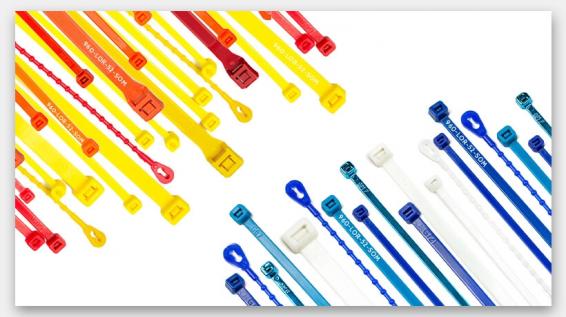
In complex electrical assemblies, a single misidentified cable can trigger hours of troubleshooting, a failed inspection, or a costly recall. Custom printed cable ties solve this problem at the source — embedding identification directly onto the fastener that already secures the bundle. For OEMs, harness manufacturers, and MRO teams, this means no separate labels to peel, no markers to smudge, and no ambiguity on the production floor.
As a B2B manufacturer of electrical identification and fastening solutions, TONFUL has produced custom printed cable ties for automotive harnesses, solar installations, data centers, and food-processing lines. This guide distills the engineering and procurement considerations that determine whether a printed tie performs for a season or for the life of the equipment.
What Are Custom Printed Cable Ties?
Custom printed cable ties are standard nylon or stainless steel cable ties onto which text, logos, serial numbers, barcodes, or QR codes are permanently applied during manufacturing. Unlike aftermarket labels or marker flags, the identification is integrated into the tie strap itself — typically on a flat, enlarged identification area near the head or along the strap.
The printing carries functional data: part numbers, date codes, voltage ratings, installation warnings, or asset-tracking identifiers. It also carries brand data: company logos, websites, or color-coded legends. The result is a single component that fastens and identifies simultaneously. For a broader overview of tie categories and their uses, see our guide to what cable ties are used for.

Benefits of Custom Printed Cable Ties
The value of printing on the tie rather than adding a separate label is measurable across four dimensions.
Permanent identification. Hot-stamped and laser-etched markings are physically embedded in the polymer surface. They resist abrasion, moisture, UV exposure, and common solvents — conditions that degrade adhesive labels within months. For outdoor or high-temperature automotive applications, this permanence directly reduces rework.
Tamper evidence. A printed tie that is cut or removed leaves an obvious gap in the identification sequence. This makes custom printed ties effective as tamper-evident security seals for logistics, clinical waste, and asset-tracking chains where evidence of interference matters. Explore our general cable tie catalog for security-graded options.
Labor efficiency. Applying a pre-printed tie is a single motion. Applying a plain tie plus a separate marker sleeve or label is two motions plus a curing or seating step. Across thousands of terminations in a wire harness assembly, the time difference compounds into measurable cost — and proper wire harness protection methods preserve both the bundle and the printed identification.
Brand and compliance visibility. Printed ties carry installer identity, certification marks, and traceability data into the field — supporting ISO 9001 traceability, IPC/WHMA-A-620 compliance, and aftermarket service workflows.
| Benefit | Plain Cable Tie + Label | Custom Printed Cable Tie |
|---|---|---|
| Marking permanence | 6–18 months (adhesive failure) | 3–10 years (embedded mark) |
| Application time per point | ~15 seconds (tie + label) | ~5 seconds (tie only) |
| Tamper evidence | None | Sequential numbering reveals gaps |
| Field rework rate | Higher (label loss) | Lower |
| Unit cost (bulk) | Lower | Marginally higher, lower total cost of ownership |
Printing Methods: Hot Stamping, Laser Etching, and Inkjet
Three printing technologies dominate custom cable tie production. Each alters the tie surface differently, and the choice depends on material, data variability, volume, and environmental exposure.
Hot stamping uses a heated metal die to press pigmented or metallic foil onto the nylon strap under controlled temperature and pressure. The foil transfers into the surface, leaving a slightly raised, high-contrast mark. It is the workhorse for high-volume OEM orders with fixed legends — logos, part numbers, company names — because the die is expensive to produce but cheap to run once made. Hot stamping supports multi-color foil and works across standard PA66 nylon cable ties, but it cannot pause mid-run for variable data, and resolution limits make it unsuitable for dense 2D barcodes.
Laser etching directs a focused beam onto the tie surface, vaporizing a thin layer of polymer to create a permanent, recessed mark. Because it is non-contact and digitally controlled, laser etching excels at variable data — sequential serial numbers, date codes, QR codes — with no die changes between batches. The mark is flat, abrasion-proof, and chemically inert. It is the preferred method for stainless steel cable ties and for ETFE (Tefzel) ties used in chemical and high-temperature environments. The trade-off is monochrome output and higher equipment cost.
Inkjet marking sprays micro-droplets of ink onto the strap surface. Like laser, it is non-contact and supports instant content changes, making it ideal for serialized asset tags and barcode printing. UV-cured inkjet formulations achieve good outdoor durability. However, inkjet marks sit on the surface rather than being embedded; under aggressive abrasion or chemical exposure, the ink can wear away, whereas a hot-stamped indent or laser-etched recess remains legible.

| Method | Mechanism | Durability | Variable Data | Best Material | Typical Use |
|---|---|---|---|---|---|
| Hot stamping | Heated die + foil transfer | High (raised, embedded) | No (fixed die) | PA66 nylon | Logos, part numbers, high-volume OEM |
| Laser etching | Beam vaporizes polymer | Very high (recessed) | Yes (digital) | Nylon, stainless, ETFE | Serial numbers, QR codes, harsh environments |
| Inkjet | Ink droplets on surface | Moderate (surface layer) | Yes (digital) | Nylon, colored ties | Barcodes, date codes, short-run variable data |
| Pad printing | Silicone pad transfers ink | Moderate | Limited | Nylon, flat straps | Multi-color logos, promotional ties |
Material Compatibility
The substrate determines which printing methods are available and how the mark performs over time.
PA66 (Nylon 6/6) is the most common substrate. It accepts hot stamping, laser etching, and inkjet equally well, and its natural off-white surface provides excellent print contrast. For UV-exposed installations, UV-stabilized black PA66 preserves both mechanical strength and print legibility. Proper moisture content control during printing is essential — brittle, over-dried nylon cracks under die pressure, while over-moist nylon deforms.
Stainless steel ties (SS304 and SS316) cannot be hot stamped. Laser etching is the standard, producing a dark, permanent mark that survives extreme heat, fire, and chemical exposure. These ties are specified in marine and offshore applications and in plenum-rated installations where polymer ties are prohibited. For load comparisons, see our stainless steel vs plastic cable ties analysis.
ETFE (Tefzel) ties serve chemical processing and radiation environments. Laser marking is the only viable method; the resulting mark is chemically inert and retains readability where nylon would degrade.
Specialty polymers extend printing into regulated spaces. Metal-detectable cable ties for food and pharmaceutical lines accept laser and inkjet marking while maintaining detectability. Cold-weather-grade ties retain print adhesion at sub-zero temperatures where standard nylon embrittles.

Applications Across Industries
Custom printed cable ties earn their place wherever identification must survive the same conditions as the bundle itself.
Automotive and commercial vehicles. Engine bay harnesses, ECU wiring, and lighting circuits use printed ties carrying circuit IDs, date codes, and OEM part numbers. The markings must withstand heat soak, oil mist, and vibration — conditions where wire harness protection is already a design priority. Printed edge-clip cable ties mount directly onto panel edges while carrying identification, combining routing and labeling in one step. For heavier vehicles, see our heavy-duty truck combination switch and push-mount vs fir-tree tie resources.
Solar and renewable energy. Outdoor arrays use UV-stabilized printed ties for string identification and installer traceability over 25-year service lives. The Nylon 66 vs Nylon 12 solar cable tie selection directly affects whether the print remains legible after two decades of UV exposure. Edge-clip cable ties for solar and automotive are a common specification here.
Data centers and telecommunications. High-density cabling demands rapid, unambiguous identification. Printed ties with sequential numbering and QR-code laser etching allow technicians to scan and trace individual runs without separate label stock. Push-mount and fir-tree ties with printed IDs anchor bundles to server frames while labeling each run.
Food, pharmaceutical, and medical. Metal-detectable printed ties carry batch codes and compliance marks while remaining detectable by inspection equipment. Clinical waste sealing uses serialized printed ties as tamper-evident seals.
Marine and offshore. SS316 laser-etched ties mark subsea and deck-level cabling where salt spray and UV would erase any adhesive label within months. For installation tooling, refer to our stainless steel zip tie tool guide.

How to Specify Custom Printed Cable Ties
A clear specification shortens lead time and prevents print-quality disputes. Procurement teams should define seven parameters before issuing an RFQ.
- Material and grade — PA66 natural, UV-black, SS304, SS316, ETFE, or metal-detectable compound.
- Tie dimensions — length, width, and minimum loop tensile strength. Standard sizes range from 100 mm to 1,000 mm; heavy-duty variants exceed 1,112 N. See also how much weight a zip tie can hold.
- Print method — matched to material and data type (see comparison table above).
- Print content — exact artwork, font, logo vector file, serial number format, barcode symbology, and QR code destination URL.
- Print position and area — head flag, strap center, or full-length printing. Minimum QR code area is 15 mm × 15 mm for reliable scanning.
- Color — strap color and print color, including RAL/Pantone references for brand consistency.
- Certifications — UL94 V-2 flammability, RoHS, REACH, UL 2043 plenum rating where applicable.
For distributors evaluating Panduit cable tie alternatives, specifying these parameters in writing is the single most effective way to compare equivalent offerings across manufacturers. Finished ties can be packed into assorted boxes for field deployment alongside electrical tools.

Printed Cable Ties vs. Labels vs. Marker Sleeves
| Criterion | Custom Printed Cable Tie | Adhesive Label | Heat-Shrink Marker Sleeve |
|---|---|---|---|
| Application speed | Fastest (one step) | Slow (separate step) | Moderate (requires heat) |
| Environmental durability | High (embedded mark) | Low–moderate (adhesive) | High (shrunk onto cable) |
| Tamper evidence | Strong (sequential) | Weak | Weak |
| Reusability | Single-use (except releasable ties) | Single-use | Single-use |
| Best for | High-volume OEM, field ID, security | Office, low-stress indoor | Dense harness ID, custom printed heat shrink |
FAQ
What is the minimum order quantity for custom printed cable ties? Typical MOQ is 3,000–10,000 pieces for hot-stamped ties (die cost amortization) and lower for laser or inkjet variable printing, since no die is required. TONFUL supports assorted box packaging for distribution and retail-ready kits.
Can barcodes and QR codes be printed on cable ties? Yes. Laser etching and high-resolution inkjet produce scannable 1D and 2D codes. The print area should be at least 15 mm × 15 mm for QR codes. Hot stamping lacks the resolution for dense 2D codes.
How long does the printing last? Hot-stamped and laser-etched marks last the service life of the tie — typically 5–10 years indoors and 3–7 years for UV-stabilized outdoor installations. Inkjet durability ranges from 2–5 years depending on ink formulation and exposure. Storage conditions also matter; see our cable tie moisture content and storage guide.
Which printing method is best for stainless steel cable ties? Laser etching is the only practical method. It produces a permanent, chemically inert mark suitable for marine and high-temperature applications. Refer to our SS304 vs SS316 guide for grade selection.
Can custom printed ties be reused? Standard ties are single-use. Releasable cable ties can be opened and re-fastened, and they accept printing for reusable identification in prototyping and temporary installations.
Conclusion
Custom printed cable ties combine fastening and identification into a single, permanent component. Choosing the right printing method — hot stamping for high-volume fixed legends, laser etching for variable data and harsh environments, inkjet for short-run barcodes — depends on material, data type, and service conditions. When specified correctly, they reduce labor, improve traceability, and carry brand identity into the field for the life of the installation.
For production volumes or custom specifications, contact TONFUL to discuss material selection, print-method validation, and OEM packaging.