
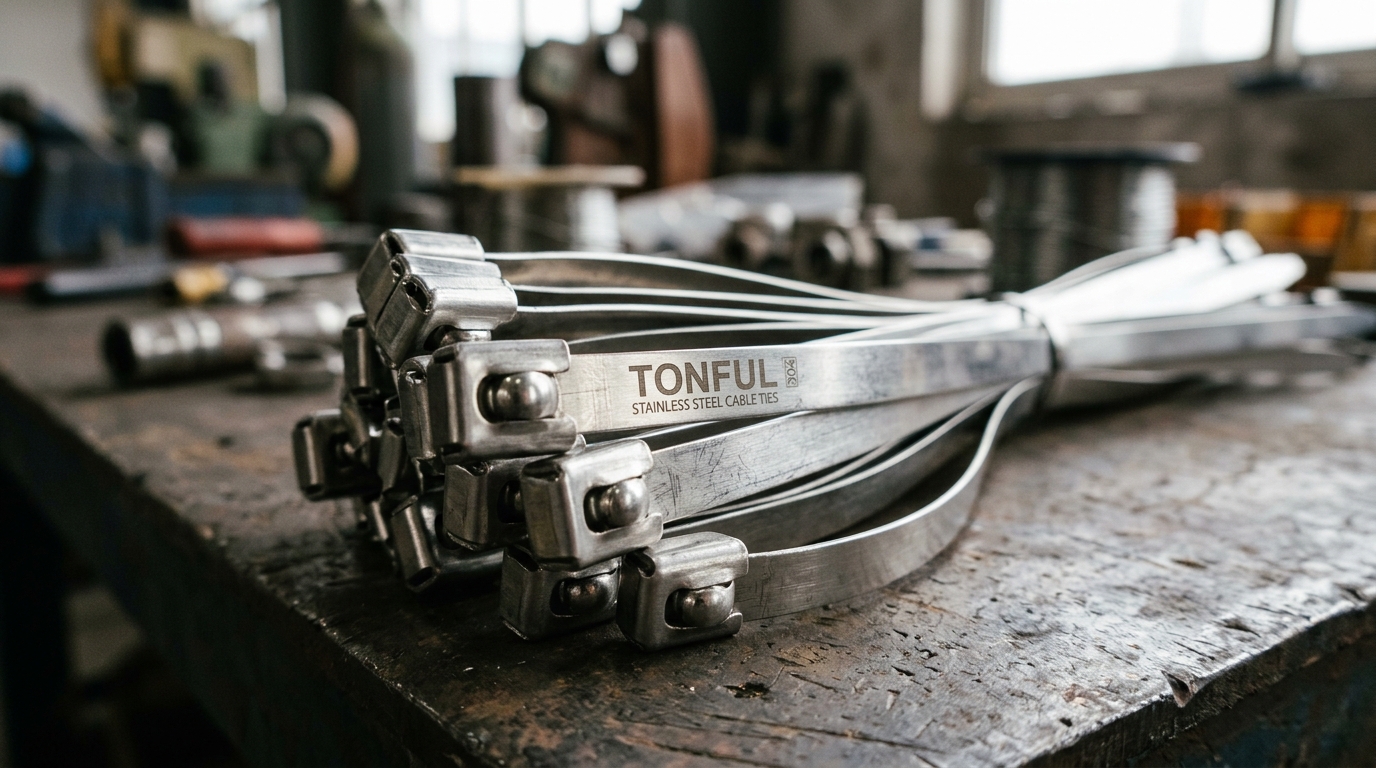
Stainless steel cable ties are non-releasable metal fastening straps engineered to bundle, secure, and route cables, hoses, and components in environments where conventional nylon zip ties degrade, melt, or snap. Built from 304 or 316 grade stainless steel with a self-locking ball mechanism, they deliver tensile strengths from 80 lb to 660 lb (40–300 kg) and survive continuous temperatures from −80°C to +538°C (−112°F to +1000°F). For B2B buyers specifying fasteners for marine, HVAC, solar, oil and gas, or food-processing projects, understanding how these ties are constructed, graded, and installed is the difference between a 20-year installation and a premature failure on the job site.
As a specialized stainless steel cable ties manufacturer, TONFUL Electric produces this guide to help engineers, procurement teams, and MRO distributors make informed specifying decisions.
How Stainless Steel Cable Ties Work
Every stainless steel cable tie shares three structural elements: a flexible steel band, a formed head housing a captive stainless steel ball, and a smooth or coated surface finish. The band is rolled from cold-rolled stainless strip, typically 4.6 mm to 15 mm wide and 0.25 mm to 0.40 mm thick. The head is either rolled from the same strip (one-piece design) or welded on as a separate buckle.
The locking principle is mechanical, not friction-based. When the free end of the band is threaded through the head and pulled, the captive ball rolls along a ramp inside the head. As tension increases, the ball wedges between the band and the head wall, biting into the metal and preventing reverse motion. This is why stainless ties are one-way devices: once locked, they hold until cut.

Stainless Steel Grades: 304 vs 316
The grade of stainless steel determines where a tie can be used. Both 304 and 316 are austenitic stainless steels, but 316 adds 2–3% molybdenum, which dramatically improves resistance to pitting and crevice corrosion in chloride environments.
| Property | SS 304 | SS 316 |
|---|---|---|
| Composition | 18% Cr, 8% Ni | 16% Cr, 10% Ni, 2–3% Mo |
| Tensile Strength | 80–250 lb (standard) | 80–660 lb (up to heavy-duty) |
| Temperature Range | −80°C to +538°C | −80°C to +538°C |
| Salt Spray Resistance | Moderate (coastal < 1 km) | Excellent (direct seawater) |
| Chloride / Acid Resistance | Limited | Superior (Mo addition) |
| Typical Cost | Lower | ~15–25% premium |
| Best For | General industrial, indoor, HVAC | Marine, offshore, chemical, food |
| Agency Approvals | Not listed | Listed (UL, CE, ABS, DNV) |
For a deeper metallurgical comparison — including pitting resistance equivalent numbers (PREN) and chloride threshold values — see our 304 vs 316 stainless steel cable ties guide. If your project involves saltwater immersion, chemical washdown, or coastal exposure within 1 km of the shoreline, 316 is non-negotiable; 304 will pit and stain within months.

Types of Stainless Steel Cable Ties
Beyond the base grade, manufacturers offer several construction variants tuned to specific duty classes and protection requirements.
| Type | Coating | Tensile Range | Typical Width | Primary Use Case |
|---|---|---|---|---|
| Standard Ball-Lock | Uncoated (naked) | 80–200 lb | 4.6 / 7.9 mm | General industrial bundling |
| Heavy-Duty Ball-Lock | Uncoated | 250–350 lb | 7.9 / 9.5 mm | Large cable bundles, hoses |
| Extra Heavy-Duty | Uncoated | 350–660 lb | 12 / 15 mm | Signage, structural, utility poles |
| PVC-Coated | Black PVC over 304/316 | 80–120 lb | 4.6 / 7.9 mm | Delicate cable jackets, galvanic isolation |
| Epoxy-Coated | Green/black epoxy | 100–200 lb | 4.6–7.9 mm | Outdoor, damp, vibration environments |
| Ladder / E-Type | Uncoated, perforated | 150–350 lb | 7.9–12 mm | High-vibration, re-tensionable needs |
| Identification (Flag) | Uncoated with tag | 80–150 lb | 4.6 mm | Asset tagging, wire marking |
Coated variants deserve a note. A PVC or epoxy layer serves two purposes: it cushions delicate cable jackets against the hard metal edge, and it interrupts galvanic corrosion between dissimilar metals. When a stainless tie grips a copper or aluminum cable directly in a wet environment, the electrochemical potential difference can accelerate corrosion at the contact point — the coating breaks that circuit. Coated ties are also easier to distinguish visually from nylon ties on a busy job site.

Key Advantages Over Plastic Cable Ties
The case for stainless steel ties over nylon 6/6 comes down to four failure modes that plastic cannot survive:
Temperature. Nylon 6/6 softens around 85°C and melts near 260°C. It also becomes brittle below −40°C. Stainless ties operate from −80°C to +538°C without mechanical change, making them the only valid choice near engine exhausts, industrial ovens, cryogenic lines, and outdoor installations in extreme climates.
UV and weathering. UV-stabilized nylon lasts 5–10 years outdoors before embrittlement. Stainless steel is impervious to UV and will outlast the assets it secures — often 20+ years with no measurable strength loss.
Fire resistance. Stainless ties are non-flammable and carry fireproof ratings. In plenum spaces, escape routes, and tunnels, cable tie selection is a life-safety decision, not just a convenience.
Chemical and mechanical toughness. Acids, alkalis, solvents, salt spray, rodent attack, and vibration fatigue that destroy nylon have negligible effect on properly graded stainless. For a full side-by-side breakdown, see our stainless steel cable ties vs plastic cable ties comparison.
| Failure Mode | Nylon 6/6 | Stainless Steel 316 |
|---|---|---|
| Max Continuous Temp | 85°C | 538°C |
| Min Continuous Temp | −40°C | −80°C |
| UV Outdoor Lifespan | 5–10 years | 20+ years |
| Flammability | Flammable (UL 94V-2) | Non-flammable |
| Salt Spray (ASTM B117) | Fails < 500 h | 3000+ h |
| Tensile Strength (typical) | 18–50 lb | 80–660 lb |
| Rodent / Animal Resistance | Poor | Excellent |
Industrial Applications
Stainless steel cable ties are specified wherever failure carries a cost — financial, safety, or operational. The table below maps common industries to the recommended grade and type.
| Industry | Recommended Grade | Recommended Type | Why |
|---|---|---|---|
| Marine & Shipbuilding | 316 | Uncoated / PVC-coated | Saltwater immersion, ABS/DNV approvals |
| Oil, Gas & Petrochemical | 316 | Epoxy-coated | H2S, acids, extreme weather |
| HVAC & Refrigeration | 304 / 316 | Standard ball-lock | Vibration, insulated ductwork |
| Solar PV | 304 / 316 | UV-rated uncoated | 25-year outdoor lifespan required |
| Power Generation | 316 | Heavy-duty | High temp, radiation, vibration |
| Food & Pharmaceutical | 316 | Uncoated, FDA-compliant | Washdown, hygiene, no polymer leaching |
| Automotive & Heavy Truck | 304 | PVC-coated | Under-bonnet heat (200°C+), chafing |
| Mining & Tunnels | 316 | Heavy-duty | Abrasion, moisture, chemical exposure |
| Construction & Signage | 304 | Extra heavy-duty | Structural loads, wind, weather |
| Aerospace & Defense | 316 | Custom / certified | Extreme reliability, traceability |

Installation and Tensioning
A stainless steel tie is only as reliable as its installation. Hand-tightening is acceptable for light bundles under 50 kg, but any load-bearing or vibration-exposed application requires a dedicated tensioning tool. The tool pulls the band to a preset tension, then cuts the excess flush — leaving a flat, safe edge rather than a sharp protruding stub that could injure technicians or abrade adjacent cables.

Key installation rules:
- Choose the right width. 4.6 mm for light bundles, 7.9 mm for most industrial work, 12–15 mm for structural or heavy-hose applications. Match tensile rating to bundle weight with a 3× safety margin.
- Use the tool. Manual tensioning is inconsistent. A calibrated tensioning gun hits the spec’d force every time and cuts clean.
- Mind the cut. A flush cut prevents injury and abrasion. A jagged stub on a vibrating bundle will saw through neighboring cable jackets.
- Store dry. Although stainless won’t rust in storage, moisture affects the packaging and the tool. See our cable tie moisture content and storage guide for distributor best practices.
- Don’t reuse. Once a ball-lock tie is tensioned, the ball has bitten the band. Removing and re-tightening compromises the lock. For applications needing re-entry, consider releasable cable ties instead.
For detailed tool operation, including how to set tension on different widths, see our guide on how to use a stainless steel zip tie tool.
How to Choose the Right Stainless Steel Cable Tie
Selection comes down to four questions:
- What environment? Indoor/general → 304. Marine, chemical, food → 316.
- What load? Match tensile strength to 3× the bundle weight. Our cable tie tensile strength guide walks through the calculation.
- What temperature? Anywhere near engines, exhausts, ovens, or cryogenics → stainless, not nylon.
- What surface? Delicate jackets or dissimilar metals → coated variant.
Related products that often accompany stainless ties in industrial BOMs include edge clip cable ties for panel-edge routing and automotive electrical connectors for harness assembly.
FAQ
Are stainless steel cable ties reusable? No. The ball-lock mechanism bites the band permanently once tensioned. Removing a tie requires cutting it. For re-entry needs, use releasable plastic ties or ladder-style metal ties that allow re-tensioning.
What is the difference between 304 and 316 stainless steel cable ties? 316 contains 2–3% molybdenum, giving it far superior resistance to chloride pitting, saltwater, and acidic chemicals. 304 is adequate for general industrial use; 316 is required for marine, food, and chemical environments.
What temperature can stainless steel cable ties withstand? Most 304/316 ball-lock ties operate continuously from −80°C to +538°C (−112°F to +1000°F). PVC-coated variants are limited by the coating to −40°C to +85°C.
How strong are stainless steel cable ties? Tensile strength ranges from 80 lb (36 kg) for 4.6 mm standard ties up to 660 lb (300 kg) for 15 mm × 0.35 mm heavy-duty ties. Always specify a tie rated at least 3× the expected bundle load.
Do stainless steel cable ties rust? 304 can stain and pit in chloride environments. 316 is highly corrosion-resistant and suitable for direct saltwater exposure. Both can experience surface oxidation above 800°C, well beyond their rated working range.
Can stainless steel cable ties be used outdoors? Yes. They are UV-proof, weatherproof, and fireproof — ideal for solar, signage, utility, and outdoor infrastructure projects with 20+ year service lives.
What tool do I need to install stainless steel cable ties? A dedicated stainless steel cable tie tensioning tool (manual or automatic) that tensions to spec and cuts the excess flush. Hand tools work for light-duty work; pneumatic or battery tools are used for high-volume production.
Conclusion
Stainless steel cable ties are the engineered answer when plastic fails. By combining 304 or 316 austenitic stainless steel with a self-locking ball mechanism, they deliver tensile strength, temperature range, and corrosion resistance that no polymer tie can match. Specifying the correct grade, width, coating, and installation method — backed by a reliable manufacturer — ensures your bundling solution lasts the full life of the asset it secures.
TONFUL Electric manufactures 304 and 316 stainless steel cable ties in standard, heavy-duty, coated, and custom configurations, with full traceability and export-grade quality control. Contact us to discuss your project specifications, or explore our complete cable tie product line.