
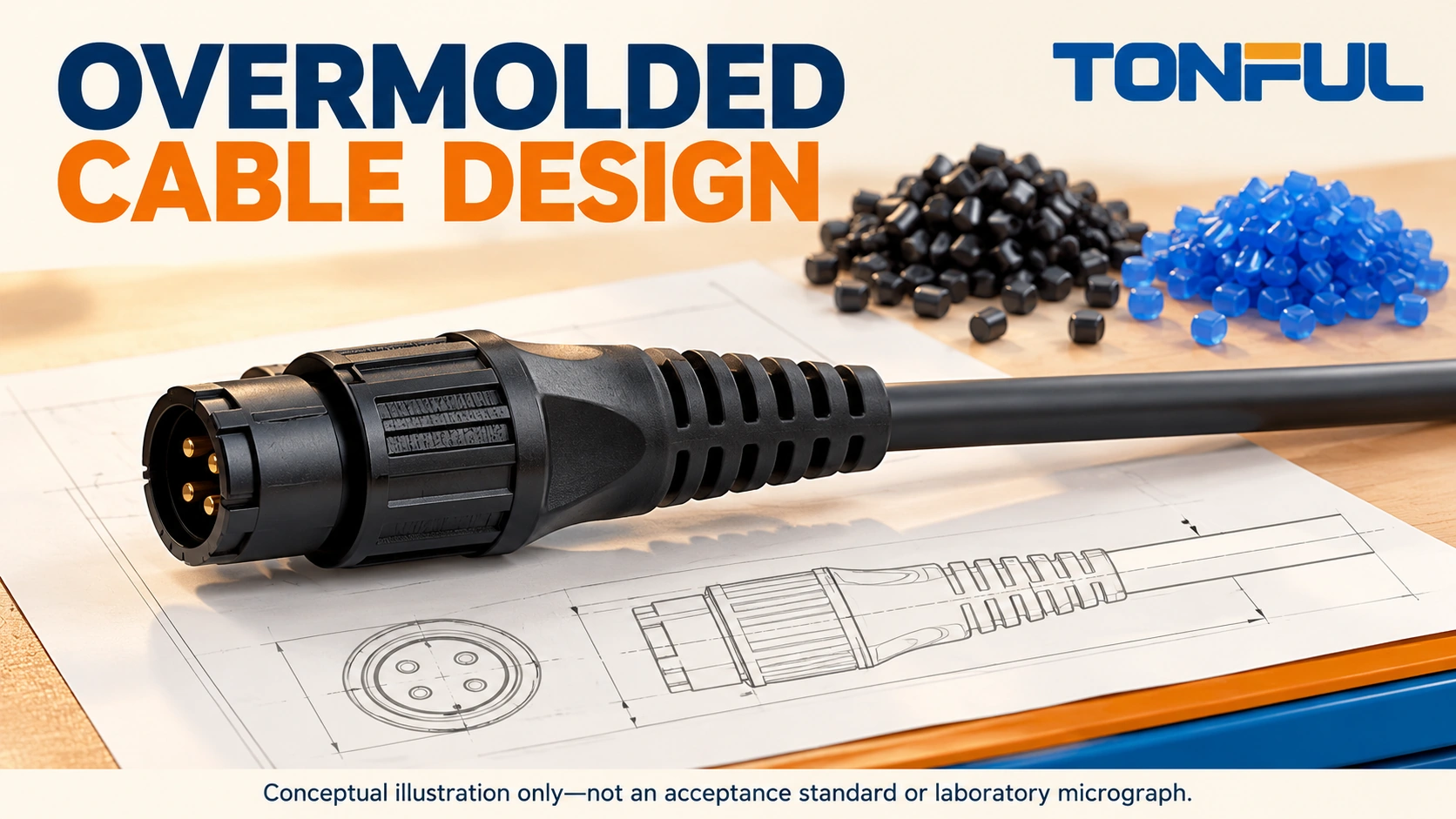
An overmold can make a cable transition easier to handle, protect a joint and move bending away from a termination. It can also conceal an assembly defect, trap an incompatible material interface or create a rigid boundary that concentrates strain. The outside shape is therefore only one part of the design decision.
Specify an overmolded cable assembly as a controlled combination of connector, cable, internal termination, molding material, tooling and process. Decide which functions the molded feature must provide and which remain the responsibility of other components. A molded boot does not automatically establish waterproof performance, electrical insulation compliance or fatigue life.
On this page: Functional scope, Materials and tooling, Assembly controls, Validation, TONFUL enquiry.
Define the Overmold’s Functional Scope
Separate grip, strain relief and sealing
A grip provides a handling surface. Strain relief manages mechanical loads between the cable and connector. A sealing feature restricts ingress across a defined interface. These functions can share the same molded body, but each needs its own requirement and evidence. A comfortable grip does not demonstrate adequate axial retention; a successful pull test does not prove resistance to moisture.
Identify the complete load path. State where the installer pulls, where the cable is supported and which feature prevents force from reaching the conductors or terminals. A cable jacket captured inside an overmold may transfer axial load differently from a design relying on adhesion. Review both approaches against the actual jacket and connector geometry.
Molex’s custom cable assembly overview describes overmolded strain relief at connector and cable interfaces. This supports the application concept, not a universal pull-force limit or a claim that an untested TONFUL design matches another manufacturer’s performance.
Define access and movement
Record whether the assembly is fixed, occasionally handled or repeatedly moved. Include the cable exit direction, available bend space and nearby panel or enclosure. The transition must not prevent connector engagement, latch operation or access to fasteners. Check clearance in the installed system rather than only against a standalone connector drawing.
Decide whether the finished connector can be repaired. An overmold may make terminal replacement impractical, so the service strategy may require replacement of the entire cable. Put that boundary into the purchasing specification. Do not promise repairability based on a connector family that becomes inaccessible after molding.
Review Materials, Tooling and Process
Material compatibility is interface-specific
Select an exact polymer grade, not only a broad label such as PVC, TPE or polyurethane. Obtain the material’s relevant processing and application data, then assess compatibility with the cable jacket, connector housing, seals, markings and any internal encapsulant. Similar material names do not guarantee adhesion or resistance to the same fluids.
Define the intended bonding mechanism. Some interfaces depend on material adhesion, some use mechanical capture, and others combine both. Surface contamination, mold-release residue or jacket formulation changes can alter the result. Specify preparation and storage controls where necessary; adding an uncontrolled cleaning solvent can itself damage the jacket or affect the interface.
Review operating exposure separately from molding exposure. A finished cable may tolerate the service environment yet be damaged by the temperature, pressure or handling of the molding cycle. Check insulation deformation, displacement of internal wires and connector insert movement. Do not assign a service-temperature range from the overmold material alone.
Tooling decisions need measurable outputs
Define the molded envelope, cable exit angle, grip surfaces, parting line, permitted flash areas and interface dimensions. Specify which dimensions affect installation and how they will be measured. A cosmetic drawing without tolerances is insufficient for tooling acceptance. Conversely, avoid adding tight tolerances to surfaces that have no functional reason for them.
Tooling ownership and technical approval are separate decisions. Identify who owns the mold, who may authorize repairs or changes, how cavity identity is recorded and where maintenance records are retained. Establish whether sample tooling and production tooling differ. An approved prototype appearance does not automatically approve a different production cavity.
| Design decision | Information to agree | Evidence before release |
|---|---|---|
| Material interface | Exact molding grade, jacket and housing | Compatibility review and applicable test results |
| Mechanical load path | Capture, adhesion and support geometry | Pull and bending results for the defined fixture |
| Sealing boundary | Interfaces, mating state and exposure | Complete assembly ingress evaluation |
| Tooling envelope | Dimensions, exit direction and clearance | Measured sample and installation review |
| Production process | Controlled parameters and cavity identity | Approved setup and traceable production records |
| Service strategy | Replaceable item and access limits | Installation and removal trial |

Establish a process window, not a single appearance
The approved process should identify the parameters that can influence fill, bonding and component damage. Their actual settings belong in controlled manufacturing records, not in a generic blog recipe. Define setup approval, first-piece checks and the response to interrupted production, material changes or cavity maintenance.
Inspect features associated with incomplete fill, voids, flash, insert displacement and cable misalignment. A visually clean surface can still conceal an unsuitable interface. Where internal examination is required, specify the technique, section location, sample allocation and acceptance source. A conceptual cutaway image cannot replace that evidence.
Control the Joint Before and After Molding
Inspect what will become inaccessible
Complete the applicable terminal, crimp, solder-joint, shield and insulation checks before encapsulation. Record the assembly revision and inspection result so that a later molding record can be linked to the internal construction. The crimp validation guide explains why a pull result alone does not establish every aspect of crimp quality.
Pre-molding electrical checks should cover the approved circuit map, unintended connections and any relevant shield path. The continuity testing guide helps define that coverage. After molding, repeat the required checks to detect damage or displacement introduced by the process. Passing before molding is not a reason to omit the final inspection.
Use approved fixtures and protected interfaces for electrical testing. Confirm whether attached electronics, suppression devices or communication components require different test conditions. Do not apply a generic insulation-resistance or dielectric test voltage to a cable assembly containing components whose limits are unknown.
Maintain lot and revision traceability
Link the finished assembly to cable, connector, terminals, molding material and relevant tooling records. Define label placement before molding so that identification remains legible and does not interfere with the functional interface. If an internal label is no longer visible, establish another controlled way to retain its identity.
The wire harness manufacturing process places these records within the assembly sequence. A substitution in jacket material, connector housing or molding grade should trigger a documented impact review. An unchanged outer shape is not proof that the previous bonding, sealing or mechanical results remain valid.

Validate the Complete Transition
Mechanical and environmental tests need boundaries
Specify axial loading direction, grip positions, loading rate, conditioning and failure definition for retention testing. Define whether acceptance concerns cable movement, separation, electrical interruption or another documented result. Do not use an arbitrary force as a universal overmold standard. Fixture contact must not create a failure unrelated to the intended installation.
Bending evaluation needs the actual bend location, radius, angle, frequency, cable restraint and monitoring method. Test the transition as installed where practical. A stiff boot can move the first bend into the adjacent cable, so examine that region as well as the molded body. State how intermittent interruptions will be detected and retained.
For sealing, identify the tested assembly boundary, mating state, cable ends and exposure conditions. Distinguish leakage through the overmold interface from leakage through an unmated connector or an open cable end. Any ingress classification must apply to the exact tested configuration; do not infer it from molding alone.
Use a copyable approval record
| Record field | Required entry |
|---|---|
| Assembly identity | Part number, revision, sample ID and lot |
| Interfaces | Connector, jacket, molding grade and preparation |
| Tooling | Mold and cavity ID, revision and setup record |
| Hidden inspection | Joint, shield and electrical evidence references |
| Installation | Exit direction, clearance, support and service method |
| Mechanical test | Fixture, conditions, raw result and acceptance source |
| Environmental test | Exposure, sample sequence and post-test observations |
| Electrical result | Initial and final checks, fixture and program revision |
| Disposition | Approved scope, deviations, reviewer and date |

Approve sample quantity and allocation before testing. Identify unaged references, sequential exposure samples and specimens reserved for destructive examination. Replacement samples require authorization and a reason; they must not silently erase a failed result. Preserve the original failure position, photographs and measurements before cutting or pulling the assembly apart.
Classify sample approval, tooling approval and production approval separately. A sample can establish installation suitability without proving process capability. A production-intent trial should demonstrate the required inspection coverage and traceability. Unresolved sealing or load-path evidence should restrict release, regardless of the visual finish.
At receiving inspection, compare the delivered assembly revision and lot with the approved record. Check the functional envelope and visible molding features using the agreed method; destructive checks should follow the authorized sampling plan rather than an improvised teardown. Preserve a controlled reference sample where appropriate, but do not let its appearance replace dimensional or electrical criteria. If a supplier proposes a tooling repair, ask which interface and process results may be affected before authorizing shipment. Document the required revalidation and distinguish temporary deviations from permanent drawing changes. This keeps production acceptance tied to the reviewed construction after the first successful sample.
Work With TONFUL on a Controlled Overmold RFQ
Send the connector and cable drawings, interface materials, installation envelope, movement duty and required evidence through TONFUL’s project enquiry channel. Include expected quantities, tooling ownership, sample timing and change-notification requirements rather than assuming standard commercial terms.
Discuss the overmold alongside the broader harness protection plan. Approve the exact construction and manufacturing scope that were reviewed. Keep claims about strain relief, sealing and durability tied to retained results, not to the presence of a molded boot.