
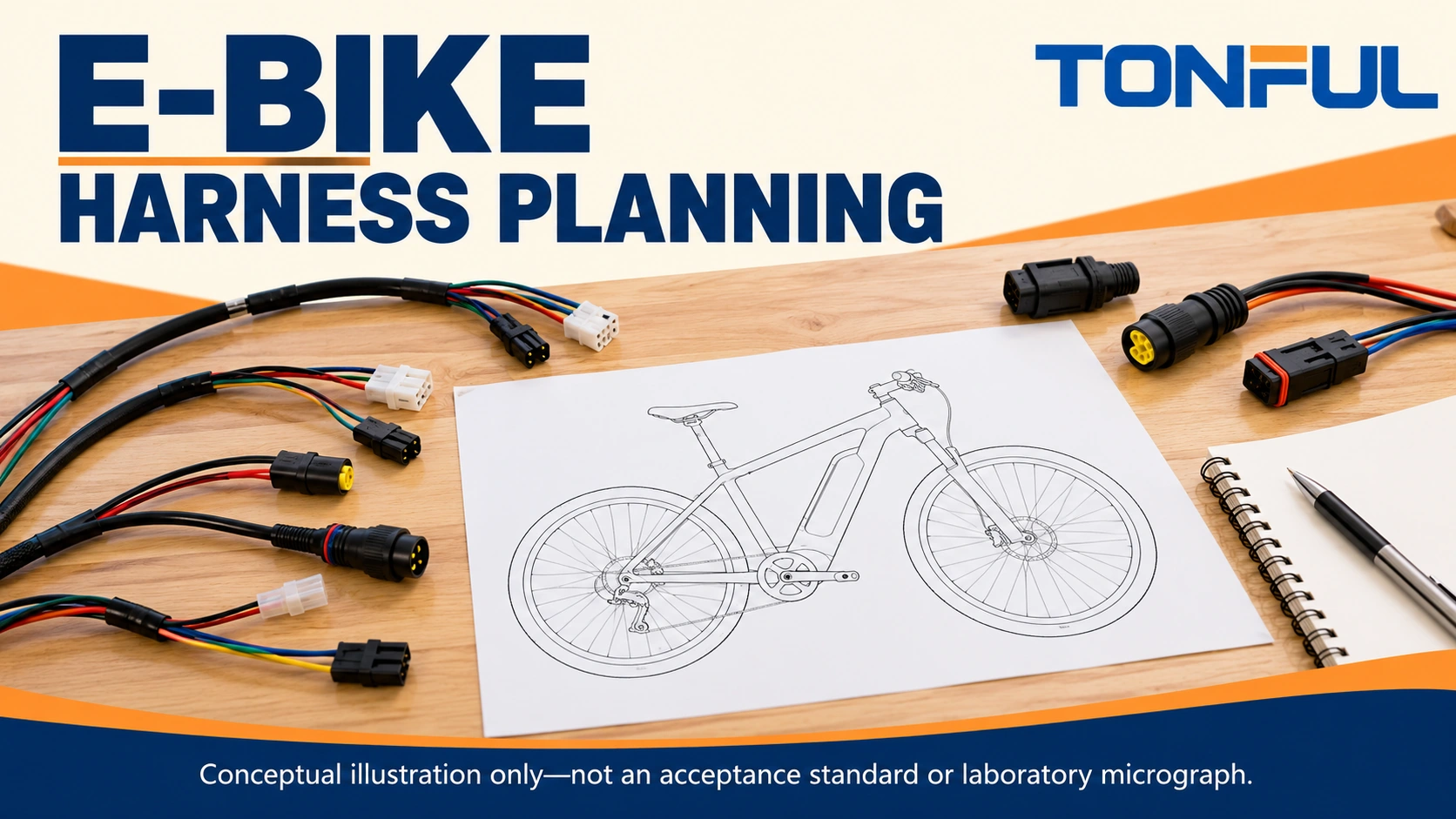
An e-bike harness connects components that do not all share the same voltage, current or signal role. Battery power, motor phases, position sensing, display communication and control inputs need separate interface definitions. Matching a plug’s shape or wire color does not establish compatibility, and a sealed connector cannot compensate for an incorrect electrical assignment.
Specify the harness around the complete approved e-bike configuration. This guide supports OEM procurement and engineering review; it is not a battery repair, charger modification or protection-bypass procedure. Battery and powered-system work should follow the manufacturer’s instructions and be performed by appropriately qualified personnel using the required isolation and test controls.
On this page: System scope, Connector choice, Routing, Validation, TONFUL enquiry.
Define the E-Bike System and Circuit Interfaces
Separate battery, phase and signal circuits
Record the battery, controller, motor, display, sensors and charger by exact part and revision. Identify the supply operating range and maximum conditions from controlled documentation, not only the nominal battery label. A motor controller can create circuit conditions different from the battery-side current, so phase and battery paths must not share an assumed rating.
For the battery interface, define polarity, current duty, protection, mating sequence and any required precharge or interlock arrangement. Starting, charging and abnormal conditions need explicit responsibility in the approved system design. Do not add an improvised resistor, bypass a protective contact or substitute a charger because the connector fits.
Motor-phase and sensor connections require their own assignment and test method. Phase order, sensor channels and connector identity should come from the actual system documents. The wire gauge selection guide helps review load and installed heating, but it cannot supply a universal e-bike conductor size or phase-current limit.
Define electronics and control behavior
Displays may use proprietary, serial or network communication alongside power. Record supply, ground, communication and wake functions separately. A matching contact count does not prove protocol or software compatibility. Identify the module and firmware configuration where it affects the interface.
Brake cutoffs, speed sensors, lighting and other inputs need a function matrix. State the expected electrical condition and system response for each defined input. Avoid inferring active level from wire color. A cable can pass continuity while connecting a safety-related input to the wrong controller channel.
Identify who owns compatibility and system approval. The harness supplier can verify a controlled circuit map and assembly requirements, while the system integrator must confirm behavior with the selected components. Keep any unresolved protocol, input-state or protection question open rather than declaring compatibility from a bench connection.
Select Connectors and Control the Sealing Boundary
Review load, retention and service together
Specify exact connector and contact parts, mating counterpart, keying, populated cavities and wire range. Review the manufacturer’s electrical and mechanical conditions against the actual circuit duty. A contact’s catalog rating is not automatically the allowable current of a densely bundled, enclosed assembly at its operating temperature.
For frequently removed batteries or service connections, define mating frequency, handling and retention evidence. Confirm whether the connector is permitted to mate or separate under load; do not assume hot-plug suitability. Establish the safe service sequence in the equipment instructions and prevent cable pull from becoming the normal removal method.
Check connector location and access with the battery, frame covers and accessories installed. A large connector may fit electrically but interfere with steering or removal. Review cable exit angle and supported transition using the overmolded cable guide. A boot must not prevent full engagement or conceal incomplete latching.
Sealing applies to a defined construction
Record seal identity, wire diameter, unused-cavity plugs, cable entry and mating state. Rain, road splash, cleaning and immersion are different exposures. Do not assign an IP rating from connector appearance or a water demonstration. Any rating must match the exact component and assembled test boundary.
Repeated handling can affect seals and contacts. Include inspection for damaged lips, contamination, jacket cuts and cable-entry movement where the validation plan requires it. An approved cleaning agent or lubricant needs material compatibility evidence. Ordinary tape wrapped around an unsuitable connector does not create a qualified sealed system.
| Interface | Requirement to define | Evidence before approval |
|---|---|---|
| Battery to controller | Voltage range, duty, polarity and protection | Circuit document and load validation |
| Controller to motor | Phase and sensor assignments | Controlled map and system function results |
| Display | Supply, communication and software scope | Interface specification and operating test |
| Brake or control input | State matrix and expected response | Input checks and system confirmation |
| Lighting | Supply, current and control method | Load and function evidence |
| Sealed transition | Mating state, seals and cable entries | Complete boundary inspection and exposure results |

Design Routing for Steering, Service and Exposure
Check the complete movement envelope
Route branches through the full permitted steering and suspension movement with representative parts. Identify the most constrained positions, not only straight-ahead alignment. Avoid tension at connector exits and contact with sharp frame openings. Define support locations, edge protection and the available service loop.
Internal frame routing needs an assembly sequence. Check whether connectors can pass through openings without damage and whether the finished cable can be inspected or replaced. Specify grommets and interfaces rather than assuming the frame edge is safe. Do not use a connector as a pulling handle through a hidden route.
The harness protection guide supports localized coverings for abrasion and noise. Added tubing or tape can change stiffness and clearances, especially near moving joints. A successful trial with an uncovered cable does not establish the fit of the protected production version.
Include handling and maintenance
Define battery removal, wheel service and accessory replacement operations that disturb the harness. Labels should identify the required interfaces without relying only on matching colors. Document permitted replacements and checks after reconnection. Avoid leaving a connector where a technician must pull on the wires to reach its latch.
List UV, temperature, moisture and cleaning exposure by location. A protected frame cavity can retain condensation even if it avoids direct rain. Review drainage and equipment boundaries with the system designer. Do not translate a material’s broad weather-resistance description into a whole-vehicle service-life claim.
Validate the Harness Within the Approved System
Component evidence is not system approval
UL’s e-bike electrical-system overview explains evaluation to UL 2849 at the e-bike electrical-system level. Use it to understand the system boundary, not to claim that a harness, connector or battery certificate automatically approves the complete bicycle. It does not establish a TONFUL certification.
Confirm which market and customer requirements apply to the finished product. Identify the exact component configuration covered by any supplied certificate and check changes against that scope. Supplier assembly evidence, system validation and formal certification are distinct records. The blog cannot replace the responsible authority’s determination of applicable requirements.
Build baseline and aged evidence
Start with identity, dimensions, connector seating, circuit map and relevant resistance or load measurements. The continuity testing guide covers opens, shorts and miswires. It does not establish adequate load temperature, contact retention, sealing or correct controller behavior.
Powered testing needs confirmed connections, appropriate protection and a documented safe setup. Do not apply external power to unidentified signal contacts. Resistance and continuity modes require an isolated circuit. Avoid tests that bypass battery protection or make a motor operate unexpectedly; follow approved equipment and system procedures.
For load evaluation, retain current duty, probe positions, temperature, voltage-drop boundary and acceptance source. Environmental and motion trials should reproduce the approved route and mating state. Inspect seals, contacts, supports and coverings afterward, then repeat the specified electrical and system functions. A final continuity pass alone is insufficient.

Copyable e-bike harness release record
| Record field | Required entry |
|---|---|
| System identity | Battery, controller, motor, display and revisions |
| Harness | Part, revision, sample ID and lot |
| Circuit map | Contacts, populated cavities and signal roles |
| Load | Supply range, phase/battery duty and protection |
| Functions | Brake, display, sensor, lighting and control matrix |
| Route | Steering, suspension, supports and service operations |
| Sealing | Exact seals, wire range, mating and exposure boundary |
| Validation | Sample plan, fixtures, conditions and raw results |
| System evidence | Operating configuration and approval responsibility |
| Disposition | Approved scope, deviations, reviewer and date |

Agree sample quantity, allocation and retest rules before execution. Reserve specimens for destructive analysis and retain failed items with their as-found route and mating condition. A replacement sample does not erase a failed result. Distinguish prototype fit, sample approval and production approval so that a development build does not silently become unrestricted supply authorization.
Control substitutions in contacts, plating, cable, seals and electronic interfaces. Even an unchanged external connector can have a different rating or circuit assignment. Receiving inspection should check revision, traceability, packaging and agreed functional coverage. Field-return analysis needs the vehicle configuration and installation history, not only the returned cable.
If a reported fault appears only during steering or over rough ground, preserve the route before moving the harness. Record controller diagnostics and the operating state, then inspect the relevant restraint and connector transition using the approved safe procedure. A symptom disappearing after reconnection does not confirm the root cause; it may reflect contact disturbance or a reset of the controller. Compare the as-found construction with the approved drawing and retain evidence of damaged seals, backed-out contacts or insulation wear. Close the issue only after the responsible feature is corrected and the required harness and system checks are repeated under comparable conditions.
Work With TONFUL on an E-Bike Harness RFQ
Share system drawings, component revisions, connector records, circuit duty, route and required evidence through TONFUL’s project enquiry channel. Identify who will approve electrical compatibility, environmental validation and complete-system compliance before ordering production quantities.
Release the exact documented construction for a defined e-bike configuration. Clear interface and safety boundaries give the supplier a measurable task and prevent connector appearance, sealing language or a standalone certificate from becoming an unsupported system claim.