
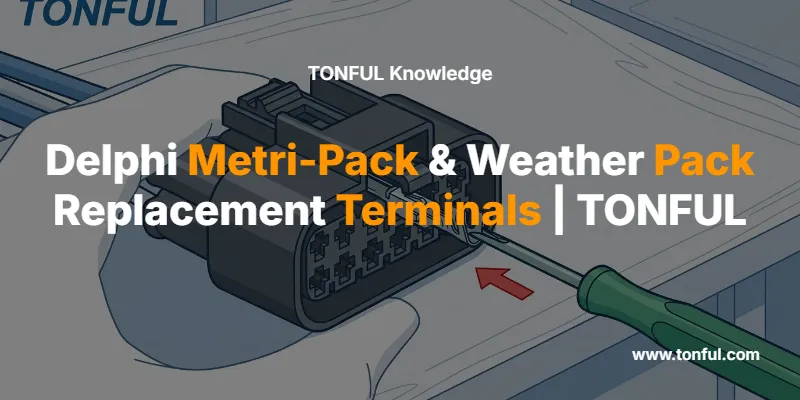
Whether you are repairing an OEM wiring harness or building a custom loom from scratch, sourcing the correct replacement terminals for Delphi Metri-Pack and Weather Pack connectors is critical to long-term electrical reliability. Both connector families—originally developed by Packard Electric and now manufactured under the Aptiv brand—remain the backbone of automotive, heavy-truck, and off-highway electrical systems worldwide. This guide provides engineers, fleet technicians, and B2B procurement specialists with the technical data needed to select, crimp, and validate drop-in replacement terminals from TONFUL Electric.

Understanding Delphi Metri-Pack and Weather Pack Connector Systems
The Delphi Metri-Pack family uses flat blade male terminals mated with box-style female receptacles. The series designation directly indicates blade width in tenths of a millimeter: the 150 series has a 1.5 mm blade, the 280 series a 2.8 mm blade, and so on. This standardized sizing lets engineers match current capacity to circuit requirements without over-sizing connectors.
Weather Pack connectors, by contrast, employ round pin-and-sleeve terminals in a push-to-seat housing design. They were engineered specifically for environmentally sealed connections in under-hood and exterior vehicle applications. For a deep-dive comparison of these two families, see our complete Weather Pack vs Metri-Pack Connectors Guide.
Both systems share a common material foundation: tin-plated copper alloy terminals housed in glass-filled PA66 (nylon 6/6) connector bodies rated for a service temperature range of −40°C to +125°C.
Metri-Pack Series Specifications at a Glance
| Specification | 150 Series | 280 Series | 480 Series | 630 Series |
|---|---|---|---|---|
| Male Blade Width | 1.5 mm | 2.8 mm | 4.8 mm | 6.3 mm |
| Max Current per Circuit | 14 A | 15 A | 20 A | 25 A |
| Primary Wire Gauge | 20–18 AWG | 18–14 AWG | 16–12 AWG | 14–10 AWG |
| Sealed Option | Yes | Yes | Yes | Limited |
| Terminal Seating | Pull-to-seat / Push-to-seat | Push-to-seat | Push-to-seat | Push-to-seat |
| Typical OEM Use | Low-current sensors, LED lighting | General-purpose engine bay | High-current actuators, fuel pumps | Starter/charging circuits |
The Delphi Metri-Pack 280 series is the most widely deployed variant in GM, Stellantis, and many European OEM platforms. Its 2.8 mm blade width matches the spacing used in mini automotive fuses (APM/ATM), which simplifies header-block integration. If you source automotive terminals and connectors in volume, the 280 series will likely account for the majority of your line items.

Weather Pack vs Delphi Metri-Pack: Side-by-Side Comparison
| Feature | Weather Pack | Delphi Metri-Pack (280 Series) |
|---|---|---|
| Terminal Geometry | Round pin (male) / sleeve (female) | Flat blade (male) / box receptacle (female) |
| Current Rating | 13–15 A | 15 A |
| Wire Gauge Range | 20–12 AWG | 18–14 AWG |
| Sealing Standard | IP67 (standard) | IP67 sealed / unsealed variants |
| Housing Material | PA66, glass-filled | PA66, glass-filled |
| Terminal Plating | Tin over copper | Tin over copper (gold option for signal circuits) |
| Locking Mechanism | Push-to-seat with tower/shroud | Push-to-seat with TPA + CPA |
| Connector Positions | 1–6 way | 2–12 way |
| Primary Application | Sealed exterior circuits | Device connections (sensors, ECUs, relays) |
Weather Pack excels where full perimeter sealing is non-negotiable—think trailer lighting, off-road LED bars, and marine bilge pump wiring. Delphi Metri-Pack dominates where higher pin density and device-level mating are required, such as connecting directly to throttle position sensors, ignition modules, and ECU headers. For projects involving sealed multi-pin connectors in harsh environments, Deutsch DT connectors offer another well-proven alternative.
Terminal Replacement Procedure
Replacing a damaged or corroded terminal inside a Delphi Metri-Pack or Weather Pack housing requires methodical steps and the right tools. Improper extraction is the leading cause of housing damage during field repairs. For general crimping fundamentals, our automotive electrical connector crimping guide covers best practices in detail.

Step-by-Step Replacement Process
- Release the secondary lock (TPA/CPA). On Metri-Pack housings, slide the TPA rearward or lift the CPA tab with a small flat-blade screwdriver. On Weather Pack, disengage the rear seal cover.
- Extract the terminal. Insert the correct removal tool into the front (mating face) of the connector. Depress the primary lance that retains the terminal, then pull the wire and terminal out from the rear.
- Inspect the housing cavity. Check for cracked lances, debris, or corrosion. A damaged cavity may require full housing replacement.
- Crimp the new terminal. Use the manufacturer-specified die set for the terminal series. Both conductor and insulation barrels must be crimped in a single stroke with a ratcheting tool.
- Install the cable seal (sealed connectors only). Slide the silicone seal onto the wire before crimping, then position it into the seal groove after the terminal is inserted.
- Seat and lock. Push the terminal into the housing until the primary lance clicks. Re-engage the TPA/CPA lock to prevent back-out.

Recommended Crimping Tools by Terminal Type
| Terminal Family | Recommended Tool Type | Die / Locator | Crimp Type |
|---|---|---|---|
| Metri-Pack 150 | Ratcheting hand crimper | Die 37A11017 | Single-action (terminal + seal) |
| Metri-Pack 280 | Ratcheting hand crimper | Die 37A11010 or 37A11015 | Dual-action |
| Metri-Pack 480/630 | Heavy-duty ratcheting crimper | Die 37A11019 | Dual-action |
| Weather Pack (20–16 AWG) | Seal-All ratcheting crimper | Integral Weather Pack die | Single-action |
| Weather Pack (16–12 AWG) | Heavy-duty ratcheting crimper | W-type die set | Dual-action |
Always perform a crimp pull-force test on the first terminal of each production lot. Minimum pull-force values range from 35 N for 22 AWG conductors to 110 N for 12 AWG conductors per USCAR-21 and SAE/USCAR-2 requirements. TONFUL replacement terminals are manufactured to meet or exceed these benchmarks, and our terminals and connectors manufacturing facility maintains in-line SPC monitoring on every stamping and plating run.
Terminal Plating Options
| Plating Type | Thickness (µm) | Contact Resistance | Best Application | Cost Index |
|---|---|---|---|---|
| Tin (Sn) | 2–5 | Moderate | General automotive power circuits | $ |
| Silver (Ag) | 1–3 | Low | High-current / high-temp engine bay | $$ |
| Gold (Au) | 0.5–1.5 | Very Low | Low-level signal / ECU data lines | $$$ |
Standard Delphi Metri-Pack replacement terminals use tin-over-copper plating, which balances corrosion resistance and cost for the vast majority of 12 V automotive circuits. For signal-integrity-critical applications such as CAN bus or sensor feedback loops, gold-plated variants reduce contact resistance below 5 mΩ. Learn how TONFUL’s plating processes compare against tier-one OEMs in our TE Connectivity vs TONFUL Electric comparison.

Industry Applications
Delphi Metri-Pack and Weather Pack replacement terminals serve far more than passenger cars. As a leading auto connector manufacturer, TONFUL supplies drop-in compatible terminals across multiple sectors:
- Heavy-duty trucking — Freightliner, Volvo, and Kenworth platforms use Metri-Pack 280 and 480 terminals extensively in chassis and engine harnesses.
- Agricultural & construction equipment — John Deere, AGCO, and Caterpillar OEM harnesses rely on sealed Metri-Pack and Weather Pack connections for sensor circuits exposed to dust, vibration, and water ingress.
- Marine — Weather Pack’s IP67 sealing makes it a staple for bilge pumps, navigation lighting, and helm electronics on boats rated for salt-spray environments.
- Industrial automation — Metri-Pack 150 and 280 terminals connect PLCs, solenoid valves, and proximity sensors on packaging and material-handling machinery.
For a broader look at how the world’s leading manufacturers address these markets, see our ranking of the top 5 crimp terminal manufacturers.
Quality Standards and Testing
Every TONFUL replacement terminal undergoes validation against international automotive standards:
- USCAR-2 / USCAR-21 — Performance requirements for automotive electrical connector systems, including terminal retention force, contact resistance, and thermal cycling.
- SAE J2030 — Environmental sealing tests for sealed connectors (dust and water immersion).
- IEC 60352-2 — Crimp connection requirements, including metallographic cross-section analysis.
- ASTM B117 — Salt-spray corrosion testing (minimum 96 hours for tin-plated terminals, 240 hours for marine-grade options).
Terminals are 100% dimensionally inspected using vision systems to verify blade width, crimp barrel I. D., and spring-contact geometry before shipment. Lot traceability from raw copper strip through plating and stamping is maintained in compliance with IATF 16949 quality management requirements.
FAQ
Are TONFUL terminals a direct drop-in replacement for original Delphi Metri-Pack terminals?
Yes. TONFUL manufactures replacement terminals to match the dimensional, material, and plating specifications of the original Aptiv (Delphi) Metri-Pack and Weather Pack designs. They seat into genuine housings without modification and meet the same USCAR-21 performance benchmarks.
Can I use the same crimping tool for both Metri-Pack and Weather Pack terminals?
No. Metri-Pack and Weather Pack terminals have different crimp barrel geometries—flat-blade barrels versus round-pin barrels—and require series-specific die sets. Using the wrong die will produce an under-compressed or over-compressed crimp that fails pull-force testing. See our crimping guide for tool selection details.
What is the difference between pull-to-seat and push-to-seat Delphi Metri-Pack terminals?
In a push-to-seat design, the crimped terminal is inserted from the rear of the housing and clicks past the primary lance. In a pull-to-seat design, the wire is threaded through the housing front-to-back, the terminal is crimped, and then pulled rearward until it locks. Pull-to-seat is common in Metri-Pack 150 sealed connectors with multi-wire rear seals.
How do I determine which Delphi Metri-Pack series I need?
Measure the male blade width with a caliper. A 1.5 mm blade indicates the 150 series, 2.8 mm the 280 series, 4.8 mm the 480 series, and 6.3 mm the 630 series. When in doubt, match the wire gauge and current requirement to the specifications table above.
Are sealed Delphi Metri-Pack terminals rated for direct burial or submersion?
Sealed Metri-Pack connectors achieve IP67 ratings (temporary submersion to 1 m for 30 minutes) when assembled with the correct cable seals and housing locks. They are not rated for continuous submersion (IP68). For underwater or direct-burial applications, Weather Pack or purpose-built IP68 connectors are recommended.
What minimum order quantity does TONFUL require for replacement terminals?
TONFUL supports both high-volume OEM orders and smaller MRO quantities through our distributor network. Contact our sales engineering team for MOQ details, custom plating options, and sample requests.