
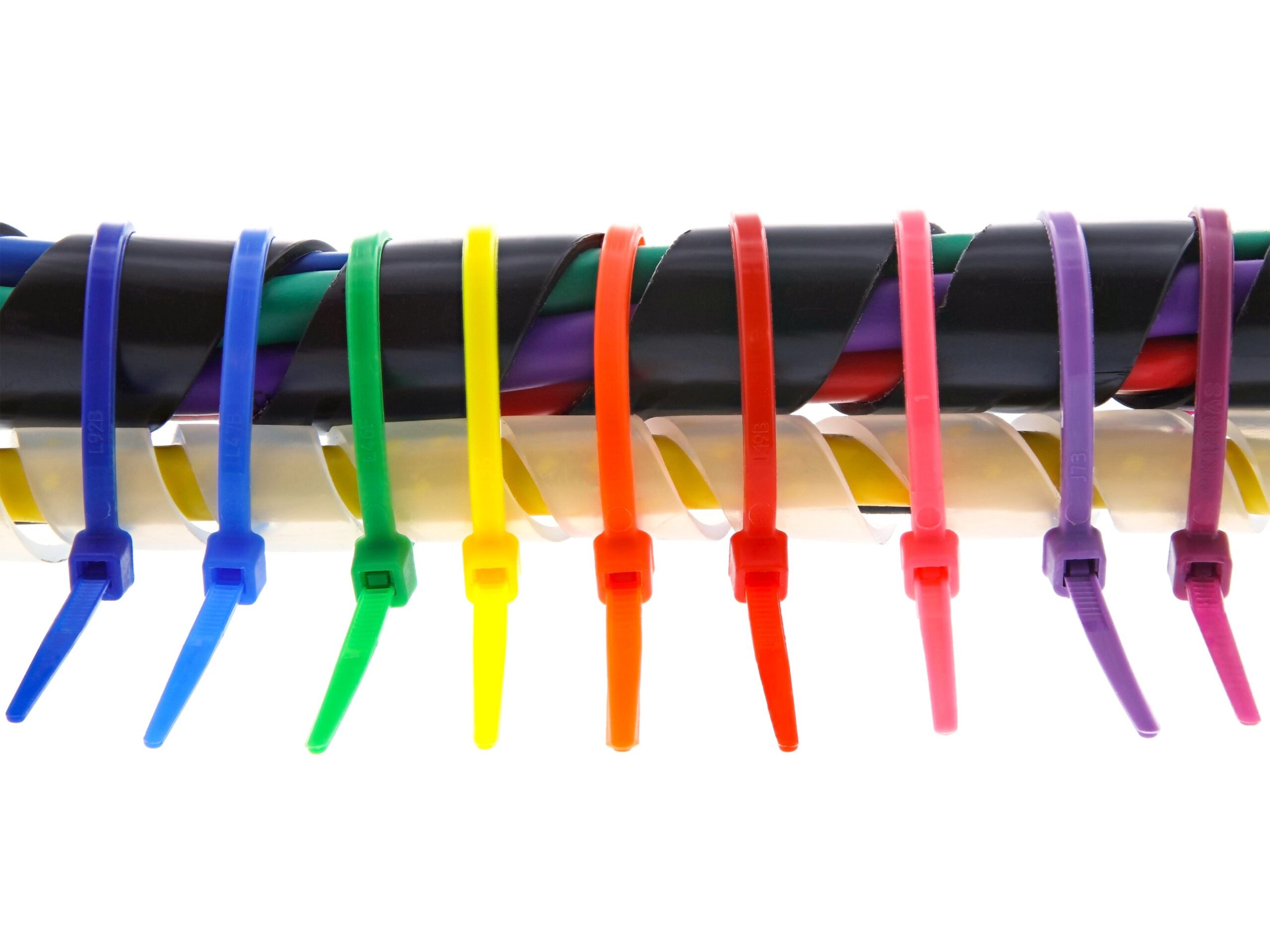
Walk into any well-organized control panel, data center, or vehicle wiring harness and you will notice something beyond the tidy routing: the cable ties are not all the same color. A red tie secures the positive feed. A blue one bundles the neutral return. A green tie marks the grounding conductor. What looks like a cosmetic choice is, in fact, a deliberate engineering decision. Colored cable ties carry information that plain natural nylon cannot — they identify circuits, mark phases, separate voltages, flag safety-critical runs, and speed up troubleshooting in the moments when seconds matter most.
At TONFUL Electric, we manufacture colored cable ties for B2B customers who understand that color is a functional specification, not a decorative afterthought. This article explains the functional and aesthetic roles color plays in cable management, the standards that govern it, the material science behind UV performance, and how to specify the right colored tie for each job.

The Functional Roles of Colored Cable Ties
Circuit and Phase Identification
The most immediate function of a colored cable tie is identification. In three-phase power distribution, electricians rely on an established convention — black for L1, red for L2, blue for L3 — so that any technician opening a panel can read the circuit at a glance. The U. S. National Electrical Code mandates specific colors for only two roles: green (or green-with-yellow-stripe) for the equipment grounding conductor, and white or gray for the grounded (neutral) conductor. Beyond those, industry convention fills in the rest, and colored cable ties are the cheapest, fastest way to enforce that convention on a bundled harness where individual wire insulation may be hidden inside a sleeve or loom.
In practice, a colored tie wrapped around a bundle acts as a non-permanent label — it travels with the harness, survives vibration, and needs no printing equipment to apply. Where printed heat-shrink markers carry the circuit ID at each termination, the colored tie carries the broader routing identification along the run. The two systems work together, as outlined in our wire harness protection methods guide.
Voltage and System Segregation
Data centers and telecommunications rooms use colored ties to separate networks that must never be confused: one color for copper data, another for fiber, another for AC power feeds, another for DC battery backup. This visual segregation allows rapid fault isolation during outages. A technician tracing a failed circuit does not need to open documentation to know which bundle belongs to which system — the color tells them. The same principle applies in automotive harnesses, where colored ties help separate low-voltage sensor circuits from high-current power feeds, and in EV battery packs, where bright orange consistently marks high-voltage conductors across global standards.
Safety and Lockout/Tagout Support
Color supports safety procedures. A red tie on a disconnect can signal “do not energize,” aligning with lockout/tagout discipline. A green tie confirms a verified ground path. In maintenance environments where multiple contractors work on the same equipment, consistent color coding reduces the risk of a technician grabbing the wrong bundle — the kind of error that causes arc flashes, equipment damage, and injury.
Industry Color Coding Conventions
There is no single universal standard governing every colored cable tie application, which is why internal consistency matters more than any external rule. That said, several conventions are widely followed:
| Application Context | Color | Typical Meaning | Governing Reference |
|---|---|---|---|
| AC power (US, 120/208V) | Black / Red / Blue | L1 / L2 / L3 ungrounded conductors | NEC Article 210.5 (industry convention) |
| AC power (US, 277/480V) | Brown / Orange / Yellow | L1 / L2 / L3 ungrounded conductors | NEC Article 210.5 (industry convention) |
| Grounded (neutral) conductor | White or Gray | Grounded conductor | NEC Article 200.6 |
| Equipment grounding conductor | Green or Green/Yellow stripe | EGC — fault current path | NEC Article 250.119 |
| High-leg delta | Orange | 208V high-leg to ground | NEC Article 110.15 |
| EV high-voltage | Orange | HV traction circuit (60V+ DC) | ISO 6469, SAE J1654 |
| Food / pharma detectable | Blue | Detectable, visible contaminant | HACCP, FDA |
| General data/telecom | Varies by site | Site-defined circuit segregation | ANSI/TIA-606 |
This table is illustrative — your facility should document its own color key in the panel directory and on every as-built drawing. Colored cable ties are only as useful as the legend that accompanies them.

For terminal and crimp color codes (red, blue, yellow by AWG range), see our crimp terminal color code chart and the automotive blade fuse amp ratings and color codes guide, which follow the same logic of color-as-information.
The Aesthetic and Organizational Value
Function aside, color has a genuine organizational and aesthetic role — one that affects perceived quality and long-term maintainability.
Visual hierarchy in dense assemblies. In a harness with 40+ conductors, a field of identical black ties reads as visual noise. Introducing three or four colors to group sub-circuits creates instant visual structure: the eye finds the right bundle faster, and photographed documentation becomes easier to interpret. This is why harness manufacturers building to IPC/WHMA-A-620 standards often specify color-coded tie groups even when the standard does not require them.
Brand and finish quality. In consumer-facing products — e-bikes, e-scooters, custom motorcycles, marine electronics — visible harness routing is part of the product’s finish. A neatly bundled harness with color-matched ties signals craftsmanship. OEMs sourcing through custom wire harness assembly frequently request ties that match the product’s accent color.
Retail and kit organization. For assortment kits sold to electricians and mechanics, color enables instant inventory recognition. Our assorted boxes and terminal kits use color consistently so that a technician reaching into a bin grabs the right size without reading the label.

Material Considerations: Why Color Is Not Just Pigment
Specifying a colored cable tie without understanding the material chemistry behind it is a common procurement mistake. Color is added to nylon 6/6 through pigments or dyes, and those additives affect performance.
UV Resistance and the Carbon-Black Exception
Here is the critical technical point most buyers miss: colored cable ties (red, blue, green, yellow) are not UV-stabilized. Standard natural (ivory/white) nylon 6/6 contains no UV inhibitors and will degrade within 2–6 months of direct sunlight. Colored ties, which use organic pigments for identification, offer roughly the same limited outdoor life — the pigment provides color, not UV protection.
Only black cable ties manufactured with approximately 2% carbon black deliver true UV stabilization. Carbon black is chemically inert, thermally stable, and virtually immune to photodegradation; dispersed evenly through the nylon, it forms a continuous barrier that absorbs UV radiation and re-emits it as harmless heat, blocking the photo-oxidative chain reaction that fragments polymer chains. A properly formulated UV-stabilized black tie retains ≥80% of its tensile strength after 1,000–2,000 hours of accelerated weathering per ASTM G154.

| Tie Type | Typical Pigment | UV Stabilized? | Outdoor Service Life | Best Use |
|---|---|---|---|---|
| Natural (white/ivory) | None | No | 2–6 months | Indoor, clean-room |
| Colored (red/blue/green/yellow) | Organic dye/pigment | No | 2–6 months | Indoor identification |
| Black, UV-stabilized | Carbon black (≈2%) | Yes | 5–10+ years | Outdoor, solar, exposed |
| Tefzel (ETFE) | Inherently UV-stable | Yes | 10+ years | Aerospace, nuclear |
| Stainless steel 304/316 | N/A | Yes | 20+ years | High-temp, corrosive |
For outdoor, solar, or any UV-exposed installation, specify carbon-black-stabilized black ties — not a colored alternative. See our nylon 66 vs nylon 12 solar cable ties comparison and the cold-weather cable ties guide for environmental selection. For applications demanding both color and UV resistance, specialty compounds like Tefzel ETFE cable ties bridge the gap at higher cost.
Detectable Colors for Food and Pharma
A specialized functional color: blue detectable cable ties. Used in food, beverage, and pharmaceutical manufacturing, these ties incorporate metal-detectable additives so that a fragment broken into a product line is caught by metal-detection equipment, while the blue color provides visual contrast against most food products for rapid identification. They help facilities comply with HACCP and EU hygiene regulations. See our metal detectable cable ties guide for specification details.
How to Choose the Right Colored Cable Tie
When the functional identification need is clear but the environment is demanding, selection comes down to four questions:
- Is the installation indoors or outdoors? Indoors, colored nylon 6/6 is fine. Outdoors, specify UV-stabilized black, or move to stainless steel for the harshest exposure — compare options in our stainless steel vs plastic cable ties guide.
- What tensile strength is required? Match the tie’s loop tensile strength to the bundle weight and any dynamic load. Our cable tie tensile strength guide covers the engineering basis.
- Is color the identification, or is a printed marker better? For permanent circuit IDs, consider custom printed cable ties — color plus printed legend is the strongest combination.
- Will the tie need to be removed for service? Use releasable reusable cable ties for prototyping and serviceable assemblies.
| Selection Factor | Natural | Colored | UV Black | Detectable Blue | Stainless |
|---|---|---|---|---|---|
| Indoor identification | ● | ● | ● | ● | ● |
| Outdoor / UV exposure | — | — | ● | — | ● |
| Food / pharma compliance | — | — | — | ● | ● |
| High temperature (>150°C) | — | — | — | — | ● |
| Color-coded identification | — | ● | — | ● | — |
| Lowest cost | ● | ● | ● | — | — |

Short FAQ
Are colored cable ties UV resistant? No. Most colored ties use organic pigments for identification and contain no UV stabilizers. They degrade in 2–6 months of direct sunlight, similar to natural nylon. Only black ties formulated with carbon black (≈2%) provide true UV stabilization for outdoor use.
Is there a universal color code for cable ties? No single standard governs every application. The NEC mandates colors only for grounded (white/gray) and grounding (green/green-yellow) conductors. All other color assignments are industry conventions or site-specific. Document your color key in the panel directory and maintain consistency across the facility.
What color is used for high-voltage EV cables? Bright orange is the global convention for EV high-voltage traction circuits (60V DC and above), specified by ISO 6469 and SAE standards. Colored cable ties or orange harness tape reinforce this identification at every bundle.
Can I use colored ties for lockout/tagout? Colored ties can support visual lockout/tagout discipline (e.g., red for “do not energize”), but they are not a substitute for compliant lockout/tagout devices. Use them as a supplementary visual cue alongside approved LOTO hardware.
Do colored cable ties have the same tensile strength as natural ones? Yes, for standard nylon 6/6 ties the pigment does not materially affect tensile strength. Loop tensile strength is governed by tie width, material grade, and design — see our cable tie tensile strength guide for ratings by size.
Where can I source colored cable ties in bulk? TONFUL Electric manufactures colored nylon 6/6 cable ties in standard and custom colors, UV-stabilized black, detectable blue, and specialty materials. Visit our cable ties product page or explore alternatives in our Panduit cable tie alternatives sourcing guide.
Conclusion
Color on a cable tie is never just decoration. It is a compact, durable, low-cost information carrier that improves safety, accelerates maintenance, enforces compliance, and elevates perceived quality. Specifying the right colored cable tie means answering four questions — identification need, environment, tensile requirement, and serviceability — and then choosing a material that performs in that environment. Indoors, colored nylon 6/6 is the right answer. Outdoors, only carbon-black-stabilized black or stainless steel will hold up. In food and pharma, detectable blue is the functional choice.
TONFUL Electric manufactures the full range — standard colored ties, UV-stabilized black, detectable blue, stainless steel, and edge-clip mounting ties — with full material traceability and B2B OEM support. Contact our engineering team to specify the colored cable tie that matches your identification system and environmental requirements.